
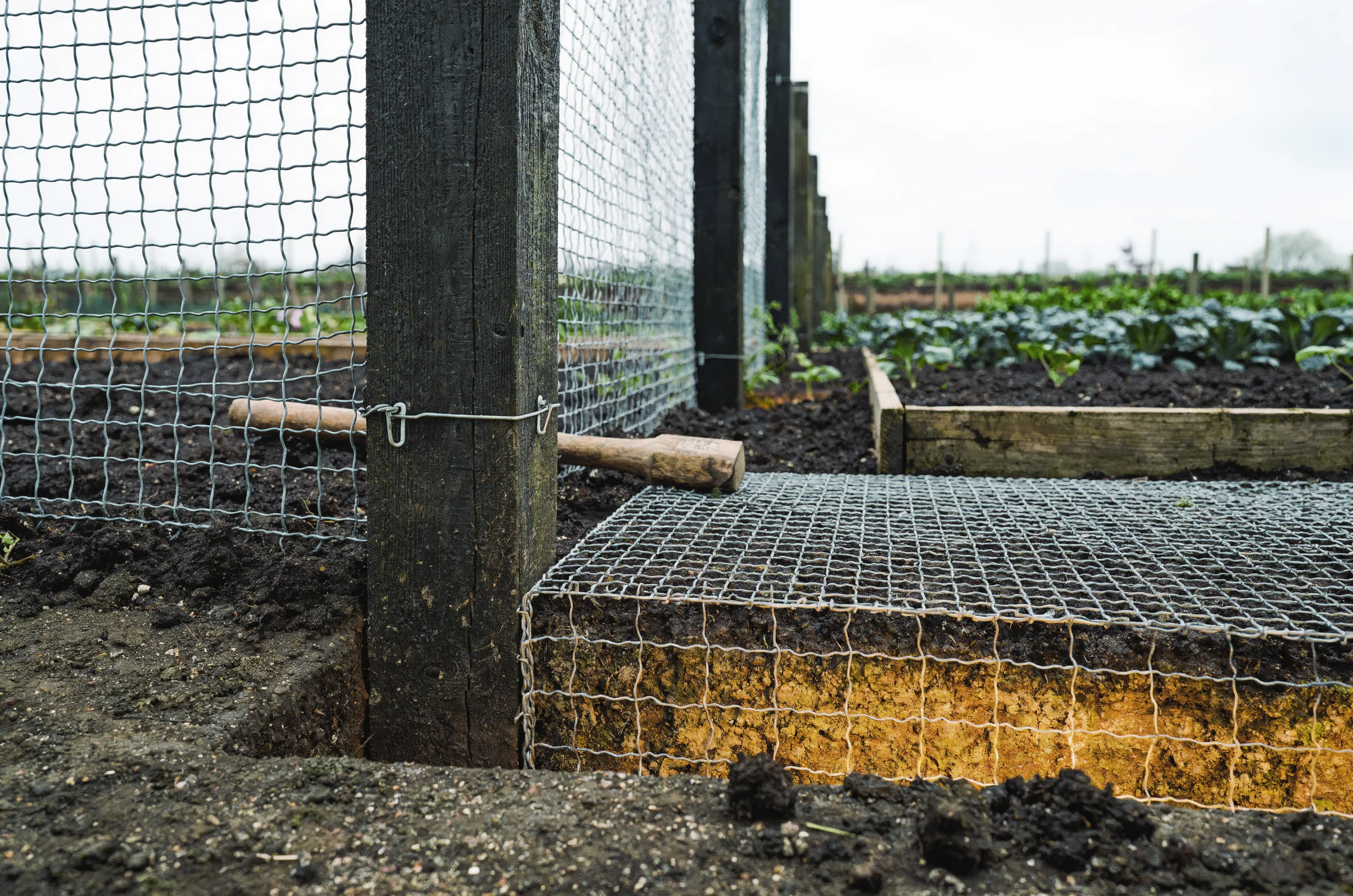
If rabbits have been through your brassicas again, the fix is a fence built to three numbers: 120 cm of height above ground, a mesh aperture no wider than 31 mm, and a 30 cm return buried or pegged flat at the base. Get those three right and most allotment plots stop losing crops within a season.
Everything below is the practical version of rabbit control allotment fencing requirements — what to buy, how deep to dig, where gates and corners let you down, and how to tell the difference between rabbit damage and something else entirely.
Why rabbits beat an ordinary garden fence
A rabbit does not need a gap. It needs a gap roughly the width of its skull, and it will find one along a 30-metre boundary that looks solid from standing height.
Three habits make them hard to exclude:
- They push through gaps under gates and between panel bottoms and soil.
- They dig shallow scrapes under a fence line rather than climbing it.
- They graze a hedge line down to a bare stem, then walk through the space underneath.
That last point matters on allotments. A boundary that is half hedge, half panel, half nothing is the classic failure. Rabbits work the soft spots, and a plot with one weak corner is a plot with rabbits in it.
There is also a legal reason to take this seriously rather than shrug at it. In England, landowners are expected to control rabbits on their land, and where that is not practical, to stop them damaging neighbouring crops with rabbit-proof fencing. The GOV.UK guidance on controlling rabbit numbers sets out the options, including permanent wire-mesh netting, and notes that you can be prosecuted if you take no action. On a tenanted plot, that duty sits with the site, but the practical work usually lands on you.
Measuring your boundary before you buy anything
Walk the plot with a tape and a notebook before you spend a penny on materials. Most wasted fencing money goes on the wrong roll length or the wrong mesh gauge.
Measure four things:
- The full perimeter you intend to enclose, in metres, including the gate opening.
- The height of any existing fence, post, or wall you plan to build onto.
- The ground type along the run — soft loam, compacted path, rubble, or tree roots.
- Where the boundary meets a neighbour's plot, a path, or a hedge you do not control.
Add 10 per cent to your perimeter figure for waste, corners, and the overlap where two rolls meet. A 40-metre plot typically needs around 44 metres of netting once you account for that.
Ground type decides your fixing method more than anything else. Soft soil takes a buried return easily. Compacted path or rubble may push you towards pegging the return flat on the surface and covering it with soil or paving. Both work; the buried version just looks tidier and survives strimming better.
If your plot sits on a site where rabbits are a known, recurring problem across several plots, it is worth asking the site secretary whether a coordinated boundary approach is possible. A single plot fenced to a high standard next to three unfenced ones still gets pressure at the shared edges.
The three numbers that decide whether the fence works
Rabbit proof fence height is the number most people search for, and it is the one most often got wrong in both directions — too low to stop a determined animal, or so high that the cost and wind loading become silly.
Height above ground
The Royal Horticultural Society advises mesh between 120 cm and 140 cm in height for garden boundaries, with the bottom section buried. Commercial netting suppliers in the UK commonly quote a 900 mm, 1.05 m, or 1.2 m roll, and note that a 60 cm fence can work in low-pressure situations where rabbits are only passing through.
For an allotment, where rabbits have a reason to keep coming back, work to 120 cm. That is high enough that a rabbit cannot clear it from a standing start on flat ground, and it still leaves you able to reach over for harvesting and strimming.
If your plot sits on a slope, measure height from the ground on the downhill side at every point. A fence that is 120 cm at the top of a bank can be 90 cm at the bottom.
Mesh aperture
Aperture is the size of the hole. The Countryside Stewardship specification for rabbit fencing calls for galvanised 18-gauge, 31 mm hexagonal wire mesh — a standard worth copying even if you are not claiming a grant.
Why 31 mm? Young rabbits are small, and a mesh that stops an adult will not necessarily stop a kit. Anything wider than about 31 mm gives a juvenile rabbit a route through. Hexagonal netting in this size is widely sold as rabbit netting, and it is usually cheaper per metre than welded square mesh of the same aperture.
Check the gauge too. Thinner wire deforms when a rabbit pushes at it and rusts through faster. Galvanised 18-gauge is the sensible baseline for a fence you want to last a decade.
Depth of the underground return
This is the part people skip, and it is the part that decides whether the fence holds.
The RHS recommends sinking the bottom 30 cm below ground level, with the lower 15 cm bent outwards to stop rabbits tunnelling underneath. That outward fold is the trick: a rabbit digging at the base meets wire angled away from it, and the dig fails.
If you cannot dig — because the boundary is a concrete path or a mature hedge root system — lay the bottom 30 cm flat on the soil surface, angled outward, and peg it down at intervals. Cover it with soil, bark, or paving so it does not become a trip hazard or a strimmer target.
A 30 cm return, whether buried or laid flat, is the difference between a fence and a fence-shaped decoration.
Building the fence, step by step
This is a weekend job for a 40-metre plot with two people. Set aside the Saturday for posts and the Sunday for netting.
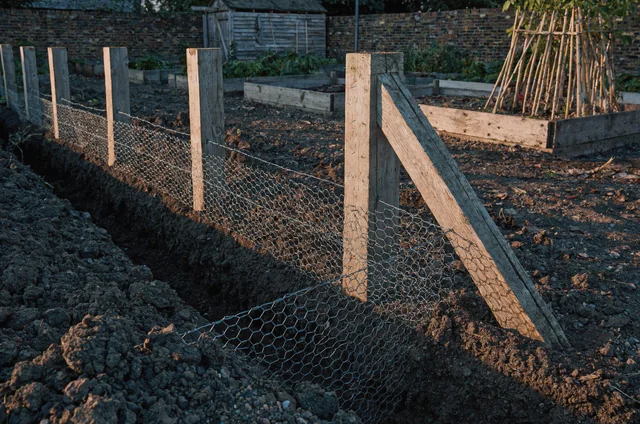
- Set your line. Run a string line along the boundary at the height you want the top of the fence. This keeps the top edge level and stops you chasing a wobbly line later.
- Mark post positions. Space posts at 2 to 3 metres for a domestic allotment fence. Closer spacing on exposed, windy sites; wider is fine on a sheltered plot. Drive or concrete corner posts and gate posts first — they take the strain.
- Dig the trench. Along the run, take out a trench 30 cm deep and wide enough to lay the return flat without kinking the wire. On soft ground this is quick. On compacted ground, a mattock earns its keep.
- Fix the netting to the bottom straining wire. Run a tensioned wire along the base of the posts, then attach the netting to it with galvanised rings. This stops the mesh bowing between posts when a rabbit pushes at it.
- Drop the netting into the trench and fold the return. Bend the bottom 15 cm outward, away from your plot, so it points at the rabbit rather than at your crops.
- Backfill and firm the trench. Tread it down. Rabbits dig soft, loose soil far more readily than firm ground.
- Tension the top wire and fix the top edge. A second straining wire at the top keeps the fence rigid and stops the mesh sagging into a ramp.
- Fit the gate and check every edge. Gates need the same mesh, the same 30 cm return, and a drop bolt or latch that closes flush to the ground. A 5 cm gap under a gate is an open door.
Work in dry conditions if you can. Wet soil smears and compacts, and netting laid into mud is harder to tension properly.
Corners, gates and the gaps rabbits actually use
Most failed rabbit fences are not defeated along the straight run. They are defeated at the details.
Corners. A corner post needs bracing — a diagonal strut from the top of the corner post down to a stake in the ground. Without it, the tension of two runs of netting pulls the post out of line within a season.
Gates. The bottom rail should sit within a few centimetres of the ground, and the mesh should continue down and fold outward exactly as it does along the fence. If your gate swings over a hard surface, fix a timber or rubber strip to the bottom edge.
Where the fence meets a wall or building. Rabbits will work the junction. Take the mesh right up to the wall and, if there is any gap, fill it with a paving slab or a length of buried mesh.
Where the fence meets a hedge. This is the hardest detail on most allotments. Either fence in front of the hedge line entirely, or take the mesh into the hedge and pin it down hard. A hedge that runs to ground level with no gap underneath is fine; one with a rabbit-sized tunnel beneath it is not.
Drains, ditches and dips. Any low point in the ground line needs the mesh to follow it down. A fence that bridges a dip leaves a gap underneath.
Telling rabbit damage from deer, pigeons and voles
Before you spend a weekend building, confirm what is actually eating your crops. The fence spec changes with the culprit.
Rabbit damage has a signature. Look for:
- Clean, angled cuts on stems, roughly 45 degrees, at heights up to about 60 cm.
- Bark stripped from young fruit trees and soft fruit canes in winter, with tooth marks around 2 mm wide.
- Round droppings, roughly 8 to 10 mm across, scattered on grass or bare soil.
- Grazed regrowth — a lawn-like stubble where seedlings used to be.
Compare that with the alternatives. Pigeons shred and leave ragged edges, usually on brassica leaves, and they work from above. Deer browse higher, up to 1.5 metres, and tend to tear rather than cut. Voles leave narrow, run-like tunnels through grass and gnaw marks at ground level.
If you are seeing clean angled cuts at ankle height plus droppings, you have rabbits. If you are seeing stripped bark on fruit trees in January, you have rabbits in winter mode, and the fence needs to be in place before the sap rises.
When a fence is not enough
A well-built fence handles most allotment rabbit pressure. There are situations where it will not, and it is worth knowing them before you commit.
The plot is inside a larger, unfenced site. If rabbits live on the site itself — in a bramble bank, under a shed, in a compost heap — a perimeter fence just encloses them with your vegetables. In that case, the problem is the harbourage, not the boundary.
The boundary is shared and unmanaged. Fencing your plot to a high standard while the neighbouring plot has a collapsed fence and a rabbit warren under a shed means constant pressure at the shared edge.
The fence keeps getting damaged. Strimmers, dogs, and winter storms all take a toll. A fence that needs repairing every month is not doing its job.
Rabbits are getting into a building. Sheds, stores, and polytunnels need proofing at the structure, not the boundary. This is a different job with different materials.
At that point, a site survey is worth more than another roll of netting. BuzzKill Pest Control covers East London and Essex and can look at where rabbits are actually living on or next to the site, not just where they are feeding. That distinction usually explains why a fence that looks correct is not holding.
Keeping the fence working through the year
A rabbit fence is not a one-off job. Twenty minutes of maintenance twice a year keeps it effective.
Check in early spring, before the breeding season ramps up and before new growth hides the base of the fence. Check again in late autumn, when rabbits switch to bark and the fence has had a summer of growth pushing against it.
What to look for:
- Mesh lifted off the ground by soil movement or root growth.
- The buried return exposed by digging, strimming, or erosion.
- Sagging between posts where the top wire has lost tension.
- Gaps at gates where the latch has dropped or the ground has worn away.
- Vegetation growing through the mesh and lifting it.
Cut back growth along the fence line rather than letting it push the mesh out of shape. Keep the base clear so you can see whether the return is still doing its job.
If you find a dig scrape under the fence, do not just fill it in. Check whether the return is intact at that point. A scrape that keeps reappearing in the same spot usually means the wire has lifted or been folded the wrong way.
Questions allotment holders ask about rabbit fencing
How high does a rabbit fence need to be?
For an allotment, 120 cm above ground is the working standard, with the RHS quoting 120 to 140 cm for garden boundaries. A 60 cm fence can hold in low-pressure situations, but on a plot with a resident rabbit population it will not last a season.
What size mesh stops rabbits?
31 mm hexagonal mesh, in galvanised 18-gauge wire, is the specification used in the Countryside Stewardship rabbit fencing standard. Anything wider risks letting young rabbits through.
Do I have to bury the bottom of the fence?
You need a 30 cm return at the base. Burying it is tidier and lasts longer. Laying it flat on the surface, angled outward and pegged down, works where you cannot dig.
Will an electric fence work instead?
Electric netting and electric strained wire are both recognised rabbit fencing options. They suit larger or temporary boundaries, but they need a power source, regular checks, and clear signage on a shared allotment site.
Can I just use a normal garden fence panel?
No. Rabbits go under panels, through the gaps between panel and ground, and around the ends. A panel fence needs mesh and a base return added to be rabbit-proof.
What if rabbits are living on the site itself?
Then fencing alone will not solve it. Rabbits harbouring in bramble, under sheds, or in compost heaps need to be dealt with at the source, which usually means a site survey and a coordinated approach across plots.
Sorting the source, not just the boundary
A correctly built fence — 120 cm high, 31 mm mesh, 30 cm return — will protect an allotment plot against rabbits coming in from outside. It will not fix a site where rabbits are already living in the brambles behind the shed.
If you have built the fence to spec and the damage continues, the next step is working out where the rabbits are actually based. That is a survey job rather than a fencing job, and it is the point at which a professional assessment saves you another wasted weekend.

Need professional help? BuzzKill offers fast, reliable pest control services across London and Essex.