
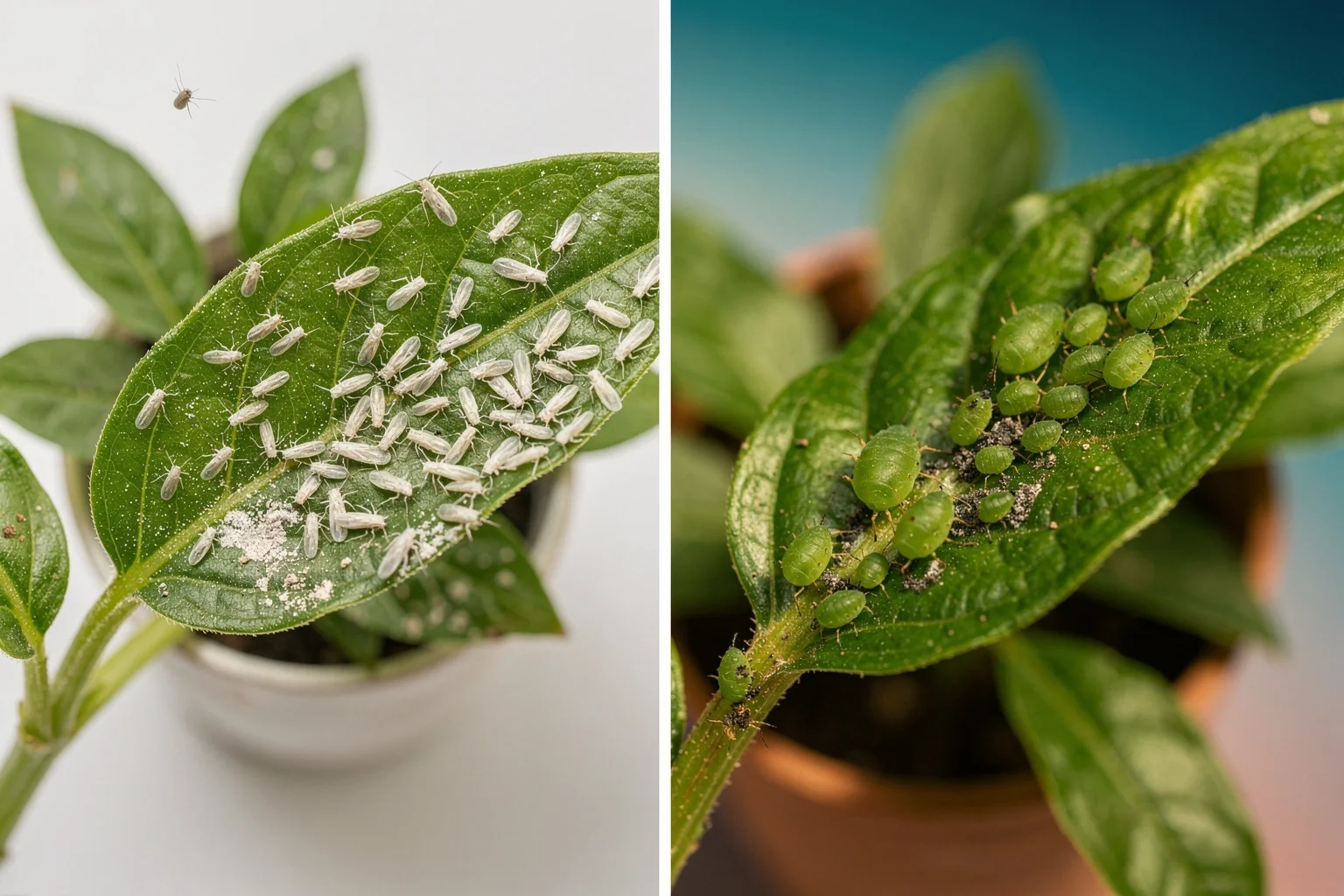
Most gardeners assume you need a magnifying glass and an entomology degree to separate whiteflies from aphids. The two pests share a lot of habits — both pierce plant veins, both drip sticky honeydew, both can turn a healthy crop into a mess — but the treatments that work for one often fail for the other. Get the identification wrong and you risk spraying a product that has no hope of working, giving the real pest extra weeks to reproduce while your plant declines. I have watched gardeners in East London waste an entire growing season firing an aphid spray at whiteflies, never understanding why the damage kept spreading.
Say a friend in Hackney shows you her prized kale patch. The leaves are glossy and the undersides are dotted with tiny white insects. “Whitefly,” she says. But when you gently brush the plant, hardly anything takes flight. That quiet response changes the whole story. The real pest is aphids — specifically a winged form that swarmed in during a late‑summer migration. That single moment, repeating across hundreds of gardens every year, teaches the fastest and most reliable diagnostic in the field.
The flight test sits at the top of my list because it needs no equipment and takes about two seconds. Below I have ordered seven practical checks, from the quickest and most unambiguous to subtler signals that back up a first impression. If you are standing in front of a plant right now, work through them in order. By the third check you will know your pest — and you will stop wasting time and money on the wrong treatment.
The Flight Test
This ranks first because it exploits a behavioural difference you can spot from across the garden. Walk up to the suspect plant and lightly brush the foliage with your hand, a pencil, or a watering wand. When whiteflies are present in numbers, the adults erupt into a brief but unmistakable cloud of tiny white insects. Seconds later most of them settle back onto the undersides of the leaves, but for that moment the plant seems to release a puff of airborne snow. That cloud is the signature calling card of a whitefly colony.
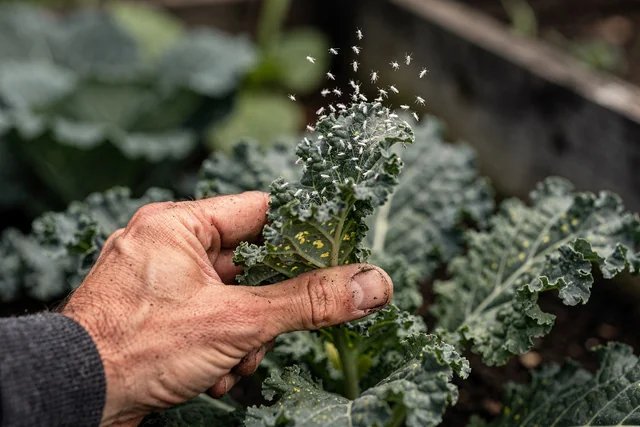
On a still morning inside a greenhouse or polytunnel, the cloud is so predictable you can use it as a quick survey tool: brush a leaf, count the tiny white motes floating up, and decide whether the population is heavy enough to need action. Outdoors on a windy day whiteflies may refuse to fly, and a light touch could be enough to knock aphids loose without any cloud — but if you see that puff of white, the diagnosis is sealed.
Aphids simply do not do this. Wingless aphids — and that is the form you will encounter nine times out of ten — stay clamped to the leaf or let go and drop off. Winged aphids can fly away when disturbed, but they do not produce a dense, swirling cloud. Each winged aphid launches individually, more like a tiny helicopter than a flurry of snow. The Virginia Cooperative Extension describes adult whiteflies as insects that “superficially resemble tiny moths” and notes that “large populations on infested plants may take flight when disturbed.” That understates the spectacle in a heavily infested greenhouse, where the air can look like a shaken snow globe.
Limit: On a windy day or with a very light touch, neither pest may react strongly enough to give you a clear signal. If nothing flies, move straight to the colony location check to confirm.
The Colony Location
Flip a few leaves and inspect the underside, especially on the freshest growth. Whitefly adults fly, but their immature stages — nymphs and pupae — are stuck in place. They look like tiny oval scales, often translucent with a yellowish centre, pressed flat against the leaf. Because they are motionless, many gardeners mistake them for a fungal disease, a weird residue, or scale insects. On a cucumber leaf in a greenhouse, the adults might be skittish on the upper canopy, but the nymphs will be thickest on the leaves just one layer below. If you miss those stationary stages and only treat the flying adults, you will wonder why the plant never recovers.
Aphid colonies, by contrast, do not include a stationary stage. Every aphid you see, from the smallest newborn nymph to the winged adult, can move if it wants to. Congregations cluster on buds, shoot tips, and the undersides of leaves, but they shift position as the plant grows. Poke a cluster with your fingertip and some of them will waddle away. A whitefly nymph will not budge.
Why this check ranks second: you can perform it straight after the flight test without any tools. If you see fixed, scale‑like dots on the leaf underside alongside flying adults, the verdict is whitefly. If every insect you see can move — even slowly — you are dealing with aphids. One common mistake is to glance at the leaves and see only the flying adults, then assume the insect is a moth or a fungus gnat. Train your eye on the undersides and the real story emerges.
The Honeydew Clue
Both whiteflies and aphids tap into plant phloem and excrete a sugary liquid called honeydew. The way that honeydew accumulates on the plant tells you which pest is doing the feeding.
Whiteflies produce honeydew so copiously that upper leaf surfaces quickly turn glossy and sticky. Within days, a black sooty mould fungus colonises the sugar layer, making the leaves look as though they have been dabbed with charcoal. This black coating is often the first thing a gardener notices — before they even see the insects themselves. Cabbage whitefly, the species most common outdoors on brassicas in the UK, can cause heavy sooty mould on kale and sprouts long before the plant shows any other stress. The fungus itself does not invade the leaf, but it blocks light and reduces photosynthesis. In a grey London summer that light loss can be enough to stunt a plant that was already struggling.
Aphids also create sticky leaves, but I typically see more physical distortion alongside the honeydew. Young, developing leaves curl and pucker because aphids inject saliva that scars the tissue. Sooty mould may appear later if the colony is large, but the curled, cupped foliage is the dramatic early marker. In a mixed border, aphid‑attacked shoots look physically warped; whitefly‑affected leaves look dirty but hold their normal outline.
A quick field check: run your finger over the top of a suspicious leaf. If it feels tacky but the leaf is flat, think whitefly first. If it feels tacky and the leaf is curled, puckered, or twisted, aphids are the stronger call. Another tip: wash the black coating off with water. If the leaf underneath is green, you are dealing with sooty mould on honeydew, not a true leaf-spot disease. Both pests can attract ants, but aphid honeydew is produced in larger, more consistent volumes and tends to draw more ant activity, especially on outdoor plants where ants farm the aphids for sugar.
The Leaf Damage Pattern
Shift your eye from the honeydew to the leaf tissue itself. The overall look of the plant reveals which pest has been feeding the longest.
Whitefly feeding causes a gradual, uniform pale look. Because both adults and nymphs drain sap from the undersides, the leaf loses chlorophyll evenly. You will notice yellow stippling that spreads across the whole surface, followed by early leaf drop and reduced vigour. A heavily infested plant may look washed‑out but rarely distorted. Whiteflies are also notorious virus vectors. The Bemisia tabaci species complex can carry over 110 plant viruses, including Tomato yellow leaf curl virus, which produces a distinct upward curling and yellowing that can be confused with aphid damage. If you see stippling combined with strange fruit or growth patterns, virus transmission may be part of the picture.
Aphid feeding localises the damage. The toxins in their saliva interfere with cell growth, so the newest leaves and shoots twist, stunt, and sometimes form galls. On roses you get that classic curled‑tip deformity. On broad beans the growing point looks cupped and leathery. On peppers, the new leaves become puckered and may show a mosaic pattern if a virus is present. The plant does not simply fade; it changes shape.
When you walk into your garden and notice one rose shoot curled into a knot while a nearby brassica leaf is flat but sticky, you have just nailed a double diagnosis: aphids on the rose, whitefly on the brassica. The shape of the damage is often more memorable than the insect itself, so use the plant as your cheat sheet.
The Seasonal Timing
This check sits in the middle of the list because the UK calendar gives you strong clues but nothing absolute. I still use it as a tie‑breaker when the first three checks leave a sliver of doubt.
Most whiteflies in Britain do not survive a London winter outdoors. The glasshouse whitefly (Trialeurodes vaporariorum) is killed by frost and persists year‑round only inside heated greenhouses, conservatories, and on houseplants. The outdoor exception is cabbage whitefly (Aleyrodes proletella), which can overwinter on kale, purple‑sprouting broccoli, and sprouts — even down to about –7°C. In sheltered back gardens in boroughs like Tower Hamlets or Hackney, you might spot cabbage whitefly adults on autumn‑sown kale as early as March after a mild winter. The urban heat island effect in London can push those survival odds up slightly, so the seasonal rule is less reliable there than in open countryside.
Aphids have strong, forecastable flight periods. Every year the AHDB publishes aphid forecasts based on winter temperatures, and the first wave of winged migrants often arrives in May and June on succulent spring growth. By late summer many aphid species produce winged forms that fly to winter hosts, which can confuse the flight test because a few winged aphids may rise from a brushed leaf. But they still do not produce that dense, swirling cloud.
If you are anywhere in London with a greenhouse — Hackney, Waltham Forest, Bromley, it doesn't matter — and you find white insects on your tomatoes in February, the answer is almost certainly whitefly. If it is May and your roses are crawling with tiny green insects, it is almost certainly aphids. The calendar narrows the list, but always confirm with the flight and colony checks.
The Magnification Test
This ranks lower only because it demands a hand lens, a macro phone camera, or a steady hand, and when you are already worried about your plants the last thing you want to do is fetch equipment. But if you have good close‑up capability, it settles the question beyond doubt.
Get your lens and study a single adult insect. A whitefly measures about 2 mm and holds four opaque, white wings roof‑like over a pale yellow body. Under a lens the wings look as though they have been dusted with icing sugar. The Virginia Cooperative Extension confirms the size and notes that adults “superficially resemble tiny moths.” If you tap a leaf over a sheet of white paper, the dislodged adults are easy to spot and examine without damaging the plant.
Aphids are pear‑shaped, with two miniature tailpipes — cornicles — projecting from the rear. Most do not have wings, but winged forms exist, especially during migration. A winged aphid carries two pairs of transparent, membranous wings held roof‑like, but the wings are not white and the body still bears those cornicles. Colour varies wildly: green, black, pink, grey, yellow. If the insect you are studying has visible tailpipes at the rear, it is an aphid. If it is pale as a ghost moth with no tailpipes, it is a whitefly.
Many gardeners tell me they have seen a “white aphid.” What they likely saw was a moulted aphid skin, a waxy‑coated aphid species such as some mealy‑cabbage‑aphid forms, or even a cluster of whitefly nymphs that they misread. True whiteflies are never pear‑shaped and their white wings are the headline feature. A simple phone macro shot, zoomed in on the insect’s rear end, can reveal those tiny cornicles and turn a guess into a solid ID.
The Treatment Response
This is the slowest and most expensive diagnostic on the list. I only turn to it when the pests have already been present for weeks and I have a history of failed attempts. But it is worth knowing: how a pest responds to a spray can be a delayed signal that your original identification was wrong.
Gardeners often reach for a standard contact insecticide first — a pyrethroid or a ready‑mixed bug gun. Aphids, with their soft bodies, usually drop quickly after a direct hit. The frustration comes later: aphids often come back within a week or two because a single surviving female can reproduce without mating, and ants actively carry survivors to fresh shoots. If your spray seems to work initially but the pests rebuild, aphids are the likely culprit.
Whiteflies are harder to kill with contact sprays. Their bodies and wings carry a waxy bloom that repels water‑based treatments, and the nymphal stages are shielded by their scale‑like covering. Systemic insecticides — those taken up by the plant — work better, as do horticultural oils that coat and suffocate the insects. Biological control with the parasitic wasp Encarsia formosa is a widely used greenhouse strategy for glasshouse whitefly, but it does not work on cabbage whitefly or on aphids. If you release Encarsia and then spray a broad‑spectrum pyrethroid, you will wipe out your own control army along with the pests.
There is another reason a spray might fail against whiteflies. The Bemisia tabaci species complex, which includes the tobacco whitefly and its many biotypes, is known for pesticide resistance and an extreme host range. DEFRA notes that different biotypes within this complex can vary in their sensitivity to insecticides, making chemical control unpredictable. If you are dealing with a whitefly population that shrugs off multiple treatment attempts, you may have a resistant biotype, and professional identification becomes essential.
When your plant is covered in white insects and every home‑treatment attempt has failed, it is time to bring in someone who can confirm the species and recommend a targeted programme. In London, a same‑day inspection from a BASIS PROMPT‑registered technician can save you a season’s worth of crop loss. Our teams across East London and Essex regularly help gardeners who have spent weeks firing the wrong product at the wrong pest — and the fix is often simpler than they feared. If whitefly is confirmed and you are under glass, Encarsia wasps could be a good fit; if aphids are the true enemy, a focused treatment plan plus ant control can stop the cycle.
If you remember one thing from this list, make it the flight test. It separates whiteflies from aphids faster than any other method and costs you nothing but a gentle brush of the plant. The diagnostic that most often leads people astray? Seasonal timing alone. Whiteflies can appear outdoors on brassicas from spring onwards, and aphids can produce winged forms in June, so the calendar will not give you certainty. Combine the flight test with the colony location check and you will know within a minute. Once you have the ID, your next step depends on the environment: outdoors, a strong water jet or insecticidal soap may be enough; indoors, you might need biological controls or a systemic approach. But everything starts with looking at the right insect.
Need professional help? BuzzKill offers fast, reliable pest control services across London and Essex.