
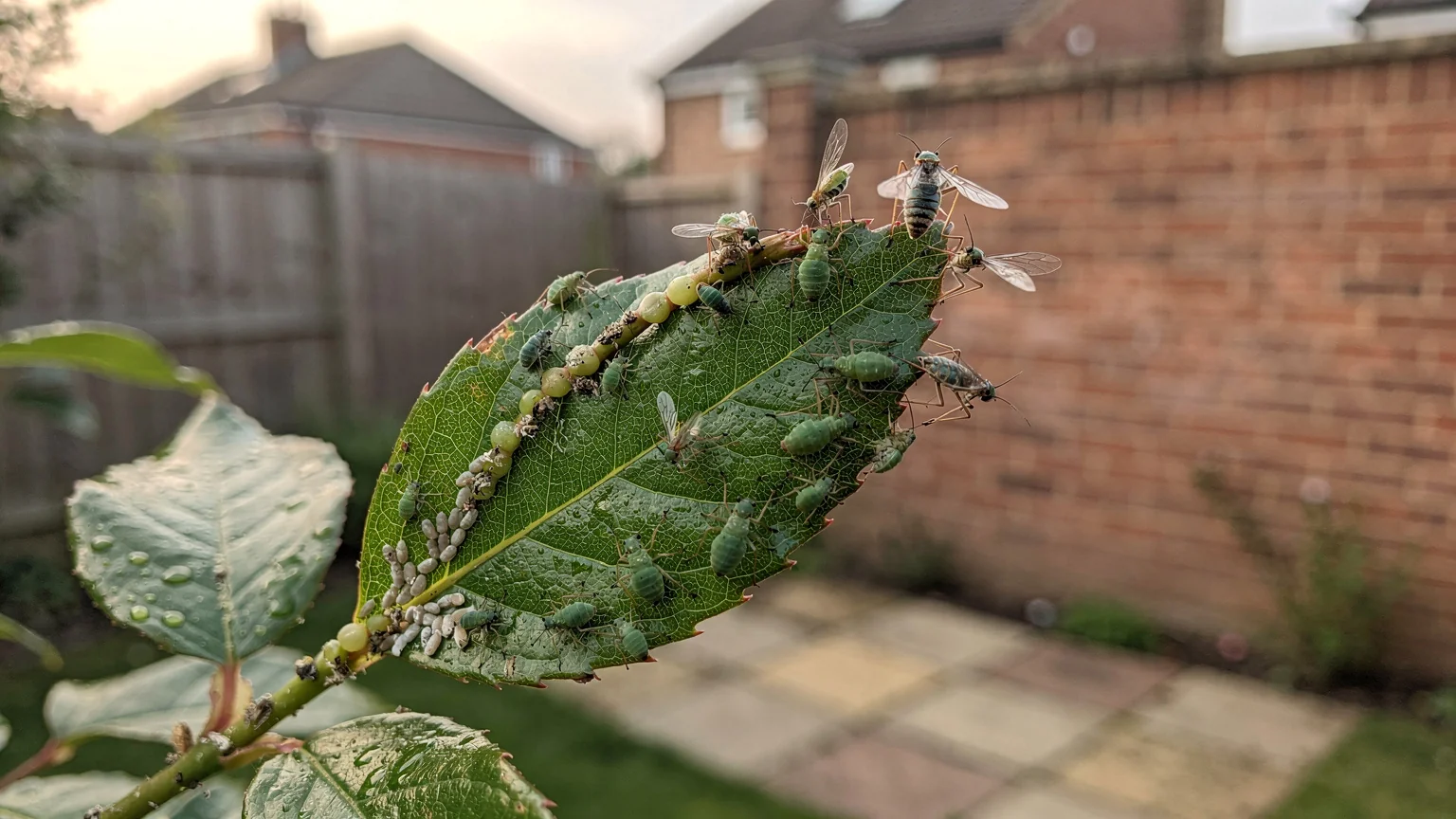
The short answer is that your spray almost certainly killed the adults you could see, but it did not reach the eggs tucked into bark crevices, soil debris, or curled leaf buds waiting to hatch. Aphids reproduce so fast that a single surviving female can restart the colony within days. If you are wondering why aphids keep returning to your roses, vegetables, or houseplants, the problem is not that you sprayed badly. It is that aphid biology is built to survive exactly this kind of disruption.
What You Are Actually Seeing on the Plant
Aphids are soft-bodied insects, usually green, black, or grey, ranging from one to seven millimetres long. They cluster on new growth, leaf undersides, and stem joints, sucking sap and excreting a sticky waste called honeydew. The honeydew attracts sooty mould, which turns leaves black and blocks light. In a London garden in May 2026, the warm February followed by a mild spring has produced what Bristol Live described as a greenfly plague across UK gardens, with rose bushes particularly badly hit.
The clusters you notice are only part of the population. Aphids produce winged forms when a plant becomes crowded. These fly to new hosts, start fresh colonies, and resume breeding within hours of landing. So the aphids on your nasturtiums this week may be the grandchildren of the ones you sprayed off your roses last week. The visible cluster is a symptom. The real problem is the reservoir you cannot see.
The Reproduction Trick That Outpaces Any Spray
Aphids do not need to mate to breed. From spring through autumn, most species reproduce by parthenogenesis, meaning females give birth to live young without fertilisation. A single aphid can produce fifty to one hundred offspring in her lifetime, and those offspring mature in as little as five to seven days. The mathematics are brutal. One aphid on Monday becomes fifty by the following Monday, and two thousand five hundred a week after that, assuming no predators and adequate food.
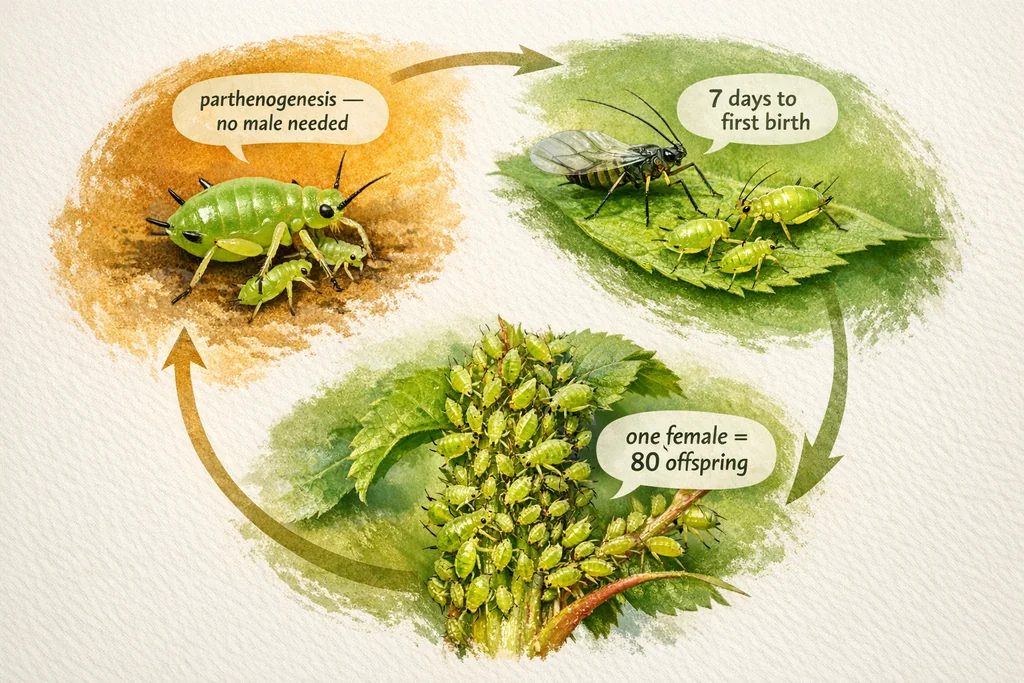
This is why a thorough spray that kills ninety-five percent of adults still fails. The five percent left includes pregnant females. Within a fortnight, numbers recover. Worse, some of those survivors will be the winged morphs that have already left to colonise your neighbour's garden or your greenhouse tomatoes. The colony you treated was never a closed system.
Where the Eggs Hide Through Winter
Most aphid species overwinter as eggs, not as active adults. The female lays these eggs in autumn on woody stems, in bark cracks, inside bud scales, or on fallen leaves and debris around the base of the plant. The eggs are tiny, often black or dark green, and glued firmly into crevices. A standard foliar spray, even a good one, does not penetrate these hiding places.
Come spring, as temperatures rise, the eggs hatch into stem mothers that begin parthenogenesis immediately. The milder winters we have seen recently, particularly the warm February of 2026, mean more eggs survive and hatch earlier. The Rothamsted Research forecast model, run independently for more than sixty years, predicted the first aphid flight for 22 April this year, with exceptionally high pressure expected. Farmers Weekly reported in mid-May that Barley yellow dwarf virus was already evident in cereal crops because of this sustained aphid pressure. Gardeners face the same pressure on a smaller scale.
If you sprayed in March or April and thought you had solved the problem, the eggs laid last October were already there, waiting. Your spray dealt with one generation. It did not break the cycle.
Why Home Remedies and Shop Sprays Fall Short
The internet offers endless aphid solutions. Soap sprays, neem oil, vinegar, garlic water, and strong jets of hose water all have their advocates. Each can reduce an active colony temporarily. None address the eggs, the winged migrants, or the fundamental reproductive rate.
Neem oil, for example, works partly by disrupting the hormonal system of feeding insects. Applied every three to four days, it can suppress aphids on a well-managed plant. Miss a week, or fail to coat the undersides of every leaf, and the colony rebounds. Horticultural soap kills on contact but has no residual effect. It does not touch eggs in bark crevices or winged aphids that land after you finish spraying.
The broader problem is insecticide resistance. When neonicotinoid seed treatments were withdrawn in 2018, UK agriculture saw what the Agricultural and Horticultural Development Board described as a return to routine foliar pyrethroid sprays. Every spray applies selection pressure. Aphids with slight genetic resistance survive and breed, passing that trait on. In a garden setting, where spraying is irregular and coverage patchy, resistance builds more slowly but still matters. Your grandfather's nicotine wash might have worked reliably in 1975. The aphids in your Hackney garden in 2026 are not the same insects.
The Hidden Reservoirs You Are Missing
Aphids do not live only on the plant that shows damage. Many species alternate hosts through the year. The black bean aphid, Aphis fabae, overwinters on spindle bushes or philadelphus, then migrates to beans, beets, and broad beans in spring. The peach-potato aphid, Myzus persicae, moves between peach and plum trees and a huge range of summer vegetables and ornamentals. You can spray your runner beans daily and still see reinfestation because the source is the unmanaged plum tree three gardens away.
Even on a single plant, aphids exploit microhabitats. They favour the sheltered undersides of young leaves, inside curled or distorted growth, and at the base of developing flower buds. A spray that drenches the upper leaf surface misses these refuges. Aphids also drop from the plant when disturbed, a behaviour called thanatosis. Shake a stem and dozens fall to the soil, where they can climb back up or survive on root sap until conditions improve.
For indoor gardeners, the reservoir problem is worse. Aphids on a windowsill basil plant may have arrived on a supermarket pot or on clothing from an infested garden. The greenhouse or conservatory provides year-round warmth, so parthenogenesis never stops. There is no winter die-off to reset the population.
When the Damage Becomes Serious
A few aphids on a mature rose bush are unsightly but rarely fatal. The plant compensates for sap loss by growing more leaves. The real damage comes from sustained heavy feeding, which stunts growth, distorts fruit and flowers, and weakens the plant until it succumbs to secondary stress or disease.
The honeydew-sooty mould combination is more than cosmetic. Sooty mould blocks photosynthesis, reducing the plant's energy production just when it needs resources to fight the infestation. Aphids also transmit plant viruses. In agriculture, this is the major economic impact. The Rothamsted forecast projected that without control measures, fifty-nine percent of the national sugar beet crop could become infected with Virus Yellows in 2026. Gardeners rarely see this level of loss, but the same mechanism applies. An aphid that feeds on a virus-infected plant picks up the pathogen on its mouthparts and transfers it to the next plant within seconds. No amount of spraying after the fact will cure the virus.
What Professional Treatment Does Differently
A pest control technician approaches aphids as a system problem, not a surface problem. The first step is identification of the species, because this determines where the eggs are likely hidden and whether alternate hosts are involved. The second step is a full inspection of not just the affected plant but the surrounding garden, greenhouse, or conservatory, including debris, pots, and neighbouring vegetation.
Treatment then targets the full lifecycle. Residual insecticides applied to bark, soil, and structural surfaces catch hatching nymphs and returning winged adults. In protected environments like greenhouses, biological control using parasitic wasps such as Aphidius colemani can provide sustained suppression without chemical residues. For severe infestations on valuable plants, a combination of contact spray, systemic treatment taken up by the plant's own vascular system, and physical removal of heavily infested growth may be necessary.
The key difference is timing and thoroughness. A homeowner sprays when they notice damage. A professional treats before the exponential growth phase, targets the hidden stages, and follows up to catch the survivors. This is the same principle that applies to professional bed bug removal or rapid cockroach elimination: breaking the reproductive cycle requires more than one intervention, and it requires hitting the stages you cannot easily see.
Reading the Signs That It Is Time to Call Someone
There are three clear signals that DIY spraying has reached its limit. First, you see fresh aphid clusters within seven to ten days of a thorough spray, indicating that eggs are hatching or winged migrants are arriving faster than you can treat. Second, you notice distorted growth, virus symptoms like yellow mottling, or widespread sooty mould, meaning the infestation has been heavy enough to cause lasting plant damage. Third, the problem has spread to multiple plant species or moved indoors, suggesting alternate hosts or a greenhouse reservoir that you cannot fully control.
In these situations, continuing to spray wastes money and risks resistance. It also risks harming the beneficial insects that might otherwise help. Ladybirds, lacewings, hoverfly larvae, and parasitic wasps all eat aphids, but they are more vulnerable to broad-spectrum insecticides than aphids themselves. Every unnecessary spray tilts the balance further in the aphid's favour.
What to Do in the Next Seven Days
If you are dealing with returning aphids right now, start with a hard physical clean. Remove heavily infested growth and bag it for council green waste collection, not your home compost. Wash remaining stems and leaves with a strong jet of water, paying attention to leaf undersides and growing tips. Check pots, saucers, and greenhouse staging for fallen aphids and clean these thoroughly.
Next, inspect the surrounding area. Look at neighbouring plants, trees overhanging your garden, and any unmanaged vegetation on boundaries. If you find aphids on an alternate host, that source needs addressing too. For indoor plants, consider isolating new purchases for two weeks before introducing them to your collection.
Finally, if fresh clusters appear within a week of this clean-up, accept that the lifecycle reservoir is beyond DIY reach. A professional inspection can identify the species, locate the hidden eggs, and design a treatment sequence that actually breaks the cycle rather than postponing it. In London and Essex, where mild winters and urban heat islands extend the aphid season, this is often the only way to protect valuable plants through the growing season.
The aphids are not coming back because you failed. They are coming back because their biology is specifically evolved to exploit exactly the kind of intermittent, surface-level disruption that home spraying provides. Understanding that is the first step to beating it.
Need professional help? BuzzKill offers fast, reliable pest control services across London and Essex.