
Leafhoppers are one of those garden pests that seem to arrive from nowhere. You notice a fine, white speckling on your rose leaves or potato foliage that looks scorched, and when you brush past, tiny wedge-shaped insects shoot sideways like miniature grasshoppers. They rarely kill a well-established plant, but they drain vigour, disfigure ornamentals, and can move plant diseases between borders. In a London garden—where sheltered courtyards and a longer-than-average growing season keep insect activity high—knowing how to get rid of leafhoppers without wiping out bees, harming pets, or making the problem worse is what matters.
Nearly 400 leafhopper species have been recorded in the UK. Some, like the rose leafhopper (Edwardsiana rosae), stick to a narrow menu while others, such as the glasshouse leafhopper (Hauptidia maroccana), hop between tomatoes, cucumbers, and a parade of ornamentals. The blue-green leafhopper (Graphocephala atropunctata) alone feeds on over 150 species of plants. That broad appetite means a single garden can host several species at once, each with its own peak season and favourite host, making control feel like a moving target.
These seven methods are arranged from least to most intensive, built for the host plants and wet-then-dry weather we actually face across Greater London. We chose each approach because it has some backing from extension research or practical gardening experience rather than just word-of-mouth. For every one, you’ll see who it fits, what the evidence says, and where it tends to struggle.
What leafhopper damage actually looks like
Before you reach for any remedy, get the identification right. Leafhopper feeding removes chlorophyll from inside the leaf, leaving tiny white or pale-yellow spots on the upper surface. Gardeners call this “stippling”. In high numbers, the spotting can blend into a bleached look that is easy to confuse with spider mite or lace bug damage. The giveaway is the insect itself. Flip the leaf over; leafhoppers are 3–5 mm long, wedge-shaped, and flee sideways or jump when you move the stem. They often cluster on the soft terminal leaves at branch tips.
A second, more serious symptom is hopperburn. As leafhoppers inject saliva, a toxin spreads into the surrounding leaf tissue, causing the tips and margins to curl, yellow, then turn brown and brittle. The University of Maryland Extension describes it as looking “as if singed by fire”. The toxin isn’t systemic, so damage stays proportional to the number of insects feeding. On vegetables such as potato and bean, you might see severe leaf loss; on shrubs like rose, the main complaint is cosmetic. London’s damp microclimates can mask hopperburn early on, so check weekly from late spring.
A few leafhopper species also transmit bacterial diseases that cause permanent leaf scorch on trees and shrubs. If you spot browning that follows the leaf edge and persists after the bugs are gone, a professional diagnosis can rule out disease. Keep an eye on dogwood, cherry, elm, and birch in particular—these are the woody plants most likely to harbour the sharpshooter-type leafhoppers that vector scorch pathogens.
Leafhoppers feed on the upper and lower surfaces of leaves, usually the terminal leaves at the end of branches. Their feeding removes green chlorophyll pigment, leaving tiny white spots … followed by curling, yellowing, and stunted leaves.
— University of Maryland Extension, Leafhoppers in Home Gardens
The life cycle you’re interrupting
Understanding the basic timeline helps you choose a method that hits the right stage. Most leafhoppers overwinter as eggs tucked into bark crevices, leaf midribs, or the stems of herbaceous weeds. Nymphs—wingless, pale, and about the size of a grain of rice—start feeding as soon as they hatch in late April or May. They moult five times before turning into winged adults that disperse and mate. In a warm London summer you can easily see two or three overlapping generations, which is why a single treatment in June rarely finishes the job.
Exclusion and garden hygiene: the first line of defence
A lot of leafhopper trouble begins before you even see an adult. Females lay eggs inside leaf tissue, and nymphs hatch and feed right where the plant is tender. The cheapest way to short-circuit the life cycle is to deny the insects access to the plants you want to protect.
Floating row covers—often sold as vegetable fleece or enviromesh—are lightweight fabrics that let light and water through while blocking airborne adults. Drape them over potato, bean, or mint beds in early summer and peg the edges down tightly. You’ll need to lift covers briefly for weeding, but the barrier stops leafhoppers from laying eggs in the first place. In a typical London back garden, this works brilliantly on a 2–3 m bed and costs under £15 a season. For small pots of herbs on a balcony, a fine-mesh net bag slipped over the pot can do the same job.
Hygiene makes a difference, too. While leafhoppers use lots of host plants, they overwinter in weedy patches, especially docks, thistles, and tall grasses. Keeping a 1 m weed-free strip around your veg patch denies them a winter hideout. In London’s built-up neighbourhoods, neglected alleyway gardens and railway embankments act as year-round reservoirs, so if you border an unkempt strip, double down on the weed strip and consider a physical barrier like a box hedge that can intercept flying adults.
Also, watch your fertiliser. Heavy nitrogen feeding produces lush, succulent growth that leafhoppers favour—research notes that over‑use of fertiliser can increase leafhopper populations, as detailed by the University of Maryland Extension. Slow-release feeds or compost keep plants sturdy without sending up a chemical dinner invitation. These steps don’t kill a single bug, but they shrink the population before it can climb.
A less common but effective trick is reflective mulch. Sheets of silver‑backed plastic or aluminium foil laid around the base of plants disorient incoming adults. Trials in vegetable gardens have shown a reduction in leafhopper landings, although the mulch works best for short, stocky crops like peppers and aubergines. It’s more fiddly than fleece, but worth trying if you’re growing a small block of a high‑value crop.
Sticky traps: a cheap early-warning system
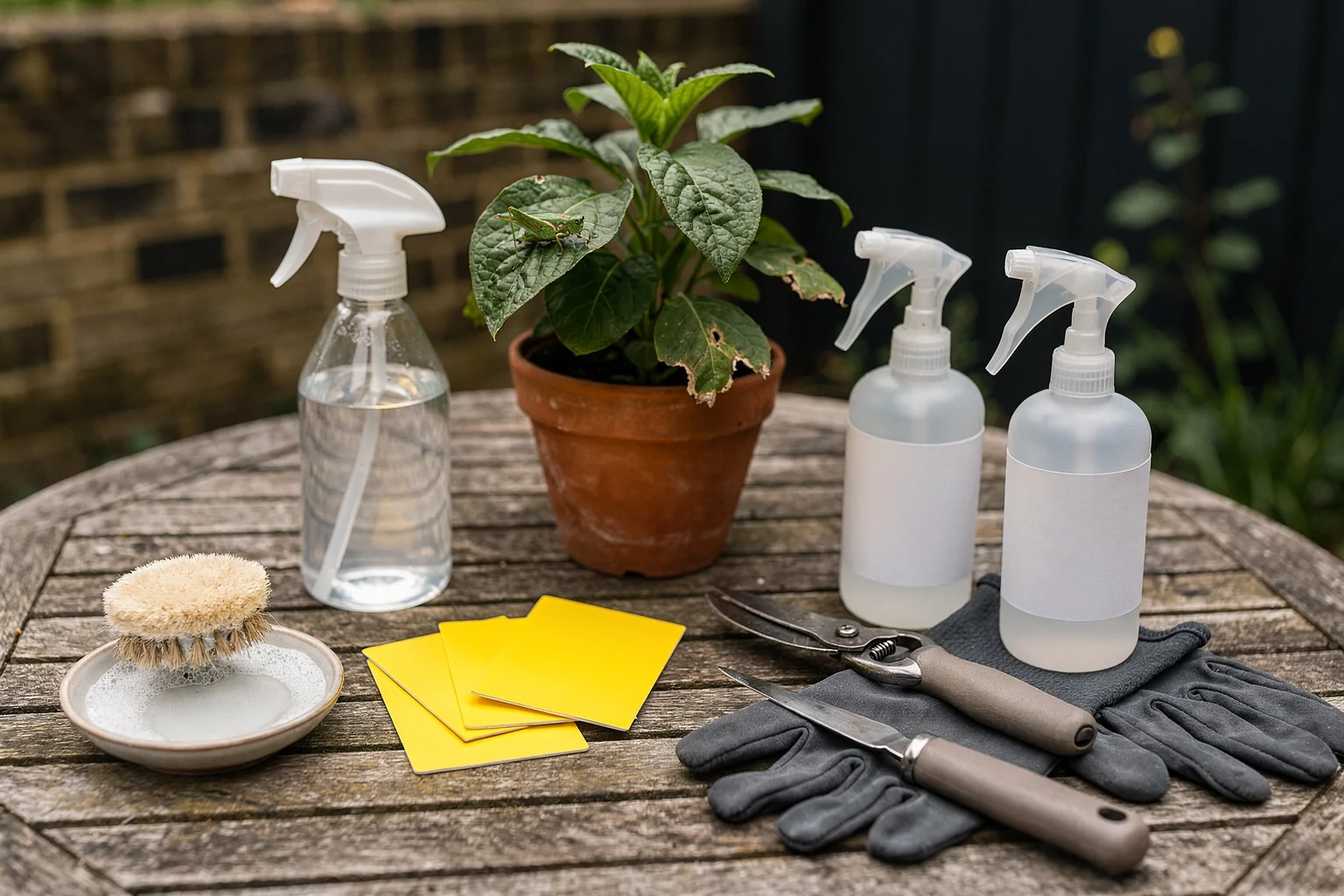
Yellow sticky cards are one of the first things gardeners grab because they’re simple and visual. Bright yellow attracts leafhoppers; they land, get stuck, and die. Hang a few cards at plant height near the foliage you want to protect. In a greenhouse or polytunnel, the trapped count gives you a nearly real-time reading of adult activity.
The catch is that sticky cards only capture flying adults. Nymphs—the tiny, wingless feeding stages—stay on the leaf surface and keep causing damage. If you rely solely on traps, you’ll miss most of the population. Traps also snare beneficial insects like hoverflies, lacewings, and ladybirds, which you’d rather keep. In an open London garden, I’d use them as a monitoring tool: check every three days from early May, and when you spot the first few adults, move to a spray or dust while the numbers are still small. Don’t expect the cards to clean up a heavy outbreak on their own.
Some gardeners rig homemade sticky traps from yellow plastic plates coated with petroleum jelly. It works, but the commercial cards are easier to count and replace. If you decide to use them, position the traps just above the crop canopy and leave at least one per square metre. A single card placed near a favoured host like a climbing bean frame will tell you more than a random spot in the middle of the lawn.
Insecticidal soap: the safest first spray
When you’ve got active leafhoppers on prized roses or a bean row, insecticidal soap is usually the gentlest option that actually works. These products contain potassium salts of fatty acids, which dissolve the insect’s protective outer cuticle so it dehydrates. They’re most useful against soft-bodied nymphs, and they leave almost no toxic residue once dry, which is why they’re popular with parents, pet owners, and anyone growing salad leaves next to the play area.
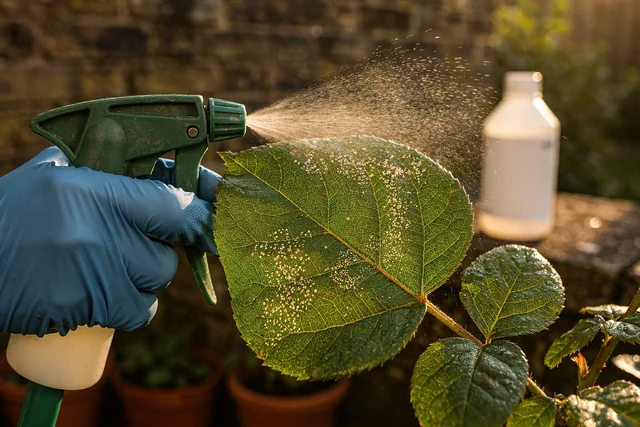
The trick is thorough coverage. You need to spray both sides of every leaf, right into the folded growing tips where leafhoppers hide. An early-morning or early-evening session avoids leaf burn and protects bees. The soap works on contact only; any nymph that walks over a treated surface later won’t be hurt, so you’ll need a repeat spray five to seven days later as the next eggs hatch. Rain washes the product off, so keep an eye on the forecast. On large shrubs, the job can become quite repetitive, which is a common reason people give up.
For edible crops you can use a ready‑made formulation labelled for fruit and vegetables—these dilute consistently and include pH buffers that reduce the risk of leaf damage. If you mix your own from pure liquid soap, use no more than 1 teaspoon per litre of water and test a small patch first. Hard London tap water can react with the soap, so mix with rainwater if you have a butt. If you want a first response that minimises fuss, soap is the best rung on the ladder, but it’s not a set-and-forget solution.
Neem oil: longer-lasting protection, but with rules
Many London gardeners reach for neem-based sprays as a step up from soap. Neem oil is pressed from the seeds of the neem tree. It works partly as an antifeedant—treated leaves taste unappealing—and partly by jamming the insect’s growth hormones, so nymphs that do feed fail to moult properly. Because the oil leaves a thin film, it offers a few days of residual activity, which soap doesn’t.
Neem needs careful handling. Concentrate must be emulsified properly with warm water and a tiny drop of mild liquid soap, or you’ll get leaf scorch. Spray only in the evening, when bees are less active and the sun won’t magnify through oil droplets. In the UK, neem oil isn’t registered as a garden insecticide for food crops; you’ll find it sold as a plant invigorator or leaf shine. For that reason, many gardeners limit it to ornamentals or use it only when the pest pressure is high. It’s a genuine tool, but because its performance depends on dry weather and precise mixing, it can struggle during a wet London June just when you need it most.
Despite the label quirks, neem can pull double duty against other sap-sucking pests like whitefly and spider mites that often accompany leafhoppers in a greenhouse. If you’re managing a mixed planting under glass, a weekly neem spray from late May can keep several problems in check. Just keep it away from open blossoms and edible parts, and never apply when the temperature is above 25 °C inside the glasshouse.
Diatomaceous earth: the dry-weather dust
Diatomaceous earth (DE) is a fine, chalky powder made from fossilised algae. To a leafhopper, the microscopic particles act like broken glass, abrading the insect’s waxy coating so it loses water and dies. You lightly dust leaf surfaces, especially the undersides, and let physics do the rest.
DE really only pulls its weight when the garden is dry. As soon as the powder gets wet, it clumps and becomes useless, so you’d need to reapply after every shower or even heavy dew. In a summer with frequent rain, that gets expensive and messy fast. Also, the dust doesn’t discriminate—ladybird larvae or lacewing eggs sitting on a treated leaf will also be affected. I’d reserve DE for a dry spell, used as a temporary barrier around the base of plants where nymphs crawl up from the soil, rather than a whole-foliage blanket.
Food-grade DE is the safest choice if children or pets are about, but always wear a dust mask when applying it; the fine silica can irritate lungs. In a small greenhouse with a concrete or paved floor, a light ring of DE at the base of grow bags will intercept crawling nymphs and stay effective for weeks provided you don’t hose down the area. For most London gardens, its window of effectiveness is too narrow to rely on as a main line of defence, but it makes a good supplementary tool during a dry August.
Pyrethrin-based insecticides: the knock-down option
Sometimes you walk out to find a dogwood or a cherry already covered in hoppers, the leaves curling fast. Pyrethrins—natural compounds from chrysanthemum flowers—deliver a rapid contact kill that can stop a blow-up in its tracks. They paralyse the insect’s nervous system within minutes, so a single thorough spraying can drop adult numbers fast enough to save a crop.
The trade-off is that pyrethrins are broad-spectrum, so they’ll kill predatory mites, parasitic wasps, and bees caught in the spray path. They also degrade quickly in bright light, meaning a heavy London thunderstorm can wash off the protection just when you thought the job was done. Use them only as a targeted spot treatment on individual plants, never as a routine blanket spray. Follow the label’s re-entry interval and avoid breezy afternoons. Apply only in the early morning or late evening, when fewer pollinators are foraging, and keep the sprayer nozzle right on the infested leaves rather than drifting across the whole border.
If you’ve spent months building up a healthy insect community, a pyrethrin hit is a last-switch, not a first. Some gardeners keep a small pyrethrin spray bottle exclusively for emergencies and pair it with a follow‑up release of lacewing larvae a week later to repopulate the area with predators. That sequence—knock down the outbreak, then reinforce with beneficials—works well in the confined space of a polytunnel or conservatory.
Beneficial insects: hiring garden allies
Every garden already hosts a few native predators of leafhoppers—lacewing larvae, ladybird beetles, minute pirate bugs, and tiny parasitic wasps that lay their eggs inside leafhopper eggs. The challenge is getting enough of them in the right place at the right time. You can buy green lacewing eggs or larvae from biological control suppliers and release them near an infestation. They arrive as granules or on cards, and once they hatch they’ll roam the plant feeding on eggs and soft-bodied nymphs. A single lacewing larva can consume dozens of leafhopper eggs and nymphs in a day, so even a small release of 1,000 larvae can clean up a heavily infested bush in under a fortnight.
This method works best in enclosed spaces like a greenhouse or polytunnel, where the predators can’t fly off before doing their job. In an open suburban garden, you’ll need to combine releases with habitat—pollen-rich plants like alyssum, dill, and yarrow keep adult lacewings and hoverflies well-fed so they stick around. Anagrus wasps, which are specialist parasites of leafhopper eggs, can also be purchased from some UK suppliers; they leave no visible trace except a small hole in the egg and a leafhopper population that collapses by early summer.
It’s a slower, prevention-heavy route, but once established, the balance tends to hold without you having to spray. If your garden is small and you’re already avoiding broad-spectrum chemicals, releasing a few thousand lacewing larvae in early May could be the cheapest long-run solution you’ll ever use. The main limitation is that you need to order ahead—most biological control suppliers sell by the hatch date, and deliveries can be unpredictable in very hot weather. Plan your release for a calm, overcast day so the tiny predators can settle onto the foliage without being blown away.
Professional pest control: when the garden isn’t responding
Most leafhopper flare-ups respond to one or two of the tactics above, especially if you catch them before stippling spreads across half the border. But there are moments when getting a trained set of eyes on the problem saves weeks of guesswork. If you grow a large collection of susceptible shrubs—dogwood, hawthorn, birch, cherry—or manage a commercial greenhouse, a professional can identify the exact leafhopper species, confirm whether disease transmission is involved, and apply targeted treatments that are more persistent than what you can buy over the counter.
In London, local pest control services can visit your site, inspect the damage, and tailor a plan that fits your schedule and comfort with insecticides. When choosing a company, it helps to know what the visit might cost, which you can get a sense of here. An inspection usually runs £60–£90 in East London, and treatment prices vary depending on the plant area and product used. If you’re comparing different providers across the area, a local pest control comparison can show you how response times, guarantees, and pricing vary. For a detailed side-by-side look at how a local independent stacks up against a national chain, the BuzzKill vs Rentokil breakdown is worth a read before you commit.
If you’re based in Havering, Barking, or elsewhere in the northeast corridor, a reliable pest controller can often attend the same day or next morning. Ask the technician about their experience with horticultural pests specifically—not all general pest controllers carry the right licence and insurance for garden treatments. Look for BASIS PROMPT certification or an equivalent qualification; it signals that the operator understands plant-health issues beyond just spraying.
A professional treatment is not a magic wand. It works best alongside the good garden hygiene and monitoring you’re already doing. The real value is that the technician can spot trouble early and tell you, honestly, whether that curled leaf is leafhopper or just yesterday’s wind.
The right approach depends on how many leafhoppers you’ve got, what you’re growing, and your appetite for repeat spraying. For a light outbreak on a few roses, insecticidal soap often settles it. For a recurring problem that jumps from your beans to your mint every July, a combination of row covers, early releases of lacewings, and spot treatments usually keeps the lid on. If you’re unsure whether the damage you’re seeing is leafhopper, or if everything you’ve tried seems to wear off too fast, don’t let it become a summer of worry. A professional eye can make the call in one visit, and a well-timed treatment can reset the balance for the rest of the season.
Need professional help? BuzzKill offers fast, reliable pest control services across London and Essex.