
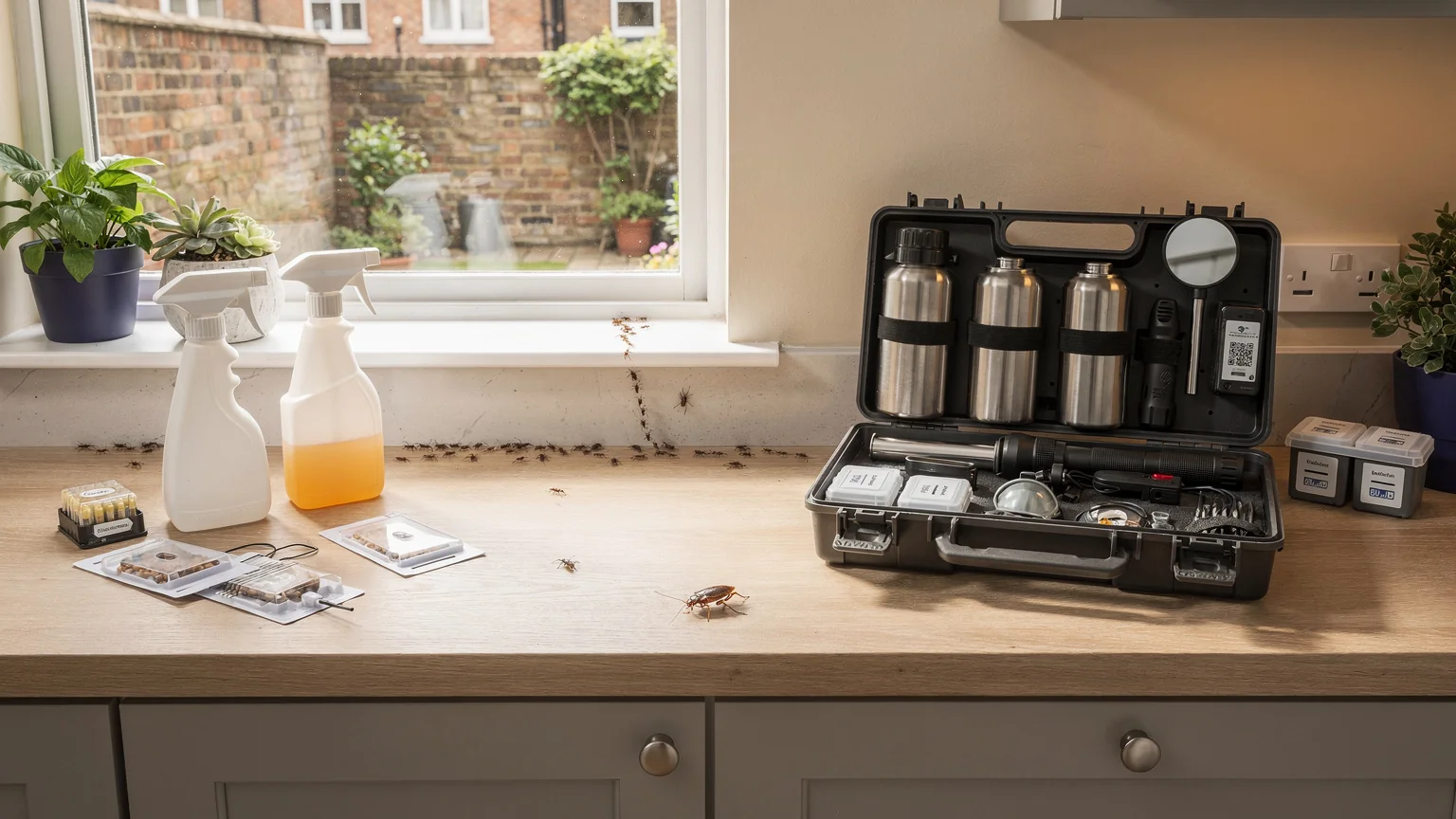
Most people searching for a bug service near me assume the choice is simple: call a big national brand and pay more for peace of mind, or gamble on a cheap local operator and hope they show up. That framing misses the actual landscape. In East London and Essex, there is a third path — established independent firms with national-grade accreditation, local knowledge, and faster response times than either extreme. The real question is not big versus small. It is whether your provider's operating model matches the pest, property, and urgency you are dealing with.
What Your Property and Pest Evidence Actually Mean
Before comparing providers, you need to read your own situation accurately. The pest evidence you have found, the type of building you live in, and how quickly the problem is escalating will determine which service model actually fits.
A single wasp nest under the eaves of a 1930s semi in Redbridge is a different job from bed bugs spreading through a converted Victorian terrace in Tower Hamlets. The first needs swift removal before the colony expands — wasp activity has risen 61% year-on-year according to Rentokil's May 2026 data, with nests increasingly found in unusual harbourage like Wellington boots and soft furnishings. The second needs systematic treatment across multiple rooms, with follow-up visits to break the reproductive cycle. One demands speed and physical access. The other demands methodical process and local knowledge of typical building layouts.
Property type matters because East London and Essex housing stock varies enormously. Post-war council estates in Newham, ex-council flats in Waltham Forest, new-build apartments in Stratford, and period properties in Essex border towns each present different entry points, harbourage zones, and treatment constraints. A technician who knows that mice often travel through cavity walls in 1960s tower blocks, or that German cockroaches cluster around boiler pipework in Victorian conversions, will find the source faster than one reading from a generic protocol.
Urgency and safety risk depend on who lives in the property. Homes with young children, elderly residents, or pets need treatments selected with toxicity and displacement in mind. Food businesses need compliance documentation. The disruption a household can tolerate also varies — some people can vacate for heat treatment, others need same-day chemical resolution because they work from home or have mobility constraints.
Recurrence risk is highest where the root cause is environmental rather than incidental. Persistent damp, poor waste management in communal areas, or neighbouring properties with untreated problems will bring pests back regardless of how thorough the initial treatment was. In these cases, the provider's follow-up guarantee and willingness to return without additional call-out charges matters more than the brand name on the van.
Council Pest Control: When It Works and When It Does Not
Your local council runs a pest control service, and for some situations it is the right first call. Council officers hold RSPH qualifications and follow statutory obligations for certain pests in social housing. The Westminster pest control team, for example, employs officers with decades of service experience and continuous annual training. Camden's pest control service treats ants, bedbugs, beetles, cockroaches, mice, moths, rats, and wasps, with clear pricing for residential and business properties.
However, council services have tightened significantly. Many London boroughs now restrict free treatment to statutory pests — typically rats, mice, and cockroaches in council-owned housing. Private homeowners and leaseholders often face charges that have risen sharply. North Yorkshire Council increased its bug treatment fees from £100 to £160 in April 2026, and London boroughs have followed similar trajectories as they seek to recover costs. The Harrow pest control policy clarifies that leaseholders may be charged individually or via service charges, while some council teams have stopped taking new commercial work entirely.
Council response times also vary by borough and season. During peak wasp season or after flooding events that drive rats indoors, waiting lists can stretch to two weeks or more. For time-sensitive infestations — a wasp nest near a child's bedroom, bed bugs before a tenant viewing, or cockroaches in a food preparation area — that delay can be unacceptable.
The council route works best when you are a council tenant with a statutory pest, when cost is the overriding concern and you can wait, or when you need official documentation for housing disputes. It tends to fail when you need same-day response, when your pest falls outside statutory coverage, or when you want guaranteed follow-up if the first treatment does not fully resolve the problem.
National Pest Control Chains: Scale, Consistency, and Gaps
Rentokil, Orkin, and similar national operators bring brand recognition, centralised booking systems, and standardised treatment protocols. For commercial clients with multiple sites or national portfolios, that consistency has value. A facilities manager with properties in Manchester, Birmingham, and London can deal with one account team and one reporting format.
For residential customers in East London and Essex, the advantages are less clear. National chains typically route calls through regional hubs, then dispatch technicians from depots that may be 30-45 minutes away during traffic. Same-day service is often promised but not guaranteed, and emergency call-outs may carry premium charges. The technician who arrives may be competent — national recruitment and training standards are generally sound — but may not have worked in your specific borough before.
Treatment protocols at national chains tend toward standardisation. This is efficient for common scenarios but can miss local variations. A technician following a bed bug protocol developed for suburban detached houses may under-treat a Victorian conversion with shared walls and multiple entry points. The London bed bug removal challenges in dense urban housing often need adapted approaches that local experience informs.
Pricing from nationals is typically at the upper end of the market. TradeMatch UK reports average pest control costs of £100-£300 nationally, with London and South East premiums of 20-40%. National chains usually sit at or above that premium band. You are paying partly for the brand, partly for the infrastructure, and partly for the reassurance of a large organisation behind the guarantee.
Where national chains tend to fail is in follow-up flexibility. If treatment needs adjustment, rebooking through a central call centre can be slow. The original technician may not be available, meaning you retell your situation to someone new. For complex or persistent infestations, that discontinuity matters.
Local Independent Bug Services: Speed, Knowledge, and Accountability
Independent operators like BuzzKill Pest Control, Bugwise, and Eastern Counties Pest Control represent a distinct model. They are typically owner-managed or small-team operations with deep local coverage and direct accountability.
Response time is the most immediate difference. A local technician based in East Ham or Ilford can often reach a property in Tower Hamlets or Redbridge within an hour. Emergency pest control London availability — same-day and often evening or weekend — is standard for independents because their travel radius is small and their scheduling is direct. There is no central call centre queue to navigate.
Local knowledge accumulates over years of working in the same postcodes. An independent technician who has treated cockroach control London problems in 1960s tower blocks knows where the riser cupboards harbour populations. One who has done moth control London in period properties knows which textiles and storage patterns create risk. This is not generic training — it is repeated exposure to the specific building stock, climate patterns, and pest pressures of East London and Essex.
Inspection depth tends to be more thorough with independents because the same person who quotes usually carries out the work. They have direct financial and reputational incentive to get the diagnosis right first time. Nationals sometimes separate survey from treatment, with different staff at each stage, which can lead to gaps in understanding.
Treatment methods vary by independent but quality operators typically hold the same accreditations as nationals. NPTA registration, BASIS PROMPT certification, and RSPH Level 2 qualifications are common among established independents. The difference is not qualification level but application — local technicians can adapt protocols to your specific property rather than following a central playbook.
Pricing is generally more competitive. Independents have lower overheads — no national marketing budget, no central office infrastructure — and can offer transparent fixed pricing. Eastern Counties Pest Control, for example, publishes prices upfront and offers discounts for payment on completion. For flea treatment service or ant control London work, this transparency helps households budget accurately.
The main risk with independents is variability. A well-established local firm with proper accreditation is reliable. A one-man operator without insurance or qualifications is not. The key verification points are: NPTA or BPCA membership, public liability insurance (£5 million is standard for reputable firms), RSPH or equivalent technician qualifications, and clear guarantee terms in writing.
Provider Profiles
The Business Trends
The Business Trends publishes directory-style guides to East London services. Their 2025 coverage noted an 18% rise in pest-related complaints across Tower Hamlets, Hackney, and Newham, framing pest control as essential urban infrastructure. They do not provide direct treatment services but aggregate provider information for comparison.
Bugwise Pest Control
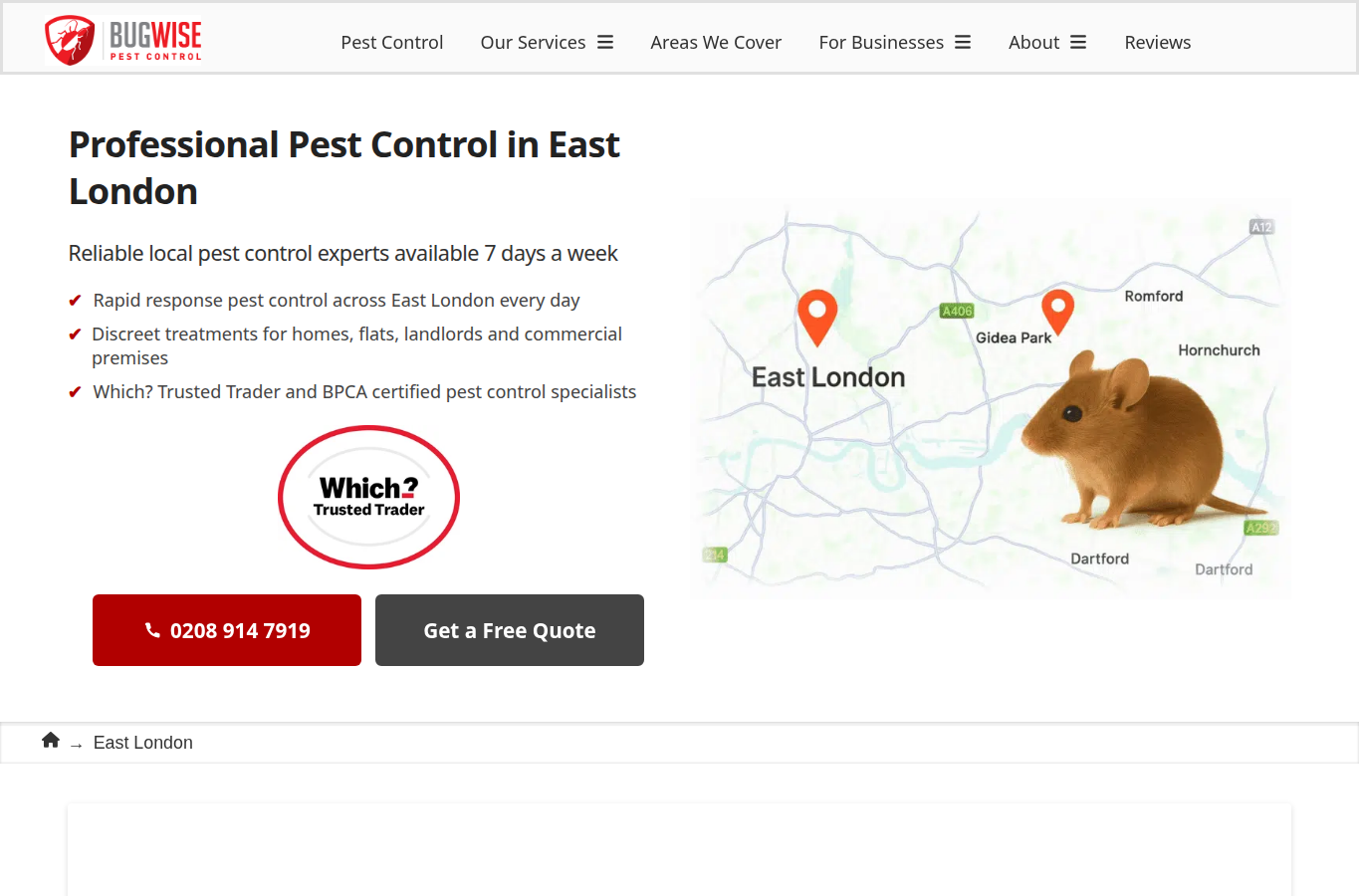
Bugwise Pest Control operates across East London with BPCA-certified technicians. They emphasise local insight combined with modern technology, covering residential flats through to commercial premises. Their service range includes grey squirrel removal and loft proofing across London and Essex, with seven-day availability.
Eastern Counties Pest Control
Eastern Counties Pest Control is an Essex-based company with over 25 years' experience and RSPH Level 2 trained staff. They cover Essex, Suffolk, and parts of Hertfordshire including Braintree, Colchester, Sudbury, and Halstead. Their pricing is transparent and fixed, with discounts for payment on completion.
BPC Pest Control
BPC Pest Control serves the East Bay area of Essex with same-day service and 24-hour call-out availability. They highlight 30 years' experience, BPCA approval, and eco-friendly practices. Their approach focuses on identifying underlying causes like access gaps and clutter to prevent recurrence.
EPB Control
EPB Control provides pest control in East Ham with around-the-clock availability. They offer tailored domestic and commercial services, with child- and pet-friendly options where needed. They aim to respond to inquiries within two hours and provide same-day service for urgent cases.
How Guarantees and Follow-Up Actually Differ
The guarantee is where service models separate most clearly. Council services typically offer treatment-only guarantees — they will apply the standard protocol, but if it does not work, you rejoin the queue. National chains often offer 30-90 day guarantees with conditions, but exercising them can involve call centre navigation and delayed rebooking.
Established independents frequently provide stronger follow-up commitments because their reputation depends on local word-of-mouth. A technician who lives in the area and serves the same postcodes repeatedly has incentive to resolve problems definitively. Guarantees of return visits without additional charge, or free retreatment if pests persist, are common among quality local operators.
For bed bug removal service work, follow-up is particularly critical. Bed bugs require multiple treatment stages, with inspections between cycles to verify elimination. A provider who commits to the full sequence upfront, with scheduled return visits, is preferable to one who treats once and leaves you to monitor. This is where local pest control services often outperform national alternatives — the same technician returns, remembers your property, and adjusts based on results.
When Each Model Fits Your Situation
Council services suit council tenants with statutory pests, limited budgets, and flexibility on timing. They are less suitable for private homeowners, time-pressured situations, or pests outside statutory coverage.
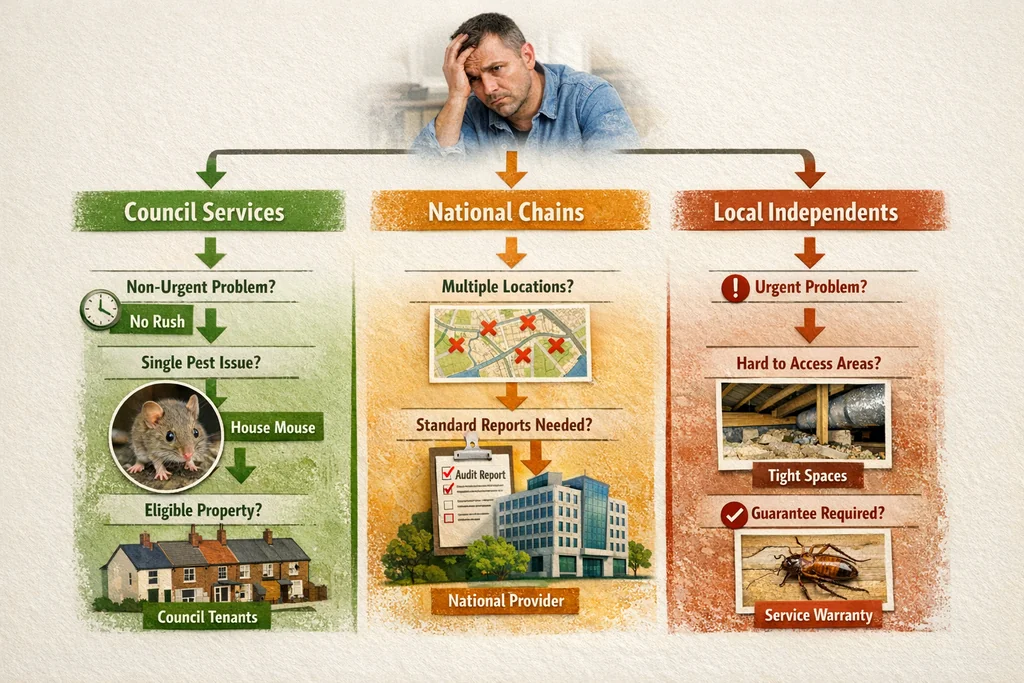
National chains suit commercial clients with multi-site portfolios, or residential customers who value brand recognition and centralised administration over speed and local adaptation. They are less suitable for complex urban properties needing customised treatment, or situations requiring rapid response.
Local independents suit most residential scenarios in East London and Essex, particularly where speed, local building knowledge, and direct accountability matter. They are especially appropriate for persistent or complex infestations, properties with access or harbourage challenges, and households needing flexible scheduling. The verification step — checking accreditation, insurance, and qualifications — is essential to avoid substandard operators.
Reading the Evidence and Choosing Your Route
The best provider for your situation depends on three factors: how quickly you need action, how complex your property and pest evidence are, and how much follow-up certainty you require. A single wasp nest in straightforward access, found on a Saturday morning, needs fast removal by whoever can reach you quickest — often a local independent with weekend availability. Bed bugs in a converted terrace with shared walls need methodical treatment by someone who understands local building stock and will return to verify elimination. A cockroach problem in a food business needs compliance documentation and may suit a national chain with standardised reporting, or a local specialist with commercial experience.
For East London pest control specifically, the density of housing, variety of building ages, and seasonal pest pressures create conditions where local knowledge translates directly into faster resolution and lower recurrence. Tower Hamlets pest control, Newham pest control area, and Redbridge pest control area each present distinct challenges that local technicians encounter routinely.
If your evidence points to a spreading infestation, if you have vulnerable residents, or if your property type creates treatment complexity, prioritise providers who demonstrate local experience, clear qualifications, and written guarantee terms. The initial cost difference between models is usually smaller than the cost of incomplete treatment and repeated call-outs.
Need professional help? BuzzKill offers fast, reliable pest control services across London and Essex.