
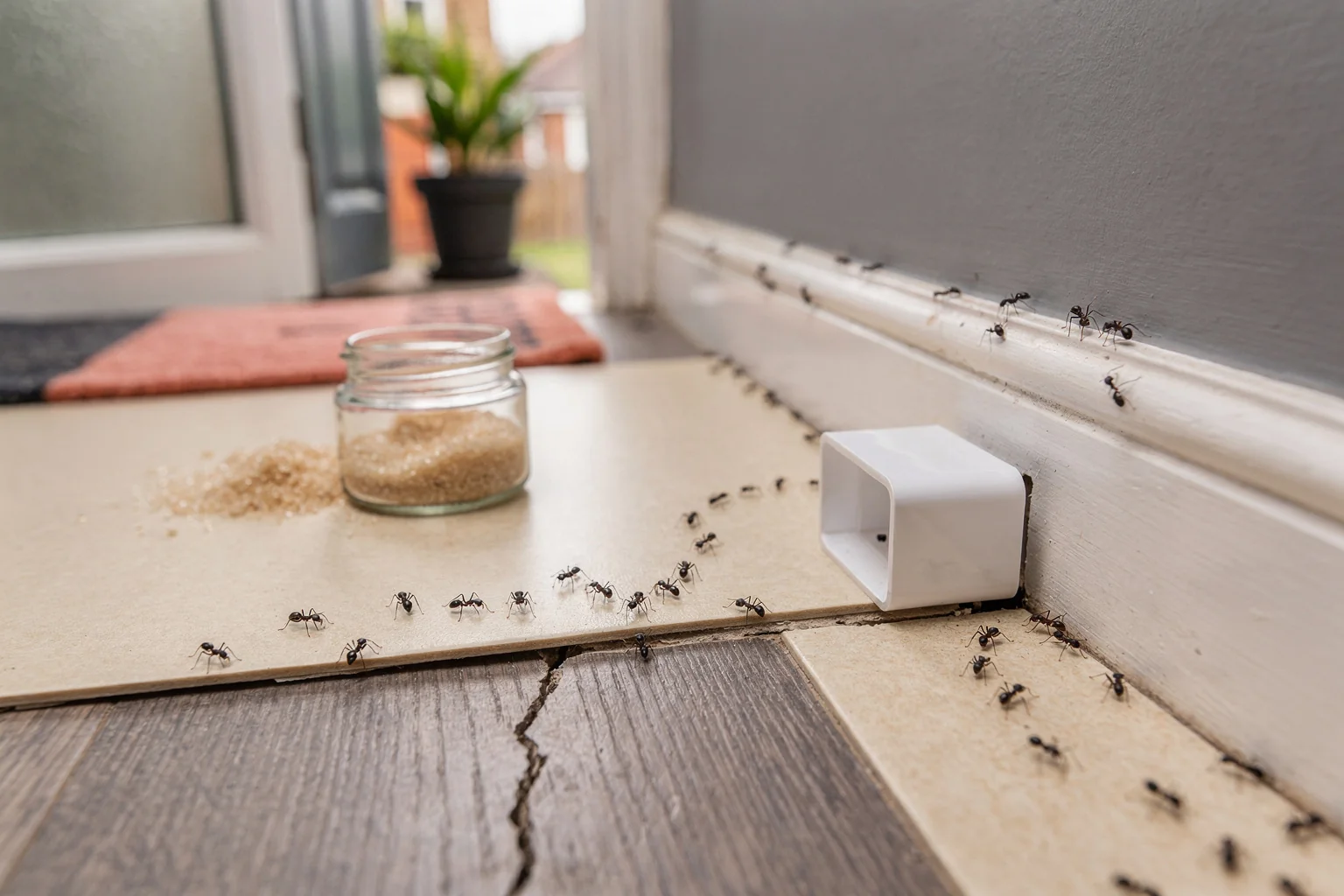
You set out the bait stations two weeks ago. For a few days, the trail across your kitchen worktop thinned. Then, without warning, the ants returned — more of them, in new places, undeterred by the same gel that seemed to work at first. If you live in Lewisham, in one of the borough's Victorian terraces or post-war flats, this pattern is frustratingly common. The problem usually isn't the bait itself. It's that the colony, and sometimes the species, demands a different approach entirely.
This guide walks through what to check now, why standard consumer baits fail in certain Lewisham properties, and the point at which calling a technician becomes the faster, cheaper option.
Why Your Bait Seemed to Work, Then Didn't
Most over-the-counter ant baits use a slow-acting insecticide mixed with a sugar or protein attractant. Worker ants carry the poison back to the nest, where it spreads through the colony over days or weeks. This process works well for garden ants (Lasius niger) with a single, accessible nest in your garden or under a patio slab.
The trouble starts when the nest is not where you think it is. In Lewisham's older housing stock — the Victorian bay-fronted houses of Brockley, the mansion flats near Blackheath, the ex-council blocks of Catford — ants often nest inside the building fabric itself. Wall cavities, under floorboards, behind boiler casings, and within the voids of cavity walls provide stable, warm environments that outdoor nests cannot match. When the nest is hidden, workers may find your bait, feed from it, and still not carry enough back to the queen to collapse the colony. The numbers dip, then rebound.
Heat complicates this further. The summer of 2026 brought record temperatures across the UK, and pest professionals reported a surge in calls as colony activity increased. Warmer conditions accelerate ant metabolism and foraging, which means more workers, more trails, and faster consumption of bait without the corresponding colony kill. One pest control specialist noted that homeowners often mistake increased ant traffic around bait stations for treatment failure, when it is actually a sign that the colony is large enough to absorb the losses.
The Species That Ignores Standard Baits
Not all ants respond to the same attractants. Lewisham's housing mix — heated flats, care homes, hospitals, and older houses with original plumbing — creates conditions where two problematic species thrive.
Pharaoh Ants
Pharaoh ants (Monomorium pharaonis) are tiny, yellow-brown ants that prefer warm, humid indoor environments. They do not forage outside. Instead, they establish multiple nests throughout a building, with dozens of queens in a single colony. This structure makes them uniquely difficult to control with consumer products.
Lewisham Council's pest control service explicitly states that tropical ants such as pharaoh ants require professional treatment for effective control. The treatment relies on workers carrying bait back to nests hidden in the building fabric, which are not usually directly accessible. Most programmes need a minimum of three visits, and treatment can extend across several months. The council's after-treatment advice emphasises that residents must not use alternative sprays or kill visible ants during this period, as this disrupts the baiting process.
Pharaoh ants also switch food preferences rapidly. A bait that attracts them one week may be ignored the next as the colony's nutritional needs shift between proteins, sugars, and fats. Consumer bait stations rarely account for this flexibility.
Argentine Ants
Argentine ants (Linepithema humile) form supercolonies with multiple nests and thousands of queens. They are less common in UK homes than pharaoh ants but appear increasingly in heated commercial premises and some residential blocks. Their cooperative behaviour between nests means that treating one location simply shifts activity to another. Standard baiting, which assumes a single nest with a single queen, cannot keep pace.
If you have tried multiple bait types and the ants persist or spread to new rooms, species misidentification is a likely cause. Garden ants and pharaoh ants need entirely different strategies.
Reading the Signs That DIY Has Reached Its Limit
Before buying another brand of bait, check for these specific indicators that professional help is warranted.
Multiple, separate trails. A single trail from a known entry point suggests a garden ant nest nearby. Trails appearing in different rooms, on different floors, or without a clear outdoor source point to indoor nesting — pharaoh ants or an established colony of another species.
Activity after dark. Garden ants forage during daylight. Ants in your kitchen at midnight, or consistently around warm appliances, are likely pharaoh ants with an indoor nest.
Bait avoidance. If ants walk past fresh bait, investigate the type. Protein-based baits attract some species; sugar-based attract others. Switching types sometimes helps, but persistent avoidance across multiple formulations suggests the colony is being fed elsewhere — by another nest in the building, or by an alternative food source you have not identified.
Reappearance within weeks. A genuine colony kill should keep ants away for the season. Return within two to four weeks indicates that the queen survived, that multiple nests exist, or that a neighbouring colony has moved in.
Shared walls or flats. In Lewisham's converted houses and purpose-built blocks, ants travel through wall cavities and service ducts. Treating your flat alone, without addressing the building-wide population, often fails. This is particularly true for pharaoh ants, where Lewisham Council notes that block-wide treatment may be necessary and would require a decision by the housing provider.
What a Professional Survey Actually Finds
When a technician visits, the first task is identification. Species determines everything — bait type, placement strategy, treatment duration, and whether neighbouring properties need notification.
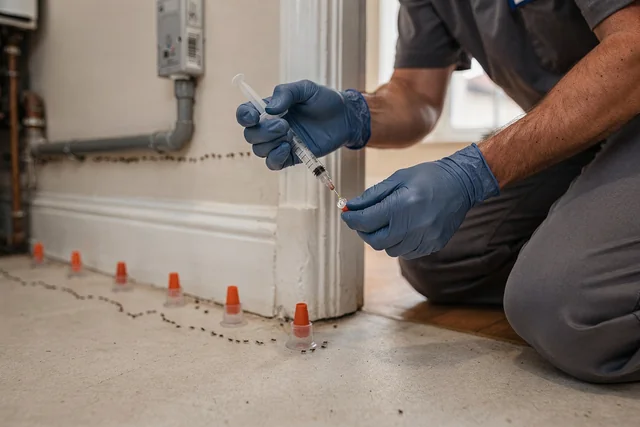
For pharaoh ants, a technician looks for the characteristic trail pattern: narrow, continuous lines along skirting boards, pipes, and electrical conduits. They check warm, humid zones — behind refrigerators, near boiler pipes, in bathroom voids. Thermal imaging sometimes reveals nest locations in wall cavities. The technician then places a specialised bait programme, usually a gel or granular formulation, at multiple points. Follow-up visits assess consumption and replace bait as needed.
For garden ants with indoor access, the survey traces entry points. These might be gaps around waste pipes, cracks in pointing, or gaps beneath door thresholds. The technician treats the nest directly where possible, uses residual insecticide at entry points, and advises on proofing.
The cost structure reflects this difference. Lewisham Council charges £186 for up to three visits for pharaoh ant treatment, with concessions at £93. Private treatment in London and the South East typically runs £130–£250, reflecting higher labour and travel costs. One local provider reported average prices around £208 for ant control jobs in the Lewisham area over the past year, with a range from £115 to £569 depending on property size and infestation complexity.
What You Can Do While Waiting for a Technician
If you have booked a professional visit, or are still deciding, certain actions help and others hinder.
Do: Clean food residues thoroughly, especially sugary spills and grease around cookers. Store food in sealed containers. Reduce moisture where possible — fix dripping taps, ventilate bathrooms. Note where and when you see ants, and photograph trails if you can. This information speeds identification.
Do not: Spray visible ants with household insecticide. This kills foragers but alerts the colony to danger, potentially causing it to bud — splitting into multiple new nests. For pharaoh ants specifically, Lewisham Council's guidance warns that using sprays or killing visible insects interferes with professional baiting programmes.
Do not: Disturb bait stations that a technician has placed. The bait must remain accessible for several weeks, with children and pets kept away during treatment.
How Lewisham's Housing Stock Shapes Treatment
The borough's architectural variety creates distinct pest control challenges.
Victorian and Edwardian houses in areas like Brockley, Telegraph Hill, and Hither Green have suspended timber floors, original lime plaster, and decades of structural adaptation. Wall cavities, chimney breasts, and underfloor voids provide extensive nesting habitat. Pointing deterioration and original timber window frames create entry points that modern sealants struggle to close permanently.
Post-war estates and system-built blocks in Bellingham, Downham, and parts of Catford have concrete construction with service ducts running vertically and horizontally. These ducts allow rapid ant movement between flats. A pharaoh ant colony established on the fourth floor can appear on the ground floor within days, using pipe runs and electrical conduits.
Newer developments, including conversions of former industrial buildings around Deptford Creek, present different issues. Underfloor heating creates the warm, stable conditions pharaoh ants favour. Open-plan designs and minimal wall cavities sometimes push nests into kitchen units and built-in appliances.
In each case, the technician's approach must match the building. Bait placement in a Victorian terrace differs from a tower block, and both differ from a modern flat. Local knowledge of Lewisham's typical construction methods helps predict where nests are likely to be found.
When Council Treatment Is Available, and When to Go Private
Lewisham Council operates a pest control service for residents, with specific provisions for council tenants and leaseholders. The council's Pest Management Policy states that it will commission treatments for rats, mice, tropical ants including pharaoh ants, and cockroaches in its managed properties. Leaseholders may be charged as part of block treatments.
For private homeowners and tenants in privately rented accommodation, the council still offers treatment, but at full cost. Waiting times vary, particularly in peak summer months. Private providers typically offer faster response — same-day or next-day appointments — which matters when the colony is expanding or when the property is a food business facing compliance pressure.
Private treatment also offers guaranteed retreatment. If ants return within a defined period, the technician revisits at no extra charge. This matters for pharaoh ants, where the initial programme may not eliminate all nests. Council services have fixed visit numbers; complex cases may need additional booking.
Understanding Guaranteed Results
The phrase "guaranteed results" appears in many pest control advertisements, but its meaning varies. A genuine guarantee for ant control should specify:
- The species covered. Guarantees for garden ants are simpler than for pharaoh ants.
- The time period. Six weeks is common for wasp nests; pharaoh ant programmes may need longer monitoring.
- What triggers a revisit. New ants in the same area? Any ants anywhere in the property?
- Whether proofing advice is included. Sealing entry points reduces reinvasion risk.
Ask these questions before booking. A technician who cannot answer clearly may not have the experience that complex ant problems demand.
Questions Lewisham Homeowners Ask
Why do ants keep coming back to the same spot?
The spot provides something they need — food, moisture, or a pheromone trail that persists even after cleaning. More importantly, the nest may be nearby, with a steady supply of new foragers. Until the nest is treated or entry is blocked, the trail will re-establish.
Can I treat pharaoh ants myself?
Lewisham Council and pest professionals agree that pharaoh ants need professional treatment. The multi-nest structure, rapid bait avoidance, and risk of colony budding make consumer products unsuitable. The council's pest control page states explicitly that tropical ants such as pharaoh ants require professional treatment for effective control.
How long does professional treatment take?
For garden ants, often one visit with possible follow-up if entry points are not fully sealed. For pharaoh ants, a minimum of three visits over several months, with some cases extending longer. The bait must work through the colony gradually; rushing the process reduces effectiveness.
Are the chemicals safe around children and pets?
Professional bait formulations are placed in secure stations or in inaccessible locations. Lewisham Council's after-treatment advice specifies keeping children and domestic animals away from bait during treatment. Your technician should explain specific precautions for your property.
Do I need to tell my neighbours?
For detached or semi-detached houses with garden ants, usually not. For flats, converted houses, or any pharaoh ant case, yes. Shared structures mean shared pest populations. Lewisham Council notes that block treatment may be necessary for pharaoh ants in council-managed properties, requiring a decision by the housing provider.
Why are ants worse in summer?
Warmer temperatures increase metabolic rate and foraging activity. The 2026 heatwave produced particularly high call volumes. However, pharaoh ants, with their indoor nests, are less weather-dependent and can remain active year-round in heated buildings.
The Real Cost of Waiting
Ant problems rarely resolve themselves. Pharaoh ant colonies expand by budding, where a queen and workers leave to establish a new nest. A single colony can become dozens within months. Garden ants, while less dramatic, can damage electrical equipment and contaminate food preparation areas.
For businesses, the cost includes regulatory risk. Food premises with ant activity face enforcement action under food hygiene regulations. Early professional intervention is cheaper than a hygiene emergency or lost trading days.
For homeowners, the cost is stress and diminishing returns on repeated DIY attempts. The £15 spent on bait stations, then £20 on a different brand, then £25 on insecticide spray, approaches the cost of a single professional visit with no guarantee of success.
Making the Call
If you have tried two bait types, followed instructions precisely, and still see ants after three weeks, you have sufficient evidence that the colony structure or species requires professional assessment. The same applies immediately if you suspect pharaoh ants, live in a flat with shared walls, or run a food business.
When you call, describe what you have seen — where, when, and in what numbers. Mention any previous treatments and their effects. This information helps the technician arrive prepared, potentially saving a return visit.
For Lewisham residents, Ant Control in Tower Hamlets offers a nearby perspective on the same decision, with comparable housing stock and species profiles. The principles apply across East London's older residential areas.

Need professional help? BuzzKill offers fast, reliable pest control services across London and Essex.