
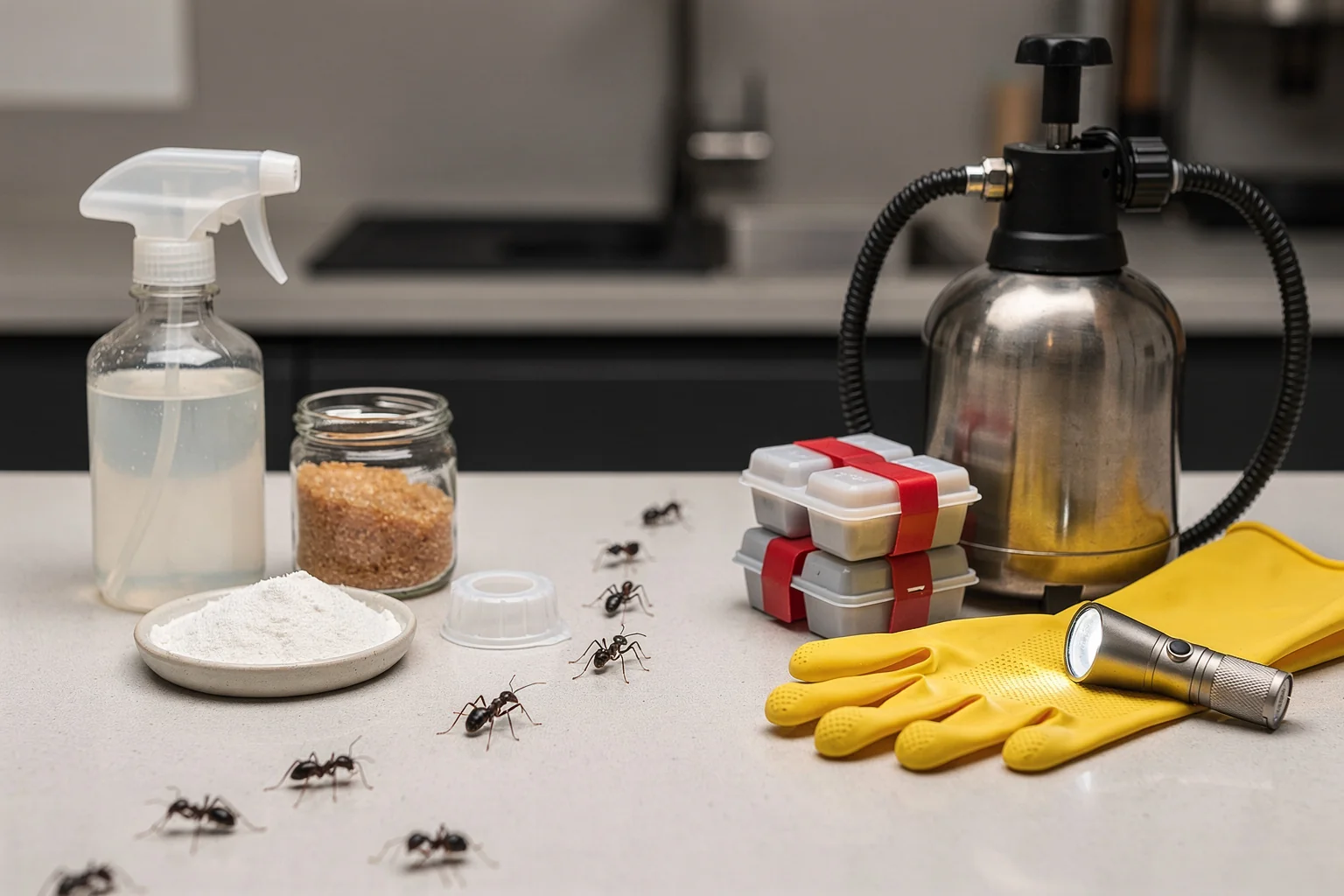
On a warm Tuesday in June, Yasmin walked into her Bow kitchen and found a dark ribbon of ants threading from the skirting board straight to the biscuit tin. She wiped the trail, set down a shop-bought ant bait station, and thought the job was done. Three mornings later the ants were back, this time following a different route behind the fridge. Yasmin’s story isn’t unusual — every summer I hear a version of it from homeowners across Tower Hamlets. The question is always the same: should I keep trying to sort this myself, or is it time to call someone in?
I’ve worked on ant problems in Bethnal Green, Mile End, Poplar and beyond, and the honest answer isn’t one-size-fits-all. Sometimes a simple DIY move gets it under control; other times the same approach just keeps the ants circulating around your home while the nest thrives out of sight. Let’s walk through what DIY can genuinely achieve, what professional ant control services bring to the table, and how to make a call that fits your home, your budget, and your peace of mind.
Why ants keep marching through Tower Hamlets homes
Most indoor ant trails in London are the work of the black garden ant (Lasius niger). Workers are only about 5 mm long, dark brown or black, and they follow well-worn scent trails between the nest and a food source. In Tower Hamlets, nests often sit under patio slabs, in cracked paving, against warm south-facing walls, or in the loose soil of a tiny front garden. A mature colony can hold 15,000 workers and a single queen, so what you see indoors is usually a tiny fraction of the operation.
This summer is shaping up to be particularly busy for ant activity. Wildlife specialists have warned that flying ant “day” in 2026 will actually stretch across several weeks, starting from late June and peaking through July and August during warm, humid spells with little wind. Those winged ants are the reproductive males and new queens from black garden ant colonies, and when they appear in large numbers it’s a sign that nearby nests are healthy and well-established. Even if you never see a winged ant indoors, the spike in surface activity usually means more foraging workers finding their way through gaps around pipework, doors and air bricks.
Tower Hamlets’ mix of Victorian terraces, post-war flats, and busy commercial streets creates plenty of nooks for nests. Add a hot spell and a few unwashed surfaces, and ants can turn up faster than most people expect. The real decision isn’t whether to act — it’s which approach will actually stop the repeat visits.
The DIY toolkit: what you can do yourself
If you’ve spotted a small trail and the ants aren’t spreading into cupboards, food areas or bedrooms, there are a few things worth trying first. I usually tell homeowners that DIY works best when it heads straight for the nest, not when it just kills the workers you can see.
Ant bait stations and gels are the most effective over-the-counter option because foraging workers carry the slow-acting poison back to the colony and share it with the queen and larvae. The catch is that you need patience: a gel laid along the trail usually takes one to two weeks to collapse a black garden ant colony, and in the first few days you may see more ants as the bait attracts them. Sprays kill on contact but rarely reach the nest; I’ve visited homes where the homeowner had used spray three times, each time wiping out the trail only to find a new one emerging from a different crack.
Simple household tactics help too. Wiping surfaces with a vinegar-and-water mix disrupts the pheromone trail, and sealing gaps around skirting boards, pipework and door thresholds closes off entry points. But these are defensive moves — they slow things down rather than eliminate the problem. For a walkthrough of those methods, our DIY ant control methods guide lays out what to try and what to skip.
The biggest DIY blind spot is identification. The UK has around 50 ant species, and while the black garden ant is the most common household invader, a few others — such as the much smaller Pharaoh ant — can become a bigger headache if you use the wrong treatment. With Pharaoh ants, spraying can actually cause the colony to split into several new nests, spreading the problem through a block of flats. If you’re not sure which ant you’re dealing with, it’s safer to pause and get a proper look at the evidence.
What professional ant control services actually deliver
When I arrive at a house in Tower Hamlets, the first thing I do isn’t spray — it’s walk the property. I check the exterior for nest sites, lift inspection hatches if they’re accessible, and look at places the homeowner rarely visits: behind the washing machine, under the stairs, around the back of kitchen plinths. That site survey tells me three things: which ant species is active, where the nest likely sits, and what’s drawing the ants indoors.
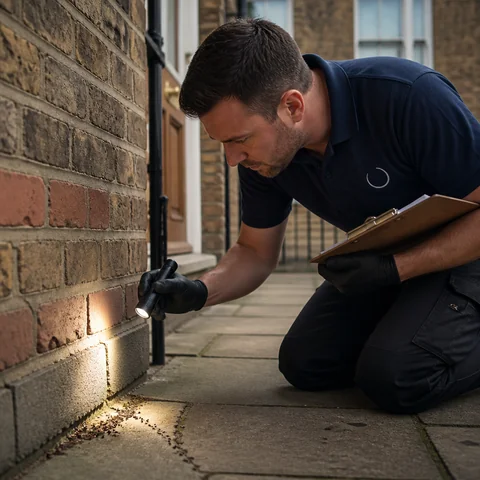
Professional treatment for black garden ants often uses a targeted insecticidal gel injected into cracks, voids and around pipework, combined with a perimeter barrier where needed. Because we use non-repellent formulations, the ants don’t avoid the treatment — they keep feeding and carry the active ingredient back to the nest. That means the queen and the brood are reached, not just the foraging workers. Most jobs are resolved in a single visit, though I’ll sometimes schedule a follow-up check two to three weeks later for heavier infestations.
Ants aren’t classed as a public health risk in the same way as rats or cockroaches, but they can still contaminate food surfaces. The CIEH pest control procedures manual notes that foraging ants may walk across unclean areas before crossing kitchen counters, and a single successful worker quickly communicates the route to hundreds of others. For parents running a busy household — or for restaurants and cafés in places like Bethnal Green Road — that’s not a detail you want to bet on.
Accreditation matters here. Our technicians hold BASIS PROMPT certification and RSPH Level 2 qualifications, and we’re registered with the NPTA. That isn’t just paperwork; it means the treatment plan follows an audited standard, the products are used safely around children and pets, and the work is backed by a guarantee. Our Tower Hamlets ant control service page explains the process in detail, and you can read more about how we approach treatment on our professional ant control services page.
If you manage a café, takeaway or restaurant, the expectation is higher. The BPCA advises that food businesses need a pest control folder that includes site plans, treatment records and corrective-action logs — especially if you work to BRC or SALSA standards. DIY ant control rarely produces the paperwork your EHO will want to see. In those situations, a professional routine is the only route that keeps you audit-ready.
Other ant control options in and around Tower Hamlets
If you’re still weighing up DIY versus calling someone out, it’s useful to know what else is available locally. Several companies and guides come up when people search for help. I’m not listing these as a ranking — they’re just the names that often appear alongside ours, and each serves a slightly different need.
Able Group
Able Group offers local ant control with a response window of 30 to 90 minutes and a no-call-out-charge policy. They say they’ve been working in Tower Hamlets for almost 30 years, which gives them a long track record in the area.
PestBuddy
PestBuddy’s expert DIY guide walks through baiting, sealing entry points and cleaning pheromone trails. It’s a solid resource if you’ve decided to go the self-help route and want a structured plan rather than guesswork.
PestPro Index
The PestPro Index 2026 guide covers UK ant species identification and treatment at a deeper level than most consumer articles. It stresses the importance of matching the treatment to the species — especially the Pharaoh ant warning — and explains when DIY is likely to fall short.
Orkin
Orkin’s advice page on DIY versus professional ant control makes a straightforward case: home remedies tend to be temporary, and real colony control usually needs a strategic approach. While Orkin is a US-based company, the principles they outline about species identification and nest targeting apply equally here.
Combat Pest Control
Combat Pest Control lists ants among the pests they cover in Tower Hamlets, alongside rodents, bed bugs, and wasps. They also provide a pricing guide that compares costs from several local providers, which can be handy if you’re shopping around.
Having options is good, but the decision still comes back to what’s actually happening inside your home. A name you recognise on a search results page doesn’t guarantee they’ll send a qualified technician who knows Tower Hamlets’ housing stock. When you’re booking, it’s worth asking what species they treat, how many visits they recommend, and what their guarantee covers.
Which route fits your home right now?
I don’t think there’s a universal answer, but there’s a reliable decision path. Here’s how I’d walk through it if you were standing in front of me with a phone in your hand.
Start with what you can see. A single trail of black garden ants heading for a splash of jam on a worktop? Try a bait station and a good clean, and keep the ant prevention tips checklist on hand — seal obvious gaps, clear crumbs, and remove pet food bowls overnight. Give it a week to ten days. If the trail thins and disappears, you’ve likely caught it.
If the ants keep shifting routes or you spot winged ants indoors, the nest is almost certainly mature and close to the building. Winged ants inside usually mean a colony has established itself in a wall void, under a floor, or in the foundations. At that point, surface baits rarely solve the problem; you need to get treatment into the nest itself.
When you’ve tried twice and it’s back, it’s time to call someone. Two failed DIY attempts doesn’t mean you did something wrong — it usually means the colony is somewhere you can’t reach or the species isn’t responding to the products you’ve used. Pharaoh ants are the classic example where the wrong move makes things worse, but even black garden ants can prove stubborn when the nest sits under a concrete slab or deep inside a cavity wall.
If you’ve got young children, pets, or vulnerable occupants, the safety of professional application matters. A technician who holds a BASIS PROMPT ticket knows how to apply gels and barriers in low-traffic areas and can give you clear environmental information. You won’t get that level of detail on the back of a retail pack.
For tenanted properties and commercial kitchens, the balance tips heavily toward professional pest control in Tower Hamlets. Landlords have repair obligations, and food businesses can face enforcement action if pest activity isn’t managed to an auditable standard.
If you’ve read this far and you’re still unsure, we’ll happily talk it through. BuzzKill covers all of Tower Hamlets, operates with no call-out charge, and can usually get a technician to you the same day. Call 0203 468 1999 or request a callback — we’ll tell you honestly whether you need us or whether a few DIY steps will get the job done.
Need professional help? BuzzKill offers fast, reliable pest control services across London and Essex.