
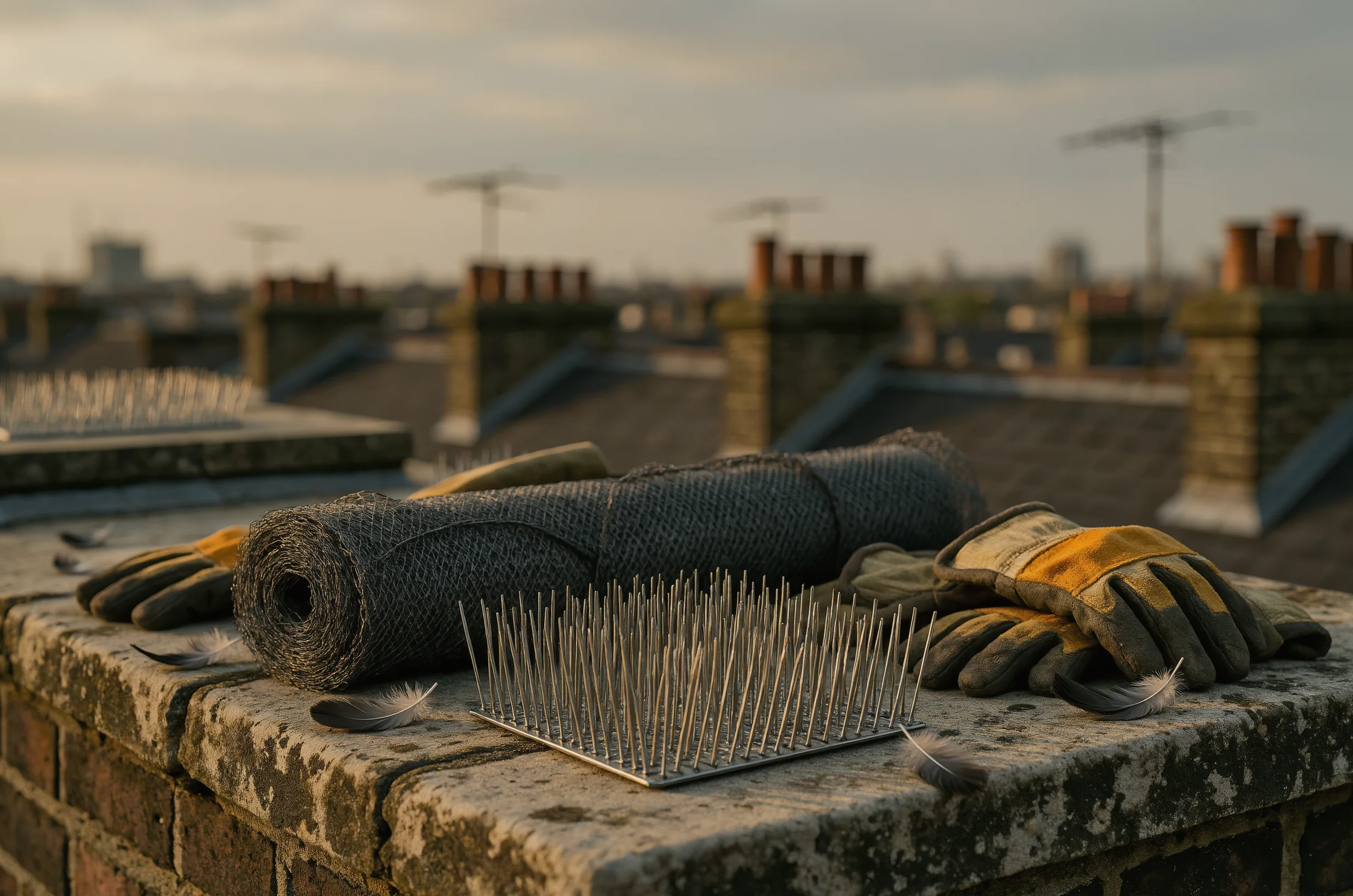
Most people who ring us about birds in Hackney have already tried something. A spike strip from a DIY shop. A plastic owl. A bit of netting stapled up on a Sunday afternoon. By the time they call, they've usually spent more than a survey would have cost, and the birds are still there.
Here's what surprises people: the sign that worries homeowners most is rarely the one that needs urgent action. Guano on a balcony gets panic calls. A blocked gutter quietly rots a fascia board for two winters before anyone notices. So this list is ordered by how much the evidence tells us about the property, not by how alarming it looks.
Five things we look for on a first visit to a Hackney property, what each one means, and where the DIY instinct usually goes wrong.
Why Hackney Buildings Suit Pigeons and Gulls So Well
Hackney is unusually good bird habitat for an inner-city borough, and it's worth understanding why before you judge your own building.
The Victorian terraces across E5, E8 and E9 were built with generous eaves, gaps under slates, and parapet walls that create sheltered ledges at exactly the height pigeons prefer. Add the Regent's Canal and the River Lea corridor, plus Victoria Park and London Fields on the doorstep, and you have roosting cover, water, and a steady food supply within a few hundred metres of most front doors.
Feral pigeons are the main offender, but not the only one. Gulls nest on flat roofs and chimney stacks across the borough. One Hackney resident reported nesting seagulls at a block in N1 in July 2026 and was told the location sat on private property, so the council couldn't act. That detail matters. Council pest teams handle certain pests on certain land, and nuisance birds on private buildings often fall outside what they'll attend. Hackney Council's pest control service is built around rats, mice and insect work, with payment taken at booking and appointments arranged within 48 hours.
So if you're waiting for the council to sort birds on your roof, you may be waiting a long time. That's usually the point at which a private contractor becomes the practical answer.
Sign 1: Guano Building Up Faster Than You Can Clean It
Fresh droppings are the sign everyone notices, and the one most people misread.
A single pigeon produces a surprising volume of droppings over a year, and the deposits are acidic. Left on stone, brick or metal, they etch the surface. On painted render they stain permanently. On balcony tiles and fire escapes they turn into a slip hazard the moment it rains.
What we look for isn't just the mess. It's the pattern. Droppings concentrated along one ledge, one parapet, or one row of window sills tells us where birds are actually landing and roosting. A scattered spread across a whole roof usually means the birds are moving around rather than settled, which is a different problem with a different fix.
The common mistake is treating guano as a cleaning job. People pressure-wash, the surface looks fine for a fortnight, and the birds return to the same ledge because nothing about the ledge changed. Cleaning without proofing is a subscription, not a solution.
There's also a genuine safety point. Dried bird droppings can carry fungi and bacteria, and disturbing them dry — with a brush, a leaf blower, or a pressure washer — sends fine particles into the air. If the build-up is thick, or if it's inside a loft or roof void, that's a job for someone with the right respiratory protection and disposal method, not a weekend project.
Verdict: act on this one when the build-up is recurring, not when it's merely visible. If you're cleaning the same ledge every few weeks, the ledge is the problem.
Sign 2: Nesting Material Blocking Gutters, Downpipes and Vents
This is the sign that costs the most money and gets noticed the least.
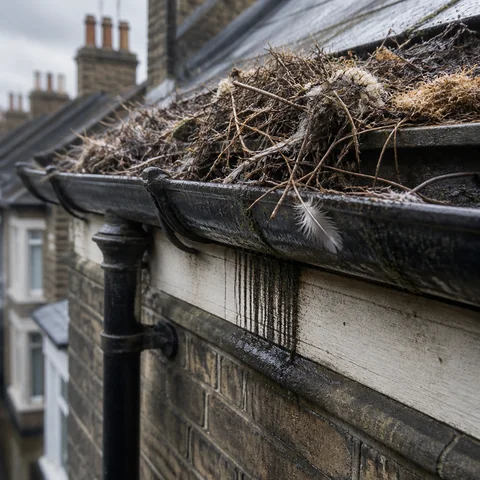
Pigeons and gulls don't just sit on your roof. They build. Twigs, grass, feathers, plastic, insulation pulled from your loft — it all goes into a nest, and nests go into gutters, behind parapets, into chimney pots, and across roof valleys. A blocked gutter in a Hackney terrace does what a blocked gutter always does: water backs up, finds the weakest point, and starts working on the building fabric.
By the time you see a damp patch on an internal wall, the water has usually been travelling for months. Fascia boards soften. Brickwork spalls in a hard frost. In older properties with original lime mortar, the damage can run further than the visible stain suggests.
Nests in vents and flues are a separate concern. A blocked air brick or extract vent reduces ventilation in a loft or kitchen, and that's how you end up with condensation problems that look nothing to do with birds.
The mistake here is timing. People clear a gutter in autumn, assume the job's done, and don't look again until something leaks. Nesting season runs through spring and summer, so a gutter that was clear in October can be full by June.
Verdict: if you've cleared nesting material more than once in the same spot, get the entry point proofed. Clearing is maintenance; proofing is the fix.
Sign 3: Noise, Smell and Complaints From Tenants or Neighbours
For landlords and letting agents, this is often the sign that forces the issue — not the property damage.
Birds roosting on a building are loud at dawn, and the noise carries through single-glazed Victorian windows and into top-floor flats. Add the smell of accumulated droppings in warm weather, and you have the ingredients for a tenant complaint, a formal report to the landlord, or a dispute between neighbouring freeholders about whose roof the birds are actually on.
Ownership is the sticking point more often than the birds are. In a converted Hackney terrace, the roosting ledge might belong to one freeholder, the affected flat to a leaseholder, and the access route through a third party's property. Sorting that out before anyone quotes for work saves a lot of friction.
There's a legal dimension worth knowing. Under section 9 of the London Local Authorities Act 2004, a borough council can serve a notice on the owner or occupier of a building where habitual nesting, roosting or alighting of birds on a structure overhanging or fronting a highway is causing nuisance to pedestrians. The notice requires measures to prevent or minimise the problem, with a minimum of 28 days to comply, and there's a counter-notice process if you want to propose alternative measures. That's the mechanism behind a lot of the "we've had a letter" calls we get.
Verdict: if complaints have started, deal with it before it escalates into a formal notice. The cost of proofing is predictable; the cost of a deadline isn't.
Sign 4: Lifted Tiles, Damaged Roofing and Debris Under Solar Panels
Structural damage is the sign that separates "annoying" from "expensive", and it's usually found rather than seen.
Gulls and pigeons will shift loose tiles and slates to get at a nesting space. They'll pull at roof felt and insulation. On properties with solar panels, the gap between panel and roof is close to ideal nesting cover — sheltered, warm, and hard to inspect. Once birds are under a panel array, nesting material builds up around the mounting rails, and the debris can affect drainage across the roof surface.
The wider point is that bird damage compounds. A lifted tile lets water in. Water in the roof void soaks insulation, which stops insulating. Damp timber becomes attractive to other problems entirely. We've surveyed Hackney roofs where the visible bird issue was minor and the hidden water damage was not.
Access is the other half of this. Most Hackney terraces need ladders, roof access, and sometimes a tower or harness work to inspect properly. That's not a criticism of anyone's DIY skills — a proper survey of a three-storey parapet roof isn't a job you do from a bedroom window.
Verdict: if you can see lifted tiles, displaced flashing, or debris under solar panels, get it inspected. This is the sign where delay genuinely costs money.
Sign 5: Birds Around Food Premises, Schools and Care Settings
The final sign isn't about the building at all. It's about who's inside it.
For restaurants, cafés, takeaways, bakeries and any premises handling open food, birds near extraction units, bin stores, delivery yards and outdoor seating are a compliance issue, not a nuisance. Environmental health officers look at pest management as part of food hygiene inspections, and evidence of birds roosting on or around a food business invites questions you don't want to be answering under time pressure.
Schools, nurseries and care homes have a similar dynamic. Droppings on playgrounds, walkways and outdoor seating areas create a cleaning burden and a genuine hygiene concern, and the people affected — children, elderly residents, anyone with a compromised immune system — are the ones least able to absorb a risk you'd shrug off elsewhere.
What makes this sign different is that it rarely gets better on its own. Food waste, warm extraction flues and sheltered loading bays are permanent attractions. Proofing here isn't a one-off tidy-up; it's a system that has to hold up against daily pressure.
Verdict: treat this as the highest-priority sign on the list. Not because the birds are worse, but because the consequences of leaving it are.
What a Proper Survey and Install Actually Looks Like
If you've matched your situation to one or more of those signs, here's what professional work involves — and what separates it from the DIY aisle.
The first visit is diagnostic. A technician maps where birds are landing, roosting, nesting and feeding, and identifies the access points. That's the step most DIY attempts skip, and it's why spike strips often end up on the wrong ledge while the birds move three feet along the parapet.
From there, the method follows the evidence:
- Anti-roosting spikes on ledges, parapets, sills and chimney tops where birds perch. Effective on narrow, defined surfaces. Useless on wide flat areas.
- Bird netting across larger openings — light wells, courtyards, under-canopy spaces, and building voids. Netting is a physical barrier, so the specification (mesh size, tension, fixing points) determines whether it works or sags.
- Post-and-wire systems on longer ledges and ridge lines where spikes would be visually intrusive or impractical.
- Solar panel proofing, which seals the gap between array and roof without affecting panel performance or access for maintenance.
- Gel and optical deterrents in specific situations, usually as part of a wider system rather than on their own.
Two things matter as much as the hardware. The first is legality. All wild birds, their nests and their eggs are protected in the UK, and lethal or disruptive methods generally require a licence. The G0233 Control of Pests guidance used across London Underground is a useful public example of how a large London property operator frames this: non-lethal methods first, with the Wildlife and Countryside Act and the Greater London Local Authorities' Code of Practice for the control of nuisance birds as the governing framework. Any contractor who talks about "just getting rid of them" without mentioning licences is telling you something.
The second is that proofing is a building job as much as a pest job. Fixings have to hold in wind, netting has to be tensioned properly, and the installation has to survive a Hackney winter. That's why a survey matters more than a price.
If you want a sense of what this costs before you commit, our breakdown of bird control costs covers how pricing is structured for pigeon proofing work.
One practical tool worth having: a simple self-survey checklist. Walk the property at dusk, note every ledge, parapet, vent and gap where birds settle, photograph each one, and mark whether you've seen droppings, nesting material, or birds actually landing. That record turns a vague "we've got a bird problem" into a specific brief, and it makes every quote you receive comparable.
How Hackney's Bird Control Providers Compare
Hackney has no shortage of options, and they're not interchangeable. Some are generalist pest firms that add birds to a long service list. Some specialise in proofing. Some are set up for domestic work, others for commercial contracts. The five below all appeared in local search results for bird work in the borough, and each has a different centre of gravity.
Able Group
Able Group's Bird Control in Hackney page positions the service around protecting roofs, ledges and buildings from persistent pigeons, with specialist bird proofing for both homes and businesses. That's a proofing-led offer rather than a removal-led one, which suits properties where the problem is roosting and nesting rather than a one-off bird trapped in a space.
A separate Able Group Hackney page describes a 24-hour operation with 30–90 minute response where possible, and lists bird proofing spikes, netting and gel pads among its methods, plus 50mm netting for larger areas. If speed of response is your priority — say, a commercial premises with an inspection looming — that's the relevant detail.
Best fit: domestic and commercial properties needing proofing hardware installed, particularly where a fast response matters.
Limitation: the published material focuses on proofing methods rather than survey and reporting detail, so if you need documented evidence for a compliance file, ask what reporting you'll receive before booking.
Pest Solutions
Pest Solutions covers Hackney as part of a broader pest control operation, with Pest Control Hackney describing an array of removal solutions including work on nuisance birds. The framing is generalist: birds sit alongside the rest of the pest range rather than as a standalone specialism.
That's not automatically a downside. If your building has birds and another issue — rodents in a bin store, insects around a kitchen — a single contractor handling both can simplify things, particularly for commercial sites where one point of contact and one set of paperwork is easier to manage.
Best fit: properties or businesses with more than one pest issue to address, or buyers who prefer a single provider across a portfolio.
Limitation: the published detail on bird-specific methods is thinner than on the general pest offer, so ask specifically what proofing systems they install and who carries out the work.
JG Pest Control
JG Pest Control's Pest Control Hackney page leads on speed and availability: same-day visits, open every day except Christmas Day, and a 4.7/5 Trustpilot rating. It lists birds alongside rats, mice, wasps and bed bugs.
For a homeowner who's just spotted something and wants it looked at today, availability is a real differentiator. Same-day service matters most when the problem is time-sensitive — a trapped bird, a nest above an entrance, or a commercial site that needs action before an inspection.
Best fit: urgent domestic callouts where getting someone out quickly is the deciding factor.
Limitation: the offer is broad rather than bird-specialist, so the depth of proofing expertise on complex roof or solar panel work is worth confirming at survey stage.
Fantastic Services
Fantastic Services lists Pest Control in Hackney E8 with same-day and emergency treatment available, covering rats, mice, cockroaches, bed bugs and more. It's a multi-service operation, which means pest control sits within a wider home services offer.
The appeal is convenience and a familiar booking process, particularly for landlords and letting agents already using the company for other property work. The trade-off is the same as with any broad-range provider: you're buying a service line, not a bird specialist.
Best fit: landlords, agents and homeowners who want pest work handled alongside other property services through one account.
Limitation: the published Hackney page doesn't detail bird-specific proofing methods, so treat bird work as something to scope explicitly rather than assume.
A & H Pest Control
A & H Pest Control's Solar Panel Bird Proofing Hackney page focuses on a genuinely specific problem: pigeons getting under solar arrays. That's a niche worth noting, because panel proofing has its own requirements — the fixings mustn't compromise the mounting system, and access for maintenance has to stay clear.
The page dates from 2017, so it's older than the others here. The specialism is relevant; the currency of the published information isn't something we can vouch for. Ask directly about current methods and warranties.
Best fit: properties with solar panels where birds have moved in underneath.
Limitation: dated published material, and a narrower scope than a full building survey would cover.
What the Comparison Doesn't Tell You
None of these pages, ours included, will tell you what your specific roof needs. The variables that decide the method — pitch, access, ledge width, whether the birds are roosting or nesting, whether there's a food source nearby — only show up on site.
Two questions worth asking any contractor before you book:
- What's the survey process, and will I get it in writing? A written survey with photographs is what makes quotes comparable and gives you something to show a freeholder, managing agent or environmental health officer.
- What happens if the birds come back? Proofing should carry a meaningful guarantee. If it doesn't, ask why.
Questions We Get Asked About Birds in Hackney
Do I need a licence to remove a pigeon nest from my own roof?
Generally, yes — wild birds, their nests and their eggs are protected while in use, and removing or disturbing an active nest usually requires a licence. This is why reputable contractors work around active nests and schedule proofing for the right time of year rather than clearing everything on sight. If a contractor offers to remove an active nest without mentioning licensing, that's a warning sign.
How long does bird proofing last?
It depends on the system and the installation quality. Spikes and post-and-wire systems on sheltered ledges typically hold up for years. Netting lifespan depends on UV exposure, tension and fixings — poorly tensioned netting sags and fails early, which is why installation standards matter more than the material spec on paper. Ask for the guarantee period in writing.
Will the council deal with birds on my building?
Often not. Hackney Council's pest control service focuses on rats, mice and insect work, and nuisance birds on private property frequently fall outside what they'll attend — as the N1 seagull report showed. Councils can serve notices requiring owners to act, but that's a different thing from doing the work for you.
Is it worth just putting up spikes myself?
On a single, narrow, easily reached ledge, DIY spikes can work. On parapets, roof valleys, light wells, or anything requiring ladder access above ground floor, the failure rate is high — usually because the wrong surface was treated, or the fixings didn't hold. If you've already tried and the birds moved rather than left, that's the signal to get a survey.
Can you proof a building without harming the birds?
Yes, and that's the standard approach. Non-lethal proofing — spikes, netting, wire systems, panel barriers — makes a surface unusable for roosting without injuring anything. It's also the approach the law expects, with lethal methods requiring justification and licensing.
What to Do First, and What to Leave Alone
If you take one thing from this list, take the order.
Act today on Sign 5 if you run or manage food premises, a school or a care setting. The compliance and hygiene exposure is real, and it doesn't improve with time. Act this week on Sign 4 if you can see lifted tiles, displaced flashing or debris under solar panels — water damage is the expensive part of bird problems, and it starts quietly.
Sign 2 — blocked gutters and vents — is the one people most often leave too long. If you've cleared nesting material from the same spot twice, book a survey rather than a third clean.
Sign 3 is the one to act on before it becomes formal. A tenant complaint is manageable; a council notice with a 28-day deadline is less so.
And Sign 1, the guano everyone panics about, is usually the least urgent on its own. If the mess is new and the birds aren't settled, a clean and a look at the ledges may be all you need. If you're cleaning the same spot every few weeks, the mess isn't the problem — the roosting site is, and that's what needs fixing.

Need professional help? BuzzKill offers fast, reliable pest control services across London and Essex.