
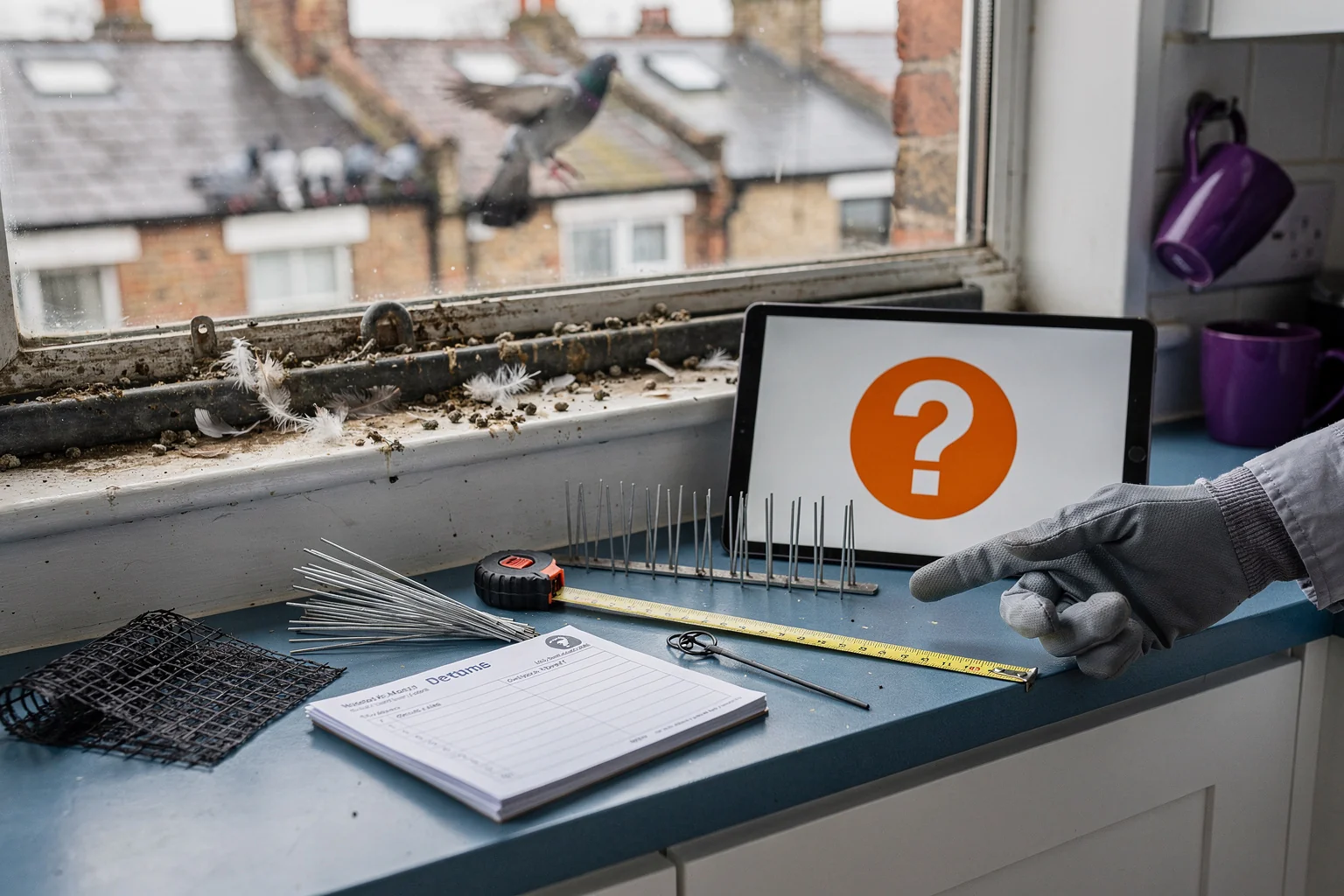
Same-day pigeon proofing in Newham starts from around £120 for small residential jobs, with most properties falling between £150 and £500 depending on the method, height, and area to cover. If you're searching for urgent bird control in Newham because pigeons have taken over your balcony, roofline, or commercial signage, this guide answers the cost questions that actually matter — with 2026 pricing, method comparisons, and the factors that push quotes up or down.
How much does pigeon proofing cost in Newham?
For a typical terraced house or small flat roof, expect to pay £150–£300 for spike installation or basic netting. Larger commercial buildings, multi-storey flats, or properties needing access equipment can run £400–£750 or more.
The price breaks down into three parts: the survey, the materials, and the labour — including access. Most reputable Newham pest controllers, including Bird Control in Newham specialists, quote fixed prices after a free or low-cost site visit rather than hourly rates. This protects you from surprises if the job takes longer because of awkward roof angles or hidden nesting sites.
In the past 12 months, the average bird control job in Newham has been approximately £351, according to local trade data. London and South East prices typically run 20–30% higher than national averages because of elevated labour costs, congestion charges, and the complexity of working on Victorian terraces, new-build apartments, and high-rise commercial units.
| Method | Typical Price Range | Best For |
|---|---|---|
| Bird spikes | £25–£50 per linear metre | Ledges, beams, signage edges |
| Bird netting | £15–£40 per square metre | Large flat roofs, courtyards, canopies |
| Wire systems | £35–£60 per linear metre | Narrow ledges, heritage buildings |
| Electric deterrents | £80–£150 per linear metre | High-value commercial facades |
| Guano cleaning | £150–£400 per job | Before proofing, or standalone |
These figures include VAT and reflect 2026 market rates. Your exact quote depends on access difficulty, the volume of existing droppings, and whether nesting material needs removal before installation.
What affects the price of bird control in Newham?
Several property-specific factors move the needle on your quote. Understanding them helps you compare like-for-like estimates and spot when a quote seems too low to be thorough.
Access height and equipment
Ground-floor shop signs need a ladder. Fourth-floor balcony netting in a Stratford new-build may require scaffolding or a cherry picker. Access equipment adds £150–£400 to the job, though some Newham controllers absorb this on straightforward residential work.
Volume of guano and nesting material
Pigeons produce roughly 11 kg of droppings per year. Heavy accumulation on a flat roof or in a loft void means hazardous waste removal before proofing can begin. This adds labour time and disposal costs — and it's non-negotiable, since dried guano carries histoplasmosis and cryptococcosis risks.
Building material and fixing points
Netting needs secure anchor points. Modern concrete and steel are straightforward. Delicate Victorian brickwork, lead flashing, or listed building facades need specialist fixings and sometimes planning consultation, adding 10–25% to material costs.
Bird species and behaviour
Feral pigeons are the main problem in Newham, but seagulls on riverside properties near the Royal Docks or gulls around London City Airport flight paths may need different approaches. Gulls are protected under the Wildlife and Countryside Act 1981, so deterrent work must be non-lethal and carefully timed outside nesting season.
Same-day urgency
Emergency callouts — say, a pigeon trapped in a restaurant kitchen extraction system — attract premium rates of £200–£350 plus the proofing work. Booking standard lead time of 2–5 days keeps you at the base rate.
Is bird netting or spikes better for my Newham property?
Spikes work best on narrow ledges, window sills, and signage where pigeons land briefly before moving to a nesting spot. They're visible, low-maintenance, and cost-effective for linear problems. The downside: pigeons can sometimes build nests on top of poorly installed spikes, and they don't suit wide flat areas where birds land in the middle.
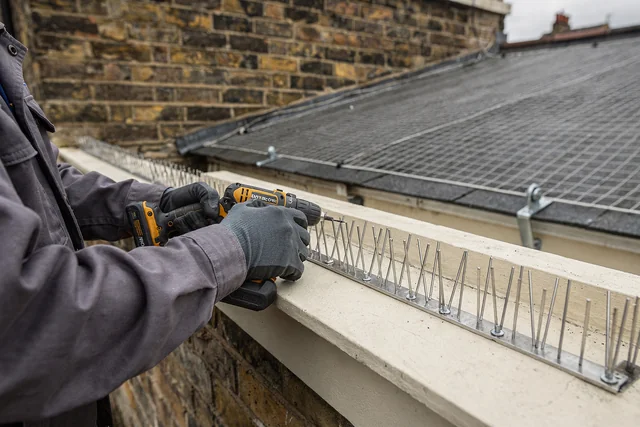
Netting covers larger zones — courtyards, flat roofs, plant enclosures, and canopies. It's nearly invisible from ground level when properly tensioned, and it blocks access entirely rather than just making landing uncomfortable. Installation takes longer and costs more upfront, but the 10–15 year lifespan often makes it cheaper per year than repeated spike maintenance.
Wire systems sit between the two: less visible than spikes, more adaptable than netting, but pricier per metre. Heritage buildings in Conservation Areas around Forest Gate or West Ham often prefer wire for aesthetic reasons.
Your technician should recommend based on where the birds are landing, not just what's cheapest. A spike-only solution for a wide roof is a false economy if pigeons simply relocate two metres along.
Can I get same-day bird control in Newham?
Yes — several local operators offer same-day callouts, including Newham Birds specialists and BuzzKill's own network. Same-day service typically means inspection and temporary deterrents (removing nests, blocking immediate access points) with permanent proofing scheduled within 48–72 hours.
For genuine emergencies — birds in ventilation systems, active nesting in food preparation areas, or aggressive gull behaviour during breeding season — same-day response is essential. The Wildlife and Countryside Act makes it illegal to disturb active nests of most species, so a technician's first job is often species identification and legal assessment before any physical intervention.
Book same-day if:
- You have birds trapped inside the building
- Nesting is blocking drains, flues, or ventilation
- You're a food business facing environmental health pressure
- Guano is entering occupied spaces
For chronic but non-urgent roosting, standard booking saves money without compromising results.
Does Newham Council offer free bird control?
Newham Council provides pest control services, but bird work is generally chargeable for private homeowners and most businesses. Council tenants may receive free or subsidised treatment for certain pests, though pigeon proofing often falls outside this — especially for external building work where responsibility sits with the landlord or leaseholder.
The council's pest control charges page lists pigeon work as "free survey and quote" for commercial and council tenant properties, with the caveat that all hygiene, housekeeping, and proofing recommendations must be followed. This suggests the survey itself is free, but the physical work is quoted separately.
For private freeholders, council services are rarely the cheapest or fastest option. Independent NPTA-registered technicians typically offer more flexible scheduling and broader method choice.
What proofing methods work best for Newham's typical buildings?
Newham's housing stock spans Victorian terraces in East Ham, interwar semis in Manor Park, 1960s tower blocks in Canning Town, and riverside apartments in Royal Docks. Each presents different bird pressure and access challenges.
Victorian and Edwardian terraces
High rooflines with decorative cornices attract pigeons to loft voids and rear extensions. Netting for rear courtyards and spike strips on front cornices are standard. Party wall gaps often need sealing — birds enter at number 12 and exit at number 14.
1960s–1980s tower blocks and maisonettes
Balconies, communal walkways, and flat roof areas suffer from mass roosting. Large-scale netting for refuse areas and balcony wire systems are common. Resident management organisations often bulk-book annual maintenance contracts.
New-build apartments and commercial units
Modern buildings with large glass facades and integrated signage create unexpected ledges. Post-construction snagging should include bird-proofing assessment, but many developers skip this. Retrofit spike or wire installation on high-spec cladding needs careful fixing to avoid warranty issues.
Food and hospitality premises
Restaurants along High Street North or Westfield Stratford need rapid, discreet proofing that doesn't alarm customers. Internal kitchen extraction cleaning plus external netting is typical. Environmental health officers can issue improvement notices for accumulated guano near food handling areas.
How long does bird proofing last?
Professional spike installation lasts 5–10 years before corrosion or physical damage needs review. Stainless steel spikes outperform plastic in London's pollution and rain cycle. Netting, properly tensioned with UV-stabilised polyethylene, lasts 10–15 years. Wire systems need tension adjustment every 3–5 years.
The bigger variable is installation quality. Poorly anchored netting sags, creating pockets where birds nest inside the net. Spikes placed too far apart or on unstable surfaces fall off within months. Guarantees of 1–2 years are standard; some Newham operators extend to 5 years for premium installations.
Annual inspection is sensible for commercial properties, especially after high winds or building maintenance work that might disturb fixings.
Are there legal restrictions on bird control in Newham?
Yes — and they're tightening. The 2026 general licences for bird control, now issued by Natural England rather than Defra, introduced several changes pest controllers must follow. Key points for Newham property owners:
- Feral pigeons: Can be controlled under GL41, but only when posing public health or safety risk — not mere nuisance
- Artificial light: Now back in scope for feral pigeon control under 2026 licences, relevant for night-time deterrent systems
- Gulls: Strictly protected; lethal control requires individual licence with evidence that no non-lethal alternative exists
- Nesting season: March–August for most species; nest disturbance is illegal regardless of general licence
Transport for London's recent pigeon culling programme — 655 birds shot across Tube stations between March 2024 and March 2026 — attracted significant protest and media coverage. TfL defended its approach as last-resort after exhausting non-lethal methods, but the controversy highlights why professional assessment matters: amateur culling without proper licence risks prosecution and negative publicity.
For Newham properties near London City Airport, additional operational restrictions may apply. The airport's planning guidance notes that "birds are the greatest threat to aircraft at any aerodrome," and development in certain areas may face biodiversity restrictions designed to minimise bird attractants.
What should I expect during a bird control survey?
A proper survey takes 30–60 minutes and covers:
- Species identification — confirming feral pigeon, gull, or other species, which determines legal options
- Activity mapping — where birds land, nest, roost, and feed; entry points to voids
- Guano assessment — volume, location, and whether hazardous waste protocols apply
- Access planning — equipment needed, fixing points, and any conservation or planning constraints
- Method recommendation — spike, net, wire, electric, or combined system with rationale
- Fixed quote — itemised where possible, with guarantee terms
Be wary of quotes given over the phone without site visit. Bird behaviour varies enormously — two identical-looking balconies can present completely different problems depending on wind direction, neighbouring feeding sources, and building microclimate.
Can I do bird proofing myself?
DIY spike strips from hardware stores cost £15–£40 for small kits. For a single ground-floor window ledge with light pressure, this can work temporarily. Beyond that, professional installation pays for itself.
Why DIY often fails:
- Wrong method for the pressure — spikes on a wide roof where netting was needed
- Inadequate fixing — adhesive failing in freeze-thaw cycles, screws pulling from soft mortar
- Missing the entry point — birds excluded from the obvious spot relocate to the hidden gap
- Legal misstep — disturbing a gull nest or using non-approved deterrents on protected species
- Safety — working at height without proper equipment risks serious injury
Professional technicians carry IPAF licences for powered access, understand species-specific legal frameworks, and can spot structural issues (broken soffits, slipped tiles) that both enable bird entry and indicate wider maintenance needs.
What about guano cleaning — is that included?
Sometimes, but clarify explicitly. Light surface cleaning may be included in the proofing quote. Heavy accumulation requiring hazardous waste disposal, biocide treatment, and protective equipment is usually extra — £150–£400 depending on volume.
Guano cleaning isn't cosmetic. Dried pigeon droppings release airborne fungal spores when disturbed. Proper protocol involves dampening before removal, HEPA-filtered vacuums, biocide application, and sealed waste disposal. Cutting corners here creates health risks for occupants and legal liability for employers.
For commercial kitchens, food storage, or healthcare premises, guano cleaning should precede proofing, with photographic documentation for insurance or environmental health records.
How do I choose a bird control company in Newham?
Look for these credentials and practices:
- NPTA or BPCA membership — trade body accountability with complaint procedures
- BASIS PROMPT certification — proof of ongoing professional development
- RSPH Level 2 as minimum technician qualification
- IPAF licence if powered access is needed
- Fixed quotes after survey — not vague estimates that balloon
- Guarantee in writing — with clear terms about what's covered
- Insurance — public liability and employer's liability, with certificates available
- Species-specific knowledge — not just "we do birds" but understanding of pigeon vs gull behaviour and legal status
Ask specifically about their experience with your building type. A technician who only does shopfront spikes may struggle with complex rooftop netting on a Stratford apartment block.
Will bird proofing harm the birds?
Professional proofing doesn't harm birds — it excludes them from specific structures. Spikes make landing uncomfortable; netting blocks access; wire creates an unstable surface. Birds simply go elsewhere.
This is both ethically preferable and legally safer than lethal control. The 2026 general licences emphasise prevention and deterrence. Lethal methods require stronger justification and individual licensing for protected species.
Some property owners worry about "where the birds will go." Urban feral pigeons are highly adaptable; removing one roosting site disperses birds to existing alternative sites. This isn't your responsibility — the goal is protecting your property, not managing the wider pigeon population.
For gulls and other protected species, proofing must be carefully timed and species-appropriate. A good technician will explain the legal framework and seasonal constraints.
What if pigeons return after proofing?
Reputable companies offer call-back guarantees — typically 1–2 years, sometimes longer for premium installations. Return visits usually mean:
- New entry point created by building movement or maintenance work
- Adjacent property unprotected, creating pressure on your building
- Proofing damage from weather, vandalism, or third-party contractors
- Initial under-specification — method inadequate for the actual bird pressure
A guarantee should cover labour and materials for fixing these issues. It won't cover new problems from unconnected building changes or your failure to maintain recommended hygiene (like leaving food waste accessible).
Annual inspection contracts for commercial properties catch issues before birds re-establish. For residential properties, a visual check after autumn gales and spring nesting season is sensible.
Pigeon Problems on Newham Balconies and Roof Terraces
Newham's new-build apartment boom — particularly around Stratford, Canning Town, and the Royal Docks — has created a specific problem: balconies designed for human enjoyment that pigeons treat as premium real estate.
The combination of shelter from rain, warmth from building fabric, and nearby food sources (outdoor dining, refuse areas, well-meaning residents feeding birds) makes balcony infestation almost inevitable without proactive proofing.
Balcony-specific solutions:
- Stainless steel wire along railings — low visual impact, effective against landing
- Netting for enclosed balconies — complete exclusion, though needs gate access planning
- Optical gel discs — newer deterrent using UV light reflection; works for 2–3 years before replacement
- Ultrasonic devices — mixed evidence; pigeons often habituate
For leasehold properties, check your management company's policy. Some blocks have communal bird-proofing budgets; others require individual leaseholders to arrange and fund their own. Disputes arise when one balcony's pigeons affect neighbours below — guano falls, noise, mites.
Questions Newham Property Owners Ask About Bird Control
Do I need planning permission for bird netting?
Rarely for residential properties. Listed buildings and Conservation Areas may need consent for visible fixings. Your technician should advise; some include planning liaison in their service.
Can my landlord refuse to pay for bird proofing?
For rented properties, responsibility depends on your lease and the problem location. External building fabric is usually the landlord's duty; internal issues from tenant behaviour (feeding birds, leaving windows open) may be yours. Environmental health can intervene in serious cases affecting health or safety.
Does bird proofing affect my mortgage or insurance?
Properly installed professional proofing shouldn't. Unauthorised structural alterations might. Use certified installers and retain documentation.
Are electric deterrents worth the cost?
For high-value commercial facades where aesthetics matter — luxury retail, hotels, corporate headquarters — electric track systems provide near-invisible protection at £80–£150 per linear metre. For standard residential or light commercial use, spikes or wire are more cost-effective.
How quickly can birds return after removal?
Pigeons can reoccupy within 24–48 hours if proofing is incomplete. Complete exclusion with quality materials provides immediate, lasting protection.
Bird Control and Property Maintenance in Newham
Smart property owners integrate bird proofing with wider maintenance. Blocked gutters from accumulated guano cause damp; corroded metalwork from acidic droppings needs premature replacement; slipped tiles from bird activity create entry points for rain and more pests.
Annual gutter clearing, roof inspection, and prompt repair of broken soffits or fascia boards reduce both bird attraction and long-term building costs. For landlords with multiple Newham properties, scheduled maintenance contracts that include bird-proofing inspection are more efficient than reactive callouts.
Commercial properties should review bird risk after any building alteration — new signage, changed extraction routing, roof plant installation. These often create new ledges or sheltered spots that birds discover before humans notice.
If you're seeing droppings on your balcony, hearing fluttering in the loft, or noticing damaged signage, the next step is a professional survey. A technician can confirm the species, assess access and legal constraints, and give you a fixed quote for proofing that lasts.

Need professional help? BuzzKill offers fast, reliable pest control services across London and Essex.