
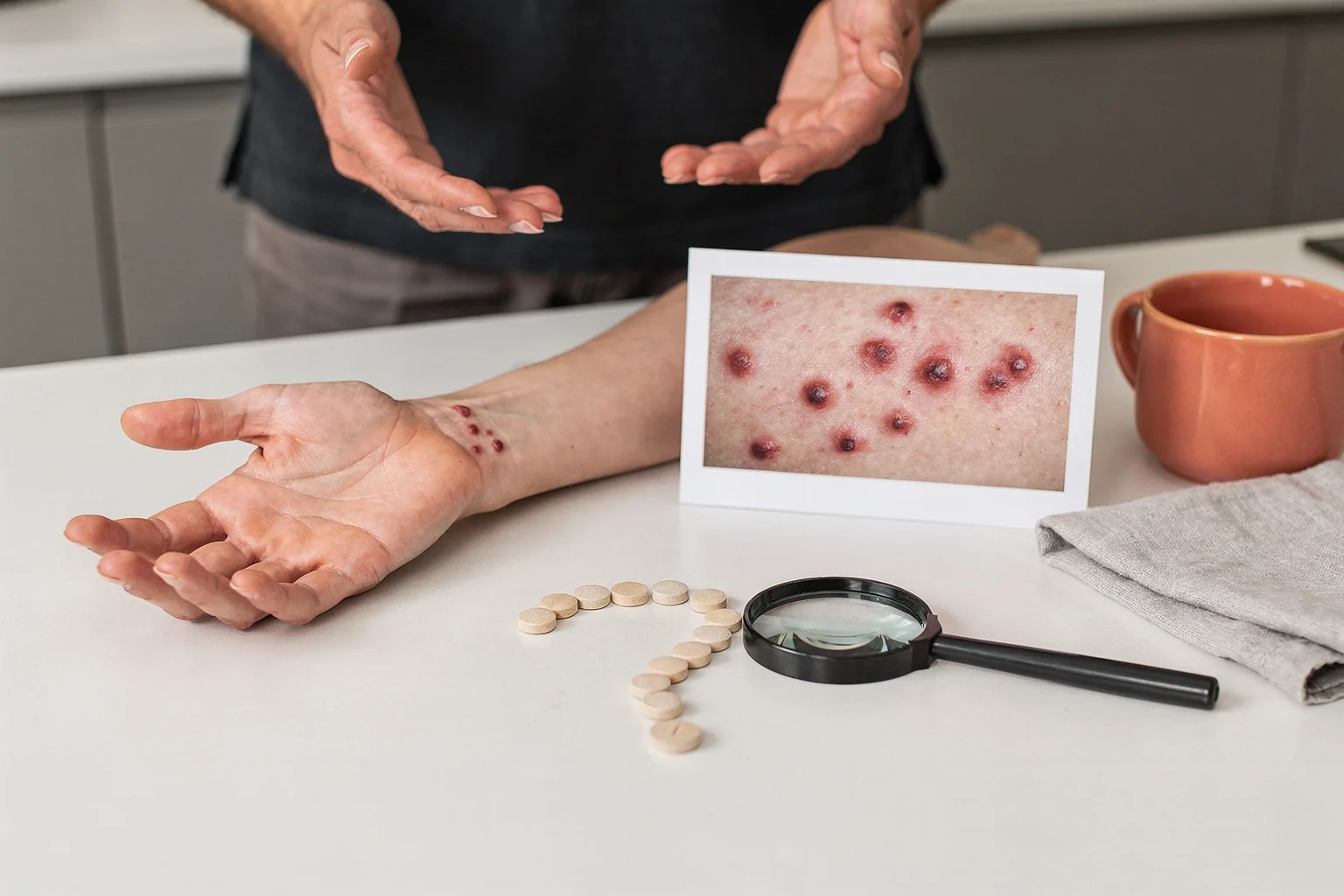
It’s 6:30 in the morning, you roll out of bed, and your arm has a cluster of angry red bumps that weren’t there last night. Your brain jumps to two possibilities: mosquito or bedbug. It’s an unsettling comparison to make while you’re still half asleep, but you need a straight answer. I’ve taken hundreds of calls across east London that started with exactly that moment — someone standing in their bedroom, phone in hand, trying to decide whether they’re dealing with a summer nuisance or a creature that’s moved into the mattress. This guide walks you through exactly how to separate one from the other using real-world signs, not guesswork.
How can I tell if my bites are from bedbugs or mosquitoes?
The quickest way to separate them comes down to three things: pattern, location, and reaction time. Bedbug bites almost always appear in a row or a tight cluster, usually on skin that was uncovered while you slept. Mosquito bites are scattered randomly wherever the insect landed, often one or two at a time.
When you look at a bedbug bite, you’ll notice a small, flat reddish bump that can look like a tiny welt. It might not be raised very high, but it will be uniformly red. Mosquito bites, on the other hand, tend to puff up into a pale, soft mound that gets redder at the edges. You’ll often see a tiny central puncture point on a mosquito bite — that’s where the proboscis went in. Bedbug bites rarely show a visible centre because the insect’s feeding tube is finer and the reaction is more generalised.
Another immediate clue is timing. If you were outdoors on a warm evening and then woke up with a single bite on your ankle, mosquito is the obvious answer. If you’ve been waking up with new bites every morning for a week, the evidence points much more towards bedbugs. The pattern grows over time because bedbugs feed every few nights and tend to take multiple bites along exposed skin in a single session.
Here’s a detail that often gets overlooked: use your phone camera to zoom in on the fresh bump. Under a bright light, a mosquito bite typically shows a tiny dark spot at the very top — the entry wound. A bedbug bite looks more like a uniform red dot, sometimes with a slightly darker centre, but not an open puncture. If you see a tiny blister forming, that favours a mosquito reaction. The number of bites also builds a story. A single large, isolated bump on your forearm after an evening in the garden is mosquito territory. Four, five, or six small welts in a row on your shoulder blades when you haven’t been outside after dark points straight at bedbugs. Taking a photo each morning may sound over-the-top, but it creates a timeline that pest controllers find genuinely useful. I’ve seen clients in Hackney who did exactly that, and the photographic sequence made the diagnosis clear within two days.
Where on the body do bedbug bites show up compared to mosquito bites?
Bedbugs are methodical. They target skin that stays exposed while you sleep: arms, shoulders, neck, back, and occasionally legs if you sleep in shorts. They rarely, if ever, crawl under clothing. So if you’re seeing bites covered by your pyjama top, it’s unlikely to be bedbugs — unless the infestation is severe and they’ve spread deep into the mattress seams.
Mosquitoes are less fussy. They bite whatever they can land on: ankles, knees, elbows, face, wrists — often the parts you didn’t cover outside. If you find a single bite on the back of your hand or on your hairline after an evening barbecue, mosquito is the more likely culprit. In the UK, mosquitoes are most active from late spring to early autumn, though warm flats with standing water can extend that window.
For families, parents often notice a difference in bite distribution between children who sleep together versus those who play outside separately. A child who wakes up with a cluster of bites on the upper back while the sibling in the same room has none is a strong bedbug signal. The bug picked one host, stayed close, and fed multiple times. In contrast, two children who both come in from the garden with bites around the ankles and lower legs on the same July evening is almost certainly mosquitoes.
Pay attention to whether the bite pattern matches your sleep position. I’ve attended calls in Brentwood where one person in a couple had bites on the left arm every morning because that was the arm they slept with draped over the mattress edge. That kind of detail matters. Another thing to consider is the season. If you’re getting new clusters of bites in December or January when central heating is on but windows are shut, mosquitoes are essentially ruled out. Bedbugs don’t care about the weather outside — they live in a temperature-controlled bedroom year-round. I once surveyed a flat in Stratford where the tenant was convinced mosquitoes were coming through a vent, but the vent was sealed. The bites were appearing on the neck and shoulders every night. Fifteen minutes after we lifted the mattress we located the bedbug harbourage tucked into the headboard joint.
Why do bedbug bites often form a line while mosquito bites don’t?
Bedbugs feed differently. They are not hunting fast and flying away; they crawl slowly across skin, probing for a capillary. As they move, they feed, move a few millimetres, feed again. That sequence produces a chain of bites — often three or four in a direct line or a tight zigzag. Technicians sometimes call these “breakfast, lunch, and dinner” marks, and they’re one of the clearest physical signs you’re dealing with bedbugs.
Mosquitoes land, take a full meal in one spot, and leave. They don’t walk across skin between bites. Even if the same mosquito bites again later, the second bite will be in a completely different location. That’s why mosquito bites look scattered — each mark is an independent landing. The line pattern is so consistent that I routinely ask people to snap a photo of their bites before the swelling changes. A few days later, a straight row of fading red spots is much harder to misinterpret than a single bump. If you can lay a fingertip along three bites that form a clear line, you’re looking at a very typical bedbug feeding trail.
One thing that confuses people: mosquito bites can sometimes cluster if you were bitten repeatedly around the same area, such as when insects are trapped under a blanket. But mosquito clusters usually look more random — two bites near each other, one an inch away — not the tidy linear arrangement bedbugs leave. To be extra sure, place a coin or a ruler next to the bites before photographing. That scale reference helps a technician see whether the distance between marks is consistent with bedbug probing. In my experience, the zigzag trail is visible even after the initial swelling subsides, especially on lighter skin. On darker skin tones, the line may appear as a series of slightly darker flat patches rather than raised red bumps, but the linear spacing is still the giveaway.
Do bedbug bites itch more than mosquito bites?
There’s no universal itch scale, but as a general rule, mosquito bites itch sooner and fade faster; bedbug bites produce a deeper, longer-lasting itch that can intensify over two or three days. The difference comes from the insect’s saliva.
When a mosquito feeds, it injects saliva that contains anticoagulants and proteins your body recognises quickly. Most people feel the itch within minutes to hours, and the reaction is acute but often brief. By day two or three, the bite is usually calming down. Some mosquito bites even go numb for a while before the itch kicks in.
Bedbug saliva is different. It contains anaesthetic-like compounds that slow the initial reaction, so you often don’t feel anything the night you’re bitten. Then, as your immune system mounts a response over the next 24 to 48 hours, the itch sets in. That delayed itch can be surprising. I’ve spoken to residents who assumed their new bite was a spider or a rash because they hadn’t noticed any night-time disturbance.
Importantly, reaction varies from person to person. Some people show almost no reaction to bedbug bites, while others develop large, firm weals that itch for a week. That’s one reason couples can share a bed and only one person appears “bitten” — both are being fed on, but only one is reacting visibly. Repeated exposure can also change sensitivity: someone who had no reaction to bedbug bites a year ago might suddenly start reacting strongly as their immune system becomes sensitised.
If the itch wakes you during the night or feels worse when your skin warms up in bed, that points toward bedbugs. Mosquito bites typically irritate more during the day and ease off with antihistamine cream, whereas bedbug itch can persist through treatment. Scratching is where things can deteriorate. I’ve seen cases in Enfield where a child’s bedbug bites became infected because the itch was so intense at night. The parent initially thought it was a heat rash, treated it with calamine lotion, and only realised the cause when a second set of bites appeared on the sibling six days later. Secondary bacterial infection from scratching is one of the most common complications of misidentified bedbug bites, and it’s completely avoidable if the pest is spotted early.
How long does a bite take to appear after being bitten?
Mosquito bites are fast reactors: the dot appears within minutes, peaks in a few hours, and then slowly shrinks. Most people can clearly connect the initial sting or buzzing to the bite mark later that day.
Bedbug bites are delayed reactors. You might not see any visible sign for 24 hours — sometimes up to several days. This delay is one of the main reasons bedbug problems grow silently. You pick up a stray bug from a hotel, it feeds on you that night, and you don’t notice the marks until three days later when you’re back home. By then, the bug has already established itself in your luggage or clothing.
The delay also complicates diagnosis because the bite could have happened in two or three different places. If you travel often, consider keeping a simple bite diary on your phone: date, location of new bites, and where you slept. It sounds thorough, but it genuinely helps pest controllers understand the timeline and likely source.
This timing gap is especially significant in blocks of flats or shared houses. I’ve seen cases in Hackney where a tenant reported bedbug bites, but the pest had actually migrated from the neighbouring flat weeks earlier. The delay in visible reactions meant the problem had already spread through the wall socket before anyone spotted a mark. In a multi-occupancy house in Waltham Forest, we traced an infestation back to a tenant who had moved out six weeks earlier and never reported bites — the only clue left behind was a line of tiny brown spots along the skirting board in the empty room. The new tenants started reacting two weeks after moving in, but the bugs had been living in the void behind the fitted wardrobe the whole time. If you’re in a shared building and starting to see delayed-appearing bites, don’t assume you brought the pest in. It could have crossed through a wall cavity from a unit where no one ever noticed a reaction.
What other signs around the home point to bedbugs rather than mosquitoes?
Bites give you half the picture — the room gives you the rest. Mosquitoes leave no trace inside your home beyond the occasional whine in a dark bedroom. Bedbugs leave physical evidence if you know where to look.
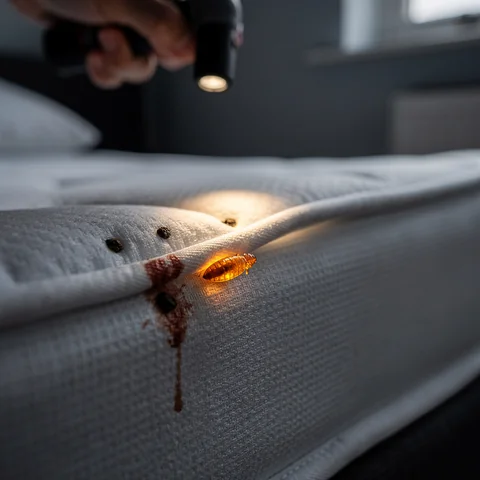
Check the seams of your mattress and the edges of your bed frame first. Use a torch and look for tiny dark spots — these are faecal stains, each about the size of a full stop. If you run a damp cloth over a suspicious mark and it smears a rusty red-brown, that’s digested blood. You may also see translucent amber casings, which are shed skins from growing nymphs, or tiny white eggs the size of a pinhead tucked into crevices.
Unlike mosquitoes, bedbugs spend nearly all their time hidden within a few metres of where you sleep. They don’t fly and they seek dark, narrow crevices. In more established infestations, you might notice a sweet, musty scent — heavier than a damp room — caused by the aggregation pheromones bedbugs release when they group together in large numbers. This odour isn’t present in small, early populations, so don’t rely on smell alone.
Practical checks that take less than five minutes:
- Lift the mattress and inspect piping, handles, and label folds.
- Pull the headboard away from the wall slightly and check the corners.
- Look at the edges of carpet where it meets the skirting board near the bed.
- Shine a light into bedside table joints and electrical sockets close to the floor.
- Check behind picture frames, inside the joins of wooden wardrobes, and along curtain pelmets near the bed.
If you find any of those signs, the bites are almost certainly from bedbugs, not mosquitoes. At that point, the evidence tips from “maybe” to “probable,” and you need to act. Our bed bug identification guide walks through every life stage so you can confirm what you’re looking at without second-guessing. The earlier you spot the physical clues, the easier the treatment — which is why I always tell residents to treat new bite patterns as a prompt to check the room rather than waiting for a second round of marks. Spotting those early bed bug bite signs while the population is still small makes a huge difference to the cost and disruption of the fix.
When should I stop self-diagnosing and call a pest control professional?
You can treat mosquito bites with cold compresses, antihistamine cream, and a bit of patience — they rarely require a professional. Bedbug bites are different because the bites themselves are only a symptom; the real problem is the population living in your home.
Call a professional if you can answer “yes” to any of these questions:
- Have you found bites that appear in straight lines or clusters on skin that was covered while you slept?
- Are new bites appearing every few days despite no obvious outdoor exposure?
- Have you spotted faecal spots, shed skins, or live insects around the sleeping area?
- Is more than one person in the household experiencing similar reactions?
- Has a neighbour or a previous holiday stay mentioned a bedbug issue?
In London, bedbug problems travel fast through shared walls, luggage, and second-hand furniture. Self-treating with shop-bought sprays often pushes the insects deeper into cracks and forces them into adjacent rooms or flats, making the eventual professional treatment more involved than it needed to be. Retail foggers and powders can also confuse a technician’s survey by scattering the evidence without solving the infestation.
A professional pest controller brings a high-powered torch, a magnifying lens, and years of pattern recognition. They’ll inspect the mattress, bed frame, headboard, bedside furniture, skirting boards, and even electrical sockets. The survey usually takes 30 to 45 minutes in a typical bedroom and gives you a factual answer, not a guess. If no bedbugs are found, you get peace of mind and a note on file. If bedbugs are present, you get a treatment plan mapped to the layout of your specific property. Early-stage infestations can often be resolved with a focused heat or chemical treatment applied to the bed and immediate surround; widespread problems may need whole-room heat treatments or multiple follow-up visits.
Our team covers the whole east London area — from Tower Hamlets and Stratford out to Barking and Enfield — and the consistent pattern we see with bedbug jobs is that early signs of bed bugs were missed for a few weeks before the call came. Catching it early reduces treatment time and prevents belongings from needing to be discarded.
If bites are your only symptom and none of the other evidence is present, keep observing for a few days. Take photos, check the mattress weekly, and be honest about your exposure history. The moment you find a second sign — even one tiny spot — treat it as confirmation and arrange an inspection. Many people wait because they think calling someone is an overreaction. It isn’t. A professional survey is non-invasive and gives you a factual answer. The sooner you know, the sooner you can either rule out bedbugs or tackle them while the infestation is still small.
And if your bites really are from mosquitoes, a quick check and some insect screens on your windows might be all you need. Getting that clarity is worth the call — whether the answer is bedbugs, mosquitoes, or something else entirely.
Need professional help? BuzzKill offers fast, reliable pest control services across London and Essex.