
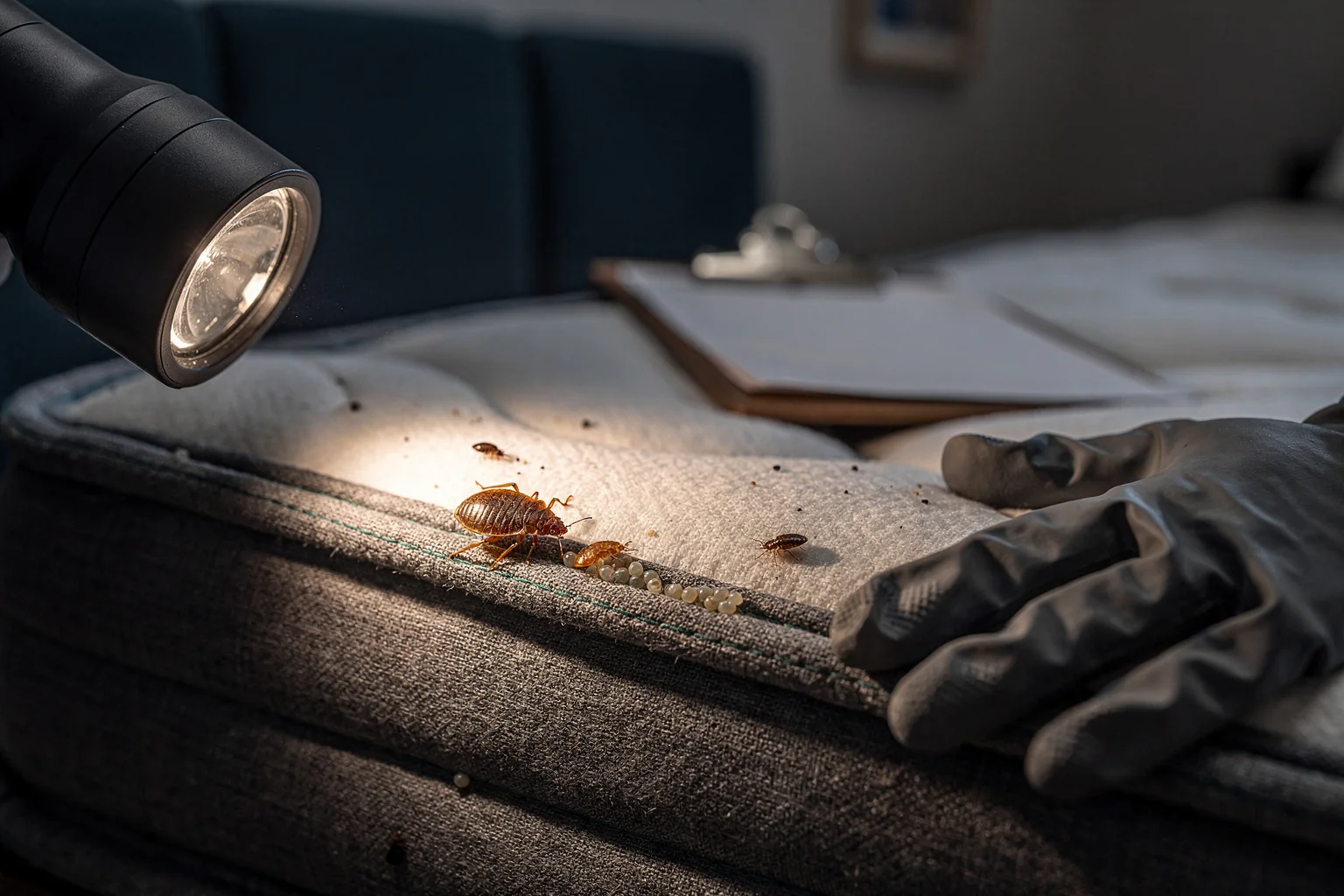
You’ve woken up with a line of itchy bites on your arm. Maybe you’ve spotted a tiny brown disc crawling along the mattress piping. Right now, you need to know whether that speck is a bed bug, a harmless beetle, or something else — and you need to know quickly enough to decide what to do next. This visual checklist walks you through exactly what to look at, in what order, so you can tick off each trait against what a real bed bug looks like — adult, nymph, and egg.
All three life stages can appear side by side once an infestation has been active for a few weeks. They vary in size, colour, and transparency, but each stage has a few telltale markers that hold true almost everywhere in the UK. I’ll call out the measurements and colours you can check with the naked eye (a magnifier helps, but isn’t essential), and I’ll flag the look-alikes that fool people most often.
Run this check in daylight or under a bright torch. The whole exercise takes about 20 minutes once you’ve got the insect in front of you. If you haven’t found a specimen yet, skip to the section on daytime hiding spots before you start ticking boxes.
What to grab before you start looking
A few household items make identification much easier, especially when you’re dealing with something only 1–5 millimetres long.
- A bright torch — phone torches work, but a small LED torch with a focused beam is better for catching translucency and egg clusters.
- A magnifying glass or a phone’s macro lens mode. You don’t need a microscope, but 5×–10× magnification turns a fuzzy brown fleck into a clear shape.
- A strip of clear sticky tape — useful for lifting tiny nymphs or eggs onto white paper without crushing them. Press the tape gently against the suspect surface, then stick it onto a sheet of plain white printer paper.
- A piece of white paper or an envelope — bed bugs show their true colour much more clearly against a bright white background.
- A ruler with millimetre markings — if you can hold it next to the insect (or next to the tape lift), you’ll get an instant size check.
Set the specimen on the white paper under the torch. Work through each checkpoint below. At each one, you’re answering a single yes-or-no question; I’ll tell you what “yes” looks like and what that means for your next step.
Start with the size — no bigger than an apple seed
Bed bugs are small, but not microscopic. The most reliable first filter is size. A full-grown adult bed bug measures between 4 and 7 millimetres long and about 1.5 to 3 millimetres wide — roughly the same length, width, and thickness as an apple seed. Several university extension guides describe adults as “about the size of an apple seed” and reddish-brown when unfed, so that’s your baseline.
“Adult bed bugs are reddish brown in color, wingless, and are about the size of an apple seed.” — How to Identify a Bed Bug Infestation, Virginia Department of Agriculture and Consumer Services
What “yes” looks like: the insect is between 4 mm and 7 mm from head to rear tip, and its body width is under half of its length. If you’ve lined it up against a mm ruler and it falls inside that range, tick it.
What it means if you get a yes: you’re likely looking at an adult or a late-stage nymph. Move on to colour and shape to confirm. If the insect is noticeably larger than 7 mm — say, the size of a ladybird or bigger — it’s almost certainly not a bed bug. Common imposters like spider beetles and carpet beetles often clock in at a similar size, so a positive size check isn’t enough on its own.
What “no” means: if the insect is much smaller than 4 mm, it could still be a first-stage nymph (which hatches at about 1.5 mm), an egg case, or a completely different pest. Keep reading — the nymph and egg sections will help you rule those in or out.
Look at the colour: reddish-brown when hungry, darker after a feed
An adult bed bug carries a distinctive mahogany-brown, reddish-brown tone when it hasn’t fed recently. That’s the colour you’ll see in most online photos, and it’s the one that matters for daytime ID because you’ll usually find them empty. After a blood meal, the abdomen darkens to a deeper purplish-red, and the insect takes on a more elongated, bloated appearance that can make it look almost black in poor light.
The US EPA notes that adults are “long and brown, with a flat, oval-shaped body (if not fed recently)” and become “balloon-like, reddish-brown, and more elongated (if fed recently).” That colour shift happens quickly — within minutes of feeding — and can persist for several days as digestion progresses.
“When full grown, bed bugs are reddish brown and about the same size as an apple seed.” — University of Arizona Cooperative Extension
What “yes” looks like: under bright light, the insect’s body is uniformly brown with a hint of red, not grey, not black, and not golden. If you’ve recently squashed one and it left a rusty smear on the sheet, that’s another strong colour clue — dried blood from a recent meal. Living unfed adults should look flat and consistent in colour across the body segments. After feeding, the rear half darkens noticeably.
What it means: colour plus size gets you very close to a confident ID. If you’ve also got a flat oval shape (next check), you can be reasonably sure it’s a bed bug.
What a false positive looks like: newly hatched cockroach nymphs are also reddish-brown but are longer-legged and have visible antennae that extend beyond the head. Booklice are pale brown to cream and much smaller — if the insect is under 2 mm and the colour is closer to translucent tan, jump to the nymph section.
Check the shape: flat oval body unless it has just fed
The classic bed bug profile is a flattened, broad oval — think of a tiny lentil or a squashed raisin. When empty, it’s no thicker than a credit card, which is why they can squeeze into mattress seams, behind skirting boards, and inside the head of a screw. That flatness disappears within hours of feeding, when the abdomen swells into a rounded, elongated shape. If you’re looking at a live insect and it’s ballooned out, it’s probably recently fed; if it’s dead and still flat, it likely starved or was killed before its last meal.
The body has three distinct sections — head, thorax, abdomen — but the head and thorax are so compact that they often look like one small segment in front of the larger abdominal plate. Bed bugs are wingless, so there’s no fold line or wing casing visible. The abdomen shows horizontal banding (segments) that become more obvious when the insect is engorged.
What “yes” looks like: the insect’s outline is a smooth, uninterrupted oval with no constriction at the “waist.” Viewed from above, it’s roughly twice as long as it is wide. There are no visible wings, and the antennae are short — only four segments, bent at the middle.
What it means: flat oval shape plus apple-seed size plus reddish-brown colour gives you a triad that very few other UK household insects match. At this point, you’ve probably identified an adult bed bug. If the insect matches the first three checks, you can start thinking about treatment. But still worth skimming the nymph and egg sections — finding nymphs or eggs tells you the infestation has been going for at least a couple of weeks and that there are multiple generations present.
If the shape is round and domed, you might have a spider beetle (which also looks brown). If it’s elongated and covered in tiny hairs, consider a carpet beetle larva. Both are common in East London flats, and I’ll cover them in the look-alikes section.
Spotting the young: translucent nymphs that turn red after a meal
Bed bug nymphs look nothing like the adults, and that’s where most misidentifications happen. They are smaller, paler, and nearly see-through — especially the first instar, which hatches at roughly 1.5 millimetres and is often described as the size of a poppy seed. At that stage, they are translucent whitish-yellow and almost invisible against a white mattress, which is why many people don’t notice them until they’ve fed and taken on a bright red dot in the abdomen.
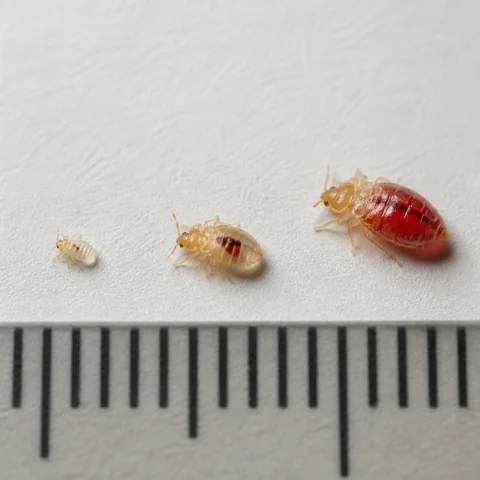
“Bed bugs just hatched from eggs are the size of a poppy seed, and are nearly see-through.” — University of Arizona Cooperative Extension
Nymphs go through five moults before they become adults, gaining size and pigment each time. A third-instar nymph may already show a faint brown wash across the body. The key identifier is a dark spot near the rear of the abdomen — that’s the gut contents showing through the translucent cuticle. Unfed nymphs appear pale yellow or cream, but after a blood meal they turn brilliant red, and the contrast between the red centre and the pale outer margins is striking.
What “yes” looks like: you’ve got a tiny (1.5–4 mm) insect that is whitish-yellow or translucent, with either a visible dark digestive spot or a bright red central area after feeding. Under magnification, you can see the same flattened oval body plan as the adult, just miniaturised and paler.
What it means: nymphs confirm an established, reproducing infestation. Eggs are almost certainly nearby. Unlike adults, which can wander between rooms, first-instar nymphs tend to stay within a metre of their hatching site because they need to feed quickly. If you find nymphs in the bed frame, check the screw recesses and the wall-floor junction behind the headboard.
The flip side: if the tiny pale insect you’re examining has a waist, long antennae, or jumps when disturbed, it’s not a bed bug nymph. Booklice (psocids) and springtails are the most common pale miniature intruders mistaken for first-instar nymphs in damp London bedrooms.
The eggs are tiny, white, and often clustered
Bed bug eggs are the hardest stage to spot without a systematic search. Each egg is about one millimetre long — roughly the size of a pinhead — and pearl-white. They’re oval, with a slight curve, and are usually glued into crevices in batches of 10 to 50. A female bed bug lays between one and five eggs per day, so the cluster grows steadily.
“Bed bug eggs, in general, are: — tiny, the size of a pinhead; — pearl-white in color.” — Bed Bugs Appearance and Life Cycle, United States Environmental Protection Agency
After about five days, a reddish eye spot appears inside the egg, which you can see with a good magnifier. If you find clusters of white grains stuck to the mattress seam, bed slats, or the gap behind a loose section of wallpaper, that’s almost certainly bed bug eggs. They’re often mixed with faecal spotting — tiny dark brown specks that are digested blood — which makes a useful visual signpost: where you see spotting, check the edges for eggs.
What “yes” looks like: you find small white ovals, about 1 mm long, cemented in a crack or seam. They don’t rub off easily with a finger — you typically need a stiff brush or a vacuum to dislodge them. A magnifier reveals the cap at one end (where the nymph hatches) and, if older than five days, a tiny red eye spot.
What it means: eggs signal that the infestation is active and reproducing. Even if you’ve removed all the live insects you can see, more will hatch in seven to ten days unless the eggs are also destroyed — by heat, a professional-grade treatment, or thorough physical removal. Finding eggs often prompts a call to a pest controller because you’re dealing with multiple generations in one location.
If what you’re seeing looks more like small rice grains, it’s more likely to be flea eggs, which are smooth and slide away easily. If it’s a hard, brown case, you’re possibly looking at a carpet beetle pupal case stuck to fabric. I cover those next.
Insects often mistaken for bed bugs
Misidentifying another insect as a bed bug can send you down an expensive and stressful path. These are the ones I see confused most often in London homes.
Carpet beetle larvae — these are elongated, slightly furry, banded in brown and tan, and move slowly. Adults are small, round, and mottled. You’ll usually find the larvae under sofas and wardrobes, not in mattress seams. They don’t bite humans but can cause skin irritation.
Spider beetles — rotund, shiny, and reddish-brown to black. They’re about the same size as a bed bug adult but have a rounded, almost spherical abdomen and long, spindly legs. They feed on stored food, not blood.
Booklice — small (under 2 mm), cream to pale brown, with a distinct head and thread-like antennae. They thrive in damp, mouldy conditions and often appear around windows in poorly ventilated flats. They don’t bite and don’t show the flat oval profile of a bed bug.
Swallow bug — in London boroughs with older brick buildings, swallow bugs occasionally enter homes when bird nests are removed. They’re almost identical to bed bugs to the naked eye but have slightly longer body hair. You need a microscope to tell them apart, but the context counts: if you’ve recently had birds nesting on the ledge outside the bedroom window, mention it to the pest controller.
If the insect fails most of the checklist above, set it aside on the white paper and take a clear close-up photo. Even if you’re unsure, a professional can usually give you a preliminary ID from a good photo before scheduling an inspection.
Where bed bugs hide during the day (and where to use this checklist)
You’ll rarely find bed bugs crawling in the open unless the infestation is heavy. During daylight, they hide in narrow, dark gaps within a couple of metres of where people sleep or sit still for long periods. Knowing where to look means you can find a specimen to run through the checklist instead of relying on bites alone.
Work through this sequence:
- Mattress seams, piping, and the underside of any buttons — lift the corded edge and shine the torch along the fold.
- The headboard, especially where it meets the bed frame. Remove it from the wall if possible; bed bugs often cluster in the joint.
- Bed frame joints, screw holes, and slatted base gaps. Anywhere there’s a crevice you can’t slip a fingernail into, a bed bug can fit.
- Skirting boards behind the bed, peeling wallpaper edges, and the gap between carpet gripper and wall — these are common egg and faecal spot sites.
- Bedside cabinets, drawer joints, and the underside of drawer bases. I’ve found clusters inside the plastic caps that cover cam-lock fittings on flat-pack furniture.
- Curtain seams and curtain-rod brackets if they’re close to the bed.
If you’re still having trouble finding a live insect, place a strip of double-sided tape around the legs of the bed — it won’t solve the problem, but it’ll often catch a few overnight, and you can lift them with your sticky tape for identification the next morning.
What a positive ID means for your next move
If your specimen has ticked the apple-seed size, the reddish-brown colour, the flat oval shape, and you’ve spotted translucent nymphs or pearl-white eggs nearby, you’re dealing with a confirmed bed bug infestation. That’s stressful, but you’ve already done the hardest part — knowing exactly what you’re facing means you can make a clear plan instead of guessing.
Your immediate steps are to contain the affected area and avoid moving bedding, clothes, or furniture into other rooms, which spreads the insects around the house. Strip the bed carefully, bag the linen, and wash it at 60°C or hotter. Vacuum the mattress seams, headboard, and carpet perimeter thoroughly, then seal and dispose of the vacuum bag outside. These steps won’t eliminate the infestation, but they’ll reduce the number of biting insects overnight while you arrange treatment.
Home freezing and steam treatments can kill bed bugs on contact, but getting the temperature right — over 50°C for steam, or at least –18°C for several days of sustained freezing — is harder in practice than it looks online. In a London home with typical central heating, insulation, and multiple rooms, spot-treating misses the eggs hidden behind skirting boards and inside light switches. That’s why many people start with DIY steps and call a technician when they realise the bites haven’t stopped.
When the checklist says yes, a same-day inspection removes the guessing. We regularly handle bed bug jobs across East London — from Hackney to Tower Hamlets to Barking — and the first visit confirms exactly which rooms are affected, what stage the infestation is at, and which treatment (heat, chemical, or a combination) is going to end it fastest. Because bed bug eggs can survive most over-the-counter sprays, a professional treatment that targets each life stage tends to get results within two visits rather than weeks of trial and error.
If you’re still unsure about your specimen after working through this checklist, put it on white paper and take a close-up. Email it to a local pest controller — many, like us, will give you a free opinion on whether it’s a bed bug or a look-alike without any commitment. It’s a five-minute step that can save you days of worry.
Need professional help? BuzzKill offers fast, reliable pest control services across London and Essex.