
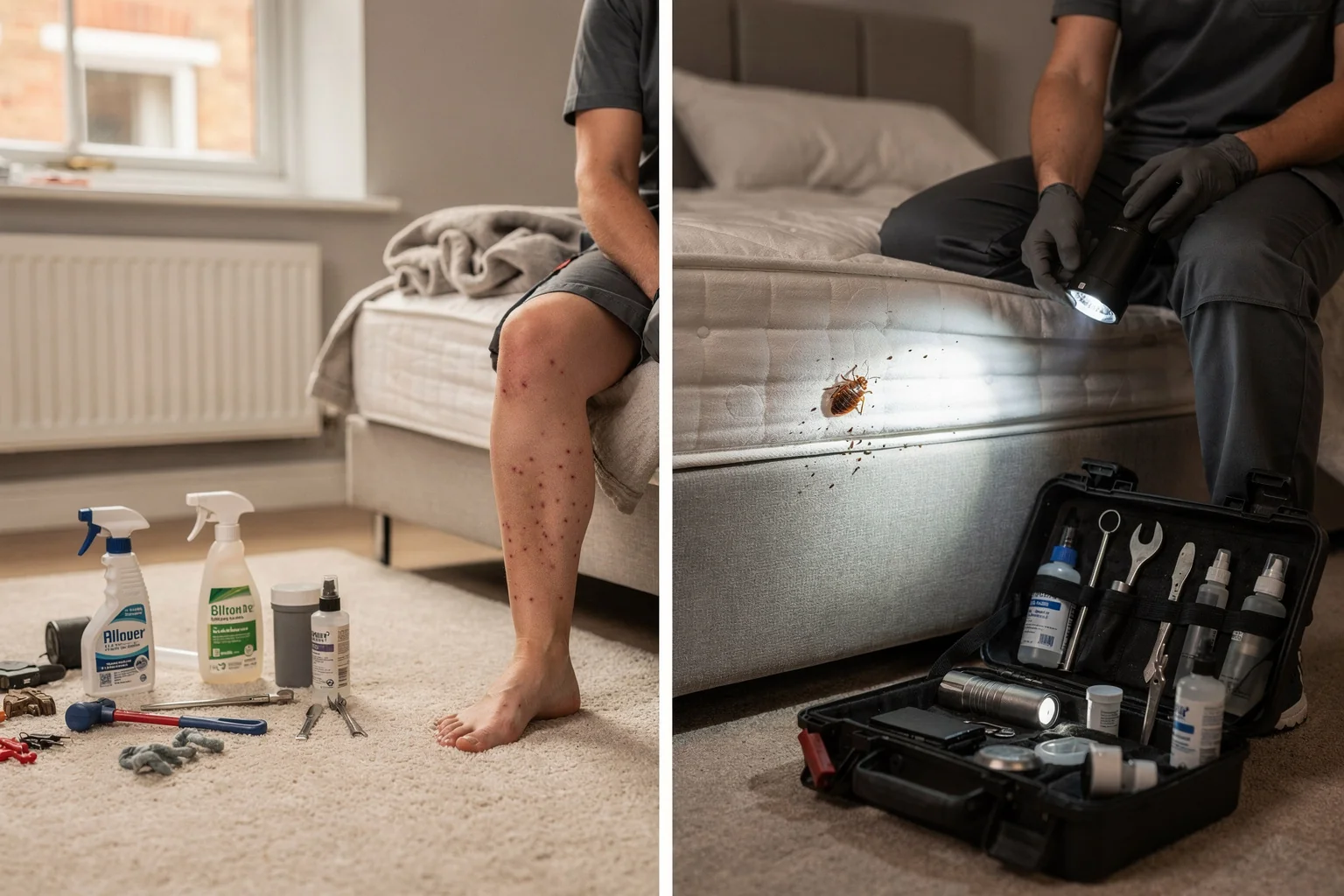
Most people in Dagenham don't notice bed bugs until the bites appear. By then, a handful of insects hiding in a mattress seam have often multiplied across the bedroom. The bites themselves are not medically dangerous, but they are the clearest early signal that something is wrong. Learning to read that signal correctly, and knowing what to check in the hours after you spot it, can mean the difference between a contained treatment and a full-home infestation.
This guide walks through what bed bug bites actually look like, how they differ from flea and mosquito reactions, where to inspect in a typical Dagenham terrace or flat, and when DIY steps end and professional heat treatment becomes the practical choice.
What Bed Bug Bites Look Like on Your Skin
Bed bug bites tend to show up on skin that touches the bed while you sleep. The face, neck, arms, and hands are common sites. The bites often appear as small red welts, slightly raised, and they are usually itchy. A key identifying feature is their pattern: they frequently form a line or cluster, sometimes described as a zigzag, where the insect has moved across the skin during feeding.
The NHS guidance on bedbugs notes that bites usually clear up on their own within a week or so, and that mild itching can be eased with a cool, damp cloth or a mild steroid cream. However, the medical treatment for the bite itself is separate from the question of whether insects remain in your home.
Not everyone reacts to bed bug bites. Some people develop no visible marks at all, while others experience significant swelling. This variability means you cannot rely on bites alone to confirm or rule out an infestation.
Telling Bed Bug Bites Apart from Fleas and Mosquitoes
Misidentification is common, especially in areas like Dagenham and Barking where pets and outdoor spaces bring multiple biting insects into contact with residents.
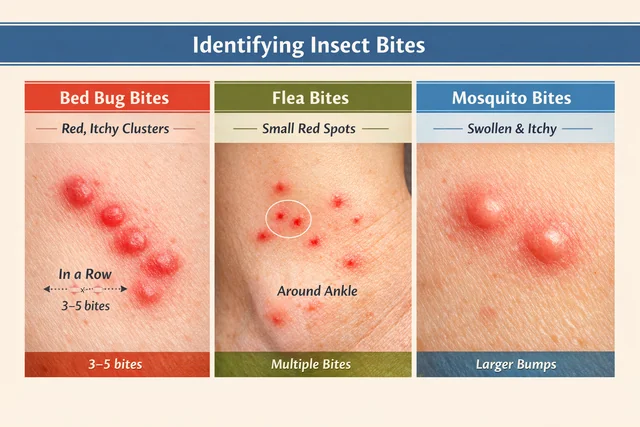
Flea bites typically concentrate around the ankles and lower legs, where fleas jump from carpets or pet bedding. They appear as small red dots with a halo, and they itch intensely. If you have pets that roam outdoors, or if you have recently moved into a property with fitted carpets, fleas are a plausible explanation. Our Barking and Dagenham flea treatment service handles these cases regularly, and the approach differs significantly from bed bug work.
Mosquito bites in London are increasingly common during warmer months, as the London pest forecast for 2026 highlights. These tend to be random, isolated swellings on any exposed skin, without the linear pattern bed bugs leave. They also usually appear after evening time spent outdoors, not after a night's sleep.
Spider bites are rarer and typically present as a single, more pronounced lesion with possible blistering. The Cleveland Clinic's overview of bed bug identification emphasises that positioning on the body is the main giveaway for bed bugs: linear groupings on skin that has pressed against bedding strongly suggest their involvement.
Where Bed Bugs Hide in Dagenham Homes
Bed bugs do not live on your body. They hide in cracks and crevices near where people sleep, emerging at night to feed. In a typical Dagenham property, whether a 1930s terrace, a post-war semi, or a newer flat, there are specific locations to check.
Start with the bed itself. Inspect the seams of the mattress, the tags, and the area where the mattress meets the bed frame. Check the headboard, especially if it is wooden with joints or gaps. Look at the base of the bed, including any storage drawers or divan openings.
Move outward to nearby furniture. Bed bugs can hide in bedside tables, the joints of chairs, and behind electrical sockets or loose wallpaper. The NHS bedbug information lists these locations explicitly, noting that the insects can squeeze into remarkably narrow gaps.
In flats with shared walls, which are common in parts of Dagenham and East London, bed bugs can travel between units through wall voids, pipe runs, and electrical conduits. This means that even thorough treatment of one flat may not suffice if neighbouring properties harbour the insects.
Signs Beyond Bites: What to Look For During Inspection
Bites are the symptom most people notice first, but physical evidence in the bedroom confirms the diagnosis. Look for small brown spots on bedding or furniture. These are bed bug faeces, digested blood that appears as dark specks. You may also find tiny blood stains on sheets, either from bites or from crushing an insect during sleep.
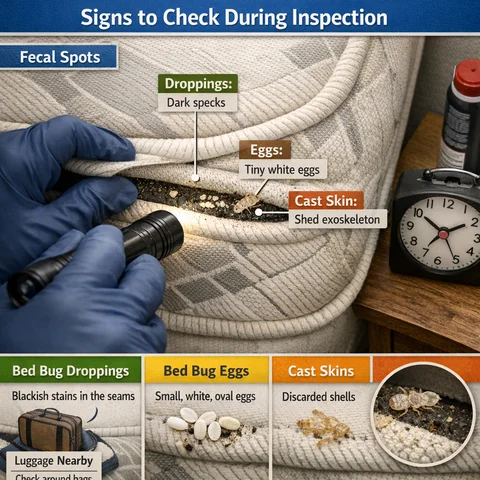
Shed skins and egg cases are another indicator. Bed bugs moult several times as they grow, leaving translucent exoskeletons in their hiding places. Eggs are tiny, about 1mm long, and pearly white, often laid in clusters within cracks.
A distinctive musty, sweet odour sometimes develops in heavier infestations. This comes from scent glands on the insects and is often described as similar to coriander or damp almonds. Not everyone detects it, and its absence does not rule out bed bugs.
The Healthline guide to identifying bedbug bites notes that you can have bedbug bites even without seeing the insects themselves, which is why systematic inspection matters.
The Spread Timeline: How Quickly Infestations Grow
Bed bugs reproduce rapidly. A single female can lay hundreds of eggs in her lifetime, and under favourable conditions, a small starting population can expand to thousands within two to three months. The Merck Manual professional entry on bedbugs describes this exponential multiplication explicitly.
Temperature and access to food drive this speed. Central heating in Dagenham homes, active year-round, creates conditions where bed bugs feed and breed continuously. There is no winter kill period indoors. This means that delaying action by even a few weeks can significantly increase the scale of the problem.
Early-stage infestations, where insects are confined to one room and one sleeping area, are far easier to eliminate than established populations that have spread to multiple rooms, soft furnishings, and clothing storage.
DIY Steps That Actually Help Containment
If you suspect bed bugs but have not yet confirmed them, there are practical steps that slow spread and improve the effectiveness of any subsequent professional treatment.
Wash bedding, clothes, and any removable fabric covers at 60°C or above, then tumble dry on high heat. This kills all life stages of bed bugs. Store cleaned items in sealed plastic bags until the infestation is resolved.
Vacuum thoroughly around the bed, mattress seams, bed frame joints, and nearby furniture. Use a brush attachment to agitate crevices where eggs may adhere. Empty the vacuum cleaner immediately into an outdoor bin, sealed in a bag.
Reduce clutter around the sleeping area. Bed bugs exploit hiding places, and a clear surface makes inspection and treatment access easier. Do not sleep in a different room to escape bites; this can draw the insects to new areas of the home.
Mattress encasements, available from hardware retailers, can trap any bed bugs inside the mattress and prevent new ones from establishing there. They are a useful containment tool but not a standalone solution.
When Professional Heat Treatment Becomes Necessary
DIY measures have limits. Insecticide sprays available to consumers rarely penetrate the deep cracks where bed bugs hide, and many populations have developed resistance to common active ingredients. More critically, DIY approaches often miss eggs, which are cemented into hiding places and hatch days or weeks after initial treatment.
Professional heat treatment raises the temperature of the entire room, or the whole property, to levels that kill bed bugs at all life stages. This method does not rely on chemical penetration into cracks, and it addresses the entire infestation simultaneously rather than treating visible areas only.
For Dagenham residents, our Dagenham bed bug removal service provides same-day inspection and, where appropriate, heat treatment scheduling. We also cover the broader borough through our Barking and Dagenham bed bug removal service, which is relevant if you are uncertain whether your property falls within Dagenham's specific boundary or the wider borough area.
The London Borough of Barking and Dagenham's pest control pricing shows council bedbug treatment for a three-bedroom property at £308.20, with five-bedroom treatment at £395.48, both including follow-up visits. Private pest control services in the area typically range from £115 to £340 depending on property size and treatment type, per local cost data. These figures give a useful reference point when comparing options.
Who to Call: Local Pest Control Options in and Around Dagenham
NHS
The NHS bedbugs page provides authoritative medical information on bite symptoms, self-care measures, and when to seek GP advice. It is a valuable resource for understanding the health implications of bites, though it does not offer pest control services or home treatment.
Cleveland Clinic
The Cleveland Clinic's bed bug identification guide offers detailed clinical perspective on distinguishing bed bug bites from other insect reactions, with specific attention to pattern and body positioning. This is a useful reference for anyone uncertain about the source of their skin symptoms.
Healthline
Healthline's guide to bites without visible bugs addresses the common scenario where people suspect bed bugs but cannot find physical evidence. It covers diagnostic approaches and the limits of visual identification, making it a practical read for the early, uncertain stage of a possible infestation.
Merck Manual
The Merck Manual professional entry on bedbugs provides technical detail on reproduction rates, harbouring behaviour, and the clinical management of bites. Its explicit note on exponential multiplication within two to three months underscores the urgency of early intervention.
Making the Decision: Inspection, Evidence, and Next Steps
If you have noticed bites that match the description above, your next move is physical inspection tonight or tomorrow morning. Check mattress seams, bed frame joints, and nearby furniture for brown spots, shed skins, or live insects. Use a torch and a credit card or similar thin edge to probe gaps.
If you find evidence, photograph it. Clear images help pest control technicians assess scale before they arrive, and they help you track whether the situation is spreading.
For confirmed infestations, or where you have bites and strong suspicion but cannot locate the source, professional inspection is warranted. A technician with experience of Dagenham and Barking properties will know the typical hiding places in local building types and can recommend whether targeted chemical treatment, whole-room heat treatment, or a combined approach is appropriate.
If you are near the borough boundary, or if your property portfolio extends beyond Dagenham, we also cover adjacent areas including Newham bed bug removal, Redbridge bed bug removal, and Havering bed bug removal, among other east London locations.
The key is speed of response. Bed bugs do not resolve themselves, and the cost and disruption of treatment rise with the population. Catching them at the bite stage, before they spread to multiple rooms, gives you the widest range of effective options and the best chance of a single-treatment resolution.
Need professional help? BuzzKill offers fast, reliable pest control services across London and Essex.