
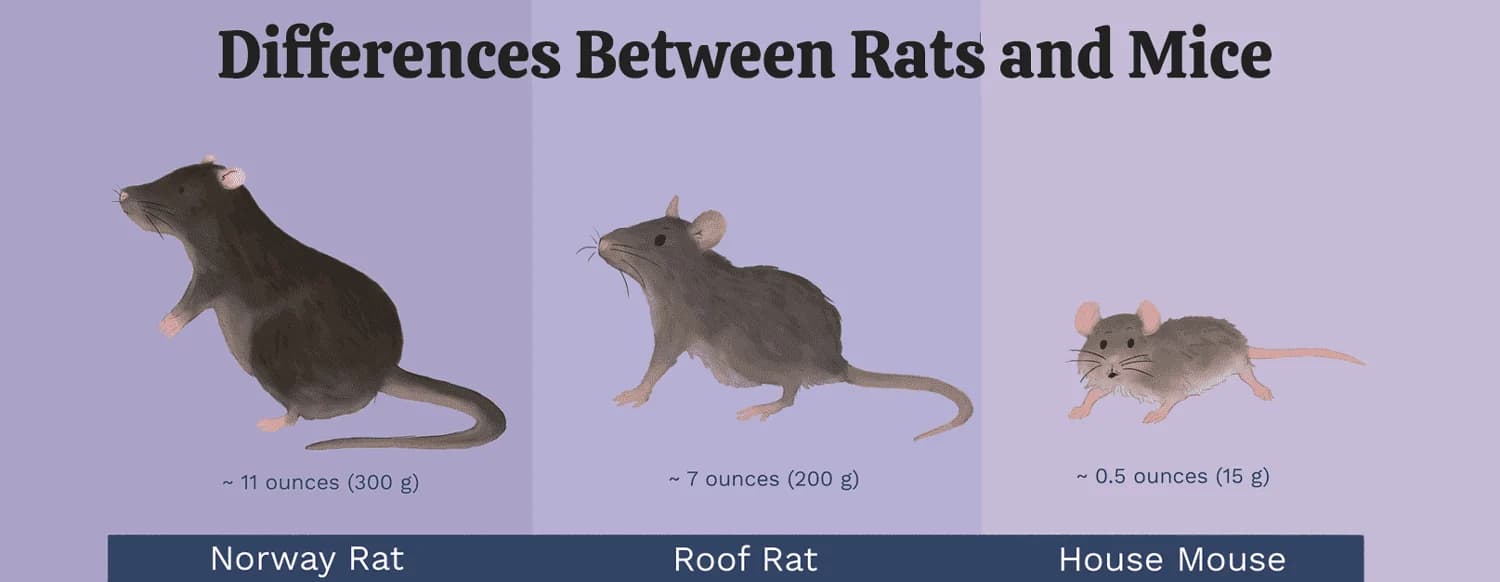

Three species of mouse are commonly encountered in UK homes and businesses: the house mouse, the wood mouse (field mouse), and the yellow-necked mouse. Knowing which species you are dealing with helps you understand their behaviour and choose the most effective control approach.
This guide covers the key identification features, habitat preferences, and behavioural differences of each species, along with practical advice on what each means for your property.
Published:
House Mouse (Mus musculus)
The house mouse is the most common pest mouse in the UK. It has a uniformly grey-brown coat, large ears relative to its body, small eyes, and a tail roughly the same length as its body. Adults are 7 to 10cm long (body only) and weigh 12 to 30 grams.
House mice are commensal — they have evolved to live alongside humans and depend on human environments for food and shelter. They rarely live outdoors in the UK and are almost always associated with buildings. They are excellent climbers and can scale rough vertical surfaces, jump up to 30cm, and squeeze through gaps as small as 6mm.
A female house mouse can breed from just 6 weeks old and produce 5 to 10 litters per year, each containing 4 to 12 pups. This extraordinary breeding rate means a small problem can become a serious infestation within weeks if not addressed. House mice are the species responsible for the vast majority of domestic and commercial mouse infestations.
Wood Mouse / Field Mouse (Apodemus sylvaticus)
The wood mouse — commonly called the field mouse — is the most abundant wild mouse in the UK. It has a sandy brown coat with a white or cream underside, large protruding eyes, large ears, and a long tail. Adults are 8 to 11cm long and weigh 13 to 27 grams.
Wood mice primarily live outdoors in gardens, hedgerows, woodlands, and fields. However, they frequently enter sheds, garages, outbuildings, and sometimes houses — particularly in autumn and winter as temperatures drop and outdoor food becomes scarce.
Unlike house mice, wood mice are typically seasonal visitors rather than permanent residents. They are more likely to be found in rural and suburban properties than inner-city homes. If you live near fields, woodland, or large gardens, the mice entering your property may well be wood mice rather than house mice.
Yellow-Necked Mouse (Apodemus flavicollis)
The yellow-necked mouse is similar in appearance to the wood mouse but noticeably larger — adults reach 10 to 13cm body length and weigh up to 45 grams. Its distinguishing feature is a band of yellow-orange fur across the chest between the front legs, forming a complete collar.
Yellow-necked mice are found mainly in southern England and Wales, particularly in areas with mature deciduous woodland. They are excellent climbers — more so than other mouse species — and frequently enter loft spaces and upper floors of properties adjacent to woodland.
This species is a significant pest in the areas where it occurs because of its size and climbing ability. Yellow-necked mice cause more damage than house mice, gnawing through cables, pipes, and even lead flashing. They are also more likely to enter properties through upper-level entry points that house mice cannot reach.
How to Tell Them Apart
Colour is the most reliable field identification: house mice are uniformly grey-brown with a grey underside; wood mice are sandy brown with a sharp white underside; yellow-necked mice are rich brown with a distinctive yellow chest band.
Size also helps. If the mouse you have seen is noticeably larger than expected and you live near woodland in southern England, it may be a yellow-necked mouse. House mice are the smallest of the three species.
Location is a useful clue too. Mice found inside inner-city properties are almost always house mice. Mice entering rural or suburban properties from gardens, especially in autumn, are more likely wood mice. Mice found in lofts and upper floors of properties near woodland may be yellow-necked mice.
Need professional help with mice control? BuzzKill Pest Control offers fast, effective treatment with no call-out charge.
Does the Species Affect Treatment?
The core treatment methods — trapping, baiting, and proofing — are the same for all three species. However, understanding which species you have helps target treatment more effectively.
House mouse infestations require thorough internal treatment because the mice are living permanently inside the building. Wood mouse incursions are often resolved more easily because the mice are typically entering from a specific outdoor route that can be identified and sealed.
Yellow-necked mice require attention to upper-level entry points — roof junctions, soffit gaps, and climbing plant routes — that might not be checked during a standard survey focused on ground-level access. Their larger size also means they can cause more damage to wiring and building materials, making prompt treatment important.
Harvest Mice and Dormice — Protected Species
Two other mouse species found in the UK — the harvest mouse and the dormouse — are protected under the Wildlife and Countryside Act 1981. They do not enter buildings and are not pest species, but it is worth knowing they exist to avoid confusion.
The harvest mouse is tiny (5-7cm body length) with a prehensile tail, found in grasslands and reed beds. The hazel dormouse is golden-brown with large black eyes, found in hedgerows and deciduous woodland. Neither species poses any pest risk, and both are declining in numbers.
If you encounter what you believe is a harvest mouse or dormouse, do not attempt to trap or remove it. Contact your local wildlife trust for advice.
Frequently Asked Questions
What type of mouse is most common in UK homes?
The house mouse (Mus musculus) is responsible for the vast majority of domestic infestations in the UK. It is a commensal species that depends on human environments for food and shelter and rarely lives outdoors.
Are field mice a pest?
Wood mice (field mice) can be a pest when they enter buildings, particularly in autumn and winter. However, they are typically seasonal visitors rather than permanent residents like house mice. Sealing entry points usually resolves the problem.
Do I need to identify the species before calling pest control?
No. A professional pest controller will identify the species during their initial inspection. However, knowing whether you are seeing mice indoors year-round (house mice) or only in autumn/winter (likely wood mice) helps your pest controller plan the most effective approach.
Can different mouse species live in the same property?
It is uncommon but possible, particularly in rural properties where house mice live inside permanently and wood mice enter seasonally. A pest controller can determine which species are present from droppings, gnaw marks, and behaviour patterns.
Are any UK mice protected by law?
Harvest mice and dormice are protected under the Wildlife and Countryside Act 1981. However, these species do not enter buildings. House mice, wood mice, and yellow-necked mice are not protected and can be legally controlled.
Professional Mice Control Service
Learn more about our mice control service, pricing, treatment methods, and customer reviews.
View Mice Control Service