

The person who arranges pigeon control and the person who pays for it may be different. If you’re searching for “leaseholder vs freeholder pigeon responsibility flats”, separating those roles is a useful first step. A problem above your balcony may involve shared building maintenance, permission for external work and a service charge contribution.
The freeholder owns the freehold interest in the property. A leaseholder holds their flat under a lease. A management company may have separate responsibilities, while a managing agent handles work on someone else’s behalf. Your paperwork should identify those relationships.
For a shared roof or gutter, start with whoever maintains that part of the building. For a private balcony, check its boundaries and maintenance clauses before assuming the whole problem belongs to you.
We’d read the following seven clues in this order because each builds on the evidence from the previous one. Keep the lease, its plan and any later amendments together. Where wording remains disputed, get individual lease advice before accepting liability or commissioning permanent work.
1. The boundary around your flat
The lease boundary is the strongest starting clue because it identifies whether the affected area forms part of your flat. Look for the demise: the parts of the property included within your lease.
Find the written description alongside the lease plan. Check references to internal surfaces, windows, outside walls, balconies, ceilings and structural parts. A coloured outline needs to be read with those words. It may leave particular building components outside your responsibility.
Now locate the pigeons precisely. Birds on a window ledge, droppings beneath an overhead pipe and nesting material behind a balcony panel describe different situations. “Pigeons at my flat” gives the manager too little information to match the problem to the lease.
Match the roost to a named building part
Take a photograph from a safe position and identify both where birds gather and where their droppings land. Those locations may fall under different clauses.
For example, suppose droppings collect on your balcony floor while birds roost on a shared roof projection above. That observation supports a request to inspect the projection. It doesn’t settle who must clean the balcony or pay for proofing.
The boundary also has limits as evidence. A part can sit within your lease while another clause reserves particular repairs to the building owner. Keep reading before treating the plan as a complete answer.
If the roost cannot be identified safely from your flat, ask for a professional inspection through the appropriate property contact. There’s no need to lean over a railing to strengthen your report.
Start with a marked photograph and the exact property description. Ask the manager to confirm which lease provision covers the affected building part.
2. The promise to repair or maintain
Repairing and maintenance clauses help identify who should act once you’ve located the affected part. A covenant is a promise in the lease, such as a promise to maintain a roof or keep a flat in repair.
Look at the leaseholder’s promises and the landlord’s or management company’s promises. Search for repairing, maintaining, cleaning, renewing and keeping in good condition. Read the full clause, including any exceptions and references to schedules elsewhere.
The visible evidence matters here. A slipped panel allowing access to a void raises a different maintenance question from birds resting on an intact ledge. Record the condition without guessing its cause.
Separate repair, cleaning and prevention
Ask for a proposed job to be divided into its actual tasks. Repairing an opening, removing accumulated droppings and fitting a deterrent are different pieces of work. The relevant lease wording may differ for each.
An obligation to repair should prompt questions about an identified defect. It shouldn’t become an automatic answer to every request for new proofing. Equally, describing the job as pest control may overlook a building repair that needs assessment.
Where masonry is part of the concern, the guide to pigeon guano masonry damage can help you prepare questions about the affected surface. Photographs alone won’t establish the extent or cause of damage.
A bird-control contractor can describe the roost and possible prevention measures. A building surveyor may be needed where the condition of the structure is uncertain.
Use the clause that matches the proposed task. Ask the responsible party to explain separately who will arrange the repair, cleaning and any new installation.
3. The wording for shared roofs and gutters
Specific wording about communal roofs and gutters can clarify a pigeon problem that looks private from inside your flat. Check whether the lease names roofs, rainwater pipes, gutters, parapets or other exterior parts.
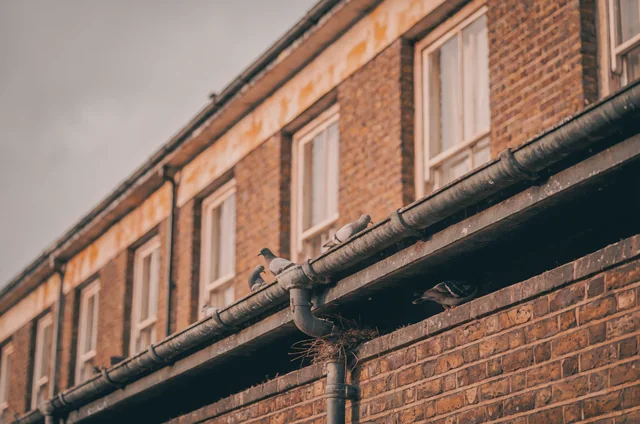
Look for the party assigned to maintain them, then check any exclusions. A reference to shared parts needs to be read alongside the description of your individual property.
Describe what you can actually see: birds entering beneath an eave, nesting material beside a gutter, or repeated droppings below a roof edge. Note whether other flats appear affected. A shared pattern gives the manager a more useful inspection brief than a complaint limited to your window.
Request an inspection before choosing a deterrent
A roof complaint needs an access assessment as well as a responsibility decision. Ask who can authorise access, which areas the contractor will inspect and whether the proposed visit includes the adjoining gutter or roof space.
Avoid choosing spikes, mesh or netting from ground-level photographs alone. The contractor needs to assess where birds enter or settle and whether the proposed installation suits that location.
If nesting material is present, record it without touching it. The bird nest removal guide is relevant preparation for a gutter-related report. Ask the contractor to assess nesting activity and confirm lawful options before removal or exclusion work.
Timing matters when there is an apparent drainage problem or loose building material. Report that condition explicitly so it can be assessed alongside the bird activity.
Where the lease assigns the affected roof or gutter to building management, direct the inspection request there. Include the clause and the location rather than commissioning high-level work yourself.
4. The balcony’s separate parts
A balcony deserves its own check because exclusive use can feel like complete responsibility. The lease may treat its floor finish, structural slab, railing, outside face and overhead surface differently.
Read the balcony description alongside the repair and alteration clauses. Alterations are changes to the property, which may include installing equipment or attaching fixings. Check what approval the lease asks for before planning permanent proofing.
Start with the physical evidence. Are birds landing on the rail, sheltering behind stored items or entering a gap above the balcony? Photograph the location and any existing deterrent. A balcony receiving droppings from above presents a different question from one containing the roost.
Check the proposed fixing points
Ask a contractor to identify where any net, wire or other installation would attach. That detail helps the manager assess whether the proposal touches shared fabric or changes the building’s appearance.
A drawing or annotated photograph is more useful than a request for permission to “pigeon-proof the balcony”. It should show the proposed coverage, fixing positions and access needed for installation and maintenance.
The common error is to treat balcony access as permission for every kind of work. Another is to accept responsibility for an overhead structural part simply because it sits above your outdoor space.
Routine housekeeping may help reveal the pattern of bird activity. Keep a dated record of what returns after the area has been dealt with safely. Substantial deposits, difficult access or nesting activity need a professional assessment.
For a balcony-only problem, start with the clauses covering its individual components and proposed fixings. Ask for written confirmation of any approval needed before accepting an installation quote.
5. The service charge schedule
The service charge schedule helps answer who may contribute financially after you’ve identified who arranges the work. A service charge is a payment towards building services and costs under the lease.
Look for wording about cleaning shared areas, maintaining exterior parts, pest control, professional fees and building management. Then check how your contribution is calculated and whether different services have different allocation rules.
A pigeon-control charge on an estimate is a reason to request detail. It doesn’t, by itself, explain why the cost belongs in your building’s shared account. Ask which lease provision the manager is relying on.
Ask for the scope behind the amount
A useful quotation should distinguish inspection, access equipment, cleaning, repair, proofing and later maintenance. It should identify the areas covered and explain any assumptions about access or bird activity.
This detail helps you compare the proposed expenditure with the lease. It also makes a narrow job easier to distinguish from a wider installation across several parts of the block.
Where a chimney is involved, chimney pigeon proofing costs provide a relevant topic to explore. Your building still needs its own quotation, with the chimney location and access requirements specified.
Ask whether the estimate includes every proposed task and whether further approval is needed before work begins. A price for fitting a deterrent may leave cleaning or repair unresolved.
If you disagree with a charge, identify the disputed task and the clause in writing. Get advice about that charge and any payment deadline rather than making assumptions from a general guide.
Separate the decision to commission work from the question of recovering its cost. Request the itemised scope, charging clause and proposed allocation before agreeing that the bill has been explained.
6. The clauses about feeding and nuisance
Nuisance and behaviour clauses become useful when there is evidence that someone’s actions contribute to the pigeon problem. A nuisance clause addresses specified interference or disturbance affecting other occupiers or the property.
Look for wording about feeding birds, leaving food outside, keeping animals, obstructing shared areas or causing a nuisance. Check exactly what the clause covers and whether the lease contains a process for asking management to enforce it.
Keep observations factual. Record food left on a ledge, dates when feeding occurs and the location where birds gather. Separate what you saw from what you suspect. A pigeon landing outside a neighbour’s window doesn’t establish that the neighbour feeds it.
Keep behaviour and building maintenance in view
An allegation about feeding can distract from an opening or shared roost that also needs inspection. Report both issues where the evidence supports them, with separate photographs and descriptions.
Ask management to address the documented behaviour through the appropriate process. The resident reporting the problem shouldn’t have to conduct a confrontation or decide how another person’s lease should be enforced.
Explain the practical effect of the droppings: an affected doorway, a balcony that cannot be used normally or repeated deposits on shared steps. The guide to pigeon droppings health risks gives context for the concern. Keep your report focused on observable conditions rather than attributing an illness to birds.
Where substantial cleaning is needed, request a safe work plan and appropriate access arrangements. Keep children and pets away from the affected area while it awaits assessment.
Use nuisance wording when you have evidence of the behaviour it covers. Ask management to assess any shared roost or building defect alongside that report.
7. The managing agent’s authority
The managing agent’s role determines where your report goes and who can turn it into an authorised job. The agent may handle correspondence and contractors while a freeholder, management company or residents’ company makes particular decisions.
Check the parties named in the lease, recent service charge correspondence and management notices. Ask who currently controls the affected building part and who can approve inspection, access and expenditure.
This clue comes last because an agent’s email address cannot replace the earlier lease checks. It does, however, help stop a well-evidenced report moving between people without a clear owner.
Give one person a defined request
Send the location, dated photographs and relevant clauses together. Describe the effect on your flat or shared area and state whether birds appear to be nesting.
Ask for confirmation of who will arrange the inspection, who can authorise any resulting work and when you should expect a response. If the agent needs approval from someone else, request the identity of that decision-maker.
A shared interactive checklist could help a block handling several reports. It could record each affected location, supporting clause, proposed task and outstanding permission, with disputed entries marked as unconfirmed.
For residents in Hackney, the guide to professional bird control signs gives further context for preparing an inspection request.
A contractor such as BuzzKill Pest Control in London can assess the physical bird problem. Responsibility for interpreting disputed lease wording stays with the relevant parties and their advisers.
If correspondence stalls, forward the original evidence and ask for the correct escalation route. Keep the reply identifying the person authorised to commission work with your lease records.
When the lease leaves you with unanswered questions
Some pigeon problems involve several clauses or more than one responsible party. These questions help turn that uncertainty into a specific request.
Can I arrange proofing and send the freeholder the bill?
Get written agreement first about the work, permission, access and payment. A quotation addressed to you doesn’t establish that someone else will reimburse it.
If work appears urgent, report the precise hazard and ask for an urgent response. Keep the correspondence. Where reimbursement is disputed, get advice before committing to expenditure on the assumption that it can be recovered.
Does having a share of freehold change the answer?
A share of freehold still leaves the flat’s lease and the building’s management arrangements to check. Your role as a leaseholder and your involvement in the freehold company may involve different decisions.
Ask which body must approve the proposed work and how that approval is recorded. An informal conversation with another resident may leave the contractor without clear instructions.
What if pigeons are nesting while responsibility is disputed?
Report the nesting location promptly and leave it undisturbed while professional advice is obtained. Ask the contractor to assess the birds’ activity and confirm what work can lawfully proceed.
The inspection request can identify the physical issue while responsibility remains under discussion. Ask who can authorise that visit and record any agreement about its cost separately.
What if I rent the flat from a leaseholder?
Start by reporting the problem to your landlord or letting agent, with photographs and the affected location. Explain whether it involves your accommodation, a balcony or a shared area.
Your tenancy and your landlord’s lease are separate documents. Ask your landlord to raise any building-wide issue with the authorised manager and give you a clear update on the proposed response.
Which lease clue should I act on today?
Start with clue one: match the roost and affected area to the lease description. Send that evidence to the property contact with a request to identify the clause governing the proposed work.
The balcony clue is the easiest to overread. Finding droppings on your balcony establishes where they landed; responsibility still needs to be checked against the component, task and lease wording. Ask for a written reply naming the person authorised to arrange the inspection.
Need professional help? BuzzKill offers fast, reliable pest control services across London and Essex.