
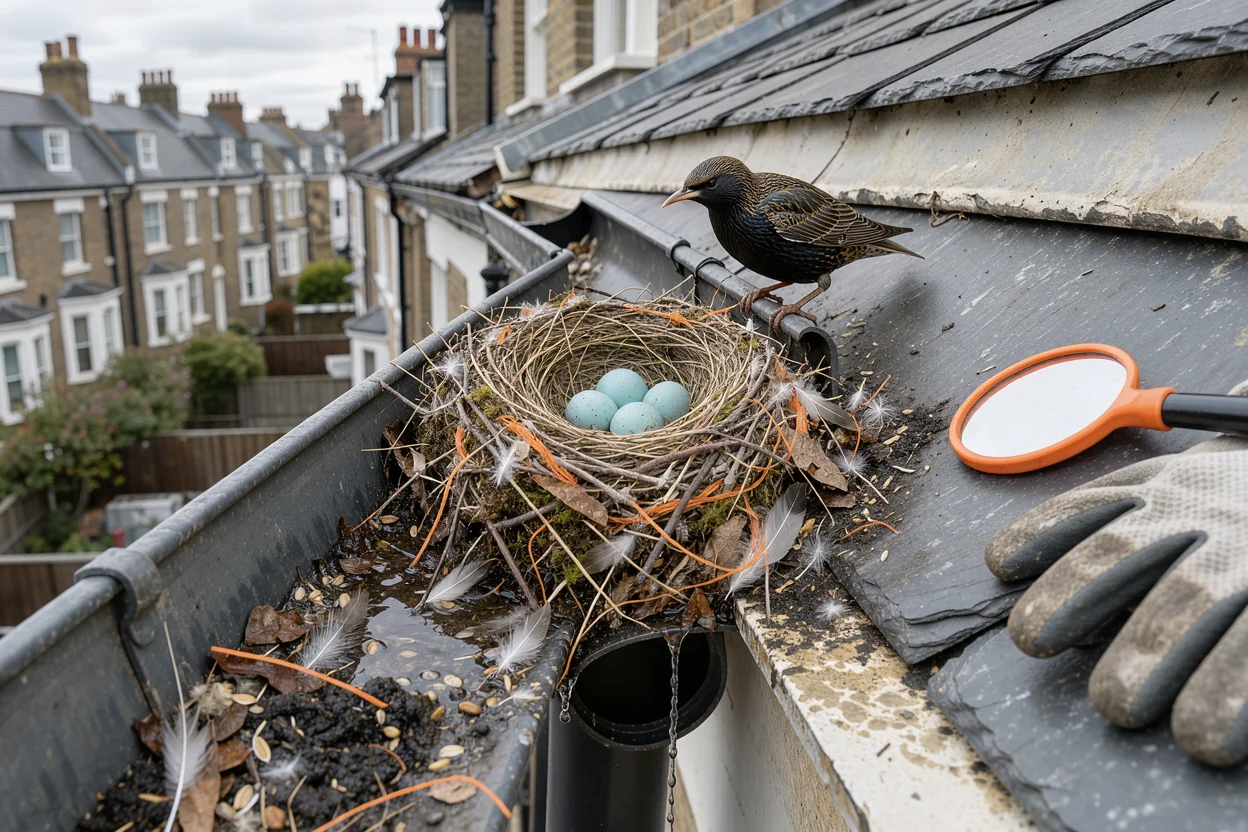
The first step with bird nests blocking gutters and downpipes can be leaving the material exactly where it is. Before anyone reaches for a scoop, you need to establish whether birds are still using it. That decision affects what work can happen, how soon it can happen and who should handle it.
An overflowing gutter is stressful, especially when water is running down brickwork or appearing near a window. You can take that seriously while keeping the nest undisturbed. The drainage fault, the birds and safe access each need checking.
I’d put these five checks in the order below. Start with evidence of nesting, establish what can safely be removed, then follow the water through the drainage system. Buying deterrents comes later.
1. An active gutter nest changes what work is allowed
A gutter blockage becomes a wildlife issue when the material is a nest that birds are building or using. This check comes first because clearing the gutter could damage the nest before you realise it is occupied.
In England, the Wildlife and Countryside Act protects wild birds’ nests while they are being built or used. Eggs or chicks make the situation clear, but a nest can be protected before either is visible.
Building activity matters before eggs appear
Watch for birds repeatedly taking grass, feathers or twigs to the same position. A small bundle tucked against a gutter bracket may be the beginning of a nest. The structure does not have to look complete.
Birds carrying food to a roofline gap, repeated visits to one entrance and calls from inside are also reasons to stop work. A nest may sit behind the fascia, the board along the roof edge, while loose material spills into the gutter.
Avoid pulling out the visible twigs to discover what is behind them. You could disturb a nest that extends beyond your view.
The calendar cannot settle this on its own. Familiar nesting-season dates are a prompt to be careful, but the actual activity at your property determines whether the nest is in use. Do not treat a particular month as automatic clearance.
Overflowing water needs a separate assessment
A blockage can need urgent attention without giving you permission to move an active nest. Explain both problems when arranging an inspection: where the water goes and what bird activity you have seen.
Keep people away from slippery paving beneath the overflow. From indoors or ground level, record any water entering the building and tell the property owner or managing agent promptly.
A suitable contractor can assess whether other drainage work is possible without disturbing the nest. Any proposed intervention affecting it needs its own legal assessment. Hiring someone does not automatically make removal lawful.
Do not move an occupied nest to a nearby ledge, lift it temporarily or fit mesh across the entrance. Each action can affect the birds’ continued use of it.
If birds are building or using the nest, leave it undisturbed and arrange an assessment of the wildlife and drainage issues together.
2. A quiet nest is not enough evidence that it is empty
An apparently empty gutter nest needs more investigation than a quick glance from the pavement. This ranks second because an adult bird can be away while eggs or young remain out of sight.
Your aim is to establish what is happening without changing it. An awkward viewing angle or an inaccessible cavity should increase caution.
Observe the entrance without approaching it
Use binoculars or a camera’s zoom from a position where your presence does not interrupt visits. Watch the suspected entrance and nearby roof edges. Birds may pause on an aerial, chimney or neighbouring roof before approaching.
Useful details to record include:
- Whether birds repeatedly return to the same opening.
- Whether they carry nesting material or food.
- Whether calls come from the gutter or the space behind it.
- Whether fresh material appears between observations.
- Whether the suspected nest is fully visible or partly concealed.
Observations at different times can build a clearer picture. There is no simple period of silence that proves every nest is abandoned.
Do not tap the gutter, poke the material or block the entrance to see whether anything reacts. Avoid pushing a phone or inspection camera into a cavity. If birds seem reluctant to approach while you watch, move farther away.
Separate loose debris from a nesting structure
Windblown twigs can collect beside a downpipe opening. Nesting material can also fall from a nest elsewhere along the roofline. Neither situation proves that the visible bundle is an occupied nest.
Look at the wider setting. Is the material gathered into a defined structure? Does a bird repeatedly enter the space above it? Are more twigs being added? These observations help frame the inspection, although hidden contents may still prevent a firm answer.
Finding no chicks does not establish that removal is appropriate. Eggs may be concealed, and birds may still be constructing or using the nest.
For a rented London property, send photographs and observations to the landlord or managing agent. Identify the exact gutter section so the contractor can inspect the correct location.
An interactive nest-and-gutter checklist could help record bird visits, visibility, overflow and access height. It should include an “uncertain” result that directs the reader towards an assessment.
If you cannot establish whether the nest is in use, keep it in place and get help identifying its status.
3. Safe nest removal starts with access and dust control
Once a nest has been confirmed as inactive and appropriate to remove, the next decision is whether you can reach it safely. Its size tells you very little about the difficulty of the job.
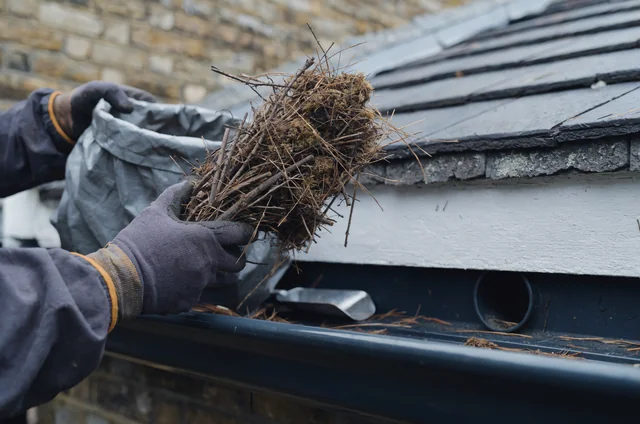
A small nest above a conservatory can require more access planning than a larger bundle beside a low outbuilding. This is why I’d assess the working position before assembling cleaning tools.
Judge the position before touching the material
Inspect the route from the ground. Note extensions, basement light wells, sloping paving, overhead cables and public paths beneath the gutter. A narrow side return can make even a modest roofline difficult to reach.
Leave the work to a suitably equipped contractor if it requires leaning from a window, stepping onto a fragile roof or stretching from a ladder. Holding a bag while handling debris also needs a stable working position.
For a genuinely accessible, low-level gutter, the basic approach is controlled removal:
- Confirm again that the nest is inactive and appropriate to remove.
- Keep children, pets and other people away from the work area.
- Wear suitable gloves and cover cuts before handling material.
- Lift out small amounts carefully and place them straight into a bag.
- Collect loose debris without pushing it towards the downpipe.
Pause if you uncover eggs, young birds or evidence that the nest is still in use. Do not continue simply because removal has already started.
Keep dry material out of the air
Old nesting material and droppings need careful handling. Avoid dry brushing, shaking debris from height or using a pressure washer. These methods can spread material across windows, paving and neighbouring property.
A household vacuum is unsuitable for this job. A mask alone also does not make a heavily soiled roofline suitable for DIY cleaning.
The amount and location of the material matter. A small accessible bundle is a different task from a deep accumulation inside a roof cavity. Our guide to bird droppings health risks explains why dust and direct contact deserve attention.
Avoid spraying insecticide or disinfectant into nesting spaces without an appropriate assessment. Cleaning should address the material and surface involved, with precautions for people, pets and nearby openings.
If removal reveals extensive droppings, difficult access or concealed nesting space, stop and arrange specialist cleaning.
4. The downpipe can remain blocked after the nest is gone
Removing the visible nest does not prove that rainwater can drain. Loose material may already have collected at the gutter outlet or lodged in a downpipe bend.
This check comes fourth because water testing belongs after nest status, access and removal have been resolved. Flushing an occupied or uncertain nesting area is not a way to diagnose the blockage.
Follow the water from gutter to drain
The gutter outlet is the opening where water enters the downpipe. Check that point first, using a safe working position or a contractor with suitable access.
Look for a compacted plug of twigs, leaves and silt. Material can sit just below the opening, beyond what is visible from above. A bend near the top of the downpipe is another place to investigate.
Different patterns suggest different areas to inspect:
- Water spilling along a long gutter section can indicate accumulated debris, poor alignment or another gutter fault.
- Water gathering around one outlet points towards a restriction there or farther down.
- Water escaping from a downpipe joint warrants inspection of the pipe and its connections.
- Water pooling around the drain at ground level may indicate a problem beyond the roofline.
These are inspection clues, not firm diagnoses. Several faults can exist at the same property.
Remove accessible loose debris before testing flow. Do not pack it farther into the pipe with a stick or force it down with high-pressure water.
Test gently and stop if water backs up
Once the relevant nesting checks and clearance are complete, a modest, controlled water test can help show whether the route is open. It should only happen from a safe position, with someone able to observe the discharge point.
Stop if water backs up, leaks from a joint or appears somewhere unexpected. Adding more water can worsen the overflow without revealing the obstruction.
A successful test means water travels through the intended route without backing up or escaping. A brief trickle does not establish how the system will perform in heavier rain.
Check the gutter during the next rainfall from ground level. Photograph recurring overflow, dripping joints or water tracking down the wall. Give those observations to the contractor if further work is needed.
For shared gutters on terraced houses or flats, involve the managing agent or relevant owners before arranging work across adjoining sections. The visible overflow may be some distance from the fault.
If the gutter is clear but the pipe or ground-level drain still backs up, arrange a guttering or drainage inspection.
5. Professional help should match the nest, the height and the recurring fault
A bird-control assessment becomes useful when nest status is uncertain, access is difficult or birds repeatedly use the same roofline opening. A guttering contractor may also be needed to restore drainage.
This is the fifth check because the earlier observations help you describe the job accurately. A clear brief reduces the chance of paying for work that leaves the underlying fault unresolved.
Choose the trade for the problem you can see
Before agreeing to work, explain the evidence you have gathered. Include photographs, the approximate position, recent bird visits and where overflow appears.
Ask the contractor how they will establish nest activity and what they will do if birds are still using the site. Also ask who will clear the downpipe, check its flow and deal with any damaged gutter components.
The guide to professional bird control assistance can help you recognise situations that need an assessment. Its Hackney focus is relevant to similar roofline problems elsewhere in London.
Check competence for the whole task. Wildlife assessment, work at height and drainage repairs require appropriate knowledge and equipment. Our explanation of pest controller credentials provides a starting point for checking a pest-management contractor.
BuzzKill Pest Control is one local option for a bird-control assessment in London. The agreed scope should make clear whether the job includes inspection, lawful removal, cleaning, drainage clearance or prevention measures.
Plan prevention around the actual nesting position
Repeated nesting deserves a closer look at the roofline. Birds may be using a gap behind the gutter, a sheltered ledge or another opening. Covering the gutter alone may leave that access unchanged.
Gutter guards, which cover the channel, and outlet guards, which sit around the downpipe opening, have different roles. Neither should be fitted in a way that traps birds or blocks access to an active nest.
Any prevention work needs to follow the nesting assessment. Avoid assuming that the first day you stop seeing birds is the right installation date.
Ask how the proposed system will allow future gutter cleaning. A guard can need maintenance, and debris collecting above an outlet still needs attention. Photographs of the finished work can help you identify what has been covered and where access remains.
For flats, schools or commercial premises, clarify who will inspect the installation and arrange maintenance. Record that responsibility alongside the work specification.
Choose professional help when uncertainty, height or repeated nesting exceeds what you can assess safely, and agree drainage checks as part of the scope.
Questions about gutter nests, timing and repeat blockages
The remaining decisions usually concern timing, guards and what an overflowing gutter actually proves. Keep each answer tied to the evidence at your property.
Can I remove the nest as soon as the chicks leave?
Do not assume that seeing young birds leave establishes that the nest has finished being used. Activity may be difficult to observe, and your view may cover only part of the nesting space.
Arrange a further check before removal or proofing. If birds return with material or food, or the nest remains concealed, leave it undisturbed while its status is assessed.
Does winter mean the gutter can be cleared?
Winter does not establish that a particular nest is inactive. Check the birds and the site before booking removal.
It can be a useful time to arrange maintenance where nesting has finished and removal is appropriate. Give the contractor your recent observations, and ask them to reassess the position before starting work.
Should I fit gutter guards straight after clearance?
Only after the nesting situation and the drainage fault have been resolved. A guard needs to suit the gutter and allow future cleaning.
Ask where debris will collect, how the downpipe opening remains accessible and whether birds can reach a nesting space behind the gutter. An unsuitable cover can leave you with another maintenance problem.
Do a few twigs mean I need extensive bird proofing?
A few twigs justify a closer look at their source. They may be windblown debris, fallen nesting material or part of a structure that is still developing.
Make the occupancy check your first action today. Keep any response to a small amount of loose material proportionate, and reserve major proofing decisions for a confirmed access or repeat-nesting problem.

Need professional help? BuzzKill offers fast, reliable pest control services across London and Essex.