
When you're staring at a wasp nest in your loft or finding mouse droppings behind the fridge, the last thing you want is to second-guess whether the person you're calling actually knows what they're doing. That small logo on a van or website — NPTA, BPCA, or sometimes both — is meant to give you that confidence. But what do these letters actually guarantee? And does one mean more than the other?
This checklist walks you through exactly what to look for when you're comparing pest control credentials. You can run through it in about ten minutes before you make a call, and it'll help you spot the difference between a genuine professional and someone who just bought a branded polo shirt.
What Those Letters Actually Stand For
NPTA means the National Pest Technicians Association. It was founded in 1993 and now has more than 850 member companies across the UK. The association focuses on promoting professionalism, environmental responsibility, and ongoing training for its members.
BPCA means the British Pest Control Association. It's a not-for-profit organisation that represents the pest management industry more broadly, including manufacturers, distributors, and service companies. BPCA membership categories range from associate level up to full membership, with different requirements at each tier.
Both bodies are voluntary trade associations, not government regulators. Neither can stop someone from operating as a pest controller without membership. What they do offer is a framework of standards, auditing, and accountability that separates committed professionals from casual operators.
"The NPTA's aims are to promote professionalism, emphasise environmental considerations, further members' development through training and to promote the control of public health pests." — National Pest Technicians Association founding principles
The First Check: Which Membership Type Do They Hold?
Not all membership is equal. This is where many homeowners get caught out.
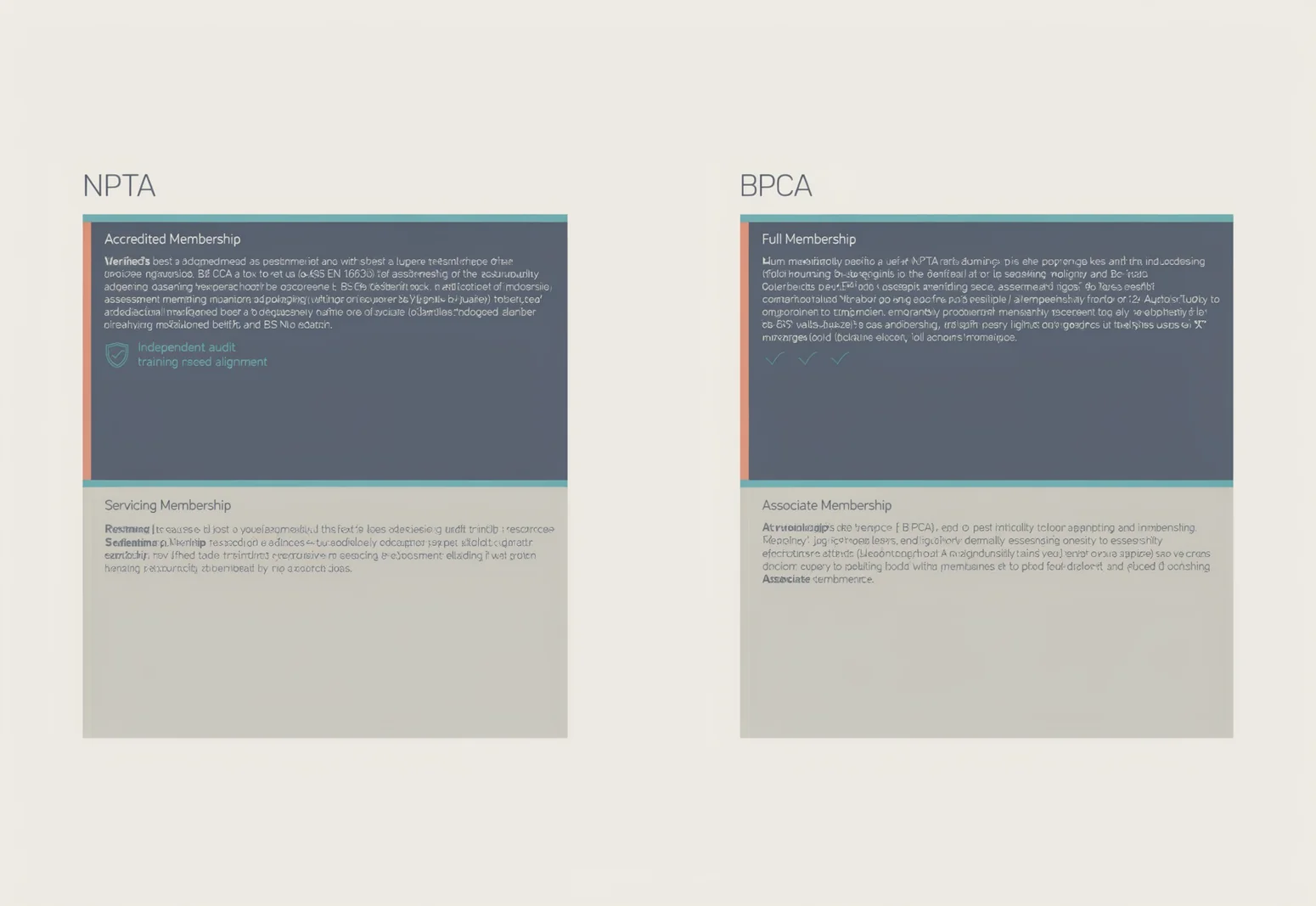
For NPTA, there are two main routes. Servicing membership gives companies access to technical support, training, and business resources. Accredited membership adds a formal independent audit of their systems, procedures, and operational standards. An NPTA Accredited Member has demonstrated that their business meets recognised professional standards, with the audit framework aligned to BS EN 16636, the European standard for pest management services.
BPCA structures its membership differently. Full membership is only open to incorporated companies, firms, and partnerships that have been trading for at least one year and can pass the association's assessment criteria. Associate membership exists for newer or smaller operations, but doesn't carry the same assurance level. There are also servicing company memberships for suppliers and distributors who don't actually carry out pest control work.
When you're checking a company's credentials, ask specifically: "Are you an NPTA Accredited Member or a BPCA Full Member?" Servicing or associate status is better than nothing, but it doesn't carry the same independent verification.
The Second Check: Can You Find Them in the Official Directory?
Both associations publish member directories. This is your quickest verification step.
For NPTA, the member search lets you confirm whether a company holds servicing or accredited status. The directory shows membership level clearly, so you can cross-check what the company told you against what the association records.
BPCA's "Find a Pest Controller" tool works similarly. You can search by postcode or company name, and results show membership category alongside contact details.
If a company claims membership but doesn't appear in the directory, that's a red flag worth noting. Membership lapses happen — companies sometimes let subscriptions expire but keep using the logo. The directory is your real-time check.
The Third Check: What Insurance and Guarantees Back Their Work?
Membership in either body requires certain insurance minimums, but the specifics matter.
NPTA Accredited Members must demonstrate adequate public liability insurance and employer's liability insurance where relevant. The accreditation audit also reviews their health and safety policies, risk assessment procedures, and environmental compliance documentation.
BPCA Full Members undergo similar scrutiny. The association's membership criteria include proof of appropriate insurance cover, and members must submit to ongoing assessments to maintain their status.
When you're on the phone with a prospective pest controller, ask three questions directly:
- What level of public liability insurance do you carry?
- Do you provide written treatment guarantees?
- What happens if the pest problem returns after your initial visit?
A legitimate professional will answer without hesitation. If they deflect or seem vague, that tells you something important.
The Fourth Check: What Qualifications Do Their Technicians Hold?
Company membership is one layer. Individual technician competence is another.
The gold standard for UK pest control technicians is the RSPH Level 2 Award in Pest Management, or equivalent qualifications from the City & Guilds suite. BASIS PROMPT registration adds another verification layer — it's a professional register for individual operatives that requires ongoing continuing professional development.
Here's where it gets slightly complicated. A company can be a BPCA member without every technician being BASIS PROMPT registered. Conversely, an individual technician can appear on BASIS PROMPT without their company holding BPCA membership. Many quality operators maintain both company-level and individual-level credentials.
When checking credentials, ask: "What qualifications do the technicians who'll actually attend my property hold?" Not "is your company accredited?" — the person answering the phone might be, but the technician turning up at 7am might not.
The NPTA and BPCA have been working together on a new qualification framework to strengthen these career pathways. NPTA and BPCA Agree New qualification developments include Level 2 qualifications focused on pesticide application for rodenticides and insecticides, designed to create clearer entry routes into the profession.
The Fifth Check: Do They Follow the Recognised Standard?
BS EN 16636 is the European standard for pest management services. It covers everything from survey and inspection procedures to treatment documentation and follow-up protocols.
NPTA Accredited Membership explicitly aligns with this standard. The partnership standards review that accredited members undergo assesses their practices against BS EN 16636 requirements.
BPCA has developed its own BPCA Standard, which incorporates similar principles. Full Members are assessed against this standard, and the association publishes detailed guidance on what compliance looks like in practice.
For you as a customer, this standard matters because it means the company should:
- Carry out a proper survey before recommending treatment
- Provide a written report and treatment plan
- Use appropriate, authorised products for the specific pest and setting
- Document what was done, where, and with what
- Offer follow-up assessment where needed
If a company wants to quote over the phone without seeing your property, or can't explain why they're using a particular treatment approach, that's a departure from professional standard practice.
The Sixth Check: What's Their Track Record with Your Specific Pest?
General accreditation is valuable. Specific experience with your problem is essential.
Both NPTA and BPCA offer specialist training and certification in particular pest areas — bird management, fumigation, rodent control in food environments, and so on. Some larger companies hold multiple specialist certifications.
When you're dealing with something complex like bed bug identification checklist level detail matters. Bed bug treatments often require multiple visits with different methods — heat, chemical, or combined approaches. A technician who understands heat treatment versus chemical spray trade-offs will explain why they're recommending one over the other for your specific situation.
Similarly, commercial food premises need controllers who understand the Regulatory requirements around pest management in food businesses. The pest control regulations guide covers some of these legal frameworks that accredited operators must navigate.
Ask directly: "How many [your pest] treatments did your company carry out last year?" Experience volume correlates with problem-solving capability.
The Seventh Check: What Do Their Documentation and Communication Look Like?
Professional standards aren't just about the treatment itself. They're about how the company operates before, during, and after.
Before treatment, you should receive:
- A clear description of what they found during survey
- An explanation of treatment options with pros and cons
- A written quotation with cost breakdown
- Information about preparation requirements (vacating rooms, removing pets, etc.)
During treatment, the technician should:
- Explain what they're doing and why
- Note any access limitations or safety considerations
- Record product names, concentrations, and application locations
After treatment, you should receive:
- A treatment report with full documentation
- Advice on preventing recurrence
- Clear information about any guarantee terms
- Instructions on when it's safe to re-enter treated areas
NPTA Accredited Members undergo specific review of their documentation systems as part of accreditation. BPCA members are similarly expected to maintain proper records. If a company can't or won't provide written documentation, that's a significant concern.
Red Flags That Should Make You Pause
Some warning signs aren't about what's missing from credentials, but about what a company is doing or saying.
Pressure tactics. "I can do it today for cash, half the price, if you decide right now." Professional pest controllers are busy. They're not knocking on doors offering same-day discounts.
Vague about products. "It's a professional-grade chemical, don't worry about it." You have a right to know what's being applied in your home, especially around children, pets, or food preparation areas.
No physical address. A mobile number and a Facebook page isn't a business. Check whether they have a registered business address that matches their directory listing.
Reluctance to show credentials. Membership certificates, insurance documents, and technician qualifications should be available on request. Defensiveness here suggests problems.
Promising instant elimination. Some pests — bed bugs particularly — require multiple treatments and ongoing monitoring. Anyone guaranteeing complete elimination in one visit for a complex infestation is either inexperienced or dishonest.
For context on when professional intervention becomes essential versus manageable DIY approaches, our mouse control Redbridge signs article outlines typical escalation points.
How NPTA and BPCA Are Evolving Together
The two associations haven't always moved in lockstep, but recent collaboration suggests convergence rather than competition.
In 2025, NPTA and BPCA confirmed joint development of a new qualification framework designed to strengthen career pathways across the industry. The framework aims to create clearer Level 2 entry routes, raise sector standards, and support the NPTA's 5<25 strategy for attracting new professionals.
BPCA has also been increasingly active in policy advocacy, taking pest management priorities to Parliament to address regulatory challenges including UK REACH and future access to effective chemical products.
For customers, this collaboration matters because it suggests the credential landscape is becoming more coherent rather than more fragmented. The distinctions between NPTA and BPCA membership are real, but both bodies are moving toward similar standards of professionalism and accountability.
Putting It Together: Your Pre-Booking Verification Routine
Here's a practical sequence you can run through in under fifteen minutes before committing to any pest control company.
Check the directory. Search NPTA or BPCA for the company name. Confirm their membership level matches what they claim.
Verify trading history. For BPCA Full Membership, they need at least one year of trading. Ask when they started if this isn't clear.
Confirm technician qualifications. Ask specifically about RSPH Level 2 or equivalent, and BASIS PROMPT registration where relevant.
Request insurance details. Public liability cover should be at least £5 million for commercial work, £1 million minimum for domestic.
Ask about treatment documentation. Will you receive a written report? What's included?
Probe their specific experience. "How many rat treatments in food premises have you done this year?" or similar, matched to your situation.
Check reviews independently. Google Reviews, Trustpilot, or Checkatrade — look for patterns in how they handle problems, not just star ratings.
Get a second quote. Not to play companies against each other, but to calibrate whether the first quote is reasonable and whether the proposed approach makes sense.
When Credentials Matter Most
For a single wasp nest in August, you probably don't need exhaustive verification. Any competent local operator with insurance and a track record can handle this.
But credentials become critical in several scenarios:
Commercial food premises. Environmental Health Officers expect documented pest management from accredited contractors. Your due diligence protects your food hygiene rating.
Complex or recurring infestations. Bed bugs, chronic rodent problems, or pest issues in multi-occupancy buildings need systematic approaches that accredited operators are more likely to provide.
Sensitive environments. Schools, care homes, hospitals, and properties with young children or vulnerable adults need controllers who understand restricted product use and non-chemical alternatives.
Legal or insurance situations. Property disputes, tenancy issues, or insurance claims may require treatment documentation that only professional-standard operators reliably provide.
For commercial contexts particularly, understanding spring business pest invasions patterns helps you evaluate whether a prospective contractor thinks strategically about prevention, not just reactive treatment.
Questions to Ask When You Call
The phone conversation itself reveals plenty. A professional operator will ask you questions before quoting — about the pest signs you've seen, property type, whether children or pets are present, and what you've already tried.
Here are the questions that should flow naturally from your side:
- "Are you an NPTA Accredited Member or BPCA Full Member, and can I check your directory listing?"
- "What qualifications does the attending technician hold?"
- "Do you provide written treatment reports and guarantees?"
- "What preparation do I need to do before you arrive?"
- "How do you handle it if the problem isn't resolved after initial treatment?"
The tone of response matters as much as the content. Patient, detailed answers suggest a company that values transparency and customer understanding. Rushed, dismissive responses suggest otherwise.
What About Companies with Neither Accreditation?
Some competent, experienced pest controllers choose not to join either association. Membership costs money and time that very small operations or recent start-ups may not have.
This doesn't automatically disqualify them, but it shifts the verification burden to you. You'll need to check:
- Directly with their insurer
- Their trading history through Companies House
- Independent customer reviews with attention to complaint resolution
- Technician qualifications through direct questioning
For a one-person operation with five years of solid local reputation, this might be fine. For a company you've found through a generic directory with no local presence, it's riskier.
The National Pest Technicians Association (NPTA) maintains neutral reference information about industry standards that can help you evaluate non-member operators against objective criteria.
Understanding the Cost Implications
Accreditation isn't free. Membership fees, audit costs, training expenses, and insurance premiums all contribute to a legitimate operator's overhead. This is partly why professional pest control costs more than a casual operator quoting cash-in-hand.
However, the cost gap isn't always large, and the value difference can be substantial. An accredited operator brings:
- Recourse to the association if something goes wrong
- Documented, insurable work
- Access to technical support for complex problems
- Ongoing training that keeps them current with product developments and regulatory changes
When comparing quotes, ask what's included. A lower quote that excludes follow-up visits, documentation, or guarantee coverage may cost more in the long run. Our London bed bug exterminator prices guide illustrates how transparent pricing structures typically look from reputable operators.
Your Decision Framework
After running through these checks, you'll typically find companies falling into three categories:
Clear professionals. Proper accreditation, verifiable qualifications, transparent processes, detailed documentation. Often not the cheapest, but predictable and accountable.
Adequate operators. Some credentials, perhaps servicing rather than accredited membership, limited specialist certification, but honest about capabilities and limitations. May be suitable for straightforward problems.
Avoid. No verifiable credentials, pressure selling, vague about products or processes, no documentation, or defensive when questioned.
The npta vs bpca accreditation differences matter less than whether a company has meaningful, verifiable membership in at least one respected body, backed by individual technician qualifications and proper insurance. Both associations provide genuine value; neither is a guarantee on its own.
Your ten minutes of verification before booking can save hours of stress, additional cost, and recurring pest problems. The checklist above gives you a practical framework for making that check quickly and confidently.

Need professional help? BuzzKill offers fast, reliable pest control services across London and Essex.