
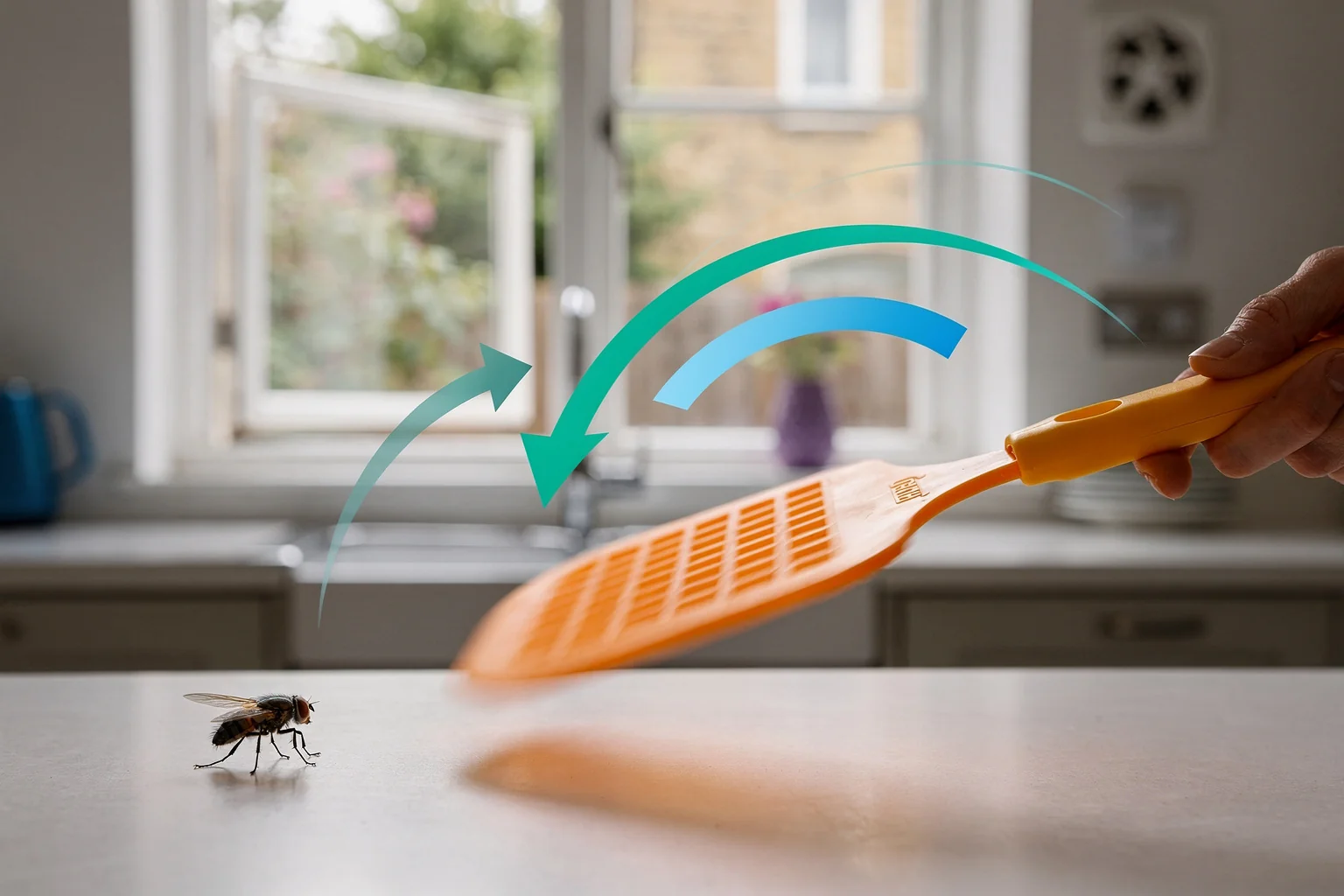
A fly lands on the arm of the sofa and you freeze mid-reach. You edge closer, hand hovering, and then—nothing. It lifts off a split second before you make contact, buzzing in a lazy arc around the room as if it’s mocking you. It’s not your reflexes. It’s the fly’s biology, and once you understand what it sees and how it moves, swatting becomes a skill you can learn in about ten minutes.
If you’re dealing with a single house fly that’s found its way through an open window, this guide is for you. If you’re seeing several every day, you might have a breeding source somewhere—in which case, there’s a bigger conversation to have later. For now, let’s get that one fly off your lampshade.
Why Swatting a Fly Feels Impossible
The standard approach—creep up from behind, swing fast, hope for the best—fails because it ignores the one thing a fly does better than almost any other insect: process motion.
House flies don’t see a sharp, colourful world like we do. Their compound eyes are built for speed. A fly’s flicker-fusion rate—the point at which a sequence of images blurs into continuous motion—sits around 250 Hz, compared to a human’s 60 Hz. In practice, that means everything we do looks like slow motion to them. They’re not guessing when they take off the moment your hand moves; they’ve already processed the acceleration and direction of your swing and fired a preprogrammed escape response before your palm covers the distance.
Even the way they jump matters. When a fly detects a threat from behind, it doesn’t just lift off—it pushes backwards and slightly upwards, a movement called an "escape jump." That’s why a downward swat aimed at a resting fly often smacks empty air. The fly has already moved a body-length in the opposite direction by the time your hand arrives.
So the real question isn’t why you miss—it’s why anyone ever succeeds with a straight-on swipe. The answer usually comes down to accidentally approaching from the right angle.
The Angle That Actually Connects
After years of watching technicians deal with flies in bakeries, restaurant kitchens, and loft conversions across East London, one thing stands out: the people who connect consistently don’t approach from behind. They approach from the front or from slightly above, and they trigger the fly’s escape response in a way that sends it straight toward the swatter.
Here’s why that works.
A fly’s escape jump is directional. It’s programmed to launch away from a looming object. Approach from the front, and the "away" direction is backward—which, if you’ve positioned your other hand or a swatter behind it, means the fly launches straight into the trap. Approach from above, and the fly pushes downward and backward; that often brings it closer to a flat surface that’s closing in, which is exactly what a swatter or cupped hand provides.
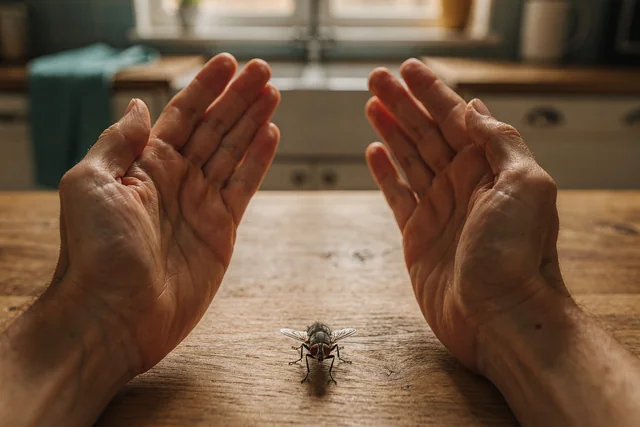
The simplest high-percentage technique uses your body to block one escape route and your hands to cover the other two.
What to do, step by step
- Let the fly settle. Chasing an airborne fly is wasted energy. Wait for it to land on a flat surface—a worktop, a window pane, a table.
- Stand so the fly is between you and a wall or window. This removes one escape direction.
- Bring both hands up slowly, either side of the fly, about 30 to 40 centimetres apart. Move at the same speed you’d use to pick up a sleeping baby—steady and smooth, no sudden stop-starts.
- When your hands are roughly level with the fly, pause for two full seconds. The fly may twitch, but it’s unlikely to fly if you haven’t accelerated.
- Clap your hands together an inch or two above the fly, not on it. The aim is to intercept the take-off zone, not the stationary body. Most people instinctively aim at the fly itself, but because the fly jumps before moving horizontally, your target should be the air just above.
- If you connect, you’ll feel the fly between your palms. Dispose of it quickly, then wash your hands.
This approach works without any gear, but it still requires a bit of patience. I’ve seen a Hackney café owner clear four flies from a window display in under two minutes using exactly this method after a customer complained. The difference wasn’t speed; it was waiting for each fly to land before moving.
Which Tool Gives You the Best Odds
You can swat a fly with a rolled-up magazine, a tea towel, a bare hand, or a dedicated fly swatter. Each has trade-offs, and the choice usually comes down to what’s within arm’s reach.
A fly swatter remains the most forgiving option. The flexible mesh head moves faster than a rigid object, and the holes reduce the air cushion that warns a fly. That’s a real advantage—the puff of air pushed ahead of a solid object can trigger the escape response before contact. A swatter also puts your hand farther from the strike zone, which is useful if the fly is resting on food preparation surfaces.
A bare hand gives you the most control over angle and timing, but sterility matters. Don’t swat flies on kitchen surfaces with your bare hand, and wash thoroughly afterwards. The clap method above works well with bare hands because you’re using two cupped palms, not a slapping motion.
A rolled-up newspaper is the classic improvisation, but it’s the least effective of the lot. Paper is thick, moves a lot of air, and telegraphs the strike. Use it only as a last resort, and aim slightly above the resting fly to account for the air cushion.
If you’re dealing with flies consistently—say in a conservatory that heats up every afternoon—it’s worth keeping a swatter in the room. It removes the scramble that gives the fly time to vanish behind a curtain rail.
What to Do When You Miss
Missing doesn’t mean the fly is impossible to catch. It just means you telegraphed your movement, or the fly chose an escape direction you hadn’t covered.
The most common mistake after a miss is chasing. People try to swipe two, three, four times in quick succession, and every swing gets slower and sloppier. By the third swipe, your hand speed has dropped enough that the fly can avoid you even without its escape jump.
Instead, step back. Let the fly settle again, even if that means waiting ninety seconds while it explores the ceiling. Use the time to reposition. Flies tend to follow a circuit around a room, often returning to a preferred landing spot. If you’ve seen it rest on a particular window pane twice, stand near that pane and wait rather than tracking it around the space.
You can also use a simple trick that exploits the fly’s response to contrast. In low light—even just drawing the curtains on a bright afternoon—a fly becomes much poorer at detecting slow movement. Dim the room, leave one window brightly lit, and you’ll often find the fly lands there within a minute or two. Approach while the contrast is high, and you’ve narrowed its escape routes to a single pane.
House Fly or Something That Needs a Different Plan
Not every small winged insect in your home responds to the same swatting approach. Before you spend twenty minutes stalking a fly, check what you’re actually dealing with.
House flies are the classic grey-and-black 6–7 mm species with reddish eyes. They rest on walls, windows, and ceilings, and they’re the ones covered by the angle approach above.
Cluster flies appear in autumn and winter, often gathering on south- or west-facing walls and inside loft spaces. They’re larger and slower than house flies, with golden hairs behind the head. Swatting a few won’t solve the problem—cluster flies emerge from wall voids and roof spaces in numbers, and you’ll kill half a dozen only to find a dozen more the next afternoon. That’s a loft treatment situation, not a swatting one.
Fruit flies hover around overripe bananas, onion bins, and recycling containers. At 3 mm, they’re tiny and erratic, and the clap method is overkill. A vinegar trap near the food source does the work more cleanly.
Fungus gnats look similar but hang around houseplant soil rather than fruit. If you’re seeing small dark flies rising from your peace lily every time you water, you’re not dealing with a house fly at all. Correct fungus gnat identification changes everything because the solution targets damp compost, not the air.
A few seconds of ID saves a lot of wasted swings. If the fly lands on a sunny window and walks rather than hops, it’s almost certainly a house fly. If it’s sluggish, clusters with others, and appears in cool weather, think cluster fly.
Not Every Fly Deserves a Swat
Most lone flies are a temporary annoyance—an open door, a torn window screen, a bin bag that stayed out too long. Swatting them is satisfying, and it’s often enough when the fly is clearly a one-off visitor.
A different picture emerges when you’re swatting three, five, eight flies a day from the same kitchen. That’s not a stray—it’s a sign of something attracting them regularly, and it usually means there’s a breeding site nearby. House flies breed in decaying organic matter: forgotten kitchen waste, a dead rodent under the floorboards, or spillage behind a bin that never quite got cleaned. In flats, a neighbour’s refuse can be the source even if your own space is spotless.
Restaurants and food premises have a legal obligation to manage fly presence under food safety regulations, but the same principle applies in a home kitchen: removing the source stops more flies from arriving. If you’ve searched, cleaned, and still can’t find the attractant, a professional pair of eyes is the next sensible step.
We occasionally get called out to a property in Barking or Dagenham where the homeowner has been swatting flies for a fortnight, convinced it’s just the summer heat. A quick check behind the understairs cupboard or inside a wall cavity often turns up a small dead mouse that’s turned into a fly nursery. That’s not something a swatter can fix.
If you’re past the point of one fly and you’re swatting daily, same-day professional fly control across East London can locate the source and treat it before the problem spreads.
Gadgets, Zappers, and When They Make Sense
If you’d rather not swat at all, there are hands-off options—but they vary in what they actually achieve.
Electric fly zappers with UV bulbs pull flies toward a charged grid. They’re effective in commercial settings like kitchens and food storage areas where flies are drawn to light, but in a domestic sitting room, the constant crackle and the risk of debris on surfaces make them a mixed choice. I looked at the real-world bug zapper effectiveness in a previous write-up—the short version is they work best when placed between the fly source and the area you want to protect, not in the middle of the room you’re trying to enjoy.
Sticky fly paper is cheap and silent, but it’s slow, and it looks terrible hanging from a lampshade while you wait. It’s better suited to utility rooms, garages, and sheds than to the kitchen where you’re trying to cook.
A battery-powered handheld vacuum with a narrow nozzle is the most underrated tool in this conversation. You don’t need to swat a fly if you can hoover it out of the air while it’s resting. The approach is the same—move slowly, get within 20 centimetres, then trigger the suction. The fly gets pulled into the dust compartment before it can jump. Empty the vacuum outside immediately afterwards unless you want it crawling back out. This method leaves no mess on walls or windows, and it’s the one I use most often when I’m dealing with flies in a finished kitchen where I don’t want to leave smears.
A Quick Word on Hygiene After the Kill
It’s easy to forget that a fly’s legs and body carry what it walked through before it landed on your windowsill. House flies feed on rotting material and waste, and they can transfer bacteria onto any surface they touch. After swatting, wipe the area with a household cleaner, especially if it was a food contact surface. Wash your hands before handling food, even if you used a swatter rather than your hands. These are small steps that take twenty seconds.
If you’re running a business kitchen, hygiene after a swat isn’t optional—it’s part of your documented pest management routine, and environmental health officers expect to see it logged. For a home, there’s no paperwork, but the same reasoning applies.
When the technique works and the fly is gone, you’re probably done for the day. If you’re still swatting the same volume a week later, the answer isn’t a faster swing—it’s finding out why they keep appearing. Give the kitchen bin area a thorough check, look behind white goods, and have a peek in the loft if it’s autumn. If you can’t locate the source or you’re seeing multiple flies every morning, a same-day inspection from a qualified technician is the quickest way to get back to a fly-free home.
Need professional help? BuzzKill offers fast, reliable pest control services across London and Essex.