
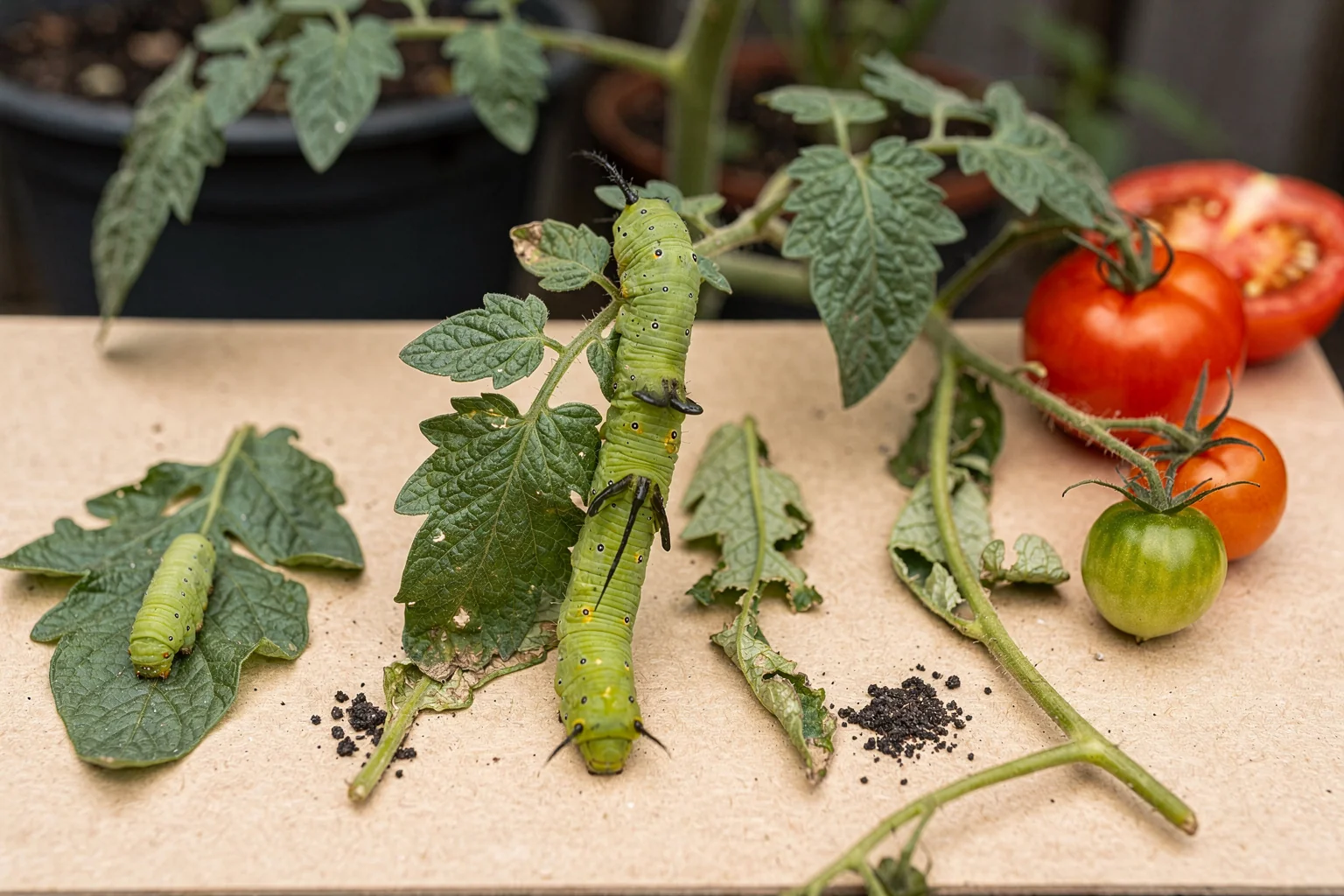
You step into the garden on a warm July morning, coffee in hand, and something about your tomato plants looks off. A whole branch is stripped bare. Leaves that were lush yesterday now have jagged edges — or are just missing. And then you spot it: a fat, bright-green caterpillar, as long as your finger, with a tiny horn at the rear. If that scene sounds familiar, you’ve probably found a hornworm on your tomato plants. There’s no need to panic. We’ve got a short, practical video from The Living Farm that walks you through exactly how to handle them, and we’ll add the UK-specific context the video doesn’t cover. Take two minutes to watch, then come back for the full guide.
Video: What’s eating your peppers and tomato plants
Spotting the Signs Before the Damage Gets Worse
Hornworm caterpillars are surprisingly hard to see at first — their green colour blends almost perfectly with tomato stems and leaves. The earliest clue is often not the caterpillar itself, but the damage it leaves behind.

Walk around your plants and look for these patterns:
- Leaves missing in large chunks. Hornworms don’t nibble delicately. They chew entire leaflets down to the midrib, sometimes stripping a whole branch in a night. As the caterpillar grows through its five larval stages (instars), its appetite increases dramatically — a single large hornworm can consume a surprising amount of foliage in 24 hours.
- Dark green or black pellets on leaves or soil. These are frass (caterpillar droppings), and they’re one of the most reliable signs. If you see little piles of what looks like coarse ground pepper, a hornworm is likely hiding somewhere above. The frass from a large hornworm is chunkier than the fine speckles left by smaller caterpillars like tomato moth larvae, so take a close look at the pellet size.
- Tomatoes with shallow, scooped-out holes. Hornworms sometimes feed on the fruit itself, leaving irregular craters that invite rot and secondary infections. Green fruit near the top of the plant is particularly vulnerable.
Take a moment to look at the remaining leaves for irregular, jagged edges rather than clean-cut holes. Hornworm feeding tends to start at the leaf margin and work inward, often leaving just the central vein. In heavy infestations, you may see whole stems defoliated almost overnight.
Once you know the damage pattern, finding the caterpillar is easier. Check the upper stems and the undersides of leaves, especially near the top of the plant where the newest growth is. They tend to rest along the stem during the day, motionless, relying on that camouflage. Early morning, when temperatures are cooler, is the best time to search because the caterpillars move more slowly. An experienced gardener I know in Hackney swears by the ‘frass patrol’ first thing with a mug of tea — she scans the soil for droppings, follows the line upward, and almost always finds the culprit clinging to a stem just above.
The caterpillar itself is unmistakable when you finally get a good look. Full-grown specimens reach around 7–10 cm, with a soft, plump body, short legs near the head, and a prominent curved horn at the rear end. The horn isn’t a stinger — it’s harmless — but it does look a bit alarming if you’ve never seen one up close. In the UK you’re most likely to encounter the tobacco hornworm (Manduca sexta) or the tomato hornworm (Manduca quinquemaculata), both of which appear on solanaceous crops like tomatoes, peppers, and aubergines. From a control perspective, the difference between the two species matters little; as one video guide puts it, any hornworm you find is a “voracious eater” and the same management methods work for both.
How a Short Video from The Living Farm Lays Out the Options
The embedded video above, How to Naturally Rid the Garden of Tomato Hornworms by The Living Farm (published September 2024), keeps things refreshingly simple: it runs through four natural control strategies that don’t involve synthetic chemicals. That’s especially useful for UK gardeners who are cautious about spraying anything around edible crops, or who garden on an allotment where organic approaches are expected.
Here’s a summary of what the video recommends, paired with how each method works in a British garden setting:
1. Floating row covers. The idea is to put a physical barrier — a lightweight horticultural fleece or insect mesh — over your plants early in the season, before the adult hawkmoths start flying. This stops the moths from laying eggs on the leaves. In UK gardens, products like Enviromesh or standard insect-proof netting work well; look for a fine mesh (0.6–1 mm) that still lets light and water through. In London greenhouse conditions, you can also use fine mesh over vents and doors to keep moths out altogether. Just remember to remove covers during flowering if your tomatoes are outdoors, or you’ll block pollinators too. For a small greenhouse, you might even install mesh panels over louvre vents, which can stay in place all summer without restricting airflow.
2. Hand-picking. The video suggests checking plants daily and dropping any caterpillars you find into a bucket of soapy water. It’s the lowest-tech solution and, honestly, the most effective if you only have a few plants. Early-morning inspections work best, because the caterpillars are sluggish when it’s cool. Wear gardening gloves if you’re squeamish, though hornworms are harmless to touch — they don’t bite or sting. The video from California Gardening demonstrates hand removal on tomatoes in under a minute, showing how quickly you can clear a plant once you know what to look for. If you’re struggling to spot them during the day, try a blacklight torch after sunset — hornworms glow slightly under ultraviolet light, making them much easier to locate against the foliage, a trick that’s gained popularity among US gardeners and works just as well in a dimly lit London back garden.
3. Companion planting. The Living Farm suggests planting basil, marigolds, or dill near tomatoes to repel hornworms or attract beneficial insects that prey on them. There’s solid gardening wisdom here, though it works better as a preventive layer rather than a cure for an active infestation. Dill, in particular, can attract parasitic wasps, which brings us to a natural ally the video doesn’t mention: braconid wasps. These tiny wasps lay their eggs inside hornworm caterpillars, and you’ll sometimes spot a caterpillar covered in what looks like white grains of rice — those are wasp cocoons. If you see that, leave the caterpillar alone; it’s already being dealt with by nature. The parasitic wasps emerge and continue the cycle, reducing hornworm numbers organically.
4. Bacillus thuringiensis (Bt) sprays. Bt is a naturally occurring soil bacterium that produces a protein toxic to caterpillars when ingested. It’s applied as a spray onto the leaves. The video frames it as a natural option, and it is—Bt is used widely in organic farming. In the UK, Bt-based products are available from garden centres and online retailers under brand names like Le Club Biocontrol or DiPel. You must check the label to ensure it’s approved for use on edible crops and that the specific strain targets caterpillars (usually B. thuringiensis kurstaki). Apply it early in the morning or on an overcast day, as UV light degrades it quickly. And because it’s selective for caterpillars, it won’t harm bees or most other beneficial insects—a key advantage if you’re trying to keep your garden wildlife-friendly.
One thing the video does not explore in depth is the timing of applications. Hornworm moths become active as temperatures rise, usually from late June through August in southern England. By July, you may already have caterpillars at various sizes, so if you’re using Bt, a couple of applications 7–10 days apart will cover the hatching window. For the best results, check the leaf undersides for newly hatched larvae (these are tiny, pale green, and only a few millimetres long) and treat immediately; small caterpillars are much more susceptible to Bt than the fully grown ones.
Why You Might See Hornworms in a London Garden or Greenhouse
Hornworms are not a classic UK garden pest in the same way that aphids or cabbage whites are. The species are native to the Americas and are far more common in the southern United States. So why are British gardeners occasionally finding them on their tomato plants?
The most common route is imported plants. Tomato seedlings, plugs, and potted pepper plants sold through garden centres, DIY stores, or online suppliers sometimes arrive with hornworm eggs already on the foliage. A London greenhouse—especially one in a sheltered spot like those in Lewisham, Hackney, or Waltham Forest—can mimic the warm, humid conditions that hornworm eggs need to hatch and mature. Once inside, the caterpillars have a protected environment and a steady food supply. I’ve seen a small community greenhouse in Tower Hamlets where a batch of imported chilli plants introduced hornworms in late spring; within three weeks, the caterpillars had munched through half the tomato crop before anyone realised what was happening.
Even outdoors, the urban heat-island effect in London can create microclimates where night-time temperatures stay high enough for these caterpillars to survive a few extra weeks. Areas like the City of London, Westminster, and parts of Hackney can be up to 5°C warmer than surrounding rural areas at night, providing conditions where hornworms might complete an extra generation. That doesn’t mean they’ll overwinter — our winters are still too cold for hornworms to establish a permanent population outdoors in the UK — but it does mean you might see a late-summer generation in a warm, south-facing garden, particularly if the summer has been unusually hot.
If you’ve recently bought tomato plants from a supplier that imports stock from continental Europe or beyond, it’s worth inspecting the leaves closely before you plant them out. Look for tiny, pearl-like spheres on the undersides of leaves; hornworm eggs are about 1.5 mm across, white to light green, and are laid singly — easy to miss unless you’re actively searching. A quick rinse with a gentle jet of water, followed by a week of observation in a quarantine corner of the garden, can catch any hitchhikers before they reach your main crop. For greenhouse growers, keep new arrivals in a separate propagation area for a week and check them daily; it’s far easier to deal with a single caterpillar on an isolated plant than to cope with a full-blown infestation across a dozen tomato vines.
What the Video Doesn’t Cover: Recognising Lookalikes and Related Pests
The Living Farm’s video focuses solely on hornworms, but in a UK garden or greenhouse, you might be dealing with more than one pest at the same time. It’s not unusual for a gardener to spot hornworm damage, start hand-picking, and then notice clusters of tiny green or black insects curled around new shoots — aphids. While hornworms are large and solitary, aphids colonise in numbers and can stunt growth before you really register the problem. I’ve written previously about aphid problems on tomato plants and why spraying alone rarely ends the cycle, so if you’re seeing distorted leaves alongside the big caterpillar bite marks, it’s worth tackling both issues.
Then there’s the tomato moth (Lacanobia oleracea), a native UK species whose caterpillars feed on tomato leaves and fruit, leaving damage that can look similar to hornworm feeding — ragged holes, missing foliage, and frass on the soil. These caterpillars are smaller (up to 4 cm), darker brown or green with a faint stripe, and lack the distinctive horn. The broad-spectrum feeding patterns can confuse the issue, so if you’re unsure, take a close-up photo of the caterpillar on a leaf and compare it with identification images from a reliable source; the University of Minnesota’s page, though US-based, has excellent close-ups that help distinguish hornworms from other large caterpillars.
There’s also a visual trick that occasionally fools gardeners: the hawk moth caterpillar (also called a lime hawk moth caterpillar or elephant hawk moth caterpillar) can look similar at a distance, with a plump body and a tail spike. Those species feed on different host plants — lime trees, willowherb, bedstraw — and are native to the UK. If you find a caterpillar on a tomato plant, the context alone usually confirms it’s a hornworm, but when in doubt, snap a clear photo and check against a guide.
And while you’re inspecting leaves, keep an eye out for tiny whiteflies or the fine webbing of red spider mites — both thrive in the warm, dry conditions of a London greenhouse and can weaken plants alongside caterpillar damage. The key is to treat each pest according to its own biology; a Bt spray, for example, will do nothing for aphids or mites. A solid integrated pest management (IPM) approach layers different controls — physical removal for hornworms, insecticidal soap for aphids, and improved ventilation for spider mites — so that you’re not relying on a single solution for multiple problems.
When a Pest Problem Outgrows the Vegetable Patch
Most hornworm issues on a handful of plants resolve with two or three days of consistent hand-picking, or a single well-timed Bt spray. But there are situations where the trouble hints at something bigger, and that’s where a professional eye can save you time and money.
Consider calling in a local technician if:
- You keep finding hornworm eggs on plant leaves even after removing every caterpillar you see, suggesting moths are repeatedly getting into a greenhouse or polytunnel.
- The damage has spread to multiple crop types and you’re not sure which pest is causing what — professional pest identification can prevent you from applying the wrong treatment.
- You manage a community garden or allotment with several plots close together; a hornworm problem in one raised bed can quickly move to neighbouring plots if the moths are not controlled.
- You’re a restaurant, café, or market gardener with a commercial growing space and need to maintain compliance with food-safety standards; an integrated pest management approach may be required, and documenting a professional assessment can be part of your due diligence.
BuzzKill Pest Control’s London-based technicians primarily handle household pests — rodents, insects, birds — but they’re well-versed in integrated pest management principles and can often advise on garden pest scenarios that have spilled into outbuildings, greenhouses attached to living spaces, or commercial kitchen gardens. For instance, a pub in Islington with a small kitchen garden found hornworms had spread from their outdoor tomatoes into a conservatory where they were growing herbs. A quick visit identified the entry points and led to a straightforward physical removal programme combined with mesh screening. Because BuzzKill offers same-day inspections across London and Essex — with no call-out charge — a phone conversation can clarify whether a site visit makes sense without any financial commitment.
If the caterpillars are confined to a few outdoor tomato plants and you’re managing them with the methods above, you almost certainly don’t need a professional intervention. That said, it’s worth taking photos and keeping a simple log of what you’re seeing and when — the dates of first damage, the size of caterpillars, how many you remove daily — so that if you do need help, you can give a technician a clear picture right from the start. The video ends with the reassurance that these four natural methods, used consistently, will keep hornworms under control. That’s true for the garden it was filmed in, but every garden is different. A London greenhouse in a built-up area, a shared allotment with neighbours growing the same crops, or a conservatory that traps heat well into the evening — each scenario shifts the timeline and calls for a slightly different combination of those tactics. Pick the approach that fits your space and your schedule, and if the caterpillars keep winning, don’t hesitate to pick up the phone for backup.
Need professional help? BuzzKill offers fast, reliable pest control services across London and Essex.