
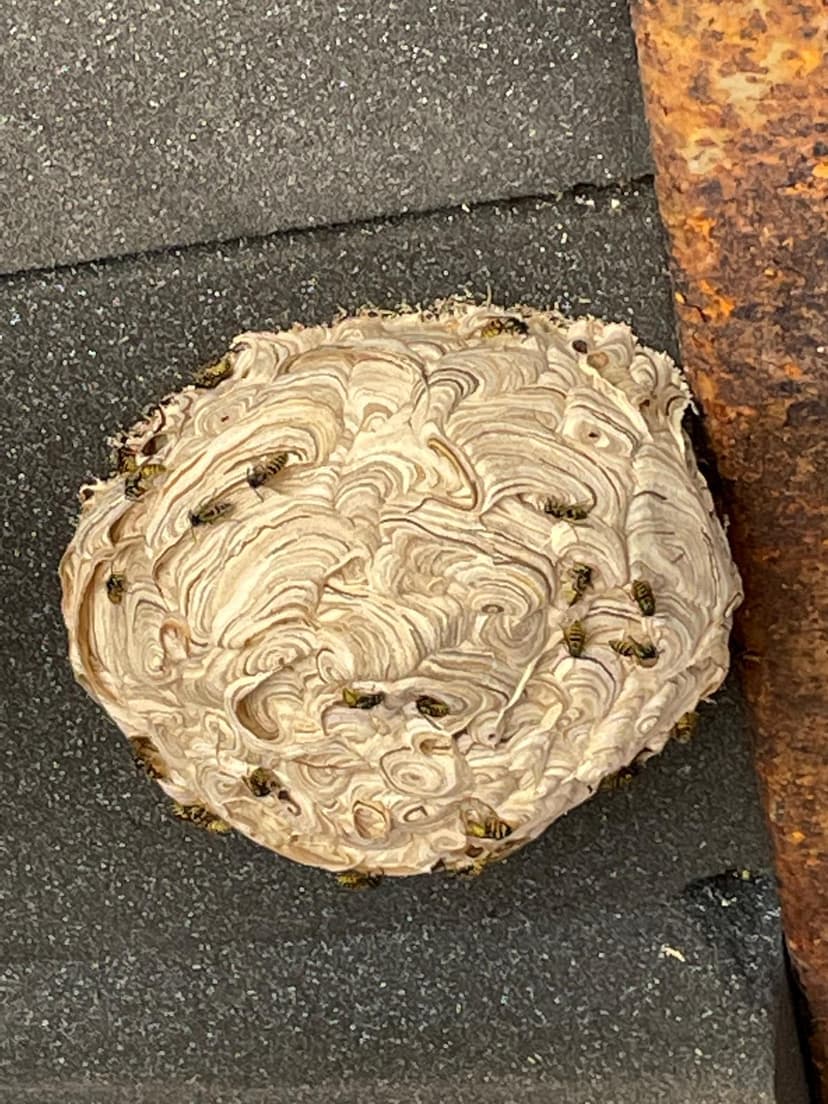
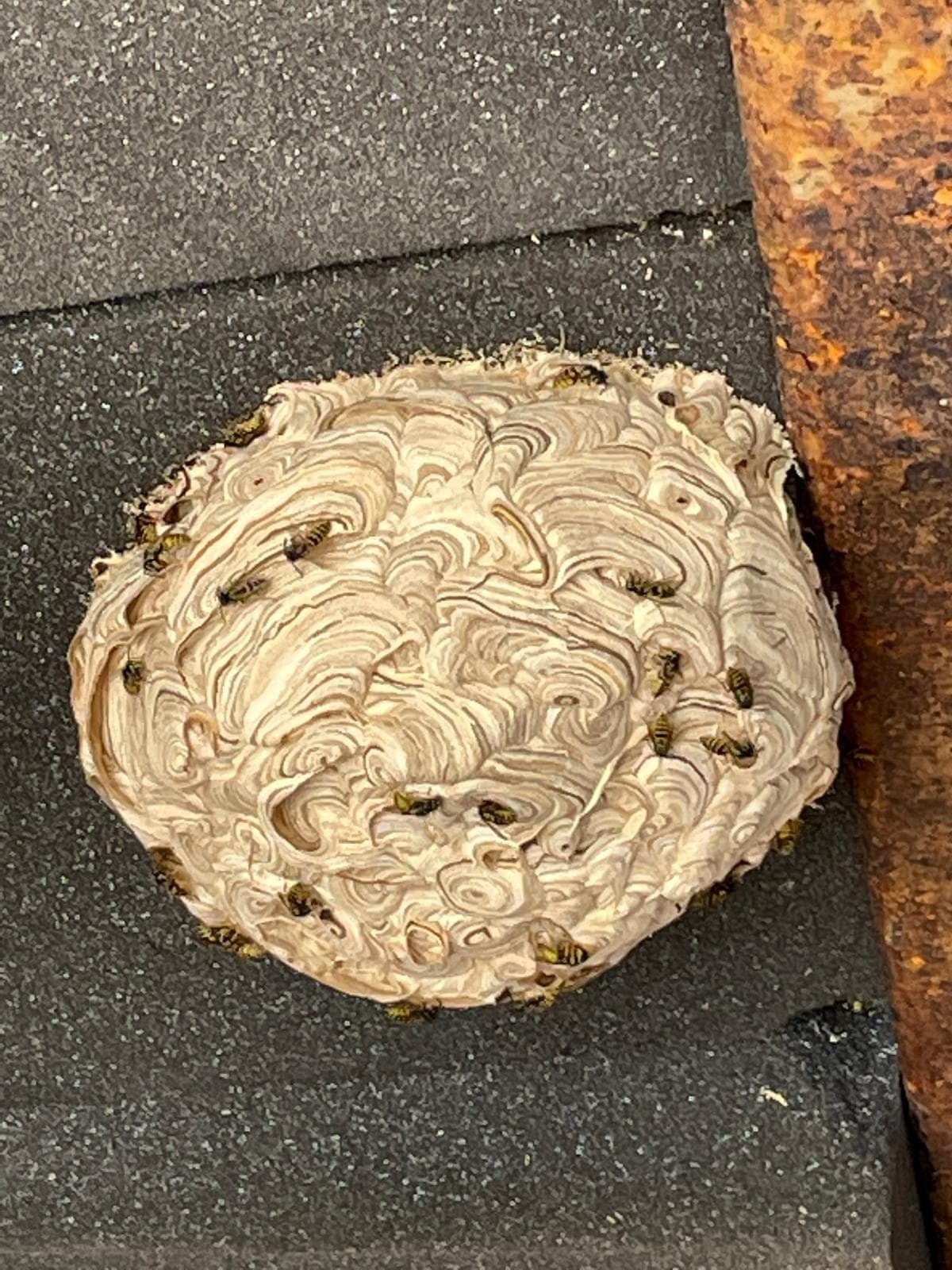
Hornets are the largest social wasps in the UK. The European hornet (Vespa crabro) is a native species that has been present in Britain for thousands of years. The Asian hornet (Vespa velutina) is an invasive species first detected in the UK in 2016 and poses a serious threat to honeybee populations.
Hornets are often feared because of their size, but European hornets are actually less aggressive than common wasps. This guide covers both species, the risks they pose, and what to do if you find a hornet or hornet nest.
Published:
How to Identify a Hornet
Hornets are sometimes mistaken for large wasps. These quick checks help you tell them apart:
Size — hornets are noticeably larger. European hornets are 20–35mm, Asian hornets 25–30mm. Common wasps are only 12–17mm.
Colour — European hornets have a reddish-brown head and thorax with yellow-brown banding — they look like a large brown wasp, not bright yellow. Asian hornets are predominantly dark brown or black with a single orange-yellow band and distinctive yellow-tipped legs.
Active at night — European hornets fly at night and are attracted to lights. If a large wasp-like insect is buzzing around your lights after dark, it is almost certainly a European hornet. Common wasps are not active at night.
Nesting — European hornets nest in hollow trees, wall cavities, and lofts with smaller colonies of 400–700 workers. Asian hornets build large nests (up to 60cm+) high in trees, often above 10 metres.
For detailed identification of all wasp, hornet, and bee species, see our species identification guide.
European Hornets — When to Treat
European hornets are native, ecologically beneficial, and less aggressive than common wasps. They prey on flies, wasps, and other insects, making them useful garden predators. A nest should only be treated if it poses a direct safety risk.
Leave alone if — the nest is in an undisturbed location such as a tree, hedge, or outbuilding not regularly used. The colony dies naturally in autumn and the nest will not be reused.
Treat if — the nest is near a doorway, pathway, children's play area, or where someone in the household has a sting allergy. The sting is more painful than a common wasp sting due to their larger size.
Treatment — the process is the same as for wasp nests. Insecticidal dust is injected into the nest entrance and the colony dies within hours. Visit our Wasp Removal page or call 0203 468 1999.
Need professional help with wasp removal? BuzzKill Pest Control offers fast, effective treatment with no call-out charge.
Asian Hornets — Report Immediately
The Asian hornet (Vespa velutina) is an invasive species and a serious threat to UK honeybees. A single Asian hornet can kill up to 50 honeybees per day. Sightings have been confirmed in southern England and the species is expected to spread further.
If you see an Asian hornet or an Asian hornet nest, do not attempt to treat or disturb it. Report it immediately:
Asian Hornet Watch app — free on iOS and Android. Take a photo and submit with your location.
Email — alertnonnative@ceh.ac.uk with a photograph and location details.
Online — report via the Non-Native Species Secretariat website.
The Animal and Plant Health Agency (APHA) investigates confirmed sightings and destroys nests. Asian hornet nest destruction is handled by government agencies, not private pest controllers, because containment is a national priority.
Frequently Asked Questions
Are hornets more dangerous than wasps?
European hornet stings are more painful due to their larger size, but hornets are actually less aggressive than common wasps. They rarely sting unless the nest is directly disturbed. Allergic reactions can occur to hornet stings just as with wasp stings.
Are there Asian hornets in London?
Asian hornet sightings have been confirmed in southern England, and the species is expected to establish in the UK over coming years. Sightings in London are currently rare but should be reported immediately via the Asian Hornet Watch app.
Can a hornet sting kill you?
A single hornet sting can cause anaphylaxis in allergic individuals, which can be fatal without emergency treatment. For non-allergic people, a single sting is painful but not dangerous. Multiple stings are more serious — seek medical attention if stung many times.
Do hornets come out at night?
Yes. European hornets are active at night and are attracted to light. They may fly into lit rooms through open windows. Common wasps are not active at night. If a large wasp-like insect is flying around your lights after dark, it is most likely a European hornet.
Should I kill a hornet?
European hornets are native and beneficial predators — killing individuals is not recommended unless they are inside your home. If you have a nest causing a problem, call a pest controller. If you see an Asian hornet, do not kill it — photograph it and report it so the nest can be located and destroyed by the authorities.
Professional Wasp Removal Service
Learn more about our wasp removal service, pricing, treatment methods, and customer reviews.
View Wasp Removal Service