
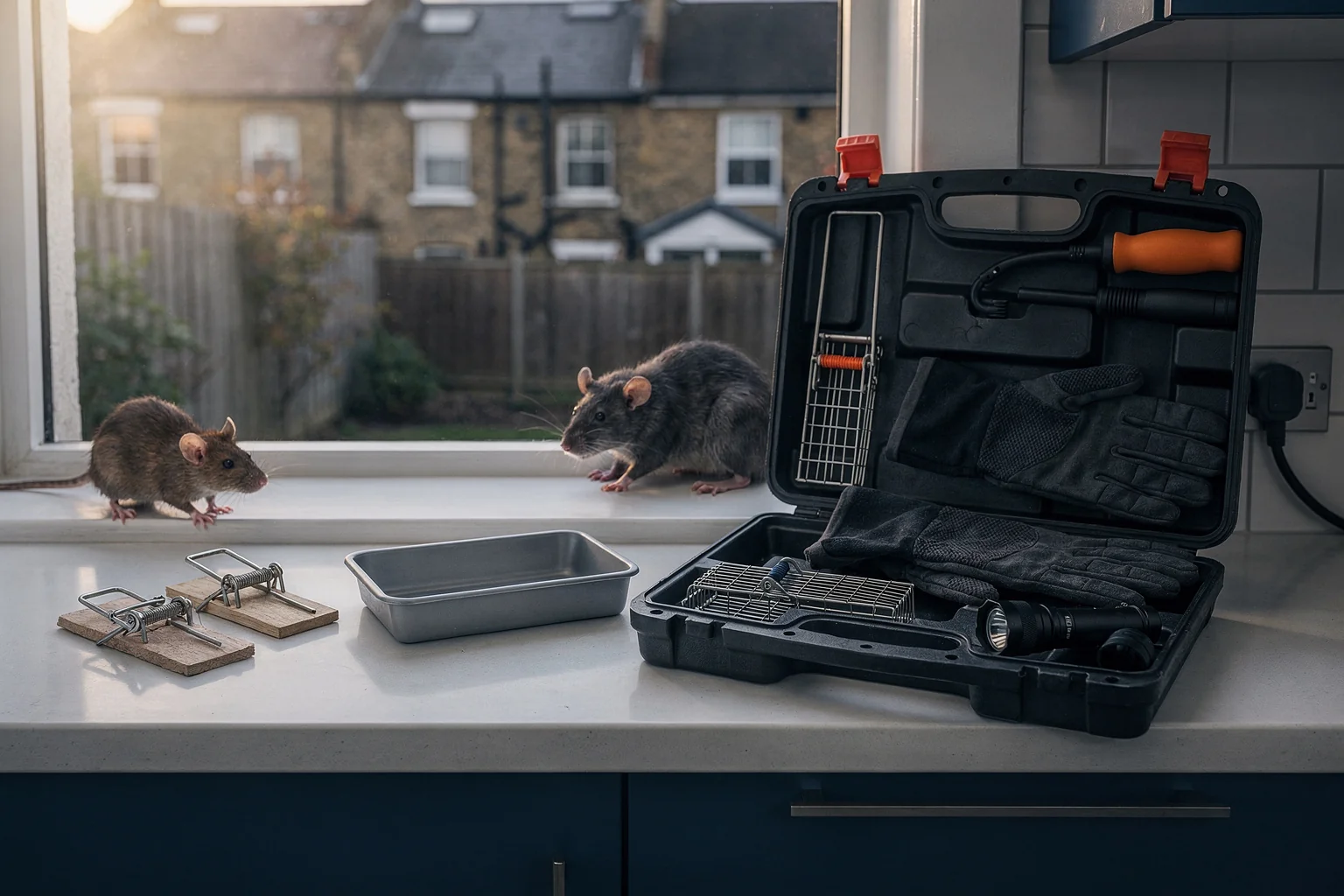
A scratching sound in the wall at 2 a.m. A scattering of dark pellets behind the kitchen bin. For most Londoners, the first reaction is the same: “I’ve got a rodent problem.” And then comes the more expensive thought — “I’ll just buy some traps and poison from the hardware shop.”
The problem is that rats and mice look similar in a blurry torch beam, but their behaviour, entry points, breeding speed, and response to control measures are completely different. Treating a rat infestation like a mouse problem almost always fails. Putting down the wrong bait in the wrong place can even make things worse — building resistance, scaring the animals into new areas, and wasting weeks while the population grows.
This article walks through the practical differences that matter when you’re standing in your Hackney kitchen or Greenwich loft, trying to work out what’s actually inside your walls. We’ll cover what to look for, how the two species behave inside London homes, and why the treatment plan has to be built around the animal — not the other way round.
The cost of guessing wrong
In 2023, local authority data showed that UK councils recorded 271,343 rodent infestations — a jump of over 20% in a single year, based on analysis by Direct Line Group and published on RatGate. In London, the picture is intensified: dense terraced housing, old sewer networks, and shared walls mean that a misidentified rat or mouse problem in one flat can become a building-wide issue inside a fortnight.
If you confuse rats with mice, you’re likely to:
- Underestimate the entry points. A brown rat (Rattus norvegicus) can squeeze through a gap the size of a 50p coin. A house mouse (Mus musculus) can slip through a hole the width of a biro. Sealing the wrong gaps lets one species in while you focus on the other.
- Use the wrong trap size. A snap trap sized for mice won’t hold a rat, and a rat trap left along a mouse run will be ignored.
- Misjudge the scale. A single pair of brown rats can produce up to 60 offspring a year given shelter and food. Mice breed even faster, with a female capable of having a new litter every three weeks. Spotting early signs of rats or mouse infestation signs lets you act before the numbers explode.
Size, droppings, and sound: the first three things to check
Most of the time, you’ll hear or see evidence long before you see the animal. Start with what’s measurable.
Body size. Adult brown rats are heavy. A body length of 20–25 cm (not counting the tail) is typical, and they can weigh over 300 grams. House mice are far smaller — roughly 7–10 cm body length, and lighter than a standard AA battery. The UK rat species most often found indoors is the Norway rat; the black rat is almost certainly absent from London homes, despite persistent myths about “roof rats” in Hackney attics.
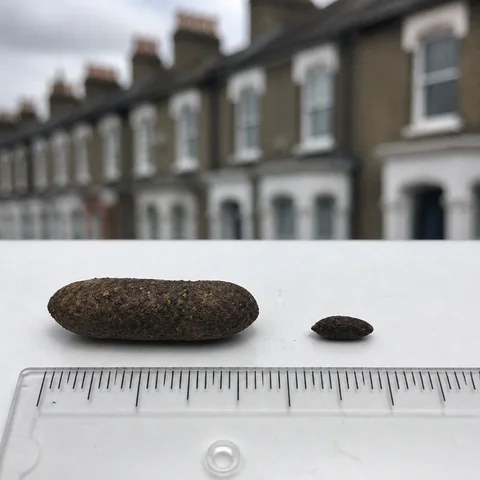
Droppings. This is the most reliable clue when you can’t see the animal. Rat droppings are capsule-shaped, dark brown or black, and noticeably large — roughly 12–20 mm long. Mouse droppings are small, pointed at the ends, and typically 3–8 mm. As a rough guide: if a dropping is larger than a grain of rice, suspect rats. A detailed rat droppings guide can help you compare safely, and mouse droppings identification covers the smaller end of the scale. Because rodent urine and faeces can carry bacteria, it’s worth reading up on safe cleanup before you handle anything.
Sound. Rats tend to produce heavier scurrying and gnawing, often in wall cavities, under floorboards, or in loft insulation. Mice move more quickly and their gnawing is lighter; you might hear persistent scratching behind skirting boards or inside kitchen cupboards. If the noise sounds like something the size of a kitten moving through the stud wall, that’s almost certainly a rat.
Where they nest and why it matters for control
Mice are agile climbers and curious explorers. The Home Office code of practice for rodents describes the house mouse as a “largely nocturnal burrowing and climbing animal” that prefers to stay close to walls and vertical surfaces, relying heavily on smell and creating urine trails to mark its environment. Indoors, you’ll find their nests in wall voids, behind appliances, inside stored boxes, and within the insulation of warm loft spaces.
Rats, derived from the wild brown rat, are described in the same document as “a highly social animal” that generally travels along established routes and is wary of new objects. In a London terrace, they’ll often enter at ground level — through broken drain pipes, gaps around soil stacks, or disused chimney breasts — and then move up into cavity walls and suspended floors. The London protocol for dealing with sewer rat infestations highlights the need for coordination between councils and Thames Water because a significant proportion of surface rat problems actually begin in the sewer network and then enter properties through defects in private drainage.
That means a house with rat activity at ground-floor level may be dealing with an issue that started deep underground — while a mouse problem on the third floor of a converted flat could be entirely self-contained within the walls and ceiling voids. The approach for each is completely different.
Why rat control and mouse control aren’t the same job
The treatment plan has to match the biology. Rats are neophobic: they avoid new objects appearing in their territory. A freshly laid bait box or trap may be ignored for days. That’s why professional rat treatment often involves a “run” strategy — placing stations along established paths and letting the animal become comfortable before any lethal agent is introduced.
Mice are more curious and will explore new items quickly, but they feed in a “nibble and move” pattern, taking small amounts from many locations. A handful of bait stations placed centrally won’t do the job; you need multiple small placements along the skirting boards, inside cupboards, and near food sources.
Regulation now reinforces the case for professional treatment. Since January 2026, the purchase of professional-use rodenticides in England, Scotland, Wales, and Northern Ireland requires proof of competence and CRRU UK-approved certification at the point of sale. Glue traps, meanwhile, will be banned in Scotland from July 2026 under the Wildlife Management and Muirburn (Scotland) Act, and the wider UK is watching that shift closely. The message from the Transport for London pest control guidance mirrors this: in a dense urban environment, uncontrolled rodent populations present a real public health risk, and the methods used to control them must be safe, targeted, and compliant.
Put another way: if you’re a homeowner in Barking or Enfield who bought a generic rodent poison block from the garden centre last summer, you may no longer be able to legally buy the same product without proof of competence. And if you’re a landlord in Tower Hamlets managing a tenancy with a reported pest issue, relying on uncertified bait could leave you exposed if a tenant complains to the council. Solid rat removal methods now start with correct identification and a site survey, not a bucket of bait.
What other pest professionals get right — and what’s often left out
Several UK pest control companies have published their own guides on telling rats from mice. Reading across them gives a fuller picture — but also reveals persistent gaps.
JG Pest Control

JG Pest Control’s guide is a practical, numbers-first breakdown. It anchors the difference in measurements: brown rat droppings at 12–20 mm, mouse droppings at 3–8 mm, and the 8 mm threshold as the decision point. The piece rightly emphasises that both species reproduce rapidly and need prompt treatment. Where it could go further is connecting those droppings to the likely entry zone on the property — something that really matters in London’s Victorian conversions, where a rat dropping behind the washing machine means something different from a mouse dropping in the loft hatch.
Bugwise Pest Control
mouse vs rat infestation makes a point that many guides miss: snap traps and bait placed without species-level identification often fail, and proofing work done without knowing which animal you’re dealing with can miss the actual entry points entirely. That’s the right mindset. The article is stronger on behavioural contrast — rats as cautious route-followers, mice as nibblers — than on the structural side, but it’s a solid justification for a pre-treatment inspection.
Gov.uk

The gov.uk pest control page is the statutory anchor. It lists permitted methods, prohibited tools (including glue traps for rodents in Scotland, and explosives), and routes to find a qualified pest controller through the British Pest Control Association or the National Pest Technicians Association. What it doesn’t do is help the average Lewisham householder tell a mouse dropping from a dead fly at 7 a.m. — which is exactly why these practical identification guides exist.
Pestology

Pestology’s “Myths of Rodent Control” is one of the more useful myth-busters online. It directly addresses the “roof rat” myth (the black rat, Rattus rattus) and explains why almost every rat found in a UK roof is actually the Norway rat — the so-called sewer rat. The article’s strength is its grounding in field experience: “at the time of writing we are undertaking around 150 jobs each month.” It also acknowledges that many customers arrive with preconceptions formed from internet forums, which is a reminder that good identification advice has to cut through a lot of noise.
Inoculand Pest Control
Inoculand’s piece focuses on mice in London flats and houses, which is a valuable narrowing of the topic. The title suggests it’s about removal, but the underlying premise is the same as this article’s: the treatment only works if you know exactly what you’re treating.

Across these five perspectives, the common thread is clear: size the evidence, don’t guess, and treat the animal’s habits, not the problem’s name. The gap most guides share is a lack of London-specific structural context — shared drains, converted cellars, party wall disrepair — which is where local knowledge really counts.
London pressure points: drains, terraces, and a warmer climate
London homes face particular rodent pressure that a generic guide can’t easily address. Victorian and Edwardian terraces often share roof spaces, party wall cavities, and below-ground drainage. If one house on the row has a broken drain collar, every connected property becomes a candidate for rat ingress. The London Sewer Rat Baiting and Treatment Protocol exists precisely because surface baiting alone can’t solve a problem that originates 6 feet underground in a Thames Water sewer.
Warmer winters and record summer temperatures have also pushed rodent activity higher. Rentokil recorded a 10% year-on-year increase in confirmed rodent activity heading into 2026, according to Property Watchdog, and BASF’s rural rodent survey found rodenticide resistance rising on farms — both indicators that the UK’s rodent population is not only growing but becoming harder to control with off-the-shelf products.
For the homeowner, the practical takeaway is that early rat infestation signs are not just about droppings in the kitchen. They include greasy smear marks along walls where rats repeatedly travel, burrows in the garden near the house wall, and gnawing on the bottom edge of wooden doors or air bricks. Signs of mice tend to be less destructive but more pervasive — tiny holes in food packaging, shredded paper or fabric in hidden corners, and a musky smell in enclosed cupboards.
If you’re in a Camden basement flat and you’re finding fresh droppings in the morning, the first question isn’t “which poison should I buy?” It’s “am I looking at a rat that came up through the floor from a broken drain, or a mouse that’s nesting in the kitchen kickboard?” That single question changes everything about what to do next — and how urgently to act.
If the evidence points to rats, London rat control that starts with a site survey, drain inspection, and targeted treatment plan will almost always beat a few bait boxes bought online. If you’re dealing with mice, sealing the tiny entry points in the kitchen and loft, combined with multiple small bait placements, is the foundation — and that mice extermination for London properties tends to succeed when it’s built around the animal’s feeding pattern, not a one-size-fits-all routine.
Need professional help? BuzzKill offers fast, reliable pest control services across London and Essex.