
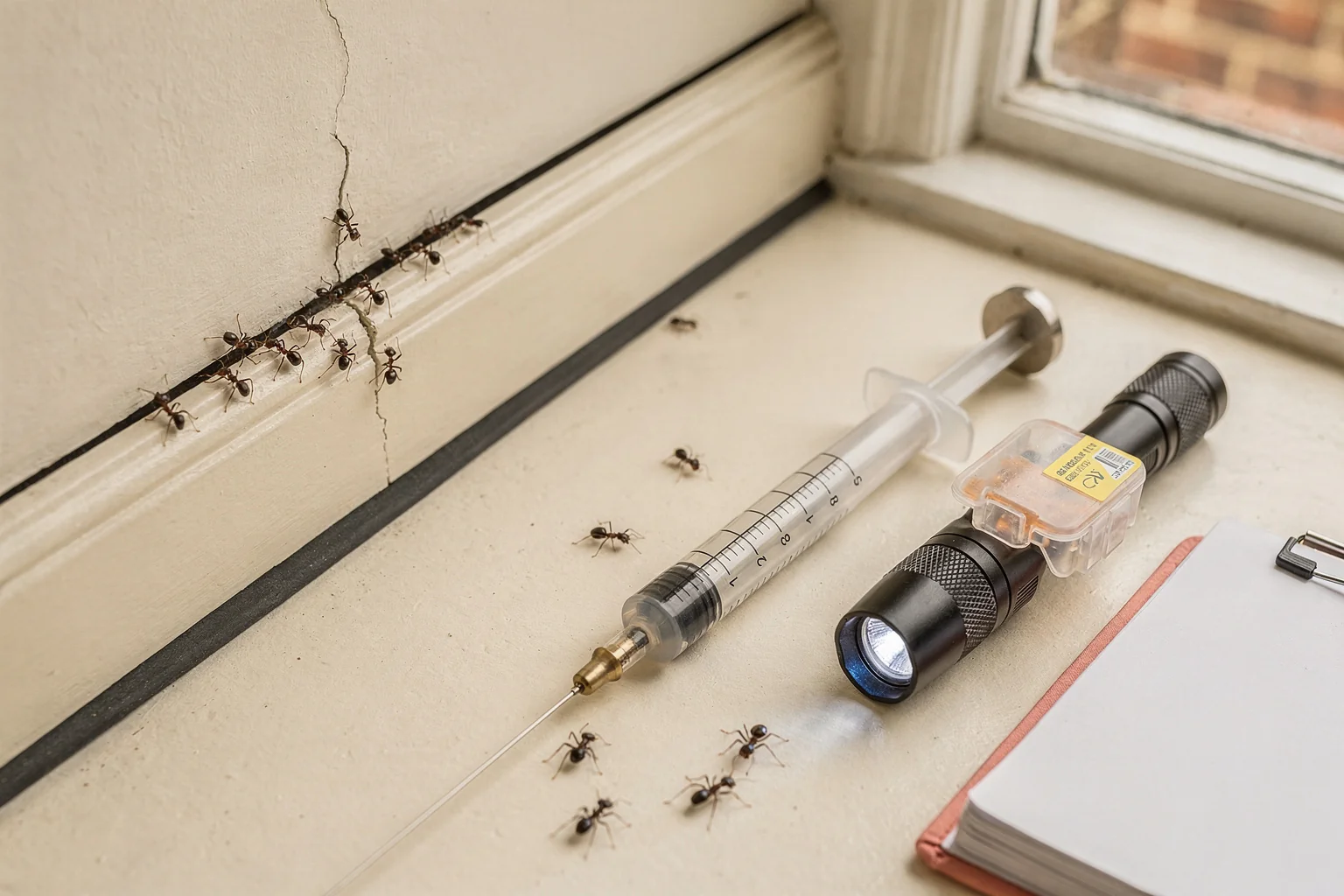
The black garden ant — the one you see marching across your Greenwich kitchen worktop at 6am — rarely lives in your kitchen. The colony is almost certainly inside a wall cavity, under the floorboards, or behind the skirting boards of your Victorian terrace, 1930s semi, or new-build flat near the Peninsula. The worker you spotted is simply the forager, following a pheromone trail back to a nest you cannot see.
That gap between your skirting board and the floor? A one-millimetre opening is enough. In dense East London boroughs like Greenwich, where older properties share party walls and newer developments sit on former industrial ground, ants exploit these routes constantly. During the record heat of June 2026, one London pest firm recorded 32 ant callouts in a single day — roughly 3.4 times their normal summer average — as colonies expanded and sent out more foragers.
This list ranks the seven most reliable signs that ants have moved into your walls, not just your sugar bowl. Each sign includes what to look for, where to check, the common misread that wastes time, and the threshold for calling a professional rather than reaching for another can of spray.
1. Persistent Foraging Trails That Reappear Within Hours
You wipe the counter. You seal the honey jar. Two hours later, the line of ants is back, following precisely the same path. This is the single most telling sign of a wall nest.
A lone scout wandering randomly is normal in summer. A repeating trail means a colony has mapped your home. The pheromone highway runs from a food source back to a nest cavity, often travelling along the back of kitchen cabinets, under laminate flooring, or behind tile grout. In Greenwich's older housing stock — the Victorian terraces around East Greenwich, the ex-council stock in Charlton — these routes frequently follow the voids left by original plumbing or gas pipes.
Where to check: Follow the trail to its apparent end. If it disappears into a crack where the worktop meets the wall, or under the kickboard of a fitted kitchen, the nest is likely behind that surface. Shine a torch into the gap. You may see ants moving in both directions, which confirms an active route to a colony.
The common misread: Assuming the nest is "outside somewhere" because you saw ants near the back door. Black garden ants travel substantial distances, but if the trail is consistent and rapid, the nest is probably closer than you think.
When to escalate: If the trail reappears after cleaning and sealing food for 48 hours, the colony is established inside the building envelope. Surface sprays will kill visible workers but leave the queen and brood untouched. This is where DIY ant control limits become apparent — the nest survives, and the trail returns within days.
2. Frass Piles Near Baseboards or Window Frames
Ants do not produce wood shavings like woodworm or termites. But they do excavate soft mortar, decaying timber, and insulation to expand nest chambers. The resulting material — a mix of soil particles, insulation fragments, and ant body parts — accumulates in small piles where the colony breaches an internal surface.
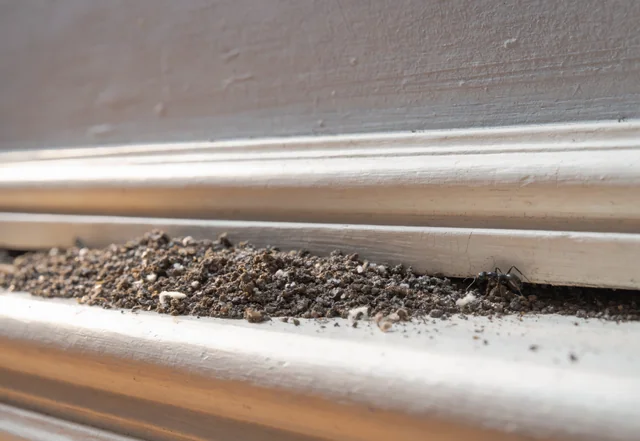
In Greenwich, this sign appears most often in pre-war properties with lime mortar or in flats where cavity wall insulation has settled and created accessible voids. The frass is typically dark, fine, and slightly greasy to the touch. You might find it where a radiator pipe enters the wall, beneath a window sill with cracked pointing, or along the junction between an original wall and a later extension.
Where to check: Run a finger along the bottom of skirting boards, particularly in rooms with external walls. Check window reveals, especially on south-facing elevations where thermal expansion has opened mortar joints. Look behind furniture that has not moved in months.
The common misread: Dismissing the material as general dust or debris from building settlement. If the pile grows or reappears after vacuuming, it is active excavation.
When to escalate: Frass indicates structural modification by the colony. The ants are not merely visiting; they are engineering their environment. At this stage, gel baits placed on the surface rarely penetrate far enough into the wall void to reach the brood chamber. A technician needs to locate the exact cavity and apply targeted treatment.
3. Rustling or Tapping Sounds in Quiet Rooms
Ant colonies produce sound. Worker ants stridulate — rub body parts together — as a distress signal when the nest is disturbed. In large colonies, this creates a faint rustling, like dry leaves or very fine crackling, audible in quiet conditions. You may also hear tapping as workers excavate, particularly in soft plasterboard or decaying timber.
This sign is most detectable at night, when household noise drops and ant activity peaks. In Greenwich's converted flats, where original plaster and lath meets modern stud walls, the acoustic transmission can be surprisingly clear. One homeowner near Greenwich Park described hearing "a kind of static" from the party wall at 2am, which turned out to be a colony of several thousand ants in a cavity where a soil pipe had leaked and rotted the adjacent timber.
Where to check: Place your ear against walls in rooms where you have seen ant activity, particularly after dark. Focus on walls with known moisture issues — previous leaks, condensation-prone external walls, or areas near bathrooms. A stethoscope, or even a glass tumbler pressed to the wall, can help.
The common misread: Attributing the sound to mice or birds. Rodent noise is typically more irregular and includes gnawing. Insect stridulation is continuous and rhythmic, rising if you tap the wall sharply.
When to escalate: Audible colony noise indicates substantial nest size. The British Pest Control Association notes that species such as Pharaoh's ants and ghost ants, increasingly found in heated London properties, should only be dealt with by qualified members because incorrect treatment causes colonies to split and spread. Even with common black garden ants, a nest large enough to hear requires professional assessment to determine the full extent before treatment.
4. Winged Ants Emerging from Wall Fixtures
Flying ants are not a separate species. They are the reproductive caste — males and virgin queens — produced by established colonies for the annual nuptial flight. When you see winged ants emerging from a light fitting, air vent, or the gap around a pipe, the colony has matured and is expanding.
In 2026, Flying Ant Day in London fell on 26 June, coinciding with the hottest June day on record at 37.7°C. But indoor emergence can happen earlier and continue later if the building provides stable warmth. In Greenwich's riverside developments, where underfloor heating runs through the cooler months, colonies may produce alates outside the normal seasonal pattern.
Where to check: Window frames, ceiling roses, extractor fan housings, and the gaps around radiator pipes are common exit points. Winged ants are attracted to light, so you may find them on window sills or near lamps in the evening. Dead wings on the floor, shed after mating, are a reliable indicator even if you missed the live emergence.
The common misread: Treating flying ants as "just passing through" from outside. If they are emerging from internal fixtures, the colony is inside. Sealing the visible exit point simply forces the next generation to find another route.
When to escalate: A colony producing alates is mature and well-established. The presence of multiple winged ants suggests the nest has been active for at least one full season, possibly longer. Surface treatments will not address the brood cycle that generates future colonies. Professional heat treatment or targeted insecticidal dust in wall voids is typically required.
5. Moisture Damage or Discolouration with No Obvious Leak
Ants need water as well as food. In wall cavities, they are drawn to condensation, pipe sweat, or residual moisture from old leaks. Their constant movement through damp material can spread moisture and create visible staining on internal surfaces that seems to have no source.
In Greenwich's Victorian and Edwardian housing, where lead pipes have been replaced piecemeal and cavity insulation sometimes bridges damp courses, this sign is particularly misleading. You notice a spreading patch on the plaster, assume a roof or plumbing leak, and call a builder. The builder finds no leak. The stain continues. The ants, meanwhile, are farming the damp zone for hydration and using it as a nursery area for brood.
Where to check: Any wall with unexplained staining that does not correspond to known plumbing, particularly in ground-floor rooms or below bathrooms. Look for a musty smell, which may accompany ant activity in damp voids. Thermal imaging, available from some pest control firms, can reveal the heat signature of a dense colony behind apparently dry plaster.
The common misread: Pursuing plumbing repairs or damp-proofing work before ruling out biological activity. Ant-related moisture spread is often misdiagnosed as rising damp or condensation, leading to unnecessary expense.
When to escalate: If moisture staining persists after plumbing checks, or if you have already had damp treatment with no resolution, request a pest inspection alongside building assessment. The pesticide regulations for homeowners restrict what can be applied in wall voids without certification; professional access to insecticidal dust formulations and application equipment is typically necessary.
6. Ant Activity in Multiple Rooms with No Clear Food Source
A single foraging trail to the honey jar is straightforward. Ants appearing in the upstairs bathroom, the downstairs cloakroom, and the kitchen — with no food in two of those rooms — indicates a colony using the wall cavity network as a highway system.
In terraced and semi-detached Greenwich properties, party walls and continuous floor voids allow colonies to range across multiple rooms without emerging into open space. Newer flats with service ducts and shared risers provide similar connectivity. The ants you see in the bathroom are not there for food; they are travelling through, or they have found moisture, or they have established a satellite nursery.
Where to check: Map every sighting by room, time, and whether food or water was present. Multiple sightings on different floors, or on opposite sides of the same wall, suggest cavity movement. Look for the smallest signs — a single worker on a windowsill, two or three in a sink — as these may be strays from a main trail rather than random wanderers.
The common misread: Treating each room as a separate "ant problem" with its own bait station. This scatters treatment and misses the central colony. The BPCA emphasises that correct identification and locating the nest is vital, as dusts and sprays applied blindly can cause colony budding in some species.
When to escalate: Distributed activity across three or more rooms almost certainly means a single large colony or multiple connected nests. Baiting every room is inefficient and may stress the colony into dispersing. A technician needs to trace the network, often using non-repellent tracking gels or thermal detection, before selecting treatment points.
7. Failed DIY Treatment with Escalating Ant Numbers
This is the sign that homeowners most often misinterpret. You used ant bait. You saw increased activity for a few days — the label said this was normal, as workers carry bait to the colony. Then the numbers dropped. Then, two weeks later, they surged higher than before.
What happened? The bait killed a portion of the workforce, but not the queen. In a stressed colony, the queen increases egg production to replace losses. Some ant species, when detecting repellent chemicals, will bud — split into multiple satellite colonies with their own queens. Your single nest has become three. The numbers you see now are the recovery, amplified.
In Greenwich's competitive rental market, where tenants may attempt quick fixes before informing landlords, this pattern is common. A £5 bait station from the supermarket, applied without understanding the colony structure, can convert a localised problem into a building-wide issue.
Where to check: Review your treatment history. Did numbers drop then rebound? Did activity shift to new rooms? Did winged ants appear after treatment? These are all stress responses, not success indicators.
The common misread: Believing that "more ants after bait means it's working." Initially, yes. Sustained increase after three weeks means the colony is compensating for losses and the treatment has not reached the reproductive core.
When to escalate: If any DIY treatment has failed to eliminate activity within 21 days, or if activity has increased or spread, stop treating and call a professional. Continued amateur intervention reduces the effectiveness of subsequent professional treatment by altering ant behaviour and dispersing the colony. This is precisely when ant bait failure signs indicate that technician intervention is the practical next step.
What a Professional Greenwich Ant Inspection Actually Involves
A proper inspection starts with species identification. The black garden ant (Lasius niger) is straightforward. Pharaoh's ants (Monomorium pharaonis), increasingly common in heated London buildings, require entirely different treatment — they are smaller, yellowish, and their colonies bud aggressively when disturbed. Ghost ants (Tapinoma melanocephalum) are newer to the UK but established in some tropical plant nurseries and heated commercial premises.
The technician will trace activity with non-repellent tracking gels, use borescopes or thermal cameras to locate wall void colonies, and assess moisture and building factors that sustain the nest. Treatment selection depends on colony location, species, and building type — insecticidal dust for dry voids, gel baits for sensitive areas, or targeted spray applications where appropriate.
In Greenwich, typical ant treatment costs range from £115 to £569 depending on property size and infestation extent, with an average around £209 based on recent local data. This generally covers inspection, treatment, and a follow-up visit to confirm colony elimination. For NPTA-registered firms, treatment comes with guaranteed return visits if activity persists.
Questions Greenwich Homeowners Ask About Hidden Ant Colonies
Can ants damage my property like termites? Black garden ants do not eat wood, but their excavation of soft mortar, damp timber, and insulation can accelerate existing decay. In extreme cases, large colonies have caused plaster to crack and electrical conduits to fail where damp and ant activity combined.
Why do ants keep coming back after I clean? Cleaning removes food sources but does not remove the colony. The pheromone trail is re-established quickly if the nest remains. Permanent resolution requires eliminating the queen and brood, not just the visible workers.
Are ant treatments safe around children and pets? Professional treatments use targeted application in wall voids and cracks, minimising exposure to living spaces. Gel baits are placed in inaccessible locations. Your technician should explain specific precautions for your property and family situation.
How quickly can a professional respond in Greenwich? Same-day or next-day inspection is standard for most local pest control firms during the active season, with some offering evening and weekend appointments for working households.
If you have checked three or more of the signs above and suspect a wall colony, the practical next step is a professional inspection before further DIY treatment risks dispersing the nest. A technician can confirm species, locate the colony, and apply treatment that reaches the reproductive core — the only way to stop the trail from returning.

Need professional help? BuzzKill offers fast, reliable pest control services across London and Essex.