
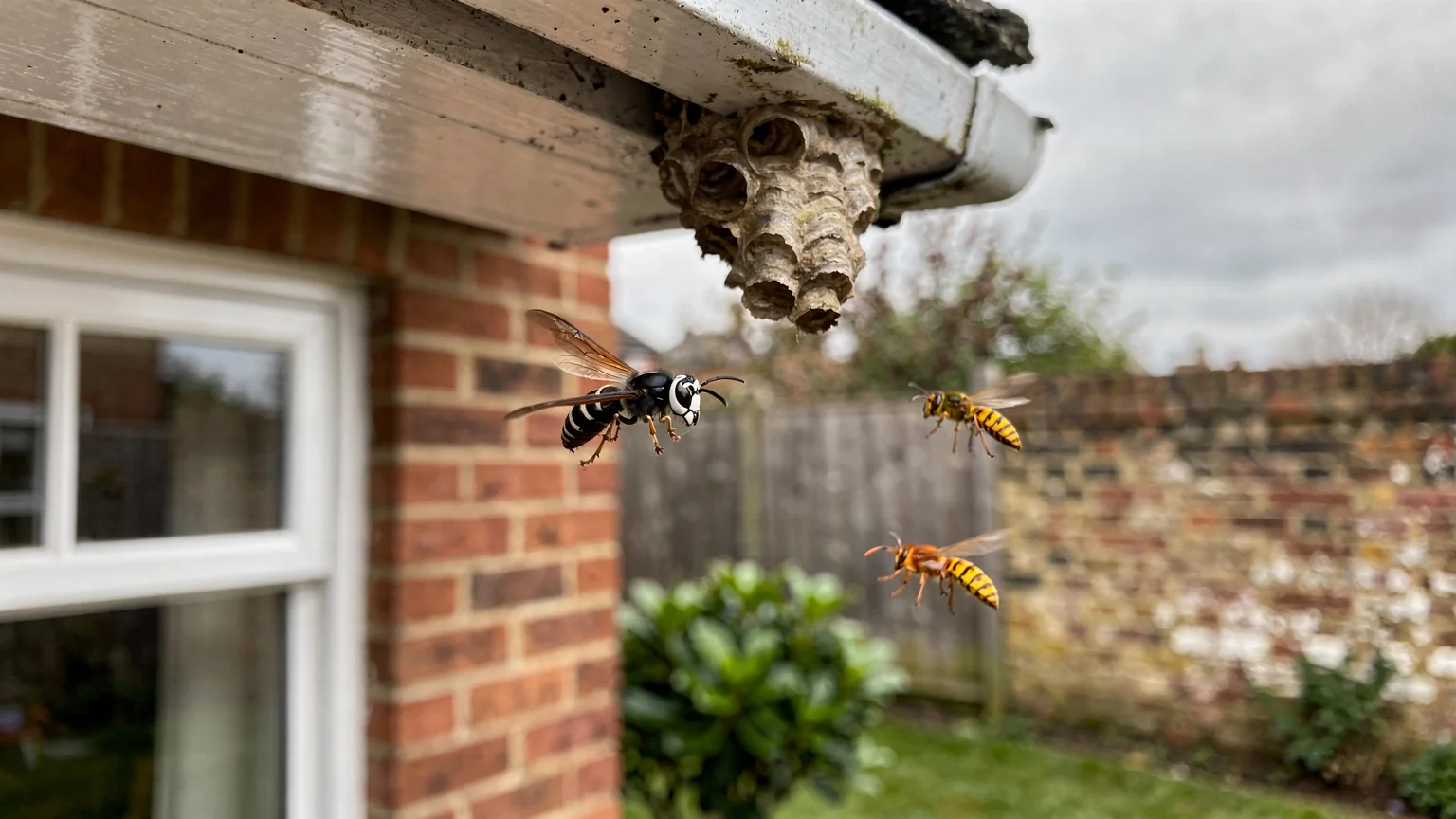
A field guide to identifying the UK's most commonly confused stinging insects before you decide whether to call a professional.
A white faced hornet is not actually a hornet at all. Most people who use that name are describing the bald-faced aerial yellowjacket, a North American species that occasionally surfaces in British conversations because of its dramatic black-and-white colouring and aggressive reputation. If you are standing in a garden in East London or Essex and wondering what just stung you, the insect is almost certainly something else entirely. This guide will help you identify what you are really dealing with, compare it against similar species found in the UK, and decide when professional pest control is the safest next step.
Why Names Matter for Safety
Misidentification leads to poor decisions. Someone who believes they have encountered a "white faced hornet" may delay treatment because the species sounds exotic and rare, or they may panic unnecessarily because of its fearsome reputation online. In reality, the insect in your loft or garden is likely a common wasp, a European hornet, or one of several yellowjacket species that do establish nests in British properties.
The bald-faced aerial yellowjacket, as described in the Baldfaced Aerial Yellowjacket technical guide from Virginia Cooperative Extension, is a large black insect with pale markings where the face and head are largely white. Queens measure up to 20 mm in length, while workers are smaller at approximately 13 mm. The dark wings fold neatly lengthwise at rest. This species is native to North America and widely distributed across the eastern United States. It does not naturally occur in the United Kingdom, though occasional specimens may arrive through international shipping or travel.
When British homeowners report a "white faced hornet," pest controllers typically find one of three native or established species instead. Understanding the differences matters because treatment approaches vary significantly. European hornets require different handling than common wasps, and the Asian hornet, an invasive species of serious concern to UK beekeepers, demands immediate reporting to authorities.
Step 1: Understand the True White-Faced Insect
Despite its common name, the bald-faced aerial yellowjacket belongs to the genus Dolichovespula, which includes aerial-nesting wasps rather than true hornets of the genus Vespa. Its striking appearance makes it memorable and frequently photographed, which explains why the image spreads across social media and search results even in countries where the species does not exist.
Key identification markers include the predominantly black body with white or pale yellow markings on the face, thorax, and tip of the abdomen. The white facial pattern is particularly distinctive, giving the insect its common name. Nests are constructed from chewed wood fibres mixed with saliva, creating a grey papery material, and are typically suspended from branches, eaves, or other structures rather than hidden underground.
The species is known for defensive behaviour when nests are disturbed. Multiple stings can occur rapidly, and the insects can squirt venom toward threats from a short distance. However, this behaviour is context-dependent. As noted in field observations, left alone these insects are industrious and focused on nest maintenance and foraging. The danger arises primarily when humans accidentally disturb nests during gardening, roof maintenance, or children's play near nesting sites.
For UK readers, this species serves primarily as a reference point. If you believe you have seen one, photograph it from a safe distance and consult a professional. The more likely scenario is that you have encountered a similar-looking native species.
Step 2: Identify the European Hornet, the UK's Only True Hornet
The European hornet, Vespa crabro, is the only true hornet species established in the United Kingdom. It is larger than common wasps, with workers measuring 18-25 mm and queens reaching 35 mm. The body is reddish-brown rather than black and white, with yellow markings on the abdomen and a distinctive pale face that can appear almost white in certain lights.
This pale facial colouring causes frequent confusion. A European hornet observed in poor light or at distance can seem to have a "white face," particularly if the observer has recently seen photographs of the North American bald-faced aerial yellowjacket. The overall body colour is the decisive factor: European hornets are warm-toned, never displaying the stark black-and-white contrast of their North American namesake.
European hornets build nests in hollow trees, wall cavities, roof spaces, and occasionally in outbuildings. They are less aggressive than common wasps when away from the nest, though they will defend their colony if threatened. Their size and loud flight make them alarming, but they are valuable predators of other insects and generally avoid human contact.
Treatment of European hornet nests requires professional expertise due to the nest location preferences and the species' protective behaviour. DIY approaches are not recommended, particularly for nests in wall cavities or roof voids where disturbance can drive insects into living spaces.
Step 3: Recognise the Common Wasp and German Wasp
The vast majority of "hornet" calls received by pest controllers in East London and Essex involve common wasps, Vespula vulgaris, or German wasps, Vespula germanica. These species are smaller than European hornets, with workers typically 12-17 mm in length. They display the familiar yellow-and-black striped pattern, though colour intensity varies.
Neither species has a white face. However, lighting conditions, individual variation, and observer anxiety can create mistaken impressions. Common wasps also build the grey papery nests associated with the bald-faced aerial yellowjacket, which adds to identification confusion when photographs are compared online.
These wasps nest underground, in roof spaces, wall cavities, and garden structures. Colony sizes can reach several thousand individuals by late summer, making nests potentially hazardous. The lifecycle follows a predictable annual pattern: queens emerge from hibernation in spring, establish nests, and raise the first worker generation. Colony expansion accelerates through summer, with new queens and males produced in autumn before the colony declines.
For homeowners, the critical distinction is not between wasp species but between wasps and bees. Bees are protected and generally less aggressive, requiring different management approaches. If you are uncertain, professional identification is advisable before any action is taken.
Step 4: Spot the Asian Hornet, the Invasive Threat
The Asian hornet, Vespa velutina nigrithorax, represents a distinct category of concern. This invasive species, native to eastern Asia, was accidentally introduced to Europe, probably in a consignment of pottery from China, and was first confirmed in south west France in 2004. It has since spread across France, Spain, Portugal, Italy, Switzerland, Germany, Belgium, the Netherlands, and the Channel Islands, as documented in 2019 CIEH 554 Asian Hornet awareness materials from the National Bee Unit and associated agencies.
Research published by The Pirbright Institute in The invasion, provenance and diversity documents the first reports of this species in Great Britain and analyses its rapid European expansion. The ability of a single nest to disperse many mated queens over a large area facilitates this spread, while suitable climatic conditions allow establishment of new populations.
Asian hornets are of particular concern because of their impact on pollinators, especially the western honey bee, Apis mellifera, which lacks effective defensive behaviours against this exotic predator. For homeowners, the identification challenge is significant: Asian hornets are smaller than European hornets, with workers approximately 20-30 mm, and display a distinctive dark thorax with an orange-yellow fourth abdominal segment. The legs are characteristically yellow at the tips, giving the species its "yellow-legged hornet" alternative name.
Any suspected Asian hornet sighting should be reported immediately through the official Asian Hornet Watch app or to the National Bee Unit. Do not attempt to destroy nests yourself. Professional pest controllers work in coordination with authorities to manage confirmed sightings.
Step 5: Apply the Five-Point Field Identification Method
When you spot a large stinging insect, systematic observation from a safe position will help you identify the species correctly.
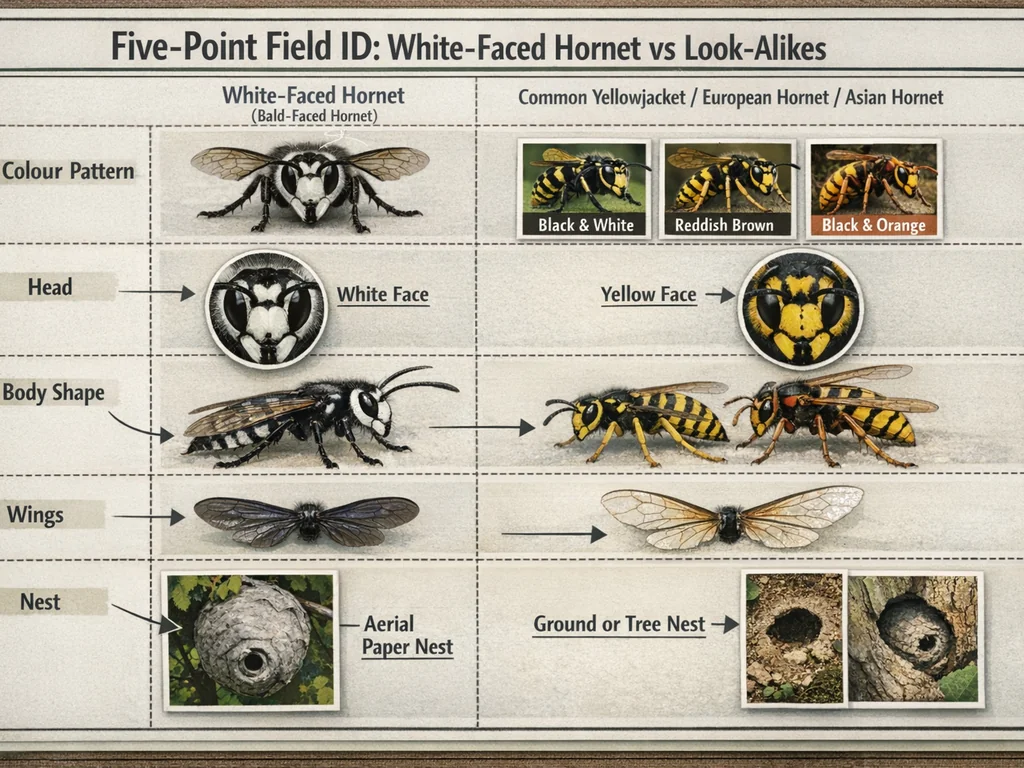
First, note the overall colour pattern. Black and white strongly suggests you are looking at a photograph of a North American species rather than a live UK insect. Warm reddish-brown and yellow indicates European hornet. Bright yellow and black stripes indicate common or German wasp. Dark body with orange-yellow abdominal segment and yellow-tipped legs raises Asian hornet suspicion.
Second, observe the flight behaviour. European hornets fly at dusk and are attracted to lights, unlike common wasps. Asian hornets exhibit a characteristic "hawking" behaviour outside beehives, waiting to catch returning foragers.
Third, locate the nest if possible. Aerial nests in trees or on structures suggest Dolichovespula species, including the bald-faced aerial yellowjacket if the location is genuinely North America. Underground nests indicate common or German wasps. Cavity nests in buildings could be any Vespula or Vespa species.
Fourth, consider the context. Is this a single foraging insect or nest defence behaviour? Foraging insects away from nests are rarely aggressive. Multiple stings or persistent buzzing around a specific location suggest proximity to a nest.
Fifth, photograph the insect if you can do so safely. Multiple angles, including a clear view of the face and body pattern, will enable accurate identification by professionals.
Step 6: Know When Professional Help Is Essential
Certain situations demand immediate professional intervention. A nest inside your home, in a roof void, wall cavity, or loft, requires expert handling to prevent insects from entering living spaces during treatment. Nests near entrances, children's play areas, or high-traffic garden paths present unacceptable sting risk. Any suspected Asian hornet sighting must be reported and managed through appropriate channels.
For businesses, particularly food premises, the presence of any stinging insect nest near customer areas or food preparation spaces creates regulatory and liability concerns. Documentation of professional treatment supports due diligence in the event of inspection or incident.
BuzzKill Pest Control provides same-day response for wasp and hornet issues across East London and Essex, with no call-out charge and guaranteed results. All technicians hold RSPH Level 2 qualifications and BASIS PROMPT registration, ensuring treatments comply with current standards. Wasp nest removal services start from £85, with emergency response available for urgent situations.
Step 7: Implement Prevention and Long-Term Management
Reducing the likelihood of nest establishment requires attention to building maintenance and garden management. Seal gaps in soffits, fascia boards, and roof tiles where wasps and hornets access roof voids. Repair damaged air bricks and ventilation covers. Remove or relocate compost heaps and fallen fruit that attract foraging insects.
Early season queen trapping is sometimes promoted as a preventive measure, but evidence for effectiveness is limited. Queens are mobile and numerous, and traps may have minimal impact on local populations. Professional assessment of your specific property and its history of wasp activity provides more reliable guidance.
For properties with recurrent issues, integrated pest management approaches address underlying attractants and access points rather than relying solely on reactive treatment. This is particularly relevant for commercial premises where annual contracts provide scheduled inspection and preventive intervention.
Frequently Asked Questions
Is the white faced hornet found in the UK?
No, the species commonly called the white faced hornet or bald-faced hornet is native to North America and does not occur naturally in the United Kingdom. Similar names are sometimes applied to the European hornet, which has a pale face but is otherwise quite different in appearance.
How dangerous are European hornets compared to common wasps?
European hornets can deliver a painful sting and will defend their nests, but they are generally less aggressive than common wasps when away from the colony. Their larger size means they can sting through some protective clothing, making professional treatment particularly important.
What should I do if I think I have seen an Asian hornet?
Report the sighting immediately through the Asian Hornet Watch app or contact the National Bee Unit. Take a photograph if you can do so safely. Do not approach or disturb the nest. Professional pest controllers coordinate with authorities for confirmed sightings.
Can I treat a wasp nest myself?
DIY wasp nest treatments are available but carry significant risks, particularly for nests in roof voids, wall cavities, or other enclosed spaces. Disturbance can drive insects into living areas, and multiple stings can cause serious medical issues. Professional treatment ensures complete nest elimination with appropriate safety measures.
How quickly can a pest controller respond?
BuzzKill Pest Control offers same-day response for wasp and hornet issues across East London and Essex, with emergency pest control available for urgent situations. Call 0203 468 1999 or request a callback to book a same-day inspection.
Other Reading
Need professional help? BuzzKill offers fast, reliable pest control services across London and Essex.