
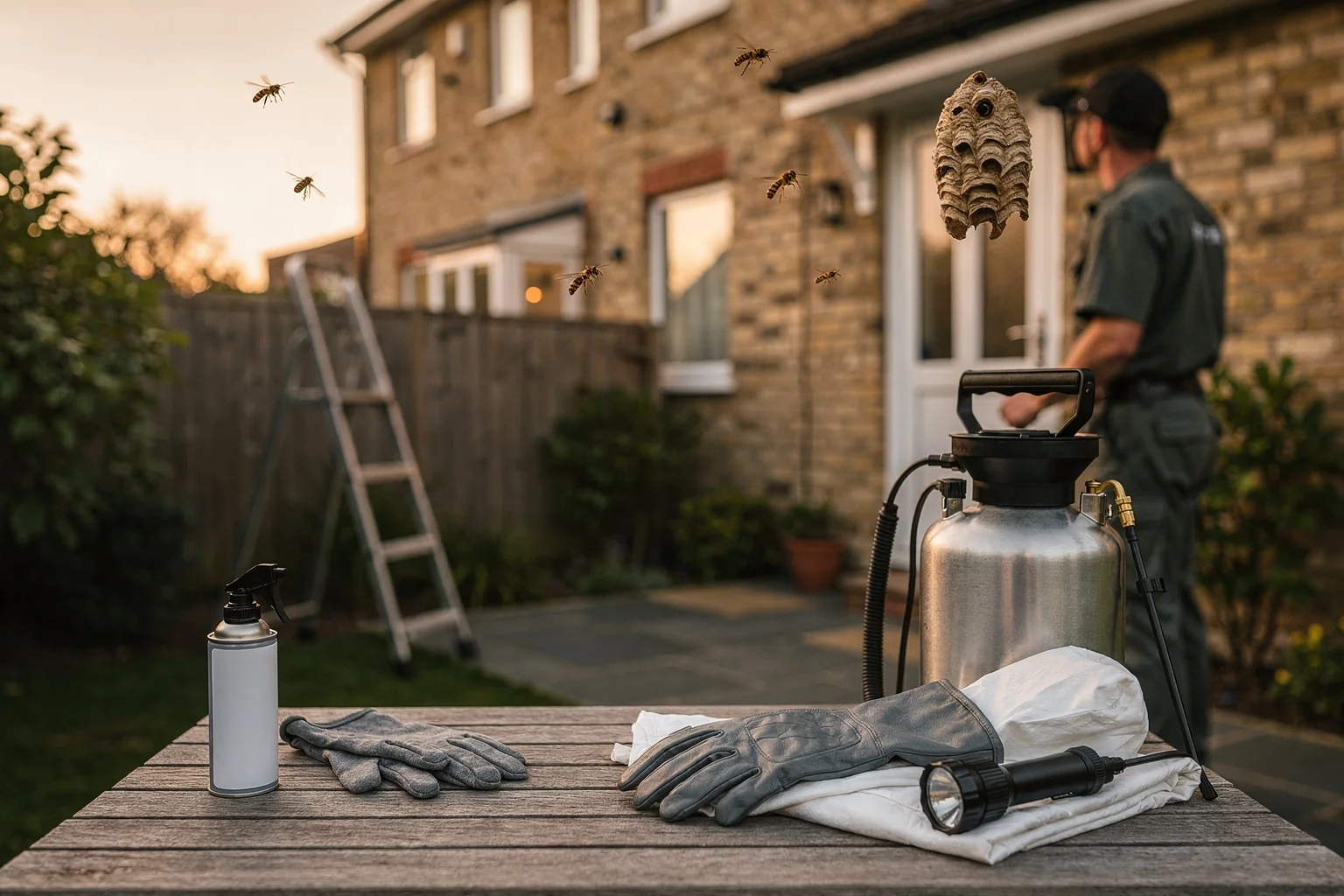
The first time you notice it, you might not be sure what you're looking at. A grey-brown papery ball tucked under the roof of your shed, or a steady stream of yellow-and-black insects disappearing into a gap in the fence. Maybe you've spotted the beginnings of something in the corner of the loft hatch after fetching the garden furniture out for spring.
Wasp nests in London gardens are not unusual, but what you do in the first few hours after discovery matters more than most people realise. Get too close too soon, and you risk a defensive swarm. Leave it unmonitored, and a golf-ball-sized starter nest can become a football-sized colony by August, with thousands of workers ready to protect it.
This guide walks through the decisions you'll face: identifying what you've found, judging whether it's active, understanding when disturbance becomes dangerous, and knowing which situations you can manage with patience and which need a technician the same day.
What You're Actually Looking At
Not every papery structure in a garden is a wasp nest, and not every wasp you see is a threat. Getting this right saves you money and unnecessary worry.
Solitary wasps are common across the UK and pose almost no risk. These are the insects you see hunting caterpillars or hovering near woodpiles. They do not form colonies, do not defend territory, and rarely sting. The wasp and hornet identification page covers the visual differences if you're unsure what species you've spotted.
Social wasps are the ones that cause problems in residential gardens. The common wasp (Vespula vulgaris) and the German wasp (Vespula germanica) build the distinctive nests made from chewed wood pulp, creating that layered, marbled grey-brown paper. A new nest in April or May may be no larger than a golf ball, built by a single queen who has overwintered and is raising her first workers alone. By July, that same nest can expand to the size of a football or larger, housing up to 10,000 workers according to pest control industry assessments.
The nest itself consists of stacked horizontal combs inside the papery outer shell, each comb holding hundreds of hexagonal cells where larvae develop. You will rarely see this internal structure unless the nest is broken open, which is precisely when the colony is most dangerous.
Where Wasps Choose to Nest in London Properties
Queen wasps emerging from hibernation in March and April seek sheltered, undisturbed locations with easy access to the outside. In London gardens and the terraced houses that back onto them, certain spots recur again and again.
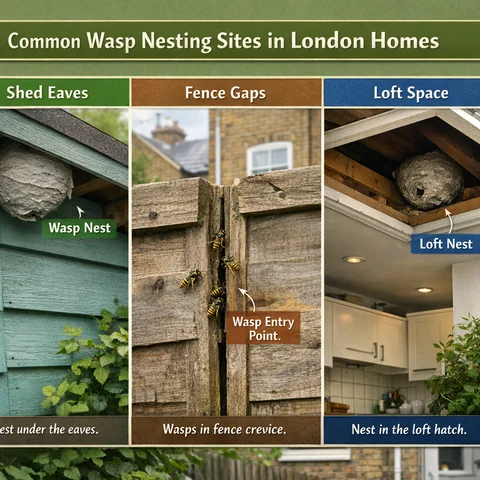
Roof voids and loft spaces are the most common, especially where tiles have shifted or fascia boards have gaps. Garden sheds, particularly those that stay cool and see little winter use, are another favourite. Wall cavities, chimney stacks, and the spaces under decking or behind climbing plants all provide the right conditions. In 2026, pest controllers have reported nests found inside Wellington boots, handbags left in sheds, and even a child's soft toy, as wasp activity surged earlier than usual with warmer spring temperatures.
The location matters for your safety assessment. A nest high in a roof void, accessed only through a small loft hatch, presents a different risk profile from one at head height in a frequently used shed. Similarly, a nest near a kitchen door or outdoor eating area creates daily exposure that a nest at the bottom of an unused garden corner does not.
The First 48 Hours: Observe, Don't Disturb
The single most important action after discovering a nest is to leave it alone and watch from a distance. Wasps do not attack unprovoked, but they respond aggressively to vibration, sudden movement, or anything they perceive as a threat to the colony.
Watch for activity patterns. Active nests show steady traffic: wasps arriving and departing from a single entrance point, particularly on warm days. The direction of flight can help you locate the exact entrance if the nest itself is hidden. Listen for buzzing from walls, ceilings, or voids, especially in the early morning when the colony is warming up.
Note the timing of your discovery. A nest found in April or early May is small and manageable. The same nest found in July or August is approaching peak aggression and worker numbers. This timeline directly affects your options and the urgency of any treatment.
If the nest is in a location away from human contact, Westminster City Council guidance notes that these can sometimes be left untreated, since wasps do provide natural pest control by hunting garden insects. The practical question is whether the location is genuinely away from contact or merely temporarily undisturbed.
When DIY Approaches Fail
Shop-bought wasp nest destroyers are widely available, but their effectiveness is limited and the risks are often underestimated. Aerosol foams require close application to the nest entrance, precisely when wasps are most defensive. Powders need repeated application and correct placement to reach the queen, who rarely leaves the protected core of the nest.
The fundamental problem with DIY treatment is disturbance. Wasps release an alarm pheromone when threatened or crushed. This chemical signal triggers coordinated defensive attacks from the entire colony. Unlike bees, wasps can sting multiple times without dying. Multiple stings can cause anaphylactic shock even in people with no prior history of allergic reaction.
Tower Hamlets Council's pest control guidance is direct on this point: nest locations are often high or difficult to reach, with risk of falling and injury. Wasps are dangerous in groups, and professional treatment is the recommended approach. The council itself offers treatment at £81 per visit for those who prefer to use local authority services.
Physical removal of an intact nest is particularly hazardous. Even at night, when wasps are less active, the colony can respond to vibration or light. A broken nest releases the entire population at once, leaving you with hundreds or thousands of aggressive, homeless wasps in an enclosed space.
Who to Call for Professional Wasp Nest Removal in London
The choice between council pest control and private providers depends on your timing, location, and the urgency of the situation. Council services vary significantly by borough. Some, like Tower Hamlets, maintain in-house teams with qualified officers who survey the infestation and place treatments appropriately, with follow-up visits to confirm success. Others have reduced or eliminated direct pest control services entirely. A 2026 report commissioned by the British Pest Control Association found that around half of local authorities no longer offer direct pest control, or have significantly reduced provision, leaving residents in lower-income areas particularly exposed.
Private pest control companies offer faster response, often same-day, which matters when the nest is in a high-traffic area or when someone in the household has a known allergy. When selecting a provider, Sutton Council's guidance advises getting at least three quotations, confirming whether there is a call-out fee or fixed charge, verifying insurance cover, and checking qualifications such as RSPH Level 2 certification or BPCA membership.
The London wasp removal service market includes both national chains and independent operators. National providers have broad coverage and standardised procedures. Independents often offer more flexible timing and local knowledge, particularly valuable in London's varied housing stock where a Victorian terrace in Islington presents different access challenges from a new-build in Beckton.
For residents in specific East London boroughs, local service pages provide direct routing: Hackney wasp removal, Tower Hamlets wasp removal, Newham wasp removal, Greenwich wasp removal, and Lewisham wasp removal all cover the core areas where early-season wasp pressure has been highest in 2026. North and central options include Islington wasp removal, Camden wasp removal, and Haringey wasp removal. East and outer London coverage extends through Bexley wasp removal, Bromley wasp removal, Redbridge wasp removal, Waltham Forest wasp removal, and Enfield wasp removal. For those near the Olympic Park or Victoria Park areas, Stratford wasp removal and Mile End wasp removal provide localised service pages.
What Professional Treatment Involves
A qualified technician will first confirm the nest location and species, then select the appropriate treatment based on access, nest size, and surrounding environment. Insecticide powder is the most common approach for accessible nests, applied around entrance and exit points so that wasps carry it into the nest on their bodies, eventually reaching the queen. Inaccessible nests in wall cavities or voids may require drilling or alternative application methods.
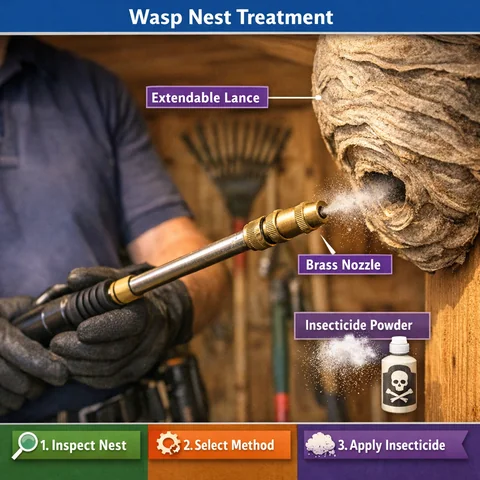
Treatment timing matters. Early morning or evening, when wasp activity is reduced, is standard practice. The colony does not die instantly; workers returning to the nest over the following 24-48 hours continue to spread the insecticide. Most providers schedule a follow-up to confirm the colony has been eliminated, particularly for larger nests or those in complex locations.
The cost of professional wasp nest removal in London typically ranges from £65 to £100 for a standard domestic treatment, based on 2026 pricing data. Factors affecting price include nest accessibility, whether ladders or specialised equipment are needed, the number of nests, and whether the property is domestic or commercial. Some providers charge per nest, others per visit regardless of nest count.
Your Options Compared
When you discover a wasp nest in your London garden, you are effectively choosing between three paths: monitored observation, council treatment, or private professional removal. Each fits different circumstances.
Monitored observation works when the nest is genuinely distant from human activity, discovered early in the season, and no household members have sting allergies. The colony will naturally decline and die off in autumn. The risk is misjudging the nest's growth rate or its proximity to areas that see more summer use than anticipated.
Council pest control offers qualified treatment at regulated prices, typically with longer lead times than private providers. Best suited to non-urgent situations where you can wait for an appointment, and where your local authority still maintains direct service provision. Worth checking your borough's current status before counting on this route.
Private professional removal provides same-day or next-day response, with treatment tailored to your property's specific access constraints. The higher cost buys speed, flexibility, and often a service guarantee. Essential for nests in high-traffic areas, properties with young children or elderly residents, or anyone with allergy concerns.
London's Wasp Season in 2026
This year has brought wasp activity earlier and more intensely than recent averages. Warmer winters with insufficient "winter kill" periods have allowed queen wasps to survive in higher numbers, while early spring temperatures triggered nest-building weeks ahead of the traditional timeline. East London has been particularly affected, with pest reports clustering in boroughs from Tower Hamlets through to Newham and Barking and Dagenham.
The practical implication is that nests found in May 2026 are likely further developed than equivalent-date discoveries in previous years. A nest that looks small may already contain more workers than its size suggests. The window for easy early treatment is narrower, and the peak risk period from July through September promises higher colony densities than the lull years of the recent past.
If you are reading this in late spring or early summer, your timing for intervention is better now than it will be in six weeks. Nests do not become less problematic with waiting.
How the Main London Providers Approach Wasp Nest Removal
Gardeners' World

Gardeners' World provides educational context on wasp biology rather than removal services. Their guidance emphasises the ecological role of wasps, distinguishing between harmless solitary species and social wasps that form colonies. Useful for identification and understanding lifecycle, but not a treatment option for active nest problems.
Sun Pest Control
Sun Pest Control covers London and Surrey with a focus on the dangers of mature colonies, noting that nests can house up to 10,000 workers in summer. Their content stresses professional intervention over DIY, with emphasis on the pheromone-triggered swarm response that makes amateur treatment hazardous.
PestPro Index
PestPro Index offers comprehensive UK-wide guidance on identification, treatment, and prevention. Their 2026 guide details nest construction from wood pulp, growth timelines from golf-ball to football size, and the alarm pheromone mechanism. A strong information resource, though they do not provide direct treatment services themselves.
Go-Pest
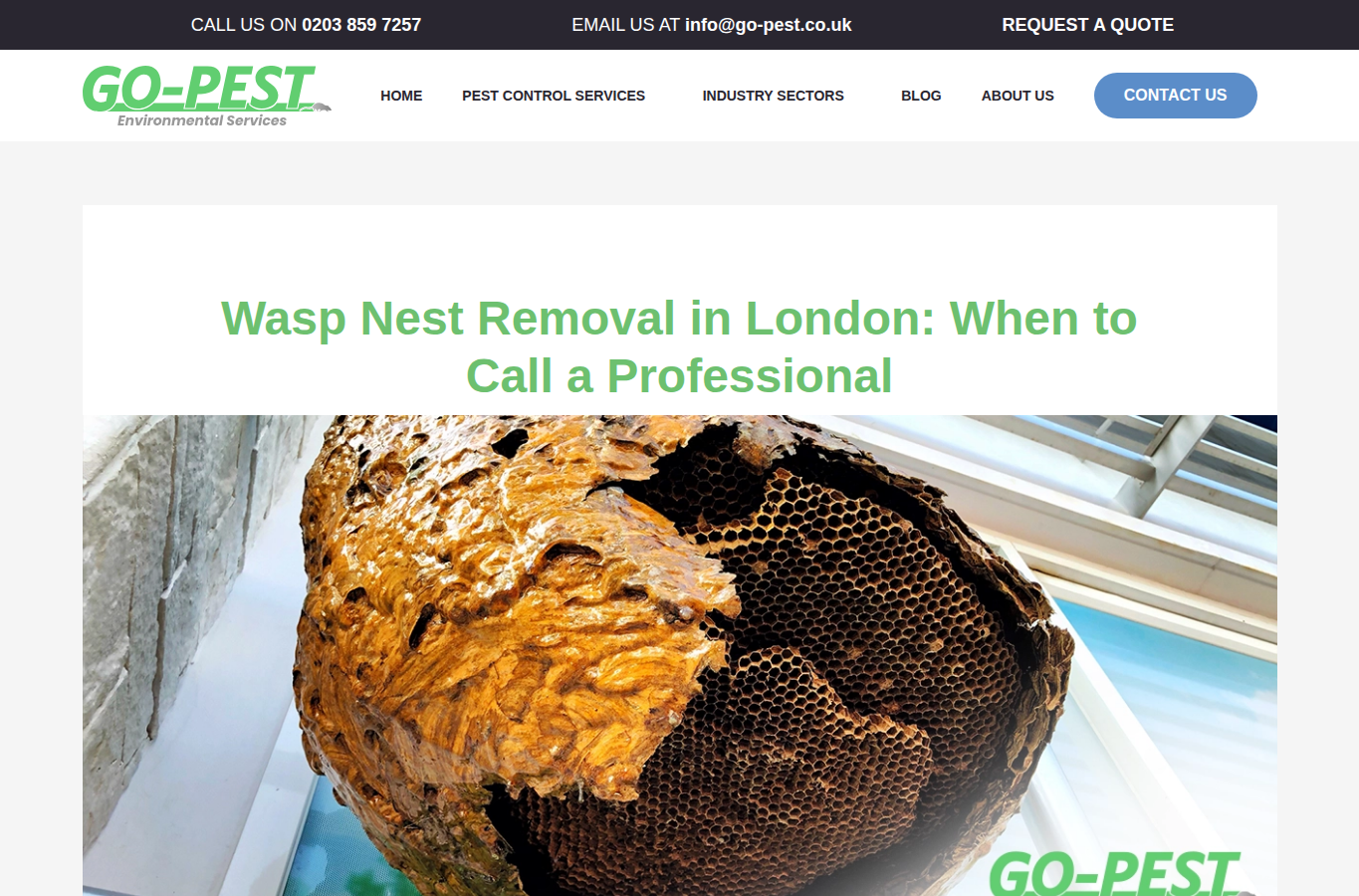
Go-Pest focuses specifically on London boroughs, from suburban Croydon to Camden terraces and Westminster restaurants. Their coverage of nest locations, loft insulation risks, and the signs of hidden nests in wall cavities reflects practical London field experience across varied property types.
Environ Pest Control
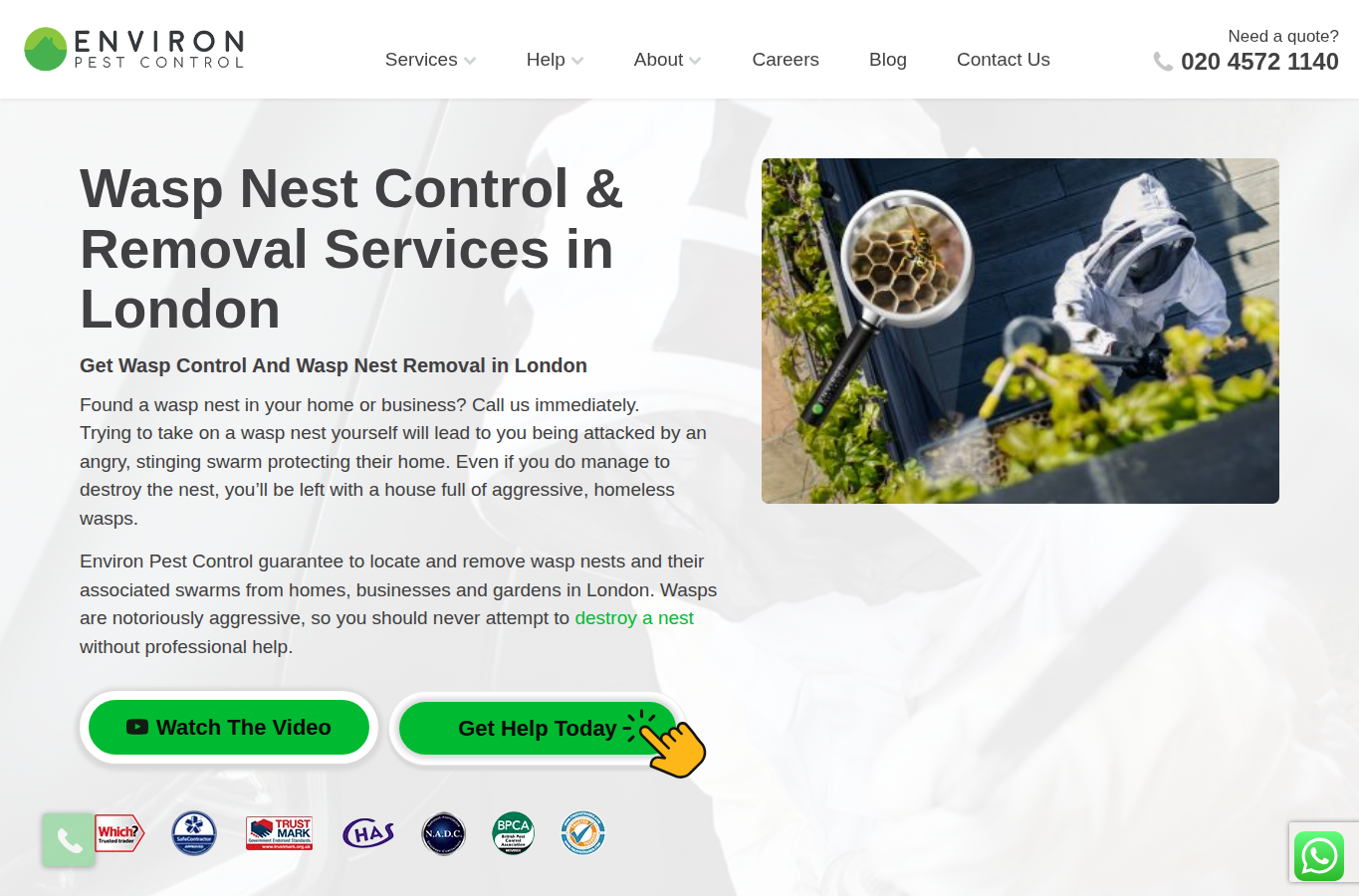
Environ Pest Control guarantees same-day wasp nest removal in London using insecticide powder carried into the nest by returning wasps. Their approach targets queen elimination as the decisive factor, with particular attention to loft and shed locations common in London housing.
Making Your Decision
The right response to a wasp nest discovery depends on three factors: location, timing, and household vulnerability.
A nest in an unused corner of a large garden, found in April, with no allergy concerns in the household, can often be observed and left to decline naturally. Mark the spot, check it weekly from a distance, and reconsider if growth accelerates or if summer plans will bring people closer to it.
A nest at head height in a shed, near a kitchen door, or anywhere children play, needs professional assessment regardless of size. The same applies to nests inside the property structure, in roof voids, wall cavities, or chimneys, where DIY access is impractical and DIY disturbance particularly dangerous.
A nest discovered in June or later, or one showing rapid growth, has likely passed the point where observation is prudent. The colony is expanding, worker numbers are increasing, and defensive behaviour will intensify through July and August.
For anyone with a known wasp sting allergy, or households with young children who cannot be relied upon to avoid the area, professional removal is the only appropriate path. The risk of anaphylaxis, while statistically low, is not one to manage through hope and distance.
If you need expert wasp removal today, call 0203 468 1999 or request a callback to book a same-day inspection. A technician can assess the nest location, confirm the species, and advise whether immediate treatment or monitored waiting is the safer choice for your specific situation.
Need professional help? BuzzKill offers fast, reliable pest control services across London and Essex.