
New rules on biocide use, tighter food safety enforcement, and clearer landlord duties reshape how properties across England manage pest risks this year.
Pest control regulations 2026 introduce substantive shifts that property owners, landlords, and business operators across the United Kingdom must understand. Many assume these rules remain static year to year, yet the regulatory landscape governing how pests are managed, documented, and prevented has evolved considerably. This guide examines the structural changes, their practical implications, and what responsible pest management now demands.
Topic Map
The 2026 regulatory framework for pest control in the UK rests on three interconnected pillars: the safe and lawful application of biocides and rodenticides, the allocation of responsibility between landlords and tenants, and the enforcement standards applied to commercial premises handling food. These domains do not operate in isolation. A landlord addressing a rodent issue must comply with biocide regulations, document treatments for housing compliance, and ensure any contractor meets food safety standards if the property includes catering facilities. This guide moves from foundational definitions through each operational layer, concluding with maturity benchmarks and practical scenarios that reveal how these rules converge in real properties.
What Is the 2026 Pest Control Regulatory Framework?
The 2026 framework refers to the cumulative body of statutory instruments, enforcement guidance, and industry standards governing pest management in England, Wales, Scotland, and Northern Ireland. Its foundation remains the Control of Pesticides Regulations 1986, the Biocidal Products Regulation (EU) 528/2012 as retained in UK law, and the Prevention of Damage by Pests Act 1949. However, 2026 brings sharpened emphasis on three fronts: environmental stewardship of anticoagulant rodenticides, clarity in landlord obligations under the Housing Act 2004, and intensified Food Standards Agency scrutiny of commercial premises. The Health and Safety Executive now coordinates more closely with local authority environmental health officers, creating a tighter compliance mesh than in previous years.
Core Concepts
Integrated Pest Management (IPM). This approach prioritises prevention, monitoring, and targeted intervention over blanket chemical application. The 2026 guidance from the Campaign for Responsible Rodenticide Use strengthens IPM as the expected standard, particularly for outdoor rodent control near watercourses.
Professional Competence Certification. Anyone applying professional-grade biocides must hold appropriate qualifications. The Royal Society for Public Health Level 2 Award in Pest Management remains the baseline, with BASIS PROMPT registration serving as the ongoing professional credential.
Hazard Analysis and Critical Control Points (HACCP). Food businesses must identify pest risks within their food safety management systems. The 2026 FSA guidance embeds pest control more explicitly within HACCP documentation, requiring evidence of proactive monitoring.
Statutory Nuisance and Category 1 Hazards. Under the Housing Act 2004, local authorities can issue improvement notices or carry out emergency remedial action when pest infestations render premises hazardous. The 2026 guidance clarifies that chronic pest presence now more readily triggers Category 1 classification.
Due Diligence Defence. Businesses and landlords can defend against enforcement action by demonstrating reasonable steps were taken. The 2026 standards raise the bar for what constitutes reasonable, particularly regarding documentation and contractor selection.
How It Works
The regulatory system operates through a layered enforcement architecture. At the apex, the Health and Safety Executive governs biocide approval and professional competence. Local authority environmental health departments enforce housing and food safety standards. Trading Standards oversees product compliance. In 2026, these bodies share intelligence more systematically through the National Pest Advisory Panel.
For property owners, compliance follows a sequential logic. First, assess the pest risk environment: building condition, neighbouring land use, waste management practices, and historical pest activity. Second, implement preventive measures: proofing, waste protocols, and staff training. Third, establish monitoring systems: regular inspections, trap placement, and documentation. Fourth, when intervention becomes necessary, select methods that minimise environmental and non-target impact. Fifth, document all actions to demonstrate due diligence.
The 2026 changes tighten this sequence at points three and four. Monitoring must now be more demonstrably systematic, and rodenticide use outdoors requires documented justification under the revised CRRU Code of Best Practice.
Main Layer 1: Biocide and Chemical Stewardship Rules
The most technically significant 2026 changes concern anticoagulant rodenticides. The UK Rodenticide Stewardship Regime, administered through CRRU, now mandates enhanced record-keeping for all outdoor, permanent, and tamper-resistant bait point applications. Professionals must document the risk assessment that justified rodenticide use over alternative methods, the specific product and active ingredient selected, the placement map, and the follow-up inspection schedule.
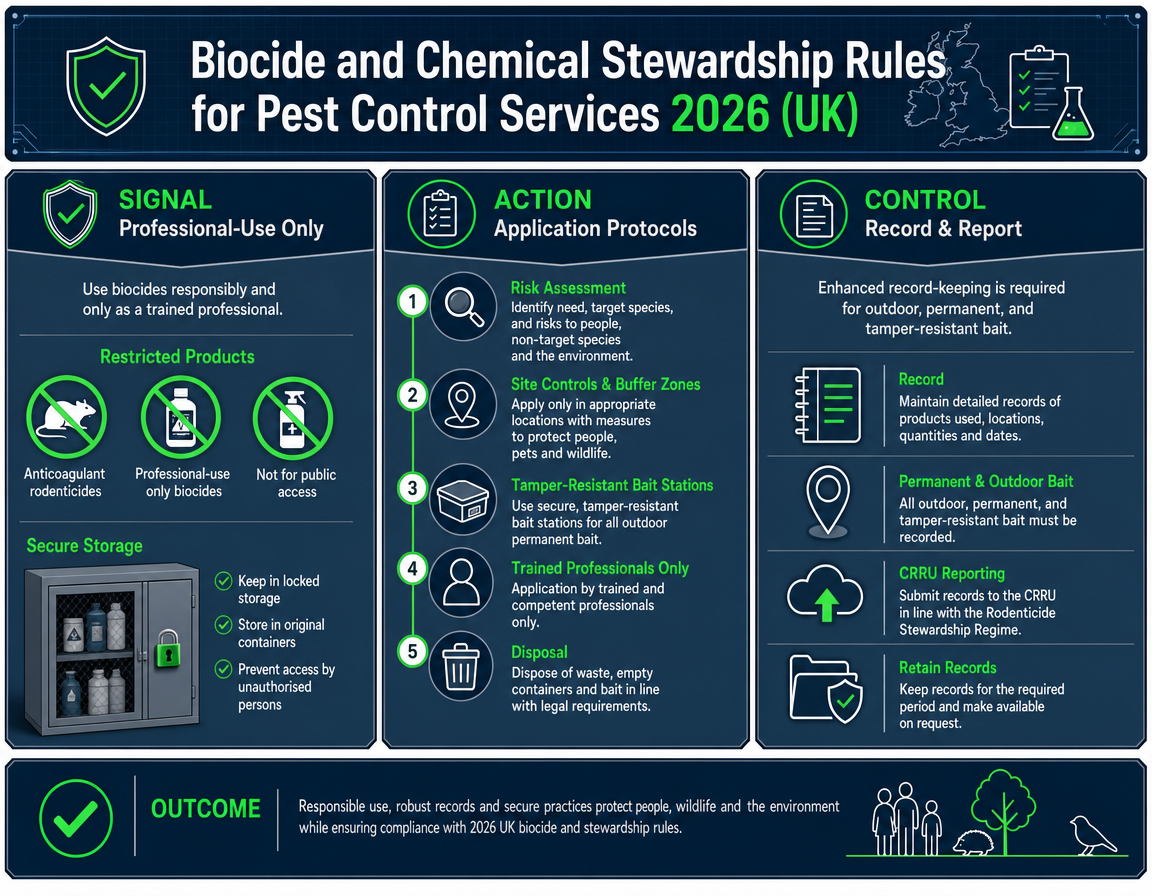
This layer directly affects how pest control technicians operate. A technician responding to a rat issue in a garden must now complete a formal environmental risk assessment before placing bait. Factors include proximity to water bodies, presence of non-target wildlife, and alternative food sources. The requirement does not prohibit rodenticide use but embeds it within a decision trail that regulators can audit.
For property owners commissioning work, this translates to more detailed service reports. Your contractor should provide written evidence of the risk assessment, not merely a treatment record. The British Pest Control Association guidance on stewardship compliance recommends retaining these records for three years minimum.
Indoor biocide applications face parallel scrutiny. The Control of Substances Hazardous to Health Regulations 2002 require risk assessments for any workplace exposure. The 2026 HSE enforcement emphasis extends this to residential settings where commercial contractors operate, particularly in multi-occupancy buildings.
Main Layer 2: Landlord and Housing Duties
The 2026 regulatory clarification most relevant to residential property concerns landlord obligations. The Housing Act 2004 and the Homes (Fitness for Human Habitation) Act 2018 together establish that landlords must maintain properties free from pests that threaten health or safety. The 2026 guidance from the Ministry of Housing, Communities and Local Government removes ambiguity about timing: landlords must act within a reasonable period after notification, and for acute infestations, this means days rather than weeks.
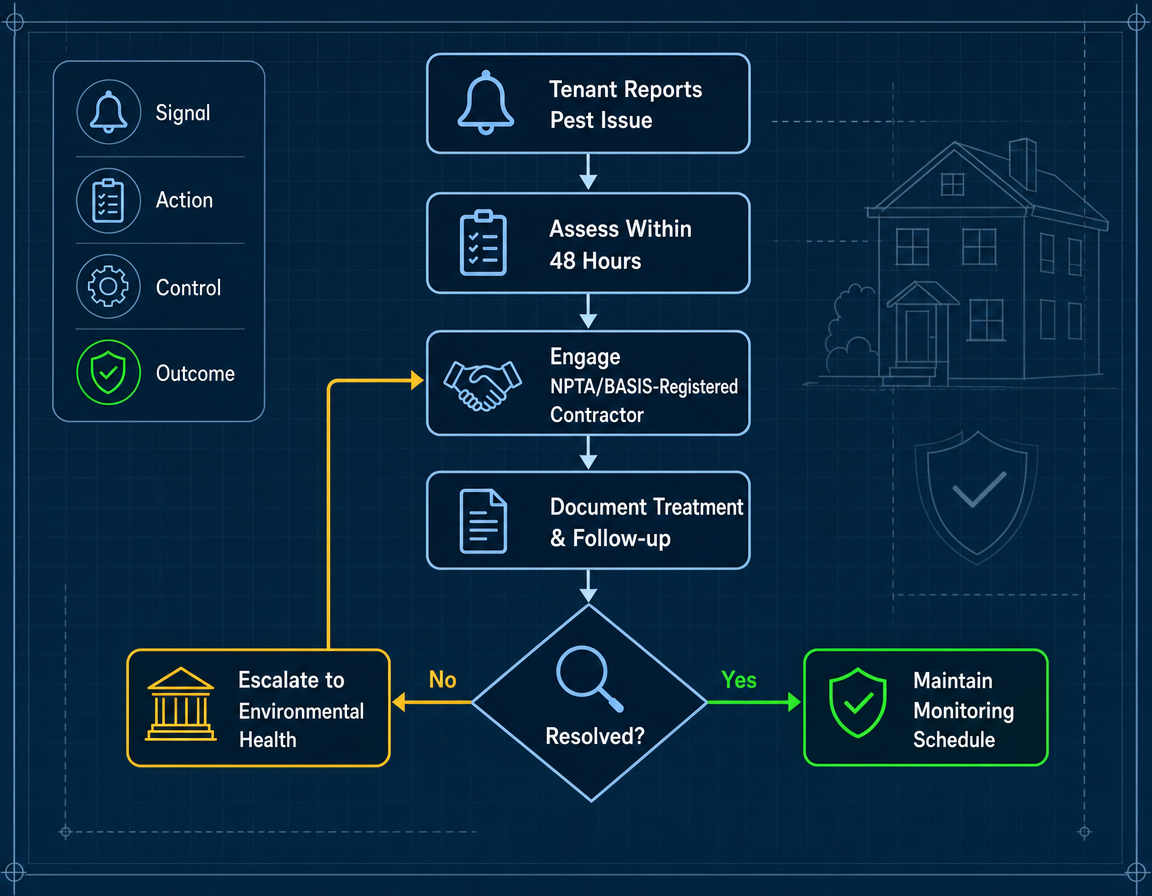
The guidance also addresses the persistent question of tenant versus landlord responsibility. Tenants remain liable for pest presence caused by their own conduct: poor waste management, accumulation of food debris, or unauthorised structural alterations that create entry points. However, the burden of proof has shifted. Landlords must now document the property condition at tenancy commencement with photographic evidence to support any claim that tenants caused the problem.
For letting agents and portfolio landlords, this creates operational implications. Property management systems must integrate pest-related inspection schedules. Tenancy agreements require clearer pest responsibility clauses. And contractor relationships must be established in advance, because same-day response may be necessary to prevent Category 1 hazard classification.
The pest control for landlords page outlines how professional services align with these compliance requirements. Similarly, pest control for letting agents addresses the specific workflow challenges of managing multiple tenanted properties.
Main Layer 3: Commercial Food Safety and Enforcement
Food business operators face the most intensified 2026 enforcement environment. The Food Standards Agency updated its Food Law Code of Practice to elevate pest control from a general hygiene consideration to a critical control point requiring documented evidence. Environmental health officers now routinely request pest management documentation during inspections, and failure to produce adequate records can trigger formal improvement notices or prosecution under the Food Safety and Hygiene (England) Regulations 2013.
The documentation standard has risen. Businesses must show: a contract with a competent pest control provider, detailed site plans indicating monitoring device locations, inspection records with technician signatures, trend analysis of pest activity, and evidence of corrective action when activity is detected. Template documentation is insufficient; records must reflect the specific operational characteristics of the premises.
The 2026 changes also expand the definition of food premises subject to formal pest control requirements. Food storage and distribution centres, even without direct consumer contact, now fall under the same scrutiny as restaurants and retailers. This affects warehouses, dark kitchens, and delivery hubs that may previously have operated with minimal pest management investment.
For businesses seeking to demonstrate compliance, the British Retail Consortium Global Standard for Food Safety Issue 9 provides a recognised framework. Many auditors now expect pest management programmes to exceed baseline legal requirements, incorporating predictive analytics and seasonal risk adjustment.
Maturity Path
Beginner: Reactive Compliance. At this stage, property owners address pests only after they appear. Documentation is minimal. Contractors are selected on price rather than qualification verification. The 2026 regulatory environment now penalises this approach more directly, with faster enforcement escalation and reduced tolerance for repeated complaints.
Intermediate: Preventive Systems. Properties at this level have scheduled inspections, proofing maintenance programmes, and established contractor relationships. Documentation exists but may be incomplete. The 2026 standards require these operators to enhance their monitoring specificity and to ensure their contractors' stewardship compliance is demonstrable.
Advanced: Integrated Risk Management. Mature organisations treat pest control as an integrated component of property and operational management. They conduct seasonal risk reviews, analyse pest data for trend identification, and coordinate with neighbouring properties on area-wide rodent management. Their documentation satisfies not only regulatory inspection but also third-party audit standards such as BRC or SALSA. The 2026 framework rewards this maturity with reduced enforcement attention and stronger due diligence defences.
Real-World Scenarios
Scenario One: The Terraced House Rat Run. A landlord in Walthamstow receives tenant reports of rats in the rear garden. Under 2026 guidance, she must respond within days, not weeks. Her contractor conducts the mandatory environmental risk assessment, identifies that the garden borders a railway embankment with established rat pathways, and recommends proofing the property perimeter alongside targeted baiting. The landlord retains the risk assessment documentation, which later proves essential when the local authority investigates a neighbouring complaint and her property is excluded from enforcement action due to demonstrable due diligence.
Scenario Two: The Restaurant Chain Audit. A group of three East London restaurants prepares for BRC certification renewal. Their pest control contractor, selected partly on BASIS PROMPT registration, provides enhanced documentation including heat maps of rodent activity, seasonal adjustment protocols, and evidence of non-chemical intervention before rodenticide deployment. The auditor notes this as a strength, and the business avoids the conditional pass that affected a competitor using a lower-standard provider.
Scenario Three: The Letting Agent Portfolio. A managing agent oversees forty properties in Essex. Following the 2026 guidance, they implement standardised tenancy commencement inspections with photographic evidence, pre-negotiated contractor response agreements, and digital tracking of all pest-related communications. When a tenant in one property disputes responsibility for a mouse issue, the agent produces the move-in documentation showing sealed proofing and no historical activity, successfully transferring appropriate costs.
Common Mistakes to Avoid
Relying on outdated contractor relationships without verifying current qualifications. BASIS PROMPT registration requires annual renewal. A contractor qualified in 2023 may not meet 2026 standards. Verify credentials before each significant contract renewal.
Treating pest control as purely reactive. The 2026 enforcement framework increasingly penalises properties with repeated pest complaints. Preventive investment, particularly proofing and waste management, now delivers compliance returns beyond mere operational convenience.
Inadequate documentation of tenant property condition. Landlords who cannot prove pre-tenancy pest status struggle to defend against tenant-caused claims. Photographic evidence at check-in, stored with date stamps, is now essential.
Selecting pest control providers on price alone. The lowest quotation may reflect inadequate insurance, absence of professional registration, or failure to follow stewardship requirements. The 2026 liability environment makes these shortcuts expensive.
Neglecting neighbouring property coordination. Rodent issues rarely respect boundaries. Advanced practitioners now engage with adjacent landowners on coordinated management, particularly in terrace housing and commercial estates.
How BuzzKill Pest Control Helps
Navigating the 2026 regulatory environment demands more than treatment capability; it requires systematic compliance support. BuzzKill Pest Control operates across East London and Essex with NPTA membership, BASIS PROMPT registration, and RSPH Level 2 qualified technicians. Our service documentation is designed to satisfy environmental health inspection, landlord compliance requirements, and third-party food safety audits. We conduct environmental risk assessments as standard, provide detailed placement mapping, and retain records for the duration required by current stewardship guidance. For properties requiring rapid response to prevent regulatory escalation, our same-day inspection service ensures issues are assessed before they become enforcement cases.
Learn more: Call 0203 468 1999 or request a callback to book a same-day inspection.
What to Read Next
The regulatory framework connects directly to operational practice. For landlords seeking deeper understanding of their specific obligations, the pest control for landlords resource examines tenancy agreements, improvement notices, and cost allocation in detail. Letting agents managing multiple properties will find workflow guidance in pest control for letting agents. Those confronting active rodent issues should consult rat control for homes for practical identification and immediate response steps, or rat control for businesses for commercial premises-specific approaches.
Related Blog Posts
Bed bug control for homes — Understanding multi-stage treatment requirements and when regulatory standards apply to residential settings.
Cockroach control for businesses — Compliance-focused approaches for food premises and commercial kitchens.
Need professional help? BuzzKill offers fast, reliable pest control services across London and Essex.