
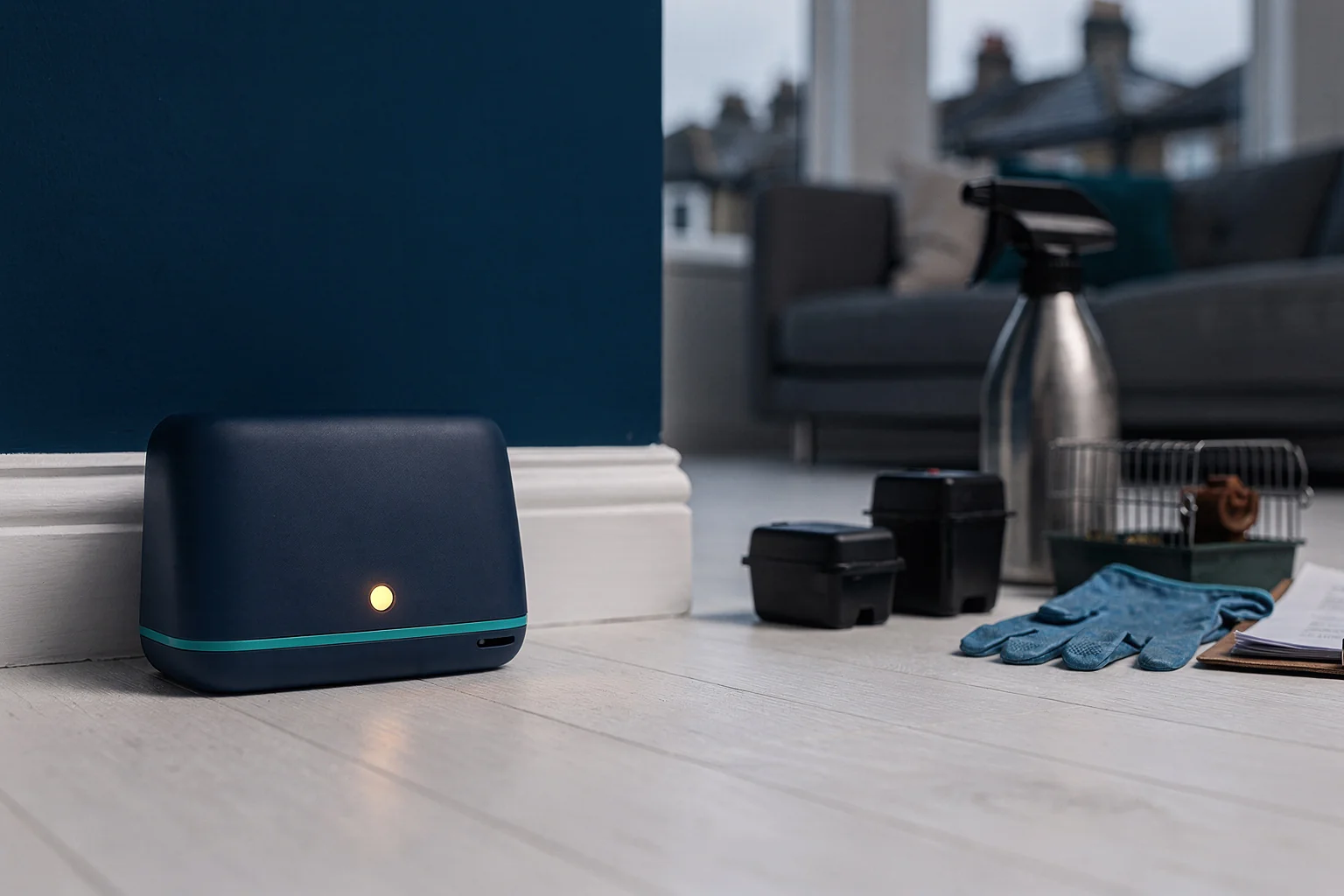
When you spot droppings behind the fridge or hear scratching in the wall at 2 a.m., the first question is rarely philosophical. You want the mice gone, and you want to know whether a gadget, a trap, or a phone call is the fastest route back to a quiet house. The ResiConnect mouse alarm for your home sits at the intersection of that panic and promise: a connected device that texts a technician the moment a mouse triggers it, promising speed without the weekly trap-checking ritual.
This roundup looks at four genuine approaches London homeowners actually use: the ResiConnect system, ultrasonic deterrents, traditional snap traps, and professional pest control services. Each earns its place based on how it handles the real job of mouse management — detection, elimination, prevention, and peace of mind. The honest limits matter as much as the sales pitch, because a mouse problem that drags on for weeks costs more than money.
How the ResiConnect System Actually Works
Rentokil launched ResiConnect in 2017 as a domestic extension of its commercial PestConnect platform. The hardware pairs an infrared-sensing RADAR trap with a central hub that connects to Rentokil's monitoring network. When a mouse enters the trap, the sensor triggers, the unit dispatches carbon dioxide to kill the animal humanely, and an alert fires to both the homeowner and a technician via the myRentokil portal.
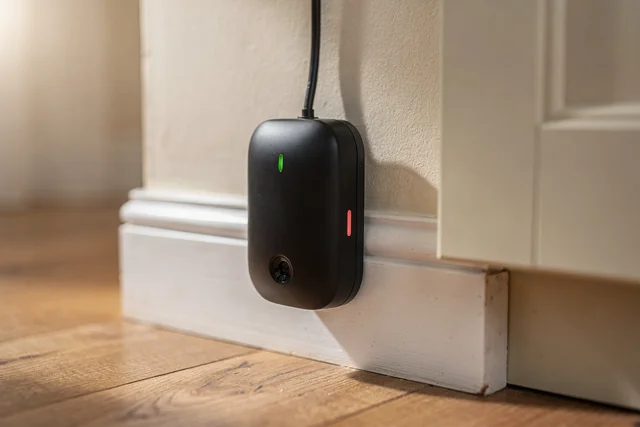
"This is a trap that's connected to the internet, essentially. Whereas there are other standard traps on the market that just catch and kill the mouse, that mouse can be caught in that trap for several weeks or several months. What this does is sends us a signal to notify us the trap has been activated, which allows us to respond." — Berwyn Evans, Rentokil, speaking to the BBC in 2017
The system was positioned as "the closest thing there is to a burglar alarm for mice," with early reports citing a roughly £1,200–£1,600 installation cost. That price covered the hub, one or more RADAR units, and the monitoring service. For homeowners who find checking traps traumatic or who travel frequently, the appeal is obvious: no decomposing mice, no forgotten traps, and a timestamped log of activity.
Where It Fits Best
ResiConnect suits properties with a known, contained mouse presence — typically a single-family home or flat where mice enter through a predictable gap, such as a utility penetration or air-brick defect. The system excels at early detection and rapid response, provided the monitoring contract stays active. If your primary stress is not the mice themselves but the uncertainty of whether your traps are working, the alert function removes that ambiguity.
The Honest Limits
The hardware does not seal entry points, remove nests, or address why mice arrived. Carbon dioxide killing is humane, but the trap still requires physical removal of the animal by a technician — meaning response time depends on Rentokil's schedule, not yours. In 2017 coverage, the system was marketed primarily through Rentokil directly, and availability for one-off domestic installation remains narrower than their commercial PestConnect rollout. If you live in a terraced house with shared walls, the trap catches mice on your side but does nothing about neighbours who may be the source.
Ultrasonic Deterrents: The Plug-In Promise
Ultrasonic repellents occupy a different niche entirely. These small devices emit high-frequency sound waves claimed to disturb rodent navigation and nesting behaviour. Prices range from £15 for a basic plug-in to £80 for units covering larger rooms or multiple frequencies.
What the Evidence Actually Shows
The scientific literature on ultrasonic rodent repellents is mixed at best. Mice can habituate to constant frequencies within days, and physical barriers like furniture, walls, and insulation absorb or deflect the sound. The Pest Management Alliance has noted that no ultrasonic device holds standalone approval for rodent control under UK biocidal regulations. Some homeowners report temporary reduction in activity, particularly when combined with other measures, but long-term elimination is rare.
Who Should Consider Them
Ultrasonic units work best as a supplementary layer in a multi-tool approach — for example, in a garage or loft where you want to discourage exploratory behaviour while you seal gaps. They are not a primary solution for an active infestation, and anyone promising "mice will simply leave" is overstating the case. For the cost of three or four mid-range units, you could fund a professional inspection that identifies the actual entry route.
Snap Traps: The Direct Approach
The classic wooden snap trap remains the most widely used mouse control tool in Britain. Modern variants include plastic quick-set designs, covered tunnels that hide the catch, and multi-catch units. A pack of four quality traps costs £8–£20, and bait — peanut butter, chocolate, or proprietary attractant — adds pennies per use.
Why They Persist
Snap traps kill instantly when set correctly, which satisfies welfare guidelines for humane control. They require no power, no subscription, and no technician visit. For a homeowner who spots one or two mice and acts immediately, a well-placed trap can resolve the problem within 48 hours. The RENTOKIL CONNECT RADAR INSTRUCTION MANUAL itself notes that traditional methods target feeding behaviour, whereas their connected system exploits travelling habits — implying that baited traps remain valid, just differently positioned.
Where Snap Traps Fall Short
The failure modes are human, not mechanical. Traps set without understanding mouse runways catch nothing. Traps left unchecked for weeks create the exact problem ResiConnect was designed to solve: decomposition, odour, and secondary insect attraction. In a London flat with multiple mice, a single trap is mathematically insufficient — you need one per estimated mouse plus spares, checked daily. For anyone with limited mobility, a phobia of dead animals, or irregular hours, the maintenance burden is real.
Professional Pest Control: The Full Job
A professional mouse control visit in London typically includes inspection, identification of entry points, treatment with traps or (where appropriate) restricted rodenticides, and follow-up monitoring. NPTA-registered technicians operate under the UK Rodenticide Stewardship Regime, which limits certain poisons to trained professionals and mandates non-chemical alternatives where feasible.
What You Actually Get
The difference between calling a technician and buying a gadget is the site survey. Mice follow thermal gradients and pheromone trails left by previous generations; a technician reads grease marks, droppings distribution, and gnaw patterns to map the infestation. In East London properties — particularly Victorian and Edwardian terraced housing with suspended floors and shared drainage — the entry point is often three rooms from where you first spotted evidence.
Professional treatment also carries accountability. If mice return within the guarantee period, the technician revisits at no extra charge. For landlords in Tower Hamlets or Newham, this guarantee is often a tenancy agreement requirement. For food premises, professional documentation supports Environmental Health compliance.
When Professional Becomes Necessary
There is a threshold where DIY tools, however smart, become insufficient. Signs you have crossed it include: mice in multiple rooms, droppings in food preparation areas, gnawing on wiring or pipe insulation, or activity persisting beyond two weeks of self-treatment. At this stage, signs DIY is failing become unmistakable — and continuing to layer gadgets delays the resolution that structured professional treatment provides.
Comparing the Four Approaches by Homeowner Situation
| Situation | ResiConnect | Ultrasonic | Snap Traps | Professional |
|---|---|---|---|---|
| Single mouse, confident homeowner | Overkill | Possible supplement | Fast, cheap | Unnecessary cost |
| Travelling/second home owner | Strong fit | Unreliable alone | Requires checker | Possible contract |
| Phobia of dead animals | Designed for this | No handling | Problematic | Technician handles |
| Multiple mice, unknown source | Catches symptoms only | Ineffective | High maintenance | Addresses cause |
| Shared walls/terraced house | Partial solution | No penetration | Limited reach | Often essential |
| Food business/compliance | Not certified standalone | Not approved | Documentation weak | Required |
The table clarifies what each tool actually does. ResiConnect is a premium monitoring and response layer, not a standalone cure. Ultrasonic devices are situational discouragements. Snap traps are effective but labour-intensive. Professional service is the only option that combines diagnosis, treatment, and prevention with regulatory backing.
The Cost Reality Over Two Years
ResiConnect's upfront hardware and installation cost, spread across a typical 24-month monitoring contract, runs toward £50–£70 monthly equivalent. Ultrasonic units are cheap to buy but require replacement and electricity, with no guaranteed outcome. Snap traps have near-zero running costs but impose time costs — daily checking, resetting, disposal — that many homeowners underestimate.
Professional mouse control in London ranges from £120–£250 for a standard three-visit residential treatment, with annual prevention contracts available for properties with recurrent risk. The professional rat extermination prices in comparable East London boroughs illustrate how structured pricing works when technicians quote per job rather than per gadget.
For a homeowner facing their first mouse sighting, the economic logic favours starting with snap traps or a single professional visit. ResiConnect becomes cost-effective only when its specific benefits — remote monitoring, humane killing, no handling — align with your constraints.
What London's Rodent Patterns Mean for Your Choice
UK pest data from 2024 shows local authorities made over 291,000 visits to homes for pest issues, with rodents accounting for a significant share. Autumn and winter drive mice indoors across London, from Camden basements to Barking and Dagenham semis with garage access. The 2026 trend continues: colder snaps correlate with spike calls, and properties with unsealed air bricks or garden access points see repeat visitors.
This seasonality matters for gadget buyers. A ResiConnect system installed in October catches mice that enter before you notice them. But if your neighbour's renovation disturbs a nest in January, the same system alerts you without stopping the influx. Professional treatment at that point includes neighbour liaison advice and proofing that a standalone device cannot provide.
The Option Most Homeowners Overlook
Integrated pest management — combining physical proofing, environmental modification, and targeted treatment — outperforms any single tool. This means: sealing gaps wider than 6mm with wire wool and mortar, removing food sources like bird seed or unsecured bins, trimming vegetation from walls, and placing monitoring traps at known entry points. A professional technician builds this plan; a homeowner can implement much of it after one guided survey.
The overlooked alternative is not a product but a sequence: act fast with traps, identify the source within a week, and escalate to professional proofing if activity persists. Gadgets that promise to replace this sequence often capture the homeowner's anxiety more effectively than they capture mice.
Choosing Based on What Actually Stresses You
If your stress is uncertainty — not knowing whether mice are present — ResiConnect's alert function is genuinely useful, provided the cost fits your budget. If your stress is speed — you need mice gone before a rental inspection or family visit — snap traps or a same-day professional visit are faster. If your stress is recurrence — this is the third autumn you've had mice — you need proofing and source elimination, not another monitoring device.
For London homeowners in Hackney or Lewisham Victorian terraces, the shared infrastructure makes individual-unit monitoring inherently limited. For new-build flats in Stratford or Beckton with better sealing, a single snap trap may suffice.
What About Rentokil's Broader PestConnect Ecosystem?
ResiConnect was the domestic brand name for what Rentokil now markets more broadly as PestConnect for commercial clients and RADAR Connect for specific trap hardware. The technology has evolved: dual-chamber units, integration with myRentokil dashboards, and compatibility with AutoGate systems for external rodenticide stations. For homeowners, the practical question is whether the domestic service tier remains actively promoted in your postcode, or whether you are being routed toward commercial-style contracts. The 2017 pricing and availability cited in early coverage may not reflect current London service areas.
Reader Questions: ResiConnect and Mouse Control Decisions
Does the ResiConnect mouse alarm prevent mice from entering?
No. It detects and kills mice that have already entered, then alerts a technician. Physical proofing — sealing gaps, repairing vents, managing vegetation — is what prevents entry.
Can I install ResiConnect myself?
The system requires professional installation and activation on Rentokil's monitoring network. It is not an off-the-shelf consumer product.
Are ultrasonic repellents a waste of money?
They are not reliably effective as standalone control. Some users report temporary behavioural changes in mice, but habituation and physical barriers limit long-term success. They may have minor value as part of a broader prevention strategy.
How quickly does professional mouse control work?
A single mouse in a well-defined location can be resolved in 24–48 hours with snap traps. Established infestations with multiple entry points typically require 2–3 visits over 2–4 weeks, with proofing recommendations to prevent return.
Is carbon dioxide killing genuinely humane?
Carbon dioxide exposure at controlled concentrations causes rapid unconsciousness before death, and is accepted by welfare guidelines as more humane than anticoagulant poisons or drowning. The mouse still experiences stress from trap entry and confinement.
Why do mice keep coming back after I use traps?
Traps catch individual mice but do not address the attractants and access routes that drew them. Mice follow pheromone trails from previous occupants, so an unsealed entry point functions as a recurring invitation. Professional rat or mouse control assessment includes identifying these persistent pathways.

Need professional help? BuzzKill offers fast, reliable pest control services across London and Essex.