
A practical guide for homeowners deciding whether to tolerate, monitor, or treat these fast-moving arthropods, with East London climate context and professional guidance.
When something long-legged streaks across your bathroom floor at midnight, few East London homeowners stop to count appendages. The reflex reaches for a shoe or a phone. That creature — almost certainly the house centipede Scutigera coleoptrata — occupies an awkward niche in British domestic life. It devours other household pests. It signals damp or prey-species trouble. It also triggers genuine distress, particularly for households already stretched by property worries. This article brings together three expert lenses — entomological, pest-management, and climate-specific — to help you judge whether your particular sighting calls for tolerance, closer monitoring, or professional survey.
What Exactly Is a House Centipede?
The house centipede is not an insect. It is a chilopod, a predatory arthropod carrying fifteen pairs of disproportionately long legs that grant it startling velocity across horizontal and vertical surfaces alike. The Centipedes AIDGAP guide from the Field Studies Council records 57 centipede species in Britain, seven restricted to greenhouses. The house centipede differs from native stock — introduced historically, it has established itself with growing success across southern England.
Adult body length runs 25–35 mm, though legs extend this footprint substantially. Colouration is yellowish-grey with three dark dorsal stripes. The species is strictly nocturnal, favouring dark, humid microclimates where it hunts actively rather than constructing webs or nests.
For formal identification, the AIDGAP guide supplies dichotomous keys and species accounts. Most householders, however, recognise the house centipede by its characteristic speed and leg span rather than detailed morphological inspection. Should you retain a specimen for confirmation, the Centipedes AIDGAP resource offers the most accessible British reference since Eason's 1964 monograph.
The Entomologist's View: Natural Pest Control Ally
Biologically speaking, the house centipede carries considerable utility. It damages neither structures, fabrics, nor stored foodstuffs. It transmits no human pathogens. Its entire domestic function is predation upon fellow arthropods — spiders, silverfish, cockroach nymphs, carpet beetle larvae, ants.
Frances Watkins's research, published in the [PDF] The House Centipede Scutigera](https://anhso.org.uk/wp-content/uploads/frit11-centipede.pdf) by the Amateur Natural History Society of Oxfordshire, tracks the species' expanding British range. Watkins observes that populations are shifting from ephemeral introductions to permanent establishment, with outdoor records climbing alongside indoor observations. This pattern indicates the house centipede has located viable ecological niches within southern England's built environment, Greater London included.
The entomological case for tolerance proceeds thus: house centipede presence signals a functioning micro-ecosystem with adequate prey to sustain predators. Removing centipedes without tackling their food base is, at most, a brief reprieve. At worst, it risks unchecked growth in prey populations — silverfish colonising damp bathrooms, cockroach nymphs exploiting kitchen voids.
Homeowners experiencing minor, occasional bathroom or basement sightings generally receive entomological advice to leave the animals undisturbed. The species fails to establish in dry conditions; persistent populations demand humidity exceeding 60% plus accessible prey.
The Pest Professional's View: Secondary Indicator Species
Pest control technicians approach house centipedes through a different frame. While accepting their non-pest status in isolation, professionals treat them as secondary indicators — evidence that conditions exist to support more problematic species.
At BuzzKill Pest Control, our RSPH Level 2 technicians encounter house centipedes routinely during surveys across East London boroughs including Tower Hamlets, Hackney, and Newham. The pattern holds steady: centipede sightings concentrate in properties with concurrent or recent silverfish, cockroach, or damp-wood decay issues.
Professional assessment weighs three factors:
Moisture sources: Persistent centipede activity correlates strongly with plumbing leaks, insufficient ventilation, or rising damp. These identical conditions support silverfish, booklice, and mould-feeding species.
Prey availability: Where centipedes proliferate, technicians search for what sustains them. A bathroom hosting centipedes and silverfish points to humidity affecting both. A kitchen with centipedes and German cockroach nymphs signals a deeper sanitation failure.
Entry pathways: Victorian and Edwardian terraced housing — widespread across East London — offers abundant harbourage via suspended timber floors, wall cavities, and service voids. Centipedes utilise the same routes as rats, mice, and cockroaches.
Pest professionals rarely treat for centipedes directly. Instead, centipede activity directs targeted intervention against underlying conditions and primary pest species. Our pest control surveys in East London employ this indicator-species methodology to uncover problems residents may not have detected independently.
East London's Climate and Building Stock: Why Sightings Are Increasing
Several factors particular to East London and the broader Thames Gateway area drive rising house centipede reports. Grasping these distinctions helps separate benign, occasional visitors from situations meriting professional attention.

Building age and construction type: Pre-1919 housing predominates in areas such as Bethnal Green, Spitalfields, and East Ham. Suspended timber ground floors, unventilated sub-floor voids, and solid external walls lacking damp-proof courses maintain higher humidity than modern construction. Continuous habitat connectivity through floor voids and party-wall cavities extends their suitability.
Urban heat island and milder winters: The [PDF] The House Centipede Scutigera](https://anhso.org.uk/wp-content/uploads/frit11-centipede.pdf) research explicitly notes increasing observation frequency across southern England. London's urban heat island prolongs active seasons for thermophilic species and trims winter mortality. Centipedes that would die in colder rural settings survive in the built environment, sustaining larger breeding populations.
Retrofit insulation and unintended consequences: Government retrofit programmes have added cavity wall insulation and sealed windows across many East London properties. Thermal efficiency gains are real; so too are reduced natural ventilation and trapped moisture from cooking, bathing, and clothes drying. Resulting humidity suits centipedes and their prey equally.
Thames Gateway regeneration and ground conditions: Former industrial zones, notably around Custom House, Canning Town, and the Royal Docks, present complex groundwater regimes. Basement damp in newer developments and residual moisture in Victorian foundations both sustain invertebrate populations.
Residents of Islington or Lewisham with period properties increasingly regard occasional autumn centipede sightings as normal. The judgement call lies in whether frequency and distribution indicate manageable seasonality or symptoms of underlying damp or pest activity.
Decision Framework: Tolerate, Monitor, or Treat?
The comparison table below distils how three expert perspectives evaluate house centipede presence, with actionable guidance for each scenario.
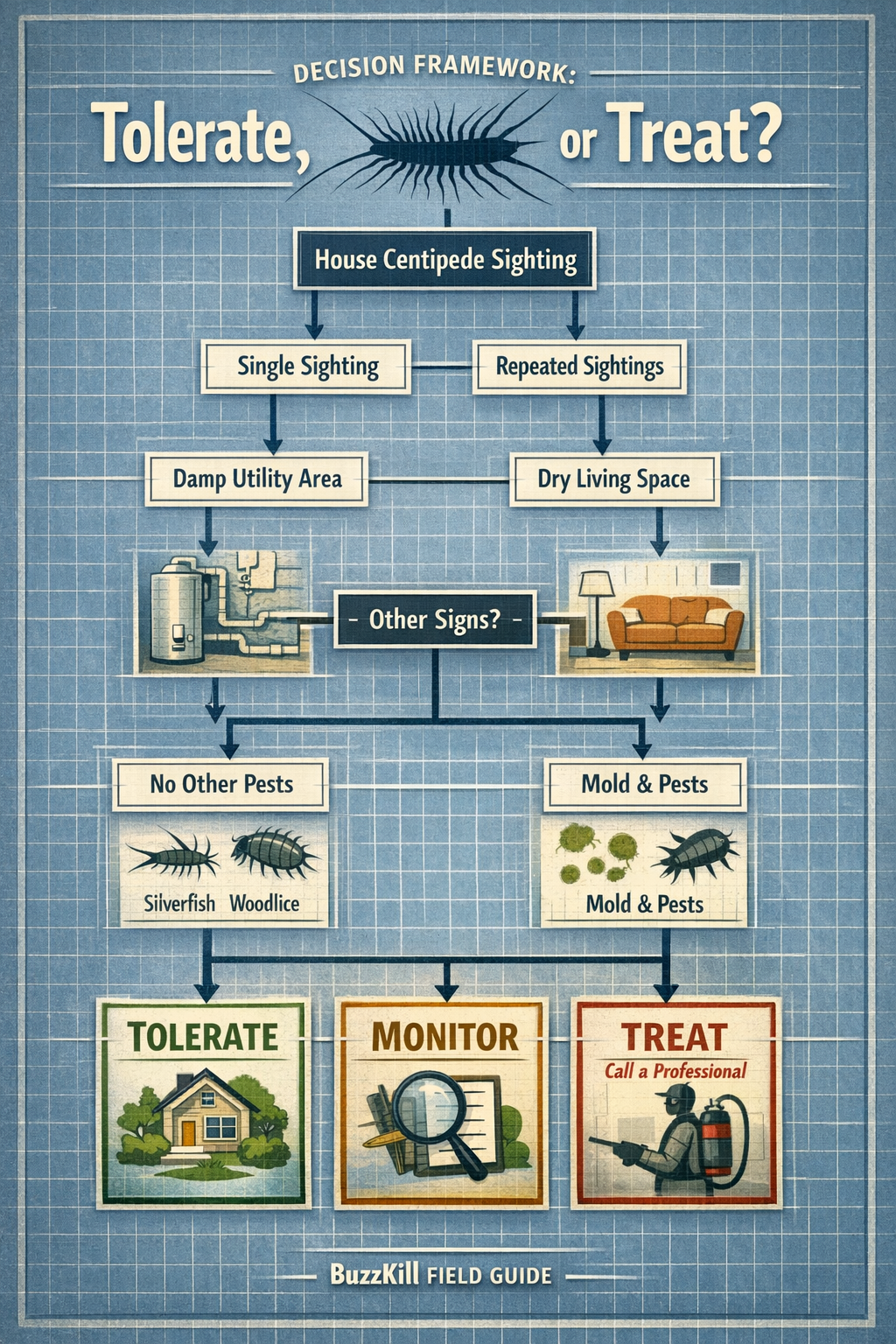
Scenario | Entomologist's Stance | Pest Professional's Stance | Recommended Action |
|---|---|---|---|
Single sighting in bathroom, summer | Beneficial predator, likely transient | Check for moisture; probably benign | Tolerate; improve ventilation |
Regular sightings in multiple rooms | Indicates healthy prey population | Suggests widespread humidity or prey species | Monitor; inspect for silverfish, cockroaches, or leaks |
Sightings with visible silverfish | Natural biocontrol in action | Dual indicator of damp conditions | Monitor; address humidity; consider professional survey if persistent |
Sightings with cockroach activity | Predator-prey ecosystem established | Serious sanitation/structural concern | Treat — contact emergency pest control for rapid assessment |
New-build flat with centipedes | Unexpected; possible importation | Check for construction moisture, inadequate drying | Monitor; escalate if accompanied by mould or other pests |
Ground-floor Victorian property, autumn | Seasonal migration normal | Examine sub-floor ventilation and damp-proofing | Tolerate if isolated; monitor if recurrent |
This framework captures the cross-perspective consensus: the house centipede itself is seldom the problem. Context determines appropriate response.
When to Call a Professional: BPCA-Aligned Guidance
The British Pest Control Association (BPCA) stresses integrated pest management — resolving root causes rather than symptoms. For house centipedes, professional intervention becomes warranted when:
Sightings occur frequently (weekly or more) and spread across multiple rooms
They coincide with confirmed or suspected cockroaches, bed bugs, or rodents
Visible damp, mould, or water damage exists that residents cannot trace
The property is rented and landlord repair obligations are unclear
The Pests support guidance from the Housing Ombudsman specifies that landlords should maintain published policies for pest response, including clear responsibility allocation and repair scheduling. For tenants in East London's sizeable private rental sector, this framework supports escalation when property conditions sustain pest populations.
BuzzKill Pest Control's same-day inspection service follows this BPCA-aligned methodology. Our technicians do not deploy blanket insecticide treatments for centipedes. We conduct moisture assessment, identify primary pest species where present, and recommend targeted treatment coupled with environmental modification. This minimises chemical exposure — a significant consideration for households with children or pets — while addressing the genuine problem.
Practical Steps for Homeowners
Whether you opt for tolerance or intervention, several measures reduce house centipede activity and the conditions enabling it.
Humidity control: Keep relative humidity below 60% through ventilation, dehumidification, and leak repair. This single measure is the most effective — it simultaneously curtails centipede survival and eliminates habitat for their prey.
Exclusion: Seal gaps around pipework, floor edges, and skirting boards with suitable fillers. Bathroom and kitchen service penetrations merit particular attention, as moisture and prey species concentrate at these points.
Prey species management: Where silverfish, booklice, or small spiders appear in centipede-active zones, address these populations through humidity reduction and, if required, targeted treatment. Eliminating prey removes the centipede's ecological base.
Monitoring: In uncertain situations, position sticky monitoring traps in dark, humid locations. These capture centipedes and prey alike, furnishing evidence of population trends without immediate treatment commitment.
Professional survey: When DIY measures fall short or multiple pest species are suspected, professional survey delivers definitive assessment. Our pest control in East London service encompasses moisture mapping, harbourage identification, and integrated treatment planning.
Case Scenarios: Three East London Homes
The following patterns from our East London survey records illustrate how the decision framework operates in practice.
The Shoreditch loft conversion: A couple in a converted warehouse near Spitalfields reported centipedes in their en-suite bathroom each autumn. Survey revealed adequate ventilation but a poorly sealed shower tray generating persistent moisture in the floor void. No other pest species detected. Recommendation: repair sealant, install continuous trickle ventilation, tolerate occasional centipedes. Six-month follow-up: sightings dropped to one per season, accepted by residents.
The Stratford new-build: A family in a 2019 apartment near West Ham reported centipedes in utility room and kitchen from move-in. Survey identified construction moisture in the concrete floor slab, supporting silverfish and booklice populations. Centipedes had established as predators. Recommendation: dehumidifier operation for eight weeks, monitoring traps, liaison with developer regarding floor membrane integrity. No chemical treatment required; centipede numbers declined as substrate dried.
The Whitechapel ground-floor flat: A tenant reported centipedes in bathroom and kitchen, with suspected cockroach activity at night. Survey confirmed German cockroach nymphs in the kitchen extraction void and excessive humidity from a leaking waste pipe. Centipedes were secondary predators exploiting the cockroach population. Recommendation: immediate cockroach treatment with gel bait and insect growth regulator, plumbing repair, humidity reduction. Centipede population eliminated indirectly through prey removal and environmental modification.
These cases span the full response spectrum — from simple tolerance through environmental management to targeted pest treatment — depending on the underlying conditions centipedes expose.
Frequently Asked Questions
Are house centipedes dangerous to humans or pets?
No. Despite alarming appearance and speed, house centipede venom subdues small invertebrates only. Their forcipules (venom claws) typically cannot penetrate human skin. Bites are extraordinarily rare, causing localised minor irritation comparable to a bee sting. Pets may occasionally capture and consume them without harm, though individual sensitivity varies.
Why am I seeing more house centipedes than previous years?
The [PDF] The House Centipede Scutigera](https://anhso.org.uk/wp-content/uploads/frit11-centipede.pdf) research documents species expansion across southern England, permanent establishment replacing former transient presence. Combined with milder winters, increased humidity in retrofitted housing, and London's urban heat island, this accounts for rising reports. Your property may also have developed moisture or prey-species conditions supporting larger populations.
Do house centipedes mean I have cockroaches?
Not necessarily. Centipedes prey on diverse species including silverfish, spiders, and ants. Their presence does indicate sufficient invertebrate activity to sustain a predator population, however. Professional assessment can determine whether this represents benign biodiversity or a symptom of more serious pest issues requiring cockroach control or other targeted intervention.
Will insecticide treatment eliminate house centipedes?
Broadcast insecticide application is generally ineffective and ill-advised. Centipedes are mobile, nocturnal, and harbour in inaccessible voids. Surface sprays miss these refuges and may drive animals deeper into structure. More fundamentally, chemical treatment without addressing moisture and prey sources wastes resources and exposes residents to unnecessary pesticide. Integrated pest management — humidity control, prey species management, targeted treatment only where primary pests are confirmed — delivers durable resolution.
Should landlords treat house centipedes in rental properties?
Under the Pests support framework, landlords should maintain clear policies distinguishing their responsibilities from tenants'. Where centipedes indicate underlying damp or disrepair falling under landlord obligation, prompt repair is required. Where they reflect tenant lifestyle factors — inadequate ventilation, poor hygiene attracting prey species — tenant education and cooperation are appropriate. BuzzKill Pest Control provides pest control for landlords with documentation suitable for dispute resolution and compliance demonstration.
Conclusion
The house centipede resists simple friend-or-foe classification. To the biologically curious homeowner, it offers free, non-toxic pest control in shadowed corners. To the pest professional, it serves as diagnostic instrument revealing conditions and species demanding attention. To the stressed resident meeting one unexpectedly at midnight, it functions primarily as alarm — not because the centipede itself threatens harm, but because its presence forces a decision about next steps.
East London's distinctive combination of historic building stock, urban climate effects, and ongoing regeneration generates conditions where house centipede encounters grow increasingly probable. Appropriate response hinges on context: tolerate the occasional bathroom visitor, monitor regular sightings for underlying patterns, treat promptly when centipedes accompany confirmed pest species or uncontrolled damp.
If your situation occupies the uncertain middle ground — regular sightings without obvious cause — professional survey offers clarity without committing to unnecessary treatment. BuzzKill Pest Control provides same-day inspection across East London and Essex, with NPTA-registered, RSPH Level 2 technicians who assess conditions holistically rather than applying blanket chemical treatments. You may reach us on 0203 468 1999 or request a callback through our website to arrange a same-day inspection.
Related Blog Posts
Need professional help? BuzzKill offers fast, reliable pest control services across London and Essex.