
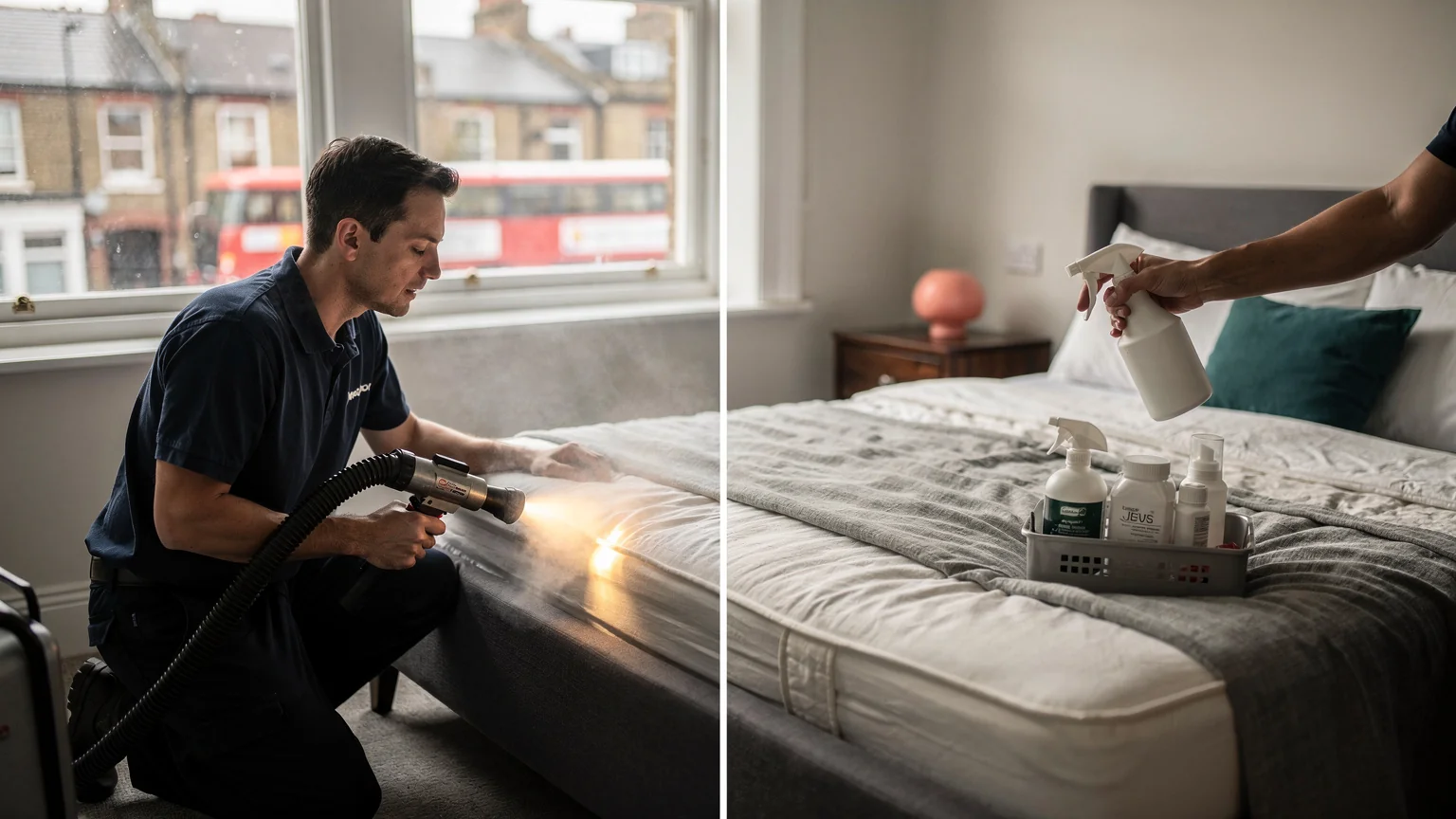
You have found the telltale signs. Rust-coloured spots on the mattress. Tiny dark specks along the bed frame. Perhaps you have even seen the insect itself, flat and reddish-brown, scuttling into a crack as you turn on the light. Now you face a decision that thousands of East London households confront each month: which treatment method will actually clear your home?
The choice between heat treatment and chemical sprays is not simply a matter of preference. Your property type, household composition, budget, and how long you can tolerate disruption all shape which approach makes sense. In Tower Hamlets high-rises, Victorian terraces in Bow, and the dense new-build blocks of Stratford, the same bed bug species behaves differently, and the available treatments perform differently too.
This comparison examines both methods on the criteria that matter most to local residents: effectiveness, preparation burden, safety for children and pets, total time from booking to sleeping soundly again, and typical costs across East London.
What heat treatment actually does to bed bugs
Heat treatment raises the temperature of an entire room, or sometimes a whole flat, to between 56°C and 60°C and holds it there for several hours. At these temperatures, bed bugs at every life stage, egg, nymph, and adult, die from protein denaturation and dehydration. The heat penetrates into mattress seams, electrical outlets, skirting board cracks, and behind wallpaper, places where sprays often fail to reach.
The equipment is substantial. Industrial heaters and fans circulate hot air while technicians monitor temperatures with thermal sensors placed throughout the space. Cold spots must be eliminated; a single untreated corner can harbour survivors that restart the population within weeks.
For a typical two-bedroom flat in Hackney or Bethnal Green, the active heating phase lasts four to six hours. The property needs several more hours to cool before you can return. Most households are back the same evening, though some technicians advise waiting until the following morning to allow thorough cooling.
The preparation burden is significant but straightforward. You must remove heat-sensitive items: candles, aerosol cans, certain medications, plants, and electronics that cannot tolerate sustained high temperatures. Clothing and bedding can usually remain if they are spread out to allow air circulation. Unlike chemical treatments, you do not need to wash and bag every textile.
Heat treatment offers one decisive advantage in East London's dense housing stock. It leaves no residue. In properties with young children, pets, or residents with respiratory sensitivities, this matters enormously. There is no drying time, no lingering odour, and no restriction on re-entering the treated space once it cools.
The drawback is cost. Heat treatment typically runs £600 to £1,200 for a two-bedroom flat, depending on the provider and whether multiple rooms require treatment. In Newham's high-turnover rental market, where tenants sometimes absorb treatment costs themselves, this price can feel prohibitive. Landlords, however, often prefer heat treatment because it minimises void periods; a single day of disruption beats multiple spray visits spread across weeks.
How chemical sprays work and where they fall short
Chemical treatments apply insecticides to harbourage areas, mattress frames, skirting boards, and other locations where bed bugs hide. Modern formulations typically combine a fast-acting agent with a residual compound that continues killing insects that cross treated surfaces for days or weeks after application.
A standard chemical programme requires two to three visits spaced ten to fourteen days apart. The first spray kills active adults and nymphs. The follow-up targets eggs that have hatched since the initial treatment. Some providers add a third visit for severe infestations or properties with complex layouts.
Preparation is more demanding than for heat treatment. You must wash all bedding, clothing, and textiles at 60°C minimum, then seal them in plastic bags until after the final spray. Furniture needs pulling away from walls. Drawers must be emptied. In a cluttered East London flat, especially in older conversions with built-in storage, this process can consume an entire weekend.
The drying time creates practical difficulties too. Most sprays require four to six hours before you can re-enter treated rooms. Residual films can irritate sensitive skin. Families with crawling infants or pets that sleep on treated floors face particular constraints.
Cost is the main attraction. A three-visit chemical programme typically costs £300 to £600 for a two-bedroom flat, roughly half the price of heat treatment. For tenants in Waltham Forest or Redbridge paying out of pocket, this difference can be decisive.
The critical limitation is resistance. Bed bug populations in parts of East London, particularly around large social housing estates in Barking and Dagenham and Tower Hamlets, have developed reduced susceptibility to common pyrethroid insecticides. A spray that worked reliably five years ago may now leave substantial survivors. Reputable technicians should assess resistance risk during initial inspection and adjust their product choice accordingly. If your provider cannot explain which chemical class they are using and why, that is a warning sign.
How East London's housing shapes what works
The physical environment matters as much as the treatment chemistry. In Victorian terraced houses common in Bow and Manor Park, heat treatment faces challenges from solid brick walls that create thermal mass and uneven temperature distribution. Skilled technicians compensate with additional heaters and extended heating periods, but this adds cost.
Conversely, these same solid structures can work against chemical sprays. Deep mortar joints and ornate plaster cornices provide endless harbourage that spray droplets struggle to penetrate. A bed bug pushed into a deep crack by the initial spray may survive entirely.
In high-rise social housing blocks, particularly in Tower Hamlets and parts of Newham, heat treatment raises building-wide concerns. Shared ventilation systems and thin partition walls can allow heat migration to neighbouring flats, triggering fire alarms or causing discomfort. Some housing associations require advance notification and risk assessments before approving heat treatment in these buildings. Chemical sprays, applied room by room with minimal building-wide impact, often face fewer administrative hurdles.
New-build developments in Stratford's Olympic Village and Greenwich's riverside towers present different issues. Lightweight construction materials and extensive plastic components, cable trunking, PVC window frames, synthetic flooring, increase fire risk during heat treatment. Chemical sprays are generally safer in these environments, though technicians must still protect polished surfaces from staining.
For families in Forest Gate or Plaistow with young children, the no-residue advantage of heat treatment often overrides cost considerations. The same applies to households with indoor pets, particularly cats that sleep in bedrooms and would ingest chemical residues through grooming.
Timing and disruption: what each method demands
Heat treatment compresses the entire elimination into a single day. You leave in the morning, return in the evening, and sleep in your own bed that night. For professionals who cannot work from home, or parents managing school runs, this single-day disruption is often worth the premium.
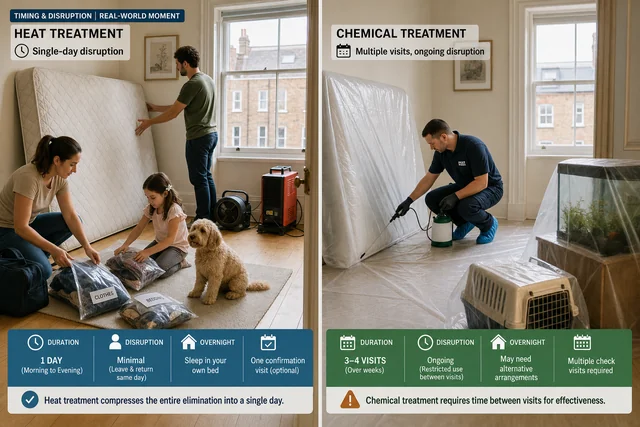
Chemical sprays spread across two to four weeks. Each visit requires you to be present to let the technician in, then absent for four to six hours while chemicals dry. The between-visit period demands continued vigilance: sleeping in the treated room to lure remaining bugs across poisoned surfaces, resisting the urge to sleep elsewhere and thereby scattering the infestation.
Some households find this sustained disruption harder than the intensive but brief upheaval of heat treatment. Others, particularly those with flexible schedules or nearby family they can stay with, manage the chemical schedule without difficulty.
Cost realities across East London
Pricing varies by provider, property size, and infestation severity. Based on typical market rates in early 2026:
| Treatment type | Typical flat size | Price range | Visits required |
|---|---|---|---|
| Heat treatment | 1-2 bedrooms | £600-£900 | 1 |
| Heat treatment | 3 bedrooms | £900-£1,200 | 1 |
| Chemical spray programme | 1-2 bedrooms | £300-£500 | 2-3 |
| Chemical spray programme | 3 bedrooms | £450-£700 | 2-3 |
These figures exclude VAT and any preparatory work you undertake yourself. Some providers, including East Ham bed bug removal services, offer guaranteed programmes where follow-up visits within a defined period carry no extra charge. Always clarify what guarantee terms apply before booking.
When combination approaches make sense
The heat-versus-spray framing is itself a simplification. Many technicians now use integrated approaches: heat treatment for the primary infestation zone, targeted chemical application to perimeter areas and adjacent rooms where complete heating is impractical. This hybrid method costs more than pure chemical but less than whole-property heat, while reducing the risk of survivors escaping to untreated areas.
In Hackney bed bug extermination work, where Victorian conversions often have awkward extensions and loft spaces that resist uniform heating, this combined approach has become increasingly common. Similarly, Tower Hamlets bed bug removal in high-rise settings sometimes uses heat for the main bedroom and chemical barriers in hallways and neighbouring rooms to prevent spread through shared walls.
Choosing your provider in East London's pest control market
Pest Control East London

Pest Control East London positions itself as a Walthamstow-based service covering north, east and south-east London since 2010. Their website emphasises affordability and friendly service across rat, mouse, flea, wasp, and bed bug treatments. They identify causes of infestation as part of their approach rather than treating symptoms alone.
Pestforce East London

Pestforce operates a franchise model with coverage across Tower Hamlets and Hackney. Their East London page lists treatments for rats, mice, wasps, fleas, bedbugs, ants, and pigeons. As a national network with local operators, experience and approach may vary by individual technician.
Decision guide: which method fits your situation
Consider heat treatment if:

- Your household includes young children, pregnant residents, or individuals with asthma or chemical sensitivities
- You need the infestation cleared in a single day
- Your property is a house or low-rise flat where building-wide heating is feasible
- You have budget flexibility and prefer to minimise disruption
- Previous chemical treatments have failed, suggesting resistance
Consider chemical sprays if:
- Cost is your primary constraint
- You can manage multiple visits and the preparation demands between them
- Your property is in a high-rise block with restrictions on heat-based methods
- The infestation is caught early, before widespread establishment
- You have access to alternative accommodation during drying periods
Consider a combined or hybrid approach if:
- Your property has complex architecture with areas that resist uniform heating
- You want the speed of heat treatment for main living spaces with chemical backup for perimeter protection
- You are treating multiple affected properties in a single building, such as a buy-to-let portfolio in Plaistow bed bug removal scenarios
What happens before any treatment begins
Whichever method you choose, proper identification comes first. Many bed bug identification signs are mistaken for fleas, carpet beetles, or simply dust and fabric debris. A reputable technician will confirm the species before quoting, since treatment for bed bugs differs substantially from approaches for other insects.
Inspection should also identify the extent of spread. Bed bugs move along pipework, through wall voids, and via shared furniture in multi-occupancy buildings. Treating only the room where you first noticed signs often fails because adjacent spaces already harbour undetected populations. In Newham bed bug removal work, where rapid tenant turnover in rental properties accelerates spread, this whole-property assessment is particularly critical.
After treatment, bed bug prevention strategies become essential. Mattress encasements, bed leg interceptors, and vigilance after travel or second-hand furniture purchases all reduce recurrence risk. No treatment method provides permanent immunity against reintroduction.
Questions East London residents often ask
Can I stay in the property during heat treatment?
No. Temperatures reach levels dangerous to humans and pets. You must vacate for the entire heating and cooling period, typically six to eight hours total.
Will heat treatment damage my electronics?
Most modern electronics tolerate the temperatures used if powered down, but you should remove items with batteries, hard drives, or heat-sensitive components. Your technician will provide a specific checklist.
How do I know if chemical sprays have failed?
Persistent bites after three weeks, live bugs visible in treated areas, or new faecal spotting on fresh bedding all suggest surviving populations. Contact your provider immediately; guarantee terms should cover reassessment.
Are bed bugs in East London actually resistant to sprays?
Resistance has been documented in specific postcode clusters, particularly around large estates with histories of repeated chemical treatment. A competent technician tests for this or selects non-pyrethroid products as standard.
Can I treat bed bugs myself with shop-bought products?
Over-the-counter sprays and smoke bombs rarely eliminate established infestations. They may drive bugs deeper into harbourage, making professional treatment more difficult and expensive. Early, professional intervention typically costs less than failed DIY followed by advanced infestation.
Does my landlord have to pay for treatment?
In England, landlords are responsible for treating pests that were present at the start of a tenancy or that arise from structural defects. If you introduced bed bugs through travel or second-hand furniture, responsibility may fall to you. Document everything and communicate in writing.
Reading the signs that treatment has worked
Success looks different depending on method. After heat treatment, you should see no live bugs and no new bites from the first night back. Any survivor would be active immediately; the absence of activity is genuine absence.
After chemical sprays, some activity may continue for days as poisoned bugs emerge from hiding to die. This does not indicate failure. However, new bites after two weeks, or live bugs seen after three weeks, suggest the programme needs revisiting.
For ongoing confidence, especially in Barking and Dagenham bed bugs scenarios where resistance is more common, consider installing bed leg interceptors. These simple traps catch any bug attempting to climb from floor to bed, providing early warning of surviving or reintroduced populations.
Final routing: your next step
If you have confirmed bed bugs and need same-day assessment, Stratford bed bug treatment providers and services across East London can typically inspect within hours. The inspection should cover your property type, household constraints, and infestation extent before recommending a specific method.
For broader context on what elimination involves beyond the initial treatment choice, a bed bug elimination guide covers the full timeline from discovery through treatment to verification.
The right method is the one that matches your property, your household's needs, and your capacity for disruption. Heat treatment offers speed and certainty at a premium. Chemical sprays demand patience and preparation but cost less. In East London's varied housing landscape, neither is universally superior; both succeed when matched to the right situation and executed by technicians who understand local building stock and resistance patterns.
Need professional help? BuzzKill offers fast, reliable pest control services across London and Essex.