
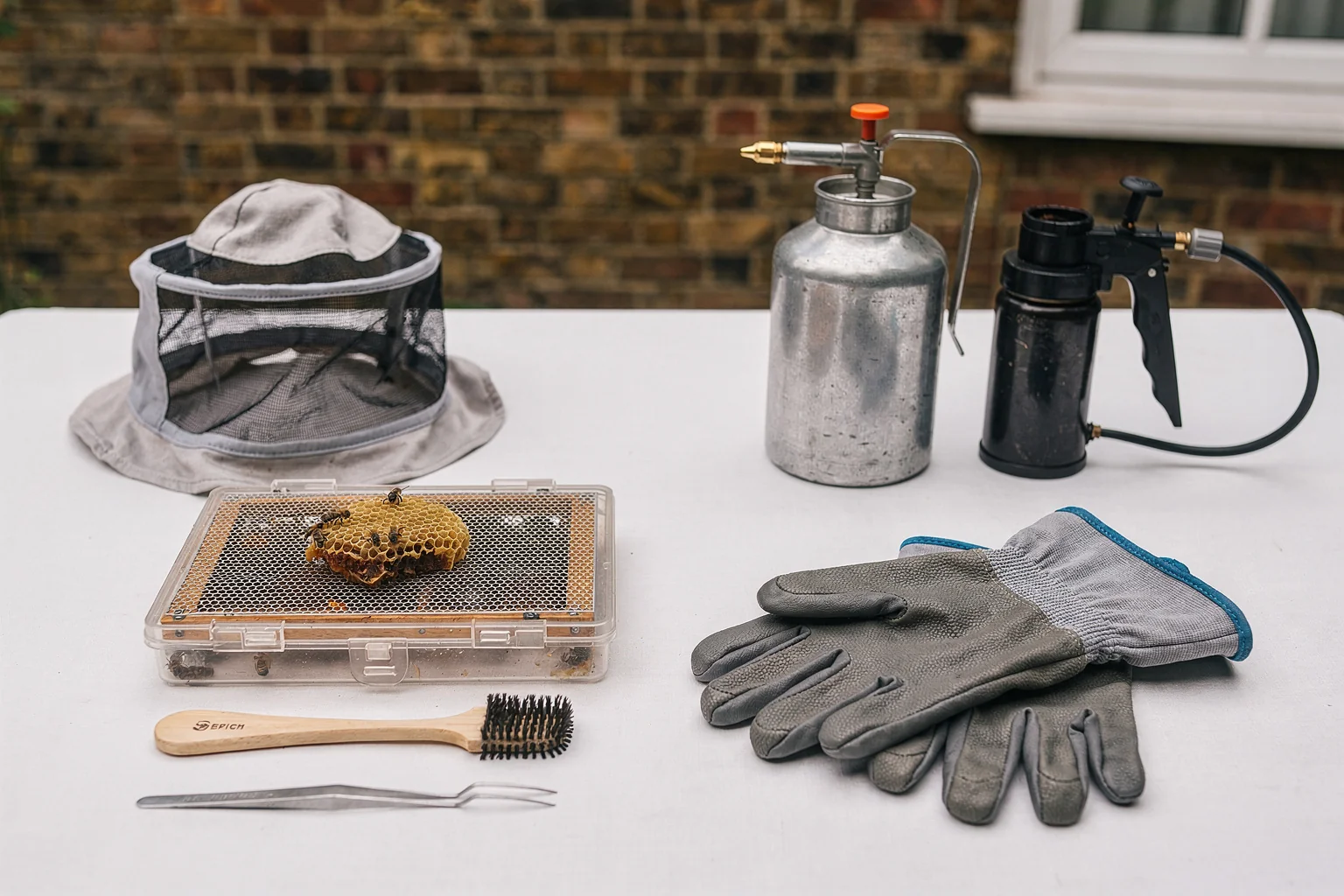
Most people assume killing a nest of bees is illegal in Britain. It isn't — not in the way they think. What actually trips people up is a patchwork of rules that apply to some bees, in some situations, for some reasons, and almost none of it is written the way the internet says it is. If you've found a nest in a wall cavity, under a shed roof, or in a chimney in East London and you're trying to work out whether you're allowed to do anything about it, the honest answer is: it depends on which bees you have, where they are, and what you mean by "get rid of."
This is a ranked list of the legal and practical distinctions that matter most when you're standing in a garden at 7pm wondering what to do. I've ordered them by how often they actually change the outcome for a homeowner or landlord, not by how often they appear in search results. The first item is the one that catches the most people out.
The species question comes before the legal question
Before any law applies, you need to know what you're looking at. UK law treats honey bees, bumblebees, solitary bees, and wasps very differently — and the average person misidentifies at least one of them.
Honey bees are the ones people worry about most. They live in colonies of tens of thousands, they swarm in late spring and early summer, and they're the species most likely to end up inside a building. A swarm hanging from a branch is usually a temporary stop while scout bees look for a permanent home. A colony that has moved into a wall cavity, a chimney, or a roof void is a different problem entirely, because now there's comb, honey, and a structure to think about.
Bumblebees nest in much smaller numbers — typically a few hundred at peak — and their nests are often in the ground, in compost heaps, or under decking. They're seasonal. The colony dies off in autumn, and the nest is never reused. That single fact changes the entire decision for most people who find one.
Solitary bees, including masonry bees and mining bees, don't live in colonies at all. They nest individually in mortar joints, bare soil, or old brickwork. They're the ones most often mistaken for a "bee problem" when there isn't really a problem to solve.
Wasps are not bees and are not covered by the same legal thinking. If you've got a wasp nest, the species question is settled quickly and the decision is much more straightforward.
Why this ranks first: every legal rule below hinges on species. Get the identification wrong and you'll either pay for a treatment you didn't need, or you'll try to handle something you shouldn't touch.
The common mistake is treating a bumblebee nest like a honey bee colony. A bumblebee nest under a shed in June will be gone by October on its own. A honey bee colony in a wall cavity will not — it will grow, build comb, and potentially cause staining and structural issues over time.
Verdict: Identify first. If you can't, get someone who can. A photograph sent to a pest control company or a local beekeeping association usually settles it within minutes.
There is no blanket ban on destroying honey bees
This is the single biggest myth in the whole topic, and it's worth stating plainly: it is not illegal to kill honey bees in the UK.
The Bees Act 1980 is the primary piece of legislation with "bees" in the title, and its purpose is disease and pest control, not species protection. It gives ministers the power to make orders preventing the introduction and spread of pests and diseases affecting bees. It allows authorised persons to destroy bees and equipment in specific circumstances — for example, where they've been imported in contravention of an order, or where they're infected with a notifiable pest or disease.
Read that carefully. The Act creates a legal framework for authorised destruction. It does not create a general prohibition on a homeowner or a pest controller dealing with a colony.
What people are usually thinking of when they say "it's illegal to kill bees" is one of three things:
- The Wildlife and Countryside Act 1981, which protects certain wild species — but honey bees are not a protected species under it, and neither are the common bumblebee species you'll find in a London garden.
- The general cultural and ecological argument that bees are valuable pollinators and shouldn't be killed unnecessarily. That's a strong argument. It isn't a law.
- Local authority practice. Many councils, including several London boroughs, will not treat bee nests at all, or will only treat where there's a serious threat to human life. That's a policy decision, not a legal one.
The gap between "councils won't do it" and "it's illegal" is where most of the confusion lives.
Verdict: You are not breaking the law by having a honey bee colony removed and destroyed. You may still be making a bad decision — for cost, for the building, and for the environment — but it isn't a criminal one.
When destruction becomes the legally required outcome
Here's the counter-intuitive part. In a narrow set of circumstances, destruction isn't just permitted — it's compulsory, and it's the government telling you to do it.
Under The Bee Diseases and Pests Control (England) Order 2006, where a notifiable disease such as European foul brood or American foul brood is confirmed in a hive, an authorised person must serve a notice on the owner or person in charge requiring the destruction of the bees, combs, or bee products from that hive. For some disease findings, treatment is an option instead. For others, destruction is mandatory.
There's also a removal prohibition that kicks in earlier. Under article 4 of the same Order, once notification of a suspected notifiable disease or pest has been given, the owner or person in charge must not remove — or permit the removal of — any hive, bees, combs, bee products, bee pests, hive debris, or appliances from the premises or vehicle where the hive is situated. That prohibition stays in place until an authorised person confirms the position or the notifying person is informed otherwise.
This matters for beekeepers far more than it matters for the average homeowner with a colony in a chimney. But it matters in one practical way: if you keep bees, or if you're buying a property with hives on it, you can't just move them because it's convenient. There's a legal hold in place during a disease investigation.
For everyone else, the takeaway is narrower. The law's real interest in bees is disease control and biosecurity, not whether a particular colony lives or dies in a wall.
Verdict: If you keep bees, know the notification rules. If you don't, this section is context — not a constraint on your decision.
Relocation is a practice, not a legal duty
Search for "bee relocation legal requirements uk" and you'll find plenty of pages implying that relocation is the legally required route. It isn't.
There is no statute that says a honey bee colony must be relocated rather than destroyed. Relocation is a professional practice, a code-of-conduct expectation in parts of the industry, and often the better outcome — but it's a choice, not a legal obligation.
That said, relocation isn't always possible, and the reasons are practical rather than legal:
- Access. A colony inside a cavity wall or under a tiled roof may need partial dismantling to reach. Some pest controllers won't do building work; some builders won't touch live bees.
- Comb and honey. Even if the bees are removed alive, the comb stays. Left in place, it can attract robber bees, wax moths, and other insects, and honey can seep through plasterboard. Removal of the comb is often the bigger job.
- Colony condition. A colony that's been treated with insecticide, or that's already diseased, isn't a candidate for rehoming.
- Timing. Swarms in spring are easy to rehome. A well-established colony in August is much harder to place.
- Beekeeper availability. Local associations and swarm collectors are volunteers. They're busy in swarm season and may not be able to attend a structural removal at all.
The honest version: relocation is the preferred route when the colony is accessible, healthy, and someone is available to take it. When any of those conditions fail, destruction becomes the realistic option — and it's lawful.
Verdict: Ask any contractor you speak to whether relocation is genuinely available for your specific situation, or whether it's being offered as a default line. A straight answer here tells you a lot about the company.
What a lawful treatment actually looks like
If destruction is the route, the law that governs it isn't bee law — it's pesticide law and health and safety law. This is where a lot of DIY attempts go wrong.
Any professional using an insecticide on a bee nest is working under the Control of Pesticides Regulations 1986 and the Food and Environment Protection Act 1985. The Code of Practice relating to the Control of Honey Bees sets out a specific expectation: where a nest is treated, every reasonable action must be taken to prevent foraging honey bees from gaining access to the treated nest, by removing the combs or blocking the nest entrances. That requirement exists because bees from neighbouring colonies will try to rob a treated nest and can be affected themselves.
In practice, a lawful and competent treatment looks like this:
- Identification confirmed before any product is chosen.
- Risk and COSHH assessments completed, with the product selected for the species and situation.
- Access and escape routes planned, including how to stop bees from other colonies getting in afterwards.
- Treatment applied, usually in the evening when foraging has stopped and the colony is inside.
- Comb removed or entrances blocked to prevent robbing and secondary problems.
- Follow-up check to confirm the colony is no longer active.
- Clearance and disposal of comb, honey, and debris where the nest was inside a structure.
If a contractor can't explain steps two, five, and seven, that's a warning sign. Those are the steps that separate a lawful, competent job from someone spraying a hole and leaving.
It's also worth checking credentials before you book. Our guide to pest controller credentials walks through what NPTA and BASIS PROMPT registration actually mean and how to verify them — useful if you're comparing quotes from companies you've never used before.
Verdict: The legal risk in bee work sits almost entirely with the person applying the pesticide, not the homeowner. That's exactly why you should care who you hire.
Where the bees are changes the answer
The same colony in two different places can lead to two completely different decisions. Location is the second-biggest factor after species.
Inside a building — cavity walls, chimneys, roof voids, soffits. This is the hardest case. The colony has comb, the comb has honey, and the honey will eventually stain, sag, or attract other insects. Removal usually means cutting into the structure. Destruction is more common here because relocation requires access that often doesn't exist without building work. Cost reflects the complexity, not the bees.
In a garden — compost heaps, decking, sheds, bird boxes. Often bumblebees. Often seasonal. Often best left alone until autumn, when the colony ends naturally. If it's a honey bee swarm on a branch, it may move on within days.
In a public or shared space — communal gardens, school grounds, care home grounds. Here the decision isn't just yours. Landlords, managing agents, and site managers have duties to people on the premises, and the risk assessment changes. A colony near a school entrance in June is a different problem from the same colony at the bottom of a garden.
In a commercial food premises. The priority shifts again. Pest control obligations for food businesses are about preventing and controlling pests that could affect food safety, and the paperwork trail matters as much as the treatment. Bee nests near loading bays, extractor vents, or delivery routes get dealt with quickly and documented properly.
Verdict: Ask what's behind the nest, not just what's in it. The answer to "can this be relocated?" usually depends on what you'd have to dismantle to get it out.
The cost reality nobody puts in the headline
Cost is where the relocation-versus-destruction decision often gets made for you, and it's worth being blunt about it.
Relocation is usually more expensive than treatment. It involves more time, more access work, and often a second party — a beekeeper or a specialist removal team — who has to be available and willing. Structural removals from a cavity wall or roof can run into several hundred pounds because of the building work involved, not the bees.
Treatment is typically cheaper and faster. It also leaves you with the comb problem, which is a separate job if the nest is inside a structure.
The cheapest option of all is doing nothing, and for bumblebees in a garden in July, that's frequently the right call. The colony will end on its own. The nest won't be reused. You'll have spent nothing.
The most expensive option is getting it wrong — treating a nest that didn't need treating, or leaving a honey bee colony in a wall until the comb has grown large enough that removal involves significant repair work.
Verdict: Get the identification right, then get a quote that separates the bee work from the building work. If a quote bundles them without explanation, ask for the breakdown.
How to verify a contractor's methods before you book
This is the practical checklist. It's the item most people skip, and it's the one that determines whether the job is done lawfully and properly.
Ask these questions before you agree to anything:
- What species do you think this is, and how did you confirm it? A good answer names the species or at least the group, and explains what they saw.
- Is relocation available for this situation, and if not, why not? You want a specific reason — access, colony condition, timing — not a vague one.
- What product would you use, and what's the safety profile around children and pets? They should be able to tell you the active ingredient and the re-entry time.
- What happens to the comb and honey afterwards? If the answer is "nothing," ask why not.
- Are you insured, and what accreditation do you hold? NPTA registration, BASIS PROMPT certification, and RSPH Level 2 qualifications are the markers worth checking.
- What's the follow-up arrangement? A single visit with no check is a red flag for a structural colony.
If you're dealing with a commercial premises, add: can you provide the documentation for our pest control file? Food businesses need that paper trail, and a contractor who can't produce it isn't the right fit regardless of price.
There's a broader point here about how pesticide rules work in practice. Our article on pest control rules and regulations covers how product approvals and legal use constraints apply in London, which is useful background if you want to understand what a contractor is and isn't allowed to do.
Verdict: The questions take five minutes. The wrong contractor can leave you with a treated nest, a comb problem, and no comeback.
What to do in the first hour after you spot a nest
Practical sequencing matters more than legal theory when you're standing outside looking at a swarm.
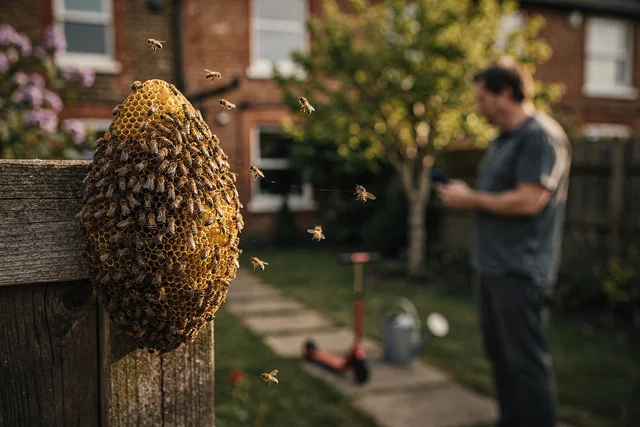
Don't spray anything. DIY sprays sold for wasps are not appropriate for honey bee colonies in structures, and a partial treatment can leave you with disoriented bees, a surviving colony, and a bigger problem. It also complicates any professional treatment afterwards.
Keep distance and keep others away. A swarm on a branch is usually calm. A colony that's been disturbed is not. Keep children and pets back, and don't block the flight path.
Photograph it from a safe distance. A clear photo of the insects and the location is the fastest way to get an accurate identification and a realistic quote.
Note the location precisely. "In the garden" isn't enough. Is it in the wall, the roof, the ground, a compost bin, a bird box? Is it at ground level or three metres up? Is there a visible entrance hole, and how big?
Decide whether it's actually urgent. A bumblebee nest in a border is not urgent. A honey bee colony with an entrance next to a front door, or above a school playground, is. Urgency determines whether you need someone today or whether you can take a day to get proper quotes.
Call someone who can identify it. A local beekeeping association may collect a swarm for free if it's accessible. A pest control company can handle structural colonies. Both are reasonable first calls depending on what you've got.
If you're in East London and want a same-day assessment, that's the kind of call we take regularly — but the sequencing above applies whoever you ring.
The item to act on today, and the one people overreact to
If you take one thing from this list, take the identification step. Everything else — the legal position, the cost, the relocation question, the treatment method — flows from knowing what species you're dealing with and where it is. Get that wrong and every subsequent decision is built on sand.
The item people overreact to is the garden bumblebee nest. It looks alarming, it sounds alarming, and it is almost always a temporary problem that resolves itself by autumn without any intervention, any cost, or any legal question arising. Leave it alone, keep a bit of distance, and check back in a few weeks.
The item people underreact to is the honey bee colony inside a wall. It's quiet, it's easy to forget about, and it gets more expensive to deal with every month it stays. If you've got bees going in and out of a cavity, a chimney, or a roof void, that's the one worth sorting properly — with someone who can explain their identification, their method, and what happens to the comb afterwards.

Need professional help? BuzzKill offers fast, reliable pest control services across London and Essex.