
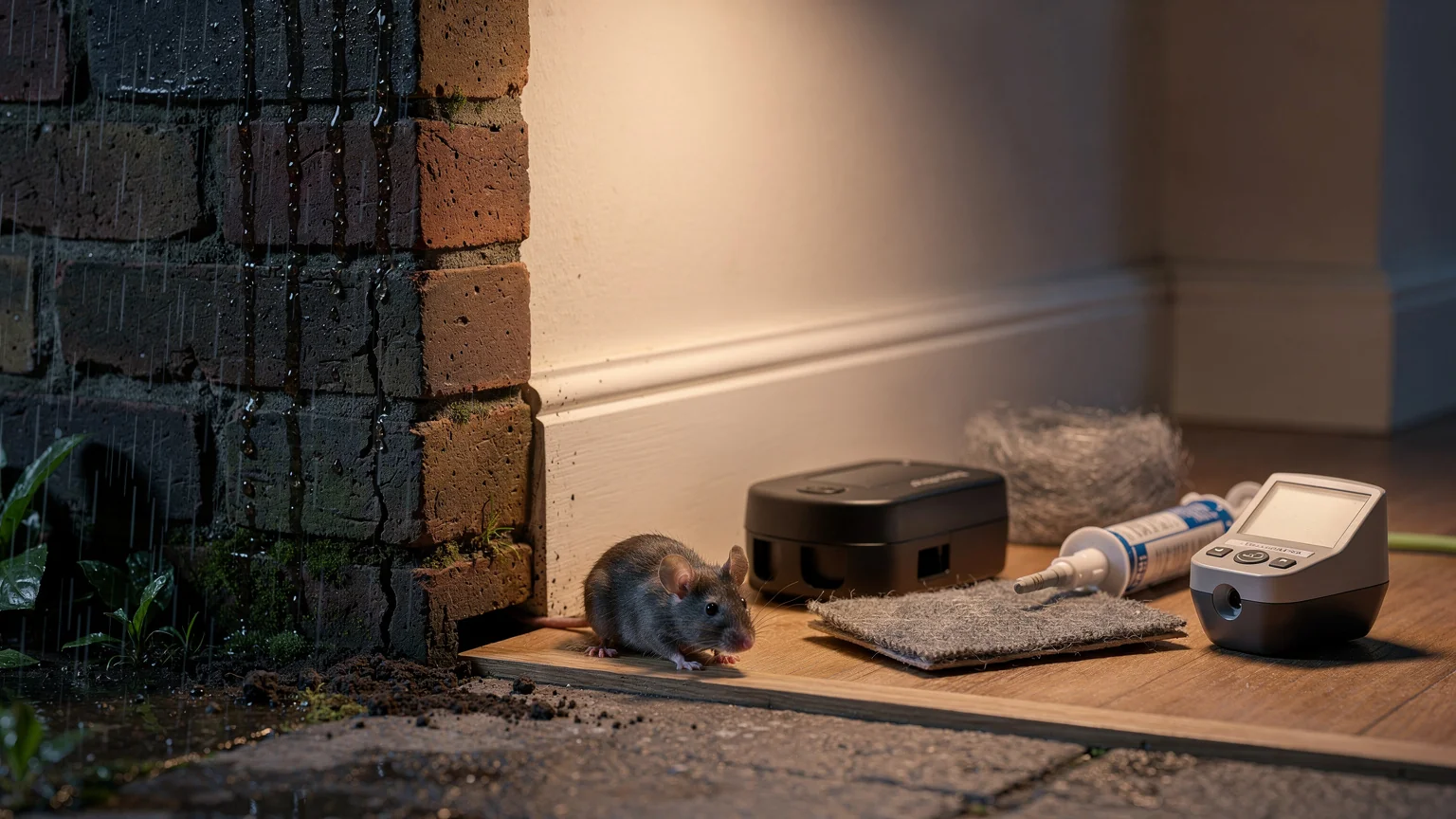
Why Mice Move In During Heavy Rain and How to Stop Them
The scratching starts three days after the storm. You are lying in bed, listening to the rain hammer the window, and somewhere between the floorboards and the plaster, something is moving. It is not your imagination. Across East London and Essex, heavy rainfall triggers a predictable surge in mouse call-outs, not because the weather creates new rodents, but because it destroys the ones already living nearby. Understanding why mice move in during heavy rain, and more importantly, how they are getting inside, is the difference between a single night of disturbed sleep and a breeding population behind your kitchen units.
This article explains the biology of mouse displacement, maps the entry points they exploit in local housing stock, and sets out the inspection, proofing, and treatment sequence that professional pest and mice control services use to resolve the problem properly. If you have heard scratching, found droppings, or simply want to prevent an intrusion before it starts, the information below will help you act at the right time and in the right way.
What Heavy Rain Does to Mouse Burrows
Mice do not live in your walls by choice. The preferred habitat of a house mouse, Mus musculus domesticus, is a dry, sheltered burrow system in soft ground, often beneath sheds, along fence lines, or in overgrown garden borders. These burrows are surprisingly elaborate: a single nest site may contain multiple chambers for food storage, nesting material, and raising young, connected by tunnels that extend 30 to 50 centimetres underground. The construction is effective against most weather, but sustained heavy rain changes everything.
When soil becomes waterlogged, burrows flood from the bottom up. Mice are competent swimmers for their size and can tread water for up to three days, but they cannot raise young in saturated nesting material, nor can they store food that is actively rotting. The thermal properties of wet soil also fail: a burrow that maintained 15 to 20 degrees Celsius in dry conditions drops rapidly, forcing the mice to seek alternative shelter or face hypothermia. This is not a gradual decision. Field studies of rodent behaviour show that mice will abandon a burrow within hours of flooding if a drier alternative exists nearby.
Your home represents that alternative. The foundations, cavity walls, and subfloor voids of a typical Victorian or post-war terrace in East London maintain a remarkably stable microclimate, even in winter. For a displaced mouse, the gap beneath your kitchen units or the void under your floorboards is functionally identical to a burrow chamber: dark, sheltered, and thermally buffered. The difference is that your home also contains food sources, nesting material, and—crucially—no predators.
Why East London Housing Is Especially Vulnerable
The housing stock across East London and Essex creates a near-perfect corridor system for mouse movement. Victorian terraces in Tower Hamlets, Hackney, and Newham share party walls with continuous cavity spaces. Post-war estates in Barking, Dagenham, and Havering were built with suspended timber floors and utility penetrations that were never sealed to modern standards. Extensions, conservatory bases, and later modifications have introduced additional gaps where the new structure meets the original building line.
Mice require a gap of only 6 millimetres to enter a building—the width of a pencil. This is not an approximate figure; it is the measured compressibility of a mouse skull, which can pass through any opening large enough to admit the head. Common entry points in local properties include:
Gaps around soil pipes and waste stacks where they pass through external walls, particularly where older lead or iron pipes have been replaced with plastic and the original sealant has degraded
Air bricks and ventilation grilles without mesh backing, especially those at or below ground level
The junction between extension walls and the main building, where settlement or poor original sealing has opened a continuous gap
Beneath door thresholds, particularly rear doors with worn brush strips or missing weather seals
Loft spaces, where mice climb rough brickwork, drainpipes, or adjacent trees to access open soffit vents or missing tiles
Once inside, mice do not remain in the point of entry. They explore along pipe runs, cable routes, and the natural channels within cavity walls. A mouse entering beneath your garden shed can reach your kitchen ceiling within 48 hours, travelling through spaces you cannot see and would not think to inspect.
The Behavioural Shift: From Foraging to Nesting
A mouse entering your home during dry weather is typically a forager, investigating food opportunities and returning to an external burrow. A mouse entering during heavy rain is different. This is a displaced animal seeking to re-establish a nest site, and its behaviour changes accordingly.
Foraging mice are cautious, predictable, and relatively easy to deter with environmental management. Nesting mice are territorial, aggressive, and focused on resource accumulation. A female mouse can produce 5 to 10 litters per year, with 4 to 8 young per litter. Under favourable indoor conditions—stable temperature, abundant food, low disturbance—breeding continues year-round rather than seasonally. A single pregnant female entering your property in October can, in theory, be the ancestor of 2,000 mice by the following spring. The figure is rarely reached in practice due to resource competition and mortality, but it illustrates why prompt intervention matters.
Nesting mice also behave differently around control measures. They are more likely to cache bait rather than consume it immediately, more resistant to disturbance, and more inclined to establish satellite nests in adjacent rooms or properties. This is why the homeowner who sets a few traps and assumes the problem is solved often sees a resurgence within weeks: the original nest was not located, the entry points were not sealed, and the surviving population simply expanded to fill the available space.
The Inspection Sequence: Finding What the Rain Revealed
Professional pest and mice control begins with a systematic inspection that treats your property as a three-dimensional system, not a collection of rooms. The objective is to identify active runs, nesting sites, food sources, and entry points in that order, because each informs the next.
The technician starts externally, examining the building perimeter at ground level. Recent rainfall is actually an advantage here: wet soil may show fresh burrow openings, disturbed vegetation along mouse runs, or smear marks on walls where greasy fur has rubbed against brickwork. Drainage systems are checked for damage or disconnection, particularly where rainwater goods enter the building. A significant proportion of mouse infestations in London originate from defective drainage; mice use broken soil pipes, displaced gully traps, or cracked inspection chambers as highway systems beneath the property.
Internally, the inspection focuses on the utility spaces where mice travel: kitchens, bathrooms, boiler cupboards, and loft voids. Droppings are the most immediate evidence, but their location matters. Fresh droppings are dark, moist, and soft; older droppings are grey, dry, and crumbly. Finding fresh droppings in a loft space that was clear before the storm indicates recent entry, not a long-established population. Grease marks, where the oils in mouse fur have deposited on repeated runs, show the routes currently in use. Nesting material—shredded paper, insulation, or fabric—confirms an active breeding site.
The critical finding is the entry point, or more commonly, the multiple entry points. Mice rarely use a single route; they establish several in case one is blocked or compromised. A thorough inspection in a typical three-bedroom terrace will identify 4 to 8 active entry points, many of which the occupant has never noticed.
Proofing: The Permanent Solution That Weather Cannot Defeat
Trapping and baiting address the mice already inside. Proofing addresses the reason they got in. Without proofing, any control measure is temporary, because the environmental pressure that drove mice indoors—the flooded burrows, the falling temperatures, the saturated ground—remains unchanged. Other mice will follow the same routes, and the cycle repeats.
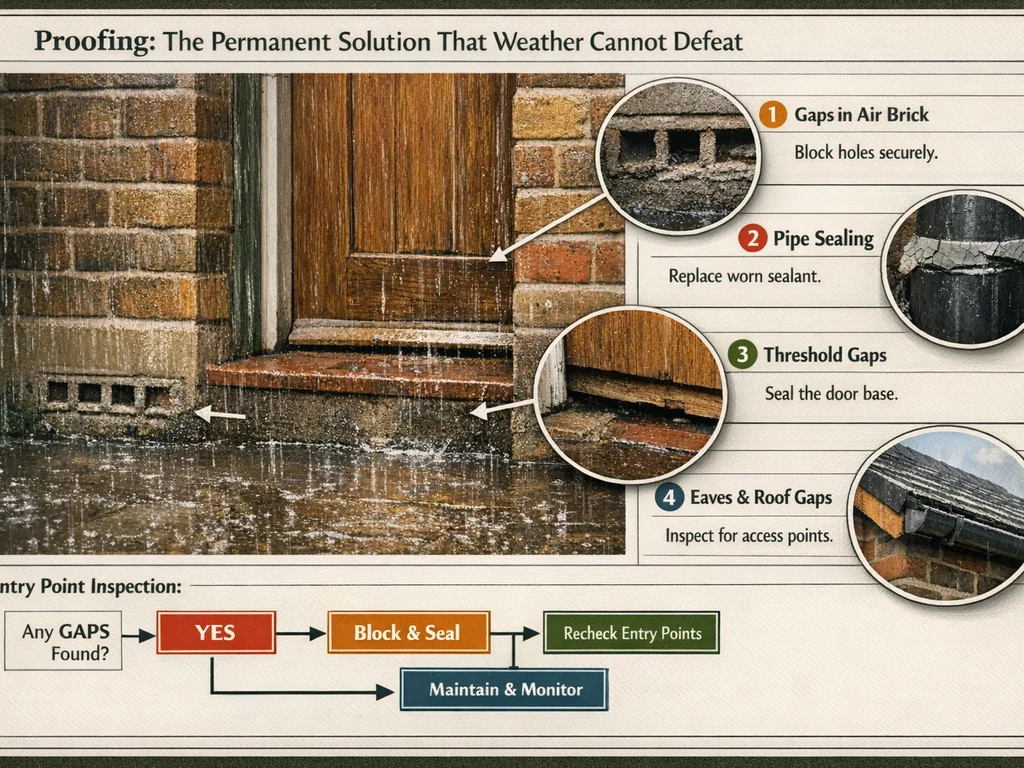
Professional proofing follows a hierarchy of intervention:
Immediate exclusion addresses the gaps that can be sealed quickly and effectively. Wire mesh (stainless steel, 6 millimetre aperture) is used to cover air bricks, vents, and drainage openings. Expanding foam is avoided for permanent sealing: mice can gnaw through it, and it degrades in ultraviolet light. Instead, metal mesh, concrete mortar, or specialist rodent-proof sealants are used for gaps around pipes and cables. Door thresholds are fitted with brush strips or metal kick plates where existing seals are inadequate.
Structural recommendations cover the modifications that require building work. This might include replacing a defective air brick with a mesh-backed equivalent, reseating a displaced drain gully, or installing a rat blocker in the main drainage run. These recommendations are documented in the service report with photographic evidence, allowing the homeowner to obtain quotes from builders or drainage contractors.
Environmental management reduces the attractiveness of the property even if entry points cannot be fully eliminated. This includes storing food in rodent-proof containers, managing bird feeding in gardens, clearing dense ground cover that provides harbourage, and ensuring refuse bins have tight-fitting lids. The objective is not to create a sterile environment, but to ensure that your property is less attractive than the neighbouring alternatives.
Proofing is labour-intensive and requires access to subfloor voids, loft spaces, and sometimes drainage systems. It is also the single most effective long-term investment in rodent control. Properties that are properly proofed typically remain mouse-free for years, even during severe weather events.
Treatment Timing: Why Acting Before the Storm Is Better
The ideal time to mouse-proof a property is September to October, before the weather turns and before breeding populations establish winter nests. This is preventive pest and mice control, and it is consistently more cost-effective than reactive treatment. A proofing survey in autumn identifies vulnerabilities that would become entry points under pressure, and addresses them before mice are actively seeking shelter.
Once heavy rain has begun and mice have entered, the treatment sequence changes. The immediate priority is population reduction to prevent breeding establishment, followed by proofing to prevent re-infestation. This two-stage approach takes longer and costs more than preventive work, because the technician must also deal with the mice already inside, the nesting material they have accumulated, and the contamination they have caused.
There is also a health dimension to timing. Mice urinate and defecate continuously as they travel, depositing approximately 80 droppings per day. These droppings, along with urine, hair, and nesting material, can carry Salmonella, Leptospira, and hantavirus. In properties with suspended timber floors, contamination can accumulate in the subfloor void, creating a reservoir of pathogens that persists even after the mice are removed. Early intervention limits this accumulation and reduces the extent of remedial cleaning required.
For commercial premises, particularly food businesses, timing is regulated. The Food Standards Agency guidance on pest control requires immediate action when signs of infestation are observed, and specifies that pest control contractors should provide service reports on every visit documenting the areas inspected, treatments applied, and recommendations for proofing or environmental management. Failure to act promptly can result in enforcement action, particularly if pest activity is observed during a local authority inspection.
What Professional Treatment Actually Involves
A professional mouse control service follows a structured protocol that reflects the standards set out in the BPCA Pest Management Codes of Best Practice. This is not simply a matter of placing traps; it is a systematic process that addresses the biology of the infestation and the structure of the building.
Initial survey and risk assessment establishes the extent of the problem, identifies sensitive areas (food preparation zones, children's rooms, areas with pets), and determines the appropriate control methods. The technician will ask about previous treatments, building work, drainage issues, and neighbouring infestations, because these factors significantly influence the approach.
Control phase uses a combination of methods selected for the specific situation. Trapping is preferred in sensitive areas where bait cannot be used safely. Baiting, where appropriate, uses secured bait stations positioned on active runs, not scattered randomly. The objective is rapid population reduction, not gradual attrition. Modern rodenticides are anticoagulants that require multiple feeds over several days; this is safer for non-target species but means that control takes time to achieve full effect.
Proofing phase follows population reduction, sealing entry points and installing preventive measures. This is typically scheduled 7 to 14 days after the initial treatment, allowing time to confirm that the active population has been controlled.
Monitoring and follow-up verifies that the treatment has succeeded and that no new entry points have been exploited. For persistent problems, this may involve regular inspections, remote monitoring devices, or ongoing service contracts.
The entire process is documented in service reports that record each visit, the findings, the actions taken, and the next steps. This documentation is important for insurance purposes, property sales, and regulatory compliance, particularly for landlords and commercial operators.
Common Mistakes That Guarantee Recurrence
Homeowners and landlords frequently undermine their own control efforts through predictable errors. Understanding these mistakes helps you avoid them and ensures that any professional treatment you commission has the best chance of lasting success.
Incomplete proofing is the most common failure. Sealing the obvious gap beneath the kitchen sink while ignoring the air brick at ground level, or the drainage defect in the rear garden, leaves multiple entry routes open. Mice are opportunistic and will find the path of least resistance.
Premature cessation of treatment is equally damaging. Seeing no mice for a week does not mean the infestation is eliminated; it may mean the remaining population is bait-shy, or that activity has shifted to a less visible area. Professional protocols specify minimum treatment durations and verification criteria for a reason.
Environmental neglect undermines even good proofing. Storing pet food in open containers, leaving bird seed accessible, or allowing garden vegetation to become dense harbourage recreates the conditions that attracted mice originally. Control and prevention must work together.
Unlicensed treatment poses safety risks and legal issues. Rodenticides are pesticides regulated under the Control of Pesticides Regulations 1986; they must be used in accordance with label instructions and only by competent persons. Improper use can poison non-target species, contaminate food, and expose the user to prosecution.
What This Means for Your Home
If you live in East London or Essex and have heard scratching, found droppings, or noticed signs of mouse activity after recent heavy rain, the cause is almost certainly displacement from flooded external burrows. The mice are not passing through; they are trying to establish a new nest site, and they will breed if given the opportunity. The correct response is prompt professional inspection to identify entry points and active runs, followed by population reduction and systematic proofing. Delaying action allows the population to establish, increases contamination, and makes eventual control more extensive and more expensive.
This week, examine your property's exterior for gaps around pipes, vents, and the base of walls. Check that air bricks are meshed, that door seals are intact, and that drainage gullies are clear and properly seated. If you find evidence of mouse activity, or if you simply want to prevent an intrusion before it starts, arrange a professional inspection. The investment in proper pest and mice control and proofing now will protect your property through the winter and beyond, regardless of how severe the weather becomes.
Learn more: Call 0203 468 1999 or request a callback to book a same-day inspection.
References
NHS England National standards — NHS England » National standards of healthcare cleanliness 2025: pest control Pest control and management is essential for safe and hygienic healthcare facilities, and
[PDF] SAFE METHOD: PEST CONTROL — Food Standards Agency l food.gov.uk/sfbb SAFE METHOD: PEST CONTROL Effective pest control is essential to keep pests out of your premises and prevent them from spreading harmful
Need professional help? BuzzKill offers fast, reliable pest control services across London and Essex.