
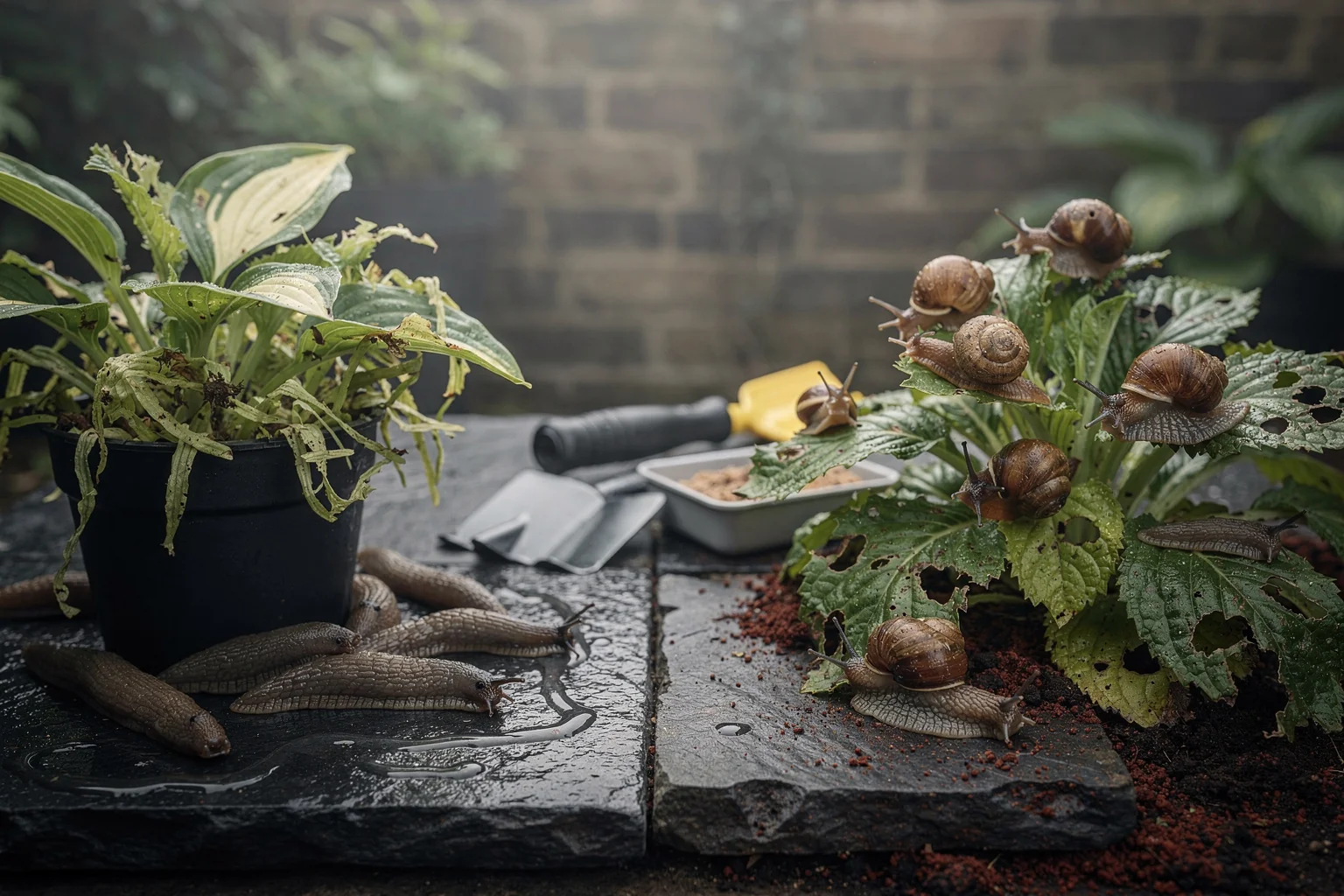
When Joan in Hackney found a glistening trail across her kitchen floor at 6 a.m., she assumed snails had invaded. She’d seen a few outside the back door after the rain. But the real culprit—the one chewing through her rubber plant and leaving slime on the skirting board—was something she hadn’t considered: slugs. And that changes what you do next.
The confusion between slugs and snails costs homeowners wasted time and money on the wrong treatments. While both are molluscs, their behaviour, damage, and what they signal about your property are remarkably different. This article sorts the clues into a practical list—starting with the most urgent sign—so you can identify which pest is actually damaging your property and decide what to do about it.
A trail of evidence
The most immediate clue that separates a slug problem from a snail one is the trail itself. Slugs produce a thicker, more persistent silver track because they rely on a constant mucus layer to move and to avoid drying out. A snail’s trail is noticeably thinner—still shiny, but it vanishes faster, especially in dry conditions.
When you spot a trail indoors, you are almost certainly dealing with slugs. Snails rarely venture inside a house; their shells make it difficult to squeeze through small gaps, and once inside they lose moisture too quickly to survive long. The slug trail often leads from an air brick or a crack near a pipe to a dark corner under the washing machine or fridge. In a Victorian terrace in Greenwich, a tenant noticed fresh trails appearing every morning. A technician traced them to a crack in the external wall where slugs were entering from a damp raised flower bed—a classic sign of a moisture problem that needed fixing before it attracted other pests. Other moisture-driven pests like silverfish also need moisture control and tend to follow the same entry points.
Common mistake: people scrub the trail away and move on, never tracing it back to the source. Verdict: this is the number-one clue to act on immediately. It proves you have an active slug ingress point and probably a damp spot that will invite more trouble.
The shell that tells a different story
Carrying a shell changes everything about risk. Snails can retreat and seal themselves inside when conditions turn dry, surviving for long stretches without feeding. Slugs have no such protection—they must stay in damp environments or they desiccate. So a snail found in a conservatory or on a porch might just be a wanderer that came in through an open door. A slug indoors, however, rarely ends up there by accident.
The shell also explains why snails don’t establish indoor populations. They need calcium to build and maintain that shell, and a typical home doesn’t supply it in the way a garden does. Slugs, lacking that need, are free to live under the floorboards or in the cavity wall as long as moisture is present. If you’re finding a mollusc in the house regularly, the absence of a shell points to a slug, and that points to a building defect.
London’s HOUSING DESIGN QUALIT AND STANDARDS highlight the importance of controlling damp for healthy living conditions. Consistent slug incursion can be a clear signal that your property falls short on ventilation or drainage. The mistake many people make is to treat all molluscs the same—spreading pellets for a handful of garden snails while ignoring the structural damp that’s feeding the slugs. Verdict: if you see a snail inside, return it outside and don’t worry. If you see slugs, investigate the building’s moisture levels.
What’s on the menu (and what isn’t)
Feeding habits often give the game away before you ever see the pest. Slugs are generalists: they’ll eat decaying leaves, fungi, pet food, paper, cardboard, even the glue on packaging. Snails, by contrast, stick to live plant material—leaves, flowers, soft fruit, seedlings—and rarely damage non-organic items.
If you open a cardboard box in the cellar and find ragged holes or a slimy residue, you’re dealing with slugs, not snails. In the garden, the pattern differs too. Slug damage typically appears as large irregular holes in soft-leaved plants at ground level, often with a fresh silvery trail nearby. Snail damage tends to concentrate on above-ground foliage and ripening fruit, sometimes with a tell-tale scalloped edge where they’ve fed.
The common mistake is the gardener who blames snails for ravaged seedlings when the real culprits—slugs—come out after dark. Next time, check the ground around the plants at night with a torch; you’ll see which mollusc is at work. Verdict: if the damage is low to the ground or on non-plant items, slugs are your top suspect. That changes which controls actually help.
The indoor signature
There is one rule that holds true in almost every London property: if you’re finding a mollusc inside on a regular basis, it isn’t a snail. Slugs have a boneless, flexible body that lets them compress through gaps as narrow as 4 mm—cracks in masonry, vent grilles, gaps under doors, even the plumbing entry point behind a toilet. Once inside, they seek dark, damp corners: under kitchen units, behind the washing machine, in the cupboard under the stairs.
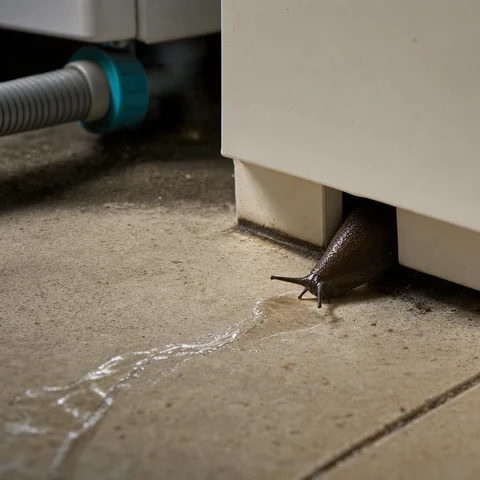
This indoor signature matters because snails cannot squeeze through such tight spaces and almost never establish a routine presence indoors. So when a tenant reports “snails in the kitchen” to a letting agent, the first thing a pest technician does is look for slug trails. If you’re waking up to fresh trails every morning, the problem isn’t just a stray mollusc—it’s a recurring entry route that needs sealing and the damp conditions that make the interior hospitable. In cases where the numbers spike suddenly, you might need emergency pest services to halt the invasion while the building repairs catch up.
When logging a pest complaint with your local authority, council officers may require property information in a structured format; the Combined Planning Data Standard lays out how that data should be submitted to speed up the process. And when looking up these standards, you’ll notice government sites use consistent URL standards for GOV.UK to help you find information quickly. But for your own sanity, remember this: indoor molluscs equal slugs, and slugs indoors equal a building issue you can’t ignore.
Weather patterns and what they trigger
The UK’s recent mild, wet seasons have been a boon for slugs. Many gardeners recall the soaked 2024 summer when slug numbers exploded, and with 2026 shaping up similarly damp, experts expect another surge. After heavy rain, slugs that had been hiding deep in the soil or under paving become active and move towards buildings, searching for shelter and moisture.
Snails, again, respond differently. Their shells allow them to climb vertical surfaces and hibernate in dry crevices, so they don’t need to seek refuge inside a home even when the weather turns. A sudden spike in indoor sightings after a downpour is almost exclusively a slug phenomenon. If your London property sits near a water course, on clay soil that holds moisture, or next to overgrown gardens, heavy rain will drive slugs towards your walls. Before reaching for chemical controls, walk the perimeter and look for gaps where render has cracked, air bricks are missing, or door thresholds have rotted. For city-wide issues, many residents turn to London pest services for a targeted survey during the worst slug periods.
Which control methods actually work for each
The same DIY trick won’t work equally for both pests. Copper tape, for example, gives snails a mild electric shock when their foot touches it, deterring them from climbing pots. Slugs, with a thicker mucus layer, are often less bothered and will slide over copper if they’re determined. Beer traps attract both, but they can become a magnet that draws in slugs from the wider garden unless you place them well outside the property’s footprint. Ferric phosphate pellets, the only slug pellets approved for organic use, are effective against both, yet their success relies on correct placement: for slugs, concentrate around the damp, shaded entry points near the building; for snails, target the plants and climbing routes they use.
Barrier products like diatomaceous earth or crushed eggshells remain a slug-specific weapon. They dehydrate the soft foot of a slug on contact, but snails can often retract onto their shell and glide over the barrier with a smaller, protected foot. The most overlooked indoor control is simply a moisture meter. A dehumidifier placed in a subfloor void or a ventilated air brick can make the environment hostile to slugs within days, whereas it will have zero impact on the snail population in your garden because they simply leave if the spot becomes dry.
What about nematodes? The microscopic worms sold as Nemaslug are a professional-grade biological control that parasitises slugs underground. They work brilliantly, but they are entirely wasted on snails because the nematodes cannot penetrate the snail’s shell to reach the body. So if you’ve spent money on nematodes and still see damage on high foliage, you’re likely dealing with snails—and need to switch to physical removal or copper barriers.
The common mistake is deploying one control across the board without first identifying whether slugs or snails are the primary troublemaker. Verdict: get the identification right first—using the trail, shelter, and feeding clues above—and you’ll stop wasting cash on the wrong solution.
When the problem isn’t just pests but the building itself
A large or persistent slug presence inside a home rarely comes from the garden alone. It usually points to a hidden moisture source that needs a builder’s eye. We’ve lifted floorboards in Hackney flats to find a broken soil pipe weeping into the subfloor, creating an ideal slug habitat. In another case, a Victorian mid-terrace in Leytonstone had slugs coming through the air brick every night because the garden soil was banked high against the wall, bridging the damp-proof course.
If you catch the problem early—say, a single slug trail every few days—focus on drying out the affected area, fixing leaks, improving ventilation, and sealing entry points. Expanding foam and fine mesh over air bricks can cut off access overnight. However, once slugs have established a breeding population inside a cavity wall or under a suspended floor, the fix almost always requires professional pest-grade treatment combined with structural repair. A technician can apply a targeted perimeter treatment that lasts several months, breaking the cycle while you sort the building defect.
This is also the point where many households discover their damp problem extends beyond slugs. The same conditions that attract slugs—rising damp, poor subfloor ventilation, leaking pipes—are exactly what woodlice, earwigs, and silverfish need. Solving the slug issue often heads off a much wider pest infestation. If you’re already seeing multiple damp-loving species indoors, treat it as a red flag that your property needs a moisture survey, not just pest control.
Making a practical plan for your property
Start by distinguishing the pest. If you find a shellless mollusc indoors, you’re dealing with a slug, and that means you must fix a building issue. If you see snails only in the garden, focus on cultural controls: remove daytime hiding spots like stacked pots and overgrown ground cover, and hand-pick them after dark when they’re most active.
For both pests, reduce the appeal of your immediate surroundings. Cut back vegetation that touches the walls, clear fallen leaves, and ensure gutters discharge well away from the foundation. In the kitchen, don’t leave pet food bowls on the floor overnight—slugs will find them. In a damp cellar or utility room, running a dehumidifier can be the single most effective slug deterrent you never thought of.
If you wake up to a trail tomorrow morning, your next move should be to trace it backwards. See where it enters the room, and whether that point aligns with an external gap or a damp patch. Then decide whether you can seal it yourself or need a professional to survey the building envelope. Slugs inside are a message your house is sending you. Listening early saves you from a much bigger repair bill later. For a tailored inspection that separates a garden snail nuisance from a structural slug problem, a local pest control specialist can give you a clear diagnosis and a treatment plan that matches what’s actually damaging your property.
Need professional help? BuzzKill offers fast, reliable pest control services across London and Essex.