
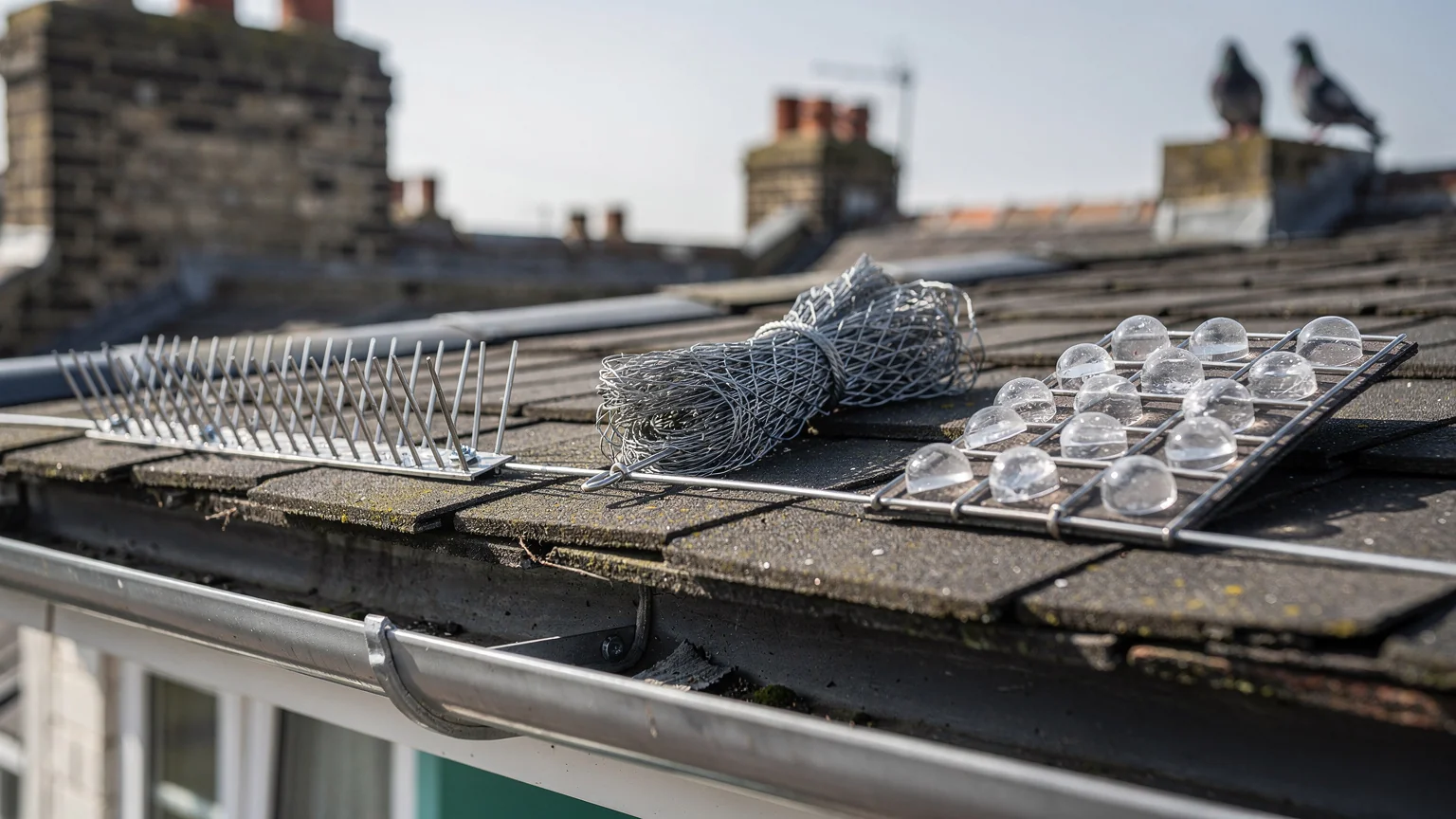
Most homeowners in East London and Essex assume the choice is simple: spikes look aggressive so they must work, or netting seems invisible so it must be better. The hidden third option, optical gel, rarely enters the conversation until someone has already wasted money on the wrong fix. The real question is not which deterrent looks toughest, but which one matches your roof geometry, your tolerance for maintenance, and how quickly you need the birds gone.
What You're Actually Dealing With on a London Roof
Before buying anything, walk outside and look at where the pigeons are landing. On a Victorian terrace in Islington, they usually crowd the chimney stack and the narrow ledge below the gutter. On a flat-roof extension in Hackney, they gather along the parapet wall or near the drainage outlet where water pools. On a commercial unit in Barking and Dagenham, they target the wide steel beams that run the length of the warehouse roof.
The property type determines the pressure points. Terraces have multiple small ledges, each one a separate landing zone. Flat roofs offer open ground, so pigeons roost in groups rather than pairs. Commercial buildings often have roof-mounted plant and ducting that creates sheltered nesting cavities. Each scenario needs a different deterrent approach, and mixing them up is where most DIY attempts fail.
Consider the timing too. Pigeon activity peaks in spring when breeding pairs scout for nesting sites, and again in autumn when juveniles disperse and compete for roosting spots. If you're reading this in March or October, the urgency is higher. A single pair on your roof in April can become eight birds by June. The guano accumulates fast, and with it comes the risk of blocked gutters, corroded metalwork, and slip hazards on pavements below. For landlords, there is also the matter of obligations under the Housing Act 2004 to keep properties free from hazards that affect health.
The disruption question matters as well. Can you tolerate scaffolding for a day? Are you comfortable with a technician working at height on your parapet? Do you need the solution to be invisible from the street because you are preparing to sell? These practical constraints narrow the field before you even compare products.
Pigeon Spikes: When They Work and Where They Collapse
Spikes are the default image most people have for bird deterrents. Stainless steel or plastic strips with upward-pointing prongs, fixed to ledges with adhesive or screws. The theory is simple: remove the flat landing area and the bird cannot settle.
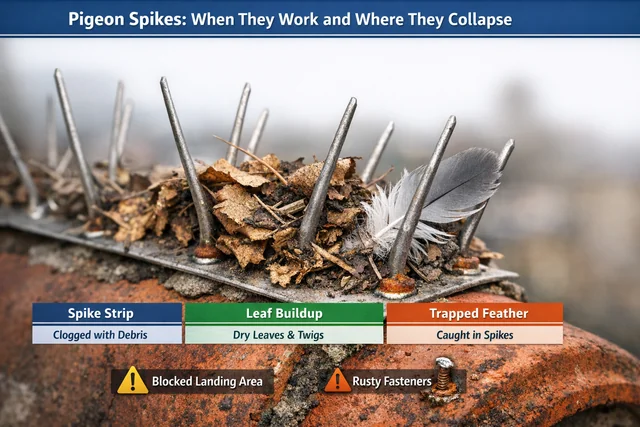
For narrow ledges on Victorian brickwork, spikes do the job. A standard five-inch ledge along a gutter line in Lewisham takes an hour to treat, and if the installer cleans the surface properly first, the adhesive bond lasts several years. The birds simply shift to the next untreated section, which is fine if you have sealed every ledge on your elevation. The problem starts when people spike one ledge and assume the job is done.
Spikes fail on wide surfaces. A flat roof parapet in Tower Hamlets might be eighteen inches across. The bird lands between the spike rows, or worse, gathers nesting material and builds on top of them. We have seen pigeon nests two inches deep burying a spike strip entirely. Spikes also struggle on irregular surfaces. Victorian chimney stacks with decorative corbelling, or modern cladding with thermal movement joints, do not offer the consistent flat base that spike adhesive needs.
The cost picture is mixed. A pack of DIY plastic spikes costs £15 to £30 and covers about three metres. Professional-grade stainless steel runs £8 to £15 per metre installed. For a typical terrace with front and back gutter lines, you are looking at £200 to £400 in materials and labour. The hidden cost is return visits. Spikes need checking every twelve months. Adhesive degrades in UV, screws loosen in thermal expansion, and detritus accumulates in the channels.
There is also an aesthetics question. Some conservation areas in Greenwich and Camden restrict visible alterations to rooflines. Spikes are not subtle. If your property faces a street with active planning enforcement, check before you fix anything.
Bird Netting: The Invisible Shield That Demands Precision
Netting works on a different principle. Instead of making the landing site uncomfortable, you block access entirely. A tensioned mesh of knotted polyethylene or stainless steel cable spans the gap between roof structures, creating a physical barrier the bird cannot penetrate.
For large flat roofs, netting is often the only practical solution. A warehouse in Newham with roof-mounted air handling units, or a school in Waltham Forest with a covered walkway between buildings, presents dozens of entry points that spikes cannot seal. Netting spans the whole zone. Properly installed, it is nearly invisible from ground level, which matters for heritage properties and retail frontages.
The installation demands are where netting earns its reputation for expense. You need anchor points: steel posts, masonry bolts, or structural cables fixed to the building. On a concrete parapet in Stratford, this is straightforward. On a fragile slate roof in Enfield, every anchor risks a cracked tile and a leak. The mesh must be tensioned correctly. Too loose and birds push through; too tight and wind load snaps the fixings.
Access for maintenance becomes a long-term consideration. If your boiler flue or satellite dish sits inside the netted zone, every engineer who visits needs a zippered access point and the skill to close it properly. A gap left open for twenty minutes is an invitation.
Costs run higher than spikes. A small domestic installation might start at £800. A commercial warehouse could reach £5,000 or more depending on access equipment and structural complexity. The lifespan is longer, though. Quality netting carries a ten-year guarantee if installed correctly. The critical phrase is "installed correctly." We have attended properties in Redbridge where a budget netting job has sagged after two winters, creating pockets where birds nest comfortably inside the supposed barrier.
Optical Gel: The Disruptor That Confuses More Than It Repels
Optical gel is the newcomer, and it works unlike either spikes or netting. The product is a dish of translucent silicone gel, roughly the size of a hockey puck, fixed to the surface with adhesive or magnets. To a pigeon, it resembles fire or smoke. The bird's visual system processes the ultraviolet-reflecting gel as an unstable, threatening surface. They avoid landing near it.
The advantage is flexibility. Gels fix to curved guttering, irregular stonework, narrow pipes, and window sills where spikes will not sit and netting cannot anchor. A row of gel dishes along a curved bay window in Haringey, or around the flues on a rounded turret in Camden, covers territory that other deterrents cannot reach.
The behavioural effect is also broader than spikes. Spikes block a specific ledge; gel creates a wider zone of avoidance. Birds typically steer clear of an area extending several inches around each dish. For scattered pressure points, a few strategically placed gels can protect a larger surface than the same count of spike strips.
The limitations are real and often underplayed by suppliers. Rain degrades the optical effect over time. In London's climate, with its mix of downpours and dry spells, gel dishes need replacing every two to three years. Dust and leaf litter coat the surface and reduce reflectivity. On a roof beneath overhanging sycamores in Havering, you might be cleaning or replacing dishes every six months.
Cost sits between spikes and netting. A pack of ten gel dishes retails at £40 to £60, and a typical domestic roof needs fifteen to thirty units. Professional installation adds labour but reduces waste from poor placement. The key is understanding that gel is a deterrent, not a barrier. A determined pigeon, especially one with an established nest nearby, may test the perimeter and find a landing spot just outside the avoidance zone. Gel works best as part of a layered approach, or for low-pressure situations where complete exclusion is not essential.
Provider Profiles
BuzzKill Pest Control is a privately owned, NPTA-registered and BASIS PROMPT-certified pest management company serving domestic and commercial customers across London and Essex. They offer same-day appointments and 24/7 emergency callouts for infestations including rodents, insects, and birds, with £5 million public liability insurance and RSPH Level 2 qualified technicians. The company combines professional accreditation with local responsiveness, operating without call-out charges and backing work with guaranteed results.
Bird B Gone
Bird B Gone manufactures and supplies a wide range of pigeon deterrent products including spikes, netting, and optical gel formulations. The company positions itself as a product-first supplier with emphasis on humane, effective bird control for residential and commercial properties.
Bird Barrier

Bird Barrier offers pigeon control solutions spanning physical deterrents, exclusion netting, and birth control programmes through its product portfolio. The company serves both the installer trade and direct customers with a focus on integrated bird management systems.
OvoControl

OvoControl specialises in pigeon birth control as an alternative or complement to physical deterrents. Its bait product interferes with egg development, reducing population growth over time rather than blocking individual birds from roosting sites.
Matching the Fix to Your Property and Timeline
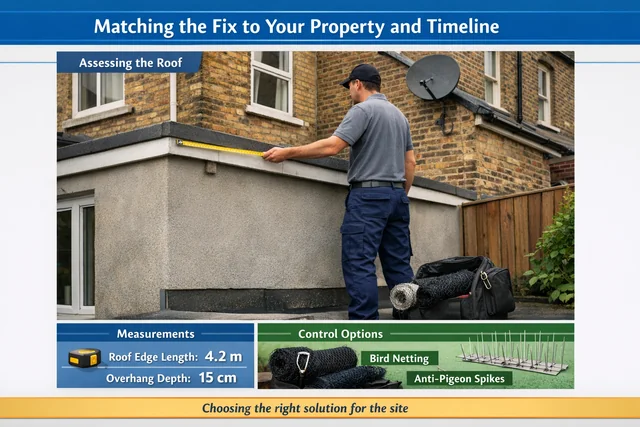
With the three options laid out, the decision framework becomes clearer. For a Victorian terrace with discrete ledges and no conservation restrictions, spikes offer a fast, affordable fix if you commit to sealing every landing point. For a flat-roof extension or commercial unit with wide open surfaces and multiple plant penetrations, netting provides the only reliable exclusion, provided you budget for proper installation and future access. For irregular architecture, sensitive facades, or low-pressure situations where total exclusion is not required, optical gel fills the gaps that other methods cannot reach.
The timeline pressure changes the calculation. If you have pigeons nesting now, with eggs or squabs in situ, deterrent installation must wait until the young have fledged. Disturbing an active nest is an offence under the Wildlife and Countryside Act 1981. A spring inspection from Hackney bird control experts can confirm breeding status and schedule work for the legal window. If the birds are roosting but not nesting, intervention can happen immediately.
For landlords managing multiple properties, consistency matters. A patchwork of spikes on one building and gel on another creates confusion for maintenance staff and tenants. Standardising on one approach per property type, with professional documentation of what was installed where, reduces long-term management burden. Professional bird control services can survey a portfolio and recommend a unified strategy.
The recurrence risk is worth weighing. Pigeons are site-faithful. Birds removed from a roof will try to return for months or years. Deterrents must outlast this persistence. A cheap spike strip that fails after one winter invites the original occupants straight back. Investing in a longer-lasting solution from the start often costs less than repeated callouts.
When the Roof Situation Needs More Than a Product
There are moments when no deterrent, however well chosen, solves the underlying problem. If pigeons are entering your roof void through a broken soffit or missing tile, blocking the exterior ledge does not remove the nesting site inside. If a neighbouring property has no deterrent at all, your roof becomes the refuge after theirs is treated. If food sources persist, a nearby bakery or household feeding birds in the park, the population pressure overrides any local deterrent.
In these cases, the fix is structural or environmental, not product-based. Repair the access point. Liaise with neighbours or the council about coordinated treatment. Address the food source if it is within your influence. For commercial kitchens and food premises, the Food Safety Act 1990 and associated regulations make pest control a compliance matter, not merely a nuisance issue.
The escalation signal is straightforward. If you have tried one deterrent and pigeons persist, if you can hear activity inside the roof space, or if guano is accumulating faster than you can clear it, you need professional assessment. Emergency pest control London services can respond same-day to evaluate whether the situation has moved beyond DIY scope.
For properties in East Ham, Newham, Tower Hamlets, and across East London and Essex, the building stock and urban density create specific challenges. Victorian terraces with shared rooflines mean pigeons treated on one property simply hop to the next. New-build flats with communal roof gardens introduce food sources and shelter that individual deterrents cannot control. Industrial estates in Barking and Dagenham and Stratford have large surface areas and high bird pressure from nearby waterways and rail corridors.
Reading the Evidence and Making the Call
Start with what you can see. Count the landing points. Measure the ledge widths. Note the roof type and any conservation restrictions. Check for active nesting, which delays physical intervention. Then match your situation to the deterrent that fits, not the one you assumed you needed.
Spikes suit narrow, accessible ledges on standard brickwork with low maintenance tolerance. Netting suits large, open areas where complete exclusion is essential and budget allows for proper installation. Optical gel suits irregular surfaces, sensitive facades, and situations where partial deterrence is acceptable. Many effective treatments combine two methods: netting across a flat roof zone with gel dishes around the access points where birds might test the perimeter.
The final routing call depends on urgency, evidence level, and property risk. If you have scattered droppings and occasional visitors, a gel or spike treatment may resolve it. If you have established roosting, internal access, or compliance pressure from a food business inspection, professional netting or integrated management is the safer path. For same-day assessment across London and Essex, London bird control specialists can survey the property and specify the right combination before you spend on the wrong fix.
Need professional help? BuzzKill offers fast, reliable pest control services across London and Essex.