
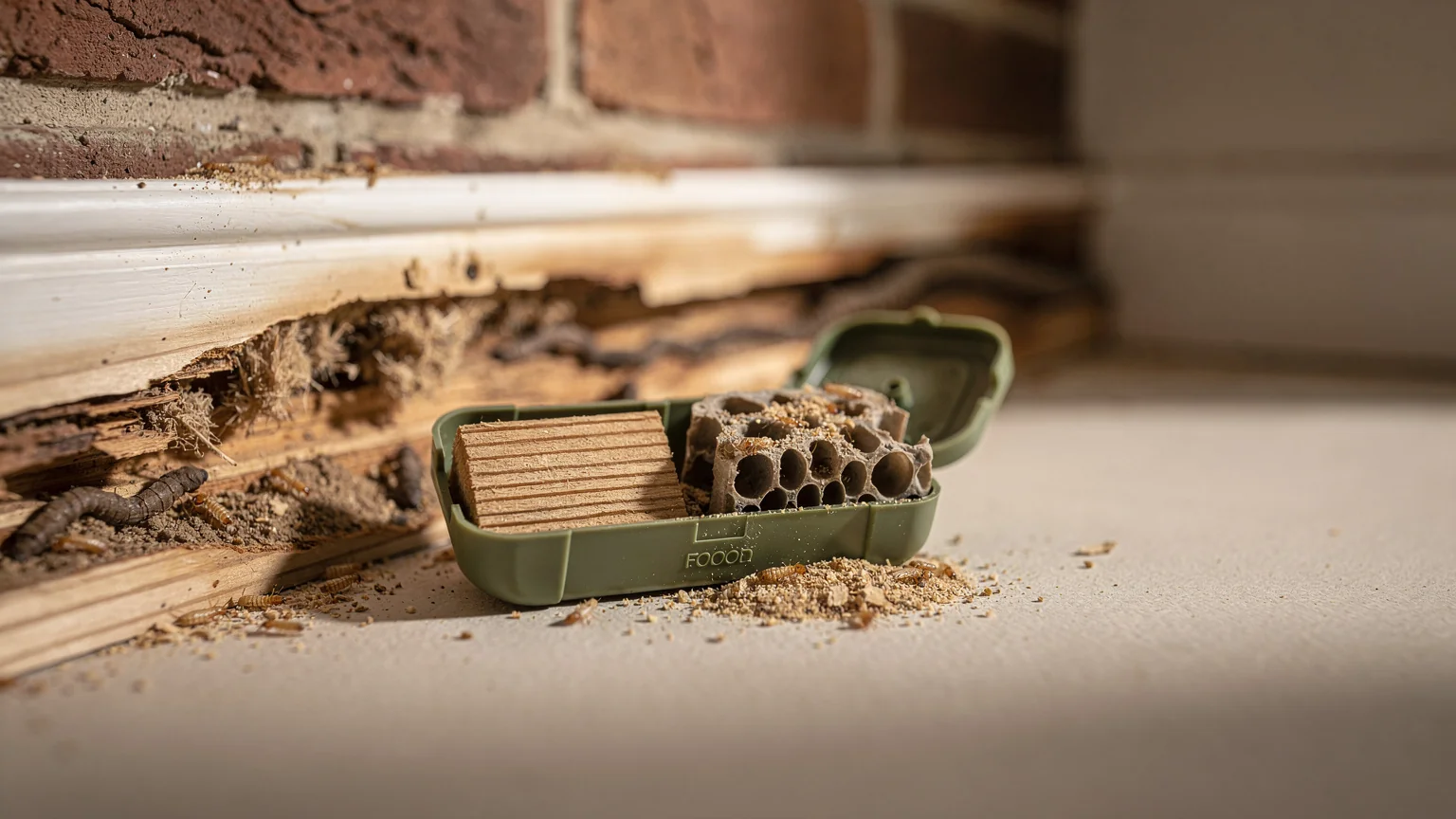
Is That Wood Damage From Termites or Just Damp? A Homeowner's Guide
Soft floorboards, crumbling skirting boards, and mysterious dust piles near timber joints can send any homeowner into a spiral of worry. Before you assume the worst, it is worth understanding what you are actually looking at. In the UK, true termite damage is extraordinarily rare, yet the signs are often mistaken for damp, woodworm, or fungal decay. This guide walks you through the practical steps to distinguish between them, what each condition means for your property, and when to bring in a specialist.
Why Termites Barely Register on UK Pest Radar
Subterranean termites thrive in warm, humid climates and cause billions in damage across Australia, Asia, and the southern United States. The British Pest Control Association confirms they are not presently found in the UK, though climate projections suggest southern England could become marginally suitable in coming decades. For now, any "termite control" enquiry in London or Essex almost always turns out to be something else entirely.
That does not mean timber damage should be ignored. The organisms that do attack UK homes, wood-boring beetles and fungal rots, can compromise structural integrity just as seriously. Knowing which culprit you face determines everything from treatment cost to whether you need to vacate during works.
The Real Culprits: Woodworm, Wet Rot, and Dry Rot
Three conditions account for nearly all timber degradation in British properties. Each leaves a distinct signature if you know where to look.
Wood-boring beetles include common furniture beetle, deathwatch beetle, and house longhorn beetle. Their larvae tunnel through timber for two to five years before emerging as adults, leaving exit holes roughly 1-3 mm in diameter. Fine, talcum-like powder called frass often accumulates beneath these holes. The timber sounds hollow when tapped, but the outer surface may appear intact until probed.
Wet rot requires sustained moisture content above 20% in timber. It typically follows leaking pipes, faulty gutters, or poor ventilation in sub-floors. Affected wood darkens, feels spongy, and may show longitudinal cracking. The fungus Coniophora puteana is the most common species, and it rarely spreads far from its moisture source.
Dry rot (Serpula lacrymans) is more aggressive. It can transport moisture through masonry and travel several metres from its origin. The timber becomes brittle and crumbles into cube-shaped fragments. A musty, mushroom-like smell often precedes visible damage, and white or grey cotton-wool mycelium may appear on surfaces.
When Sarah noticed her Victorian terrace's floorboards sagging near the chimney breast, she feared termites. A moisture meter reading of 28% and the distinctive cuboidal cracking pointed to dry rot spreading from a failed flashing. The actual pest was fungal, not insect, and the repair required masonry irrigation alongside timber replacement.
Visual Clues That Separate Insect Damage From Decay
Start with good lighting and a screwdriver for gentle probing. Insect damage tends to be localised to the timber itself, with clean exit holes and granular frass that resembles fine sawdust. The tunnels often run with the grain, and you may find dead beetles or pupal cases near emergence sites.
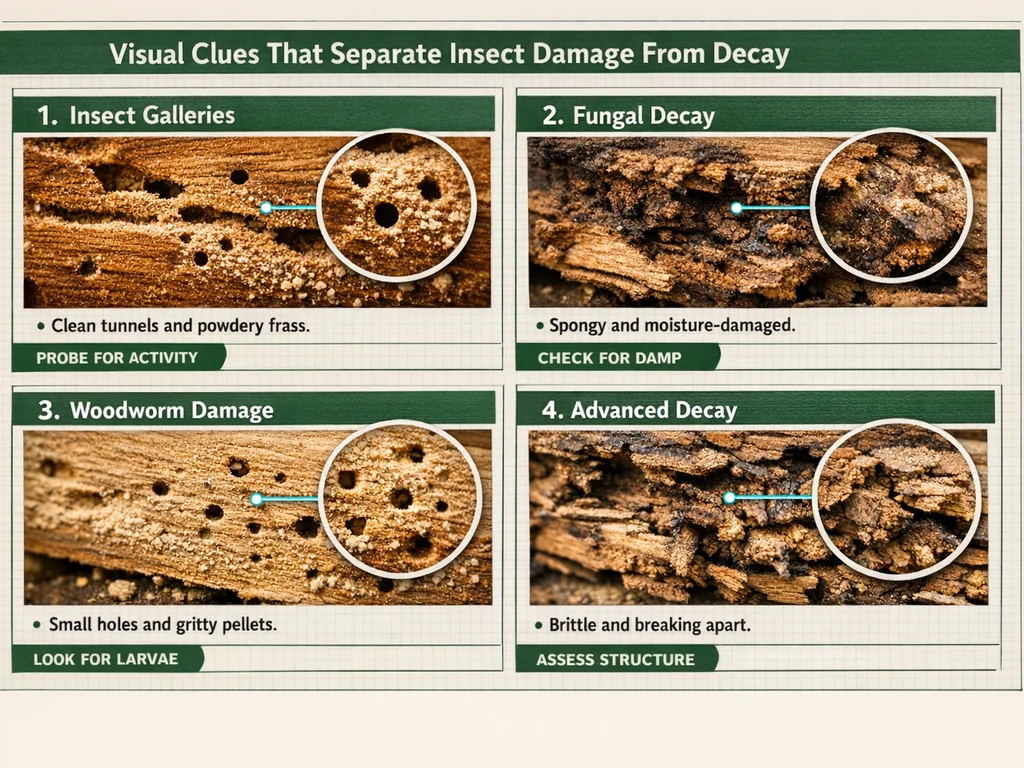
Fungal decay, by contrast, affects timber in broader patches. Wet rot darkens the wood uniformly and produces a damp, musty odour. Dry rot creates that characteristic brittle, cubed breakdown and may generate rust-coloured spore dust in advanced cases. Neither fungus produces the neat, round exit holes of woodworm.
One simple test: collect the powdery material beneath damaged timber onto white paper. Frass from beetles will be granular and uniform, often the same colour as the wood. Fungal breakdown produces irregular fibres and larger fragments. If the material smears when dampened, you are likely looking at decay rather than insect residue.
The Tap Test and Moisture Meter Method
Sound is your most accessible diagnostic tool. Healthy timber produces a clear, resonant knock. Hollow-sounding areas suggest internal voids from beetle tunnels or advanced decay. Dry rot timber sounds dull and brittle, while wet rot feels soft and may yield visibly under pressure.
A moisture meter transforms guesswork into data. Pin-type meters with insulated probes give the most reliable readings in timber. Measure at multiple depths and locations. Readings below 16% indicate sound timber. Sustained readings above 20% invite fungal growth. Readings above 25% almost guarantee active wet rot somewhere in the assembly.
For sub-floor inspection, which is where most timber damage begins, a borescope camera helps examine joist ends and wall plates without lifting every board. Many pest control specialists carry this equipment during structural surveys.
When the Damage Pattern Points to Something Else
Not all timber degradation is biological. Wood-boring weevils (Pentarthrum huttoni and Euophryum confine) attack damp, decayed timber but do not initiate damage themselves. Their presence signals pre-existing moisture problems rather than a primary insect infestation.
Chemical damage from past treatments can also mimic decay. Older properties may contain timber impregnated with pentachlorophenol or lindane, which can cause surface breakdown over decades. Similarly, fire retardant treatments applied incorrectly may degrade timber fibres.
Mechanical damage from plumbing installations, notching for cables, or compression from overloaded joists creates stress concentrations that decay organisms exploit secondarily. Always consider the building's maintenance history before diagnosing a biological cause.
What a Professional Survey Actually Involves
The BPCA Code of Best Practice for Control of Wood Boring Insects requires that structural timber surveys assess the full extent of infestation, identify the species present, evaluate moisture conditions, and specify appropriate treatments with safety considerations. This is not a quick visual scan.
A competent surveyor will measure moisture profiles across the affected area, inspect adjacent timbers even if they appear sound, and check for concealed routes of fungal spread through masonry. They should provide a written report with photographs, timber moisture readings, and a treatment specification that distinguishes between insecticide application, fungicidal irrigation, and structural repairs.
For dry rot, the survey must trace the moisture source and map the full extent of mycelial spread. Treating only visible damage guarantees recurrence. For woodworm, the surveyor should determine whether the infestation is active (fresh exit holes, live larvae, or adult beetles present) or historic, since old flight holes persist for decades after death.
Treatment Realities: What Works and What Wastes Money
Surface spray treatments for woodworm in accessible, non-structural timber can be effective when the infestation is active and localised. However, structural wood boring insect treatments require injection into flight holes, paste applications to achieve deeper penetration, or in severe cases, timber replacement. The BPCA emphasises that these treatments demand higher skill levels, appropriate insurance, and thorough knowledge of timber species and construction methods.
Fungal decay treatment addresses moisture first. Without eliminating the water source, any fungicide application is temporary. This may mean repairing gutters, improving sub-floor ventilation, installing damp-proof membranes, or resolving plumbing leaks. Only then does targeted timber replacement and preservative treatment become worthwhile.
Heat treatment and microwave systems have emerged as alternatives to chemical insecticides, particularly in heritage properties where preservative retention is restricted. These require specialist equipment and precise temperature control to avoid scorching or structural movement.
Prevention: The Only Genuine Long-Term Solution
The properties most vulnerable to timber degradation share common features: poor sub-floor ventilation, bridged damp-proof courses, leaking rainwater goods, and timber in direct contact with masonry or soil. Addressing these systematically reduces risk more effectively than any reactive treatment.
Maintain 150 mm minimum clearance between external ground levels and timber wall plates. Ensure sub-floor vents provide cross-ventilation equivalent to at least 1500 mm² per metre run of external wall. Check and clear gutters seasonally, particularly after autumn leaf fall. Inspect roof spaces for condensation staining, which indicates inadequate insulation or ventilation.
For properties with a history of woodworm, consider that adult beetles emerge between April and September. Sticky traps near known flight holes can confirm activity without committing to full treatment. If no beetles are captured over two consecutive seasons, the infestation has likely expired naturally.
What This Means for Your Home
If you have discovered damaged timber, start with moisture measurement and careful visual inspection rather than internet diagnosis. The overwhelming probability in the UK is damp-related decay or woodworm, not termites, but each requires a different response. Document your findings with photographs and meter readings before disturbing anything, as this aids professional assessment.
This week, inspect your property's sub-floor ventilation grilles for obstruction, check gutter outlets for blockages, and examine timber in roof spaces for fresh exit holes or surface breakdown. These simple observations provide the baseline that any surveyor will need. If moisture readings exceed 20% or you find active insect evidence, book a specialist survey promptly. Early intervention limits both structural damage and treatment cost.
Learn more at buzzkillpestcontrol.co.uk or call 0203 468 1999 to request a callback and book a same-day inspection.
Need professional help? BuzzKill offers fast, reliable pest control services across London and Essex.