
# How to Use DEET Safely Around Children and Pets  *A step-by-step walkthrough for applying DEET-based repellent correctly so every family member stays protected without unnecessary chemical exposure.*
## Before You Begin This guide is for parents, guardians, pet owners, and carers in ordinary homes across the UK who need to keep biting insects away from children and animals during spring and summer. I'm only covering DEET you apply directly to skin or fur — not plug-in repellents, permethrin-treated clothes, citronella candles, or whole-property pest control. I won't be talking about treating bites that have already happened, allergic reactions to DEET, using repellent in commercial kitchens, or tackling established [flea or bed bug problems](https://buzzkillpestcontrol.co.uk/blog/preventing-bed-bug-infestations) that need professional help. Here's something most people skip: actually reading the concentration on their bottle. DEET products run from 10% all the way to 100%, and that percentage changes everything about who can safely use it. A "family" label doesn't guarantee low strength. The Royal Society for Public Health found in 2023 that over a third of parents had never checked the percentage — they just trusted the packaging to mean it was fine for everyone. ## Success Checks | Check | Expected Result | How to Confirm | |-------|---------------|--------------| | Concentration match | DEET percentage appropriate for each user's age and species | Read label; cross-reference with age/concentration table in Step 2 | | Application coverage | All exposed skin treated; no product on hands of young children, near eyes, or on pet fur | Visual inspection with good lighting | | Post-application isolation | Children and pets separated for correct drying period | Timer shows 15–20 minutes elapsed; no transfer to furniture or mouths | | Residue removal | Soap-and-water wash completed after outdoor period ends | Hands feel clean; no slick residue on skin | | Storage security | Product locked away from all children and animals | Physical check of designated high shelf or locked cabinet | ## Task Map | Stage | Action | Output | |-------|--------|--------| | 1. Assess | Evaluate household members by age, weight, and species | Written list of who needs protection and their constraints | | 2. Select | Choose correct DEET concentration and formulation per user | Matched products ready for use | | 3. Prepare | Set up application area with towels, timer, and cleaning supplies | Organised station minimising mid-process movement | | 4. Apply | Follow age-specific and species-specific techniques | Even coverage on appropriate surfaces | | 5. Isolate | Ensure drying period without contact or transfer | No premature interaction between treated and untreated members | | 6. Clean | Remove residue after outdoor exposure ends | Skin and surfaces returned to baseline state | | 7. Store | Secure product in inaccessible location | Prevention of accidental ingestion or misuse | ## Step 1: Assess Your Household Members for DEET Suitability Missing this step is where problems start. A six-month-old baby, a primary schooler, a twenty-kilo Labrador, and a four-kilo cat don't just differ in size — their bodies process chemicals in completely different ways. Slapping the same product on everyone ignores biology and can cause real harm. In 2022, the UK National Poisons Information Service recorded 486 DEET exposure cases. Two-thirds involved children under five, and one in eight involved pets. Almost all came from ordinary household products used without thinking about age or species. - Write down every person and animal who'll need protection - For children, note exact ages: under 2 months, 2–6 months, 6 months–2 years, 2–12 years, 12+ years - For pets, record species and approximate weight — dog (including whether they're a flat-faced breed), cat, rabbit, or other small mammal - Note any skin conditions, eczema, open cuts, or past reactions to creams or lotions - Check if anyone's pregnant or breastfeeding — DEET crosses the placenta and shows up in trace amounts in breast milk - Think about what you're actually doing outdoors: quick garden play (under 2 hours), longer park trip (2–4 hours), or full day in the countryside (4+ hours) **Expected result:** A written list with each user, their category, any health issues, activity length, and the highest safe DEET concentration for them. **Verify:** Check your list against the guidance in Step 2. If anyone doesn't have a clear match, stop and find out more before going further. For children with complicated medical histories, ask your GP. For pets with ongoing conditions, check with your vet.
**Common Pitfall:** Trusting "family safe" on the label to cover everyone. Plenty of products marketed for families still pack 30% DEET — far too strong for babies under six months and dangerous for cats. Read the percentage, ignore the marketing. "Family" isn't a legally defined term in UK biocide law.
## Step 2: Select the Correct DEET Concentration and Formulation Here's the key thing about concentration: higher percentages don't repel better, they just last longer. For kids and pets, you want the lowest percentage that covers your activity time. Formulation matters too — lotions give you control, aerosols create inhalation risk and patchy coverage. Pump sprays sit in the middle but still need careful aiming. 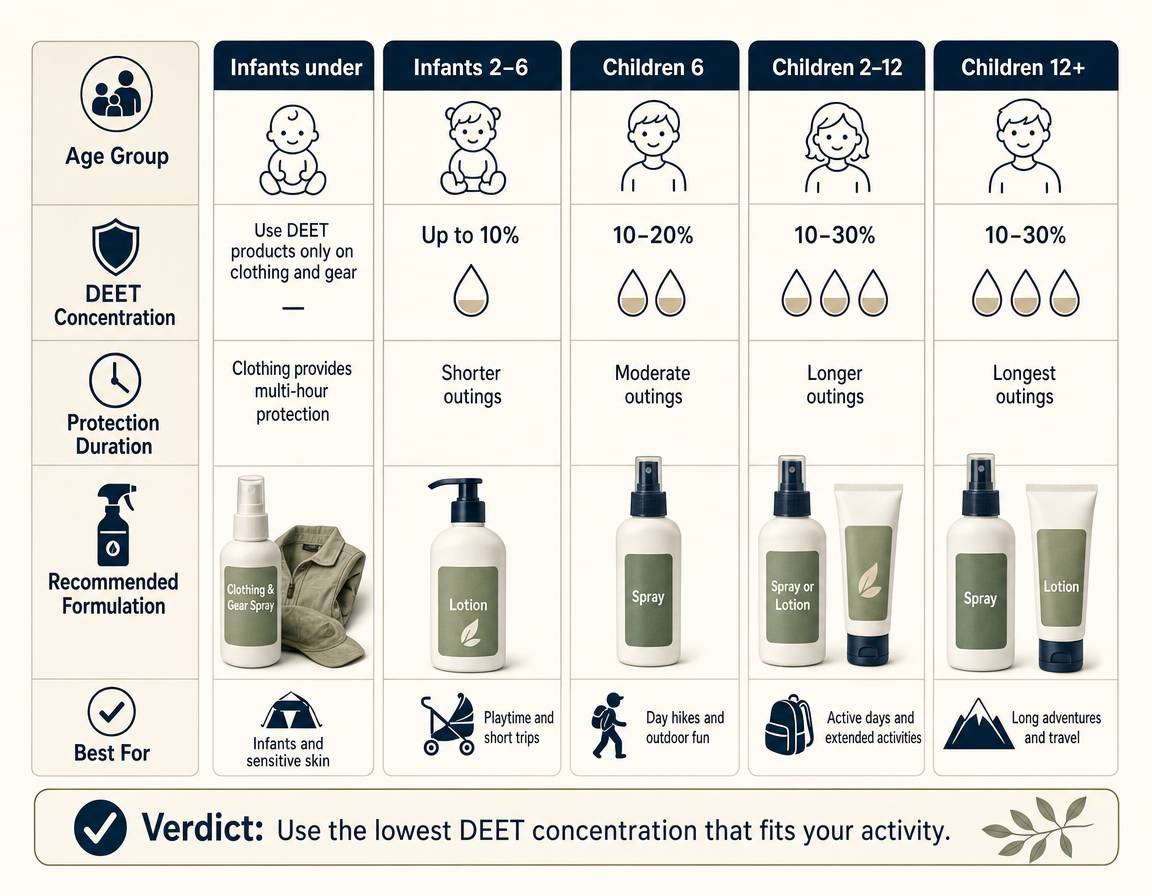 The duration curve runs like this: 10% gives roughly 1–2 hours protection, 20% stretches to 3–4 hours, 30% to 5–6 hours, and 50% to 8 hours or more. For most evenings in East London and Essex, where mosquitoes tend to appear at dusk rather than hang around all day, 10–20% does the job. The tiger mosquito (Aedes albopictus) — increasingly common in southern England — bites during daytime, so you might justify 30% for longer outdoor stints. - **Infants under 2 months:** No DEET at all. Physical barriers only — mosquito nets, long sleeves, pram covers. Their skin surface area compared to body weight is three times an adult's, and their bodies can't break down chemicals properly yet. - **Infants 2–6 months:** 10% maximum, lotion only, once daily, small areas only - **Children 6 months–2 years:** 10% maximum, lotion preferred, exposed skin only (not under clothes), once daily maximum - **Children 2–12 years:** 10–30% depending on time outside — 10% for 1–2 hours, 20% for 2–4 hours, 30% only for long rural days with lots of biting insects - **Children 12+ and adults:** Up to 50% for extended outdoor work or tropical travel; 30% covers most UK recreational use - **Pregnant women:** 10–30% considered safe by UK authorities; use sparingly and wash off promptly - **Dogs:** 10–30% on collar area and back only, never face or genitals; consider dog-specific alternatives first since their skin pH differs from ours and changes absorption - **Cats:** **No DEET, ever.** Cats lack the enzymes to process DEET and can die from even small amounts. This isn't sensitivity — it's a metabolic gap unique to felines that makes every exposure route dangerous **Expected result:** Each household member matched to a specific concentration and formulation, with cats and babies under 2 months on non-chemical protection. Pregnant women and young children get the lowest concentration that meets their needs. **Verify:** Hold each bottle against your list. The label percentage must not exceed anyone's maximum. Check the formulation fits too — lotion for babies, pump spray or lotion for young children, any formulation for adults with proper technique. Mismatches mean buying something different before you continue.
**Common Pitfall:** Buying one high-strength bottle for everyone to save money. Putting 50% DEET on a toddler delivers five times the chemical per square centimetre versus 10%, with no extra benefit for typical garden play. Get age-appropriate products even if you need multiple bottles. The extra £3–5 is nothing compared to emergency vet or hospital bills.
## Step 3: Prepare Your Application Station A chaotic setup invites mistakes — grabbing a towel with DEET-slick hands, leaving a bottle where a toddler can reach it, forgetting to start the timer. A proper station gives you a clear workflow and fewer chances to slip up, especially when you're trying to get multiple family members ready and out the door. Temperature and humidity matter too. DEET evaporates faster when it's warm, and skin absorbs more when it's hot and humid. Those sticky July evenings in Essex when mosquitoes are worst? The chemical behaves differently than on a cool May morning. Your station should have decent airflow and a way to keep cool if needed. - Pick a well-ventilated spot away from food prep, at a stable temperature if possible - Lay down an old towel or disposable sheet for drips; use a plastic-backed pad for pets - Keep soap, water, and clean cloths within reach but outside the main application zone - Set your timer for the drying period (15 minutes for children, 20 for pets) - Have a sealed, labelled container ready for storing the product afterwards - Remove toys, food bowls, water dishes, and chew items from the area - Wash your own hands first and take off jewellery that could trap product against skin - Plan for interruptions — a second adult to take over, or a safe pause point **Expected result:** A contained workspace with everything positioned for smooth, uninterrupted work. Another family member should be able to look at your setup and copy it. **Verify:** Mime the whole application without moving your feet. Everything you need should be reachable; anything that could distract or pick up residue should be outside arm's reach. Test your timer volume against normal household noise.
**Common Pitfall:** Applying DEET in the kitchen or near where pets eat. Residue transfers to food surfaces or water bowls, creating ingestion risk. Even tiny amounts build up in a cat's system over repeated exposures. Use a utility room, bathroom, or outdoor patio instead. If you're outside, pick concrete or decking — not lawn or play mats where kids go barefoot later.
## Step 4: Apply DEET to Children Using Age-Appropriate Technique How you apply matters as much as what you apply. Young children touch their faces, suck their thumbs, rub their eyes — your job is full coverage of exposed skin with zero product on hands, near eyes, or on broken skin. For kids old enough to understand, teach them the "don't touch" rule beforehand. Practice the routine on a normal day so they know what to expect. The "don't touch" rule needs different approaches by age. For toddlers, use physical barriers — gentle wrist-holding or a toy to occupy their hands. For 4–8 year olds, explain it's "sticky medicine that needs to dry" and offer a small reward for cooperating. For older kids, tell them the actual science: DEET confuses mosquitoes' smell receptors but needs to stay on skin, not in eyes or mouths. Sunscreen interaction needs attention too. The US EPA notes DEET absorbs more when combined with sunscreen, though how much this matters clinically is still debated. The cautious approach — sunscreen first, wait 15 minutes, then DEET — keeps any combined effect minimal while maintaining UV protection. Skip combination products unless your child's paediatrician specifically recommends them; sunscreen needs reapplying every 2 hours, DEET doesn't. - If using both, put sunscreen on first; wait 15 minutes before DEET to limit increased absorption - For sprays, hold 10–15 centimetres from skin; for lotions, squeeze onto your palm first — never directly onto the child - Spread evenly over exposed arms, legs, and neck with your hands; work top to bottom so you don't miss spots - **Face:** Spray into your palm first, then dab lightly on cheeks and forehead, keeping well clear of eyes, mouth, and nostrils. The skin around eyes absorbs particularly easily - **Hands of children under 8:** Don't apply directly. Treat their clothing cuffs and collar instead, and watch them closely to prevent hand-to-face contact. For 8–12 year olds, apply to backs of hands only, not palms or fingers - Use just enough to lightly moisten skin; a shiny layer means too much. The NHS suggests about 5 millilitres for an adult arm — scale down for children - Get behind ears and along the hairline where mosquitoes love to bite, but keep product below actual eye level - Don't put DEET under clothing unless a doctor specifically tells you to for high-risk travel **Expected result:** Thin, even coverage on all exposed skin with no pooling, no facial spraying, and the child's hands untreated or protected by clothing. They shouldn't feel greasy or smell strongly chemical. **Verify:** Ask them to hold their arms out. Check for missed patches — backs of knees, behind ears, between shoulder blades, hairline. Make sure their palms are dry. Run your clean hand lightly over treated areas to catch any sticky pooling from overapplication.
**Common Pitfall:** Spraying directly at a child's face or letting them hold the bottle. Aerosol droplets hit eyes or get inhaled, causing immediate irritation and coughing. Kids also tend to overspray or aim at siblings. Keep full control of the product throughout. Even pump sprays near the face create fine mist that drifts toward eyes on unpredictable air currents.
## Step 5: Apply DEET to Dogs with Species-Specific Precautions Dogs process DEET differently than we do, and their grooming habits create unique ways for them to swallow it. Focus on areas they can't reach to lick, with extra care for flat-faced breeds — pugs, bulldogs, boxers — whose breathing problems get worse with any respiratory irritation from fumes. Those shortened noses and elongated soft palates make them especially vulnerable to airborne irritants. Canine skin differs from ours too. Dogs have a thinner outer skin layer and higher pH (6.2–7.5 versus our 4.5–5.5), which changes both how DEET penetrates and how likely it is to irritate. Wrinkly breeds — shar-peis, bulldogs, pugs — can trap product in skin folds where irritation develops unseen. Long-haired dogs have the opposite problem: product may coat fur without reaching skin, giving little protection while creating oral exposure risk when they groom. Think about your dog's personality and training too. Anxious dogs, puppies under 16 weeks, and dogs who've had bad experiences with topical treatments may struggle to stay still. For these dogs, DEET application might be too risky regardless of concentration, and physical barriers or professional property-wide pest control become the safer path. - Choose spray or wipe rather than lotion, which mats fur and encourages licking - Apply to the back of the neck between shoulder blades, where even determined groomers can't reach - Add a thin line along the spine from neck to tail base, parting fur to reach skin; use a comb on thick coats - **Never apply to face, muzzle, genitals, paws, or underbelly** — these are high-lick zones with thin skin and mucous membrane exposure - Use an Elizabethan collar or distraction treats for 20 minutes after application to prevent grooming - Consider pet-specific alternatives (permethrin-based dog products, picaridin formulations labelled for dogs) before using human DEET; many vets stock appropriate repellents - For flat-faced breeds, apply outdoors or in maximum ventilation, and watch their breathing for 30 minutes afterwards **Expected result:** Product along the back where skin absorbs it but mouths can't reach it, with behaviour management in place during drying. The dog should show no immediate distress. **Verify:** Run fingers against the fur grain along the spine. You should feel slight dampness at skin level without soaked fur. Watch for immediate warning signs: excessive scratching, rubbing, drooling, vomiting, lethargy, or breathing changes. Recheck the application site at 10 minutes to make sure coat movement hasn't carried product toward lickable areas.
**Common Pitfall:** Putting DEET on a dog's paws before a walk. Paws touch ground, then mouths during post-walk grooming. This oral route bypasses skin processing and delivers concentrated chemical straight to the gut. If you need paw protection, use booties instead. Same problem if you apply before swimming — water exposure increases oral uptake through coat licking while drying.
## Step 6: Maintain Isolation During the Drying Period DEET stays transferable until fully absorbed — about 15 minutes on human skin, up to 20 minutes on dog fur. During this window, treated people and pets can contaminate furniture, bedding, toys, and each other through casual contact. This isolation period isn't optional; it's when most accidental exposures happen. A 2019 Veterinary Record study found 78% of feline DEET poisonings in multi-pet homes came from residue transfer from treated dogs or humans, not from direct application to the cat. The emotional side of isolation matters too. Kids can feel punished by separation; dogs may whine or bark. Prepare distractions beforehand and frame the time positively. For children, "screen time while your superhero shield dries" builds cooperation. For dogs, a frozen treat toy in the crate turns confinement into something rewarding. Bad associations with DEET application make future applications harder and increase movement during the crucial drying window. - Seat children on a designated "safe chair" with no fabric upholstery — plastic or wood wipes clean; avoid carpets completely - Keep dogs on a lead or in a crate with a washable mat, not on sofas, beds, or carpets where residue binds to fibres - Stop contact between treated and untreated siblings — no hugging, hand-holding, or sharing devices - Distract with screen time, books, or chew toys that stay in the isolation zone; don't let toys migrate out during drying - Set your timer and don't cut it short even if skin looks dry — absorption continues below the surface - Exclude cats completely from the isolation area and any path between treated individuals and cat spaces - Wash your own hands before touching any untreated family member or surface **Expected result:** No cross-contamination between treated users and untreated family members, furniture, or objects during the absorption window. The isolation zone stays clearly defined and respected. **Verify:** Press a clean white tissue against the treated area. If any residue transfers, extend isolation by five minutes and retest. The tissue should stay clean before anyone makes contact. For dogs, also check the crate mat or isolation surface for fur oil transfer, which means incomplete drying.
**Common Pitfall:** Letting a treated child play with the family cat during drying. Cats are extraordinarily sensitive to DEET, and residue transferred from a child's arm to a cat's fur during petting creates a grooming exposure that can cause tremors, seizures, or death. Keep all cats away from the application area entirely until after handwashing. Even brief contact — one stroke of a cat against a treated leg — can transfer lethal amounts to feline fur.
## Step 7: Remove Residue After Outdoor Exposure Ends DEET doesn't need to stay on skin indefinitely. Once you're back inside or the biting risk has passed, washing it off promptly stops prolonged absorption and reduces transfer to home surfaces. Skipping this step turns temporary protection into all-day chemical exposure. Skin becomes more permeable when warm and covered, so bedtime with DEET residue creates peak absorption conditions exactly when you're not watching for problems. Pay attention to spots people often miss. Product collects in skin folds, under watch straps, along sock lines, and in creases behind knees and elbows. These reservoirs keep releasing DEET even after a quick wash, especially if soap application was half-hearted. A methodical washing routine, built into habit, ensures complete removal without aggressive scrubbing that could irritate sensitive skin. For children who conk out during car rides home from evening activities, have a "sleep transfer" plan: gentle wipe-down with a damp soapy cloth before moving to bed, then proper washing when they wake. This middle step prevents the worst scenario — DEET-coated skin against bedding for 8–10 hours. - Wash treated skin with soap and water as soon as protection isn't needed; plain water won't do it since DEET repels water - Focus on creased areas — behind knees, elbow bends, neck folds, under watch straps, along waistbands — where product builds up - Use a soft washcloth for gentle mechanical removal rather than hard scrubbing - Wash your own hands again after helping children or pets; DEET persists on helper hands and transfers to everything you touch - Wash treated clothing separately before wearing again; DEET degrades some fabrics over time and can transfer to other items in shared loads - Check pets for skin irritation at application sites; bathe with mild soap if you see redness, swelling, or excessive scratching - For dogs, use pet-specific shampoo if bathing is needed; human soaps can alter coat pH and cause secondary skin problems - Keep a simple log of any skin reactions — date, product, concentration, what happened — to spot patterns over time **Expected result:** All treated skin back to clean baseline; clothing separated for washing; no DEET residue remaining on hands or surfaces. The house should feel and smell free of repellent. **Verify:** Smell the treated area. DEET has a distinctive faintly chemical, fruity odour that lingers even when you can't see it anymore. Clean skin should smell of soap only. Any remaining scent means more washing needed. For children, make a game of the "sniff test" — it builds compliance and teaches them to check themselves.
**Common Pitfall:** Putting children straight to bed with DEET still on their skin. Night-time warmth increases skin permeability, and eight hours of continued absorption during sleep delivers significantly more chemical than daytime use followed by washing. Always wash before bed, even after evening outings. Skipping this step for convenience carries real physiological cost that adds up with repeated nights.
## Step 8: Store DEET Products Securely Storage mistakes cause more child poisonings than application errors. Children explore cabinets and drawers; dogs chew bottles; cats knock things off shelves. A proper storage routine done immediately after use prevents these situations. The minutes right after application, when you're focused on cleanup and getting back to normal, are when storage gets forgotten — build the habit of storing before you even take off your gloves or wash your hands. Product degradation is the second issue. DEET breaks down with heat and light, losing effectiveness and potentially creating breakdown products with unknown skin effects. Aerosol cans become dangerous when pressurised in warmth. Original packaging carries crucial information — concentration, batch numbers for recalls, expiry dates — that many people throw away when decanting to "convenient" containers. - Return product to its original child-resistant cap, clicking until the safety mechanism fully engages; test the resistance before storing - Put it in a locked cabinet, high shelf, or dedicated container with a latch — "high" means above 1.5 metres, not just out of immediate reach - Keep away from heat sources and direct sunlight, which degrade the active ingredient and can pressurise aerosols; ideal temperature is 15–25°C - Keep in original labelled packaging; never transfer to food or drink containers, even temporarily for outdoor trips - Note purchase date and batch number; discard and replace after the manufacturer's stated shelf life (usually 2–3 years) or if colour, consistency, or smell changes - Store separately from medicines, cleaning products, and pet treatments to prevent dangerous mix-ups - Consider a dedicated "chemical cupboard" with consistent placement that all carers know and respect **Expected result:** Product inaccessible to all children and animals, protected from degradation, with clear identification and expiry tracking. Any substitute carer should find and identify it without searching. **Verify:** Try to access the storage as if you were a curious toddler — reach up, pull handles, test latches. If you can get to the product without deliberate adult dexterity, it's not secure enough. For dog-proofing, consider whether a determined chewer could reach it; metal cabinets beat plastic for persistent animals.
**Common Pitfall:** Storing DEET in a bathroom cabinet with medicines. Similar bottle shapes create dangerous confusion, and bathroom humidity speeds degradation. Use a separate, clearly marked container in a cool, dry spot like a hallway closet or kitchen cupboard away from food. Daily shower humidity can cut shelf life by 30–40% according to manufacturer stability data.
[IMAGE_TAG] ## Troubleshooting: Common Mistakes and Fixes | Problem | Likely Cause | Fix | |---------|-----------|-----| | Child develops rash after application | Concentration too high for age; application to eczema or broken skin; interaction with sunscreen; delayed hypersensitivity | Wash immediately with soap and water; switch to 10% or lower; apply only to intact skin; separate sunscreen and DEET applications by 15 minutes; consult GP if rash persists beyond 24 hours | | Dog drooling excessively post-application | Grooming of treated area; product applied too far forward on neck; dose too high for weight | Wash application site with mild soap; distract with treats for full 20 minutes next time; apply further back between shoulder blades; reduce concentration or frequency | | Cat shows tremors or uncoordination after household DEET use | Residue transfer from treated human or dog; cat entered application area during drying; product stored where cat could contact | Immediate veterinary emergency; prevent future exposure by complete cat exclusion during all DEET use and handwashing before contact; review storage security | | Repellent seems ineffective after 30 minutes | Insufficient concentration for activity level; sweating or swimming washing product away; expired formulation; application to clothing rather than skin | Match concentration to expected outdoor duration; reapply after heavy perspiration or water exposure; check and replace expired products; ensure direct skin application | | Clothing shows discoloured spots after DEET contact | DEET degrades acetate, rayon, spandex, and some synthetics; prolonged contact before washing | Apply only to skin, not clothing; if fabric treatment desired, use permethrin-treated garments instead; launder affected items promptly; test hidden area before future wear | | Child complains of eye sting during application | Aerosol drift or hand-to-eye contact after product on hands | Flush eyes with clean water for 15 minutes; do not use eye drops unless prescribed; prevent recurrence by avoiding facial spray and treating young children's hands only through clothing | 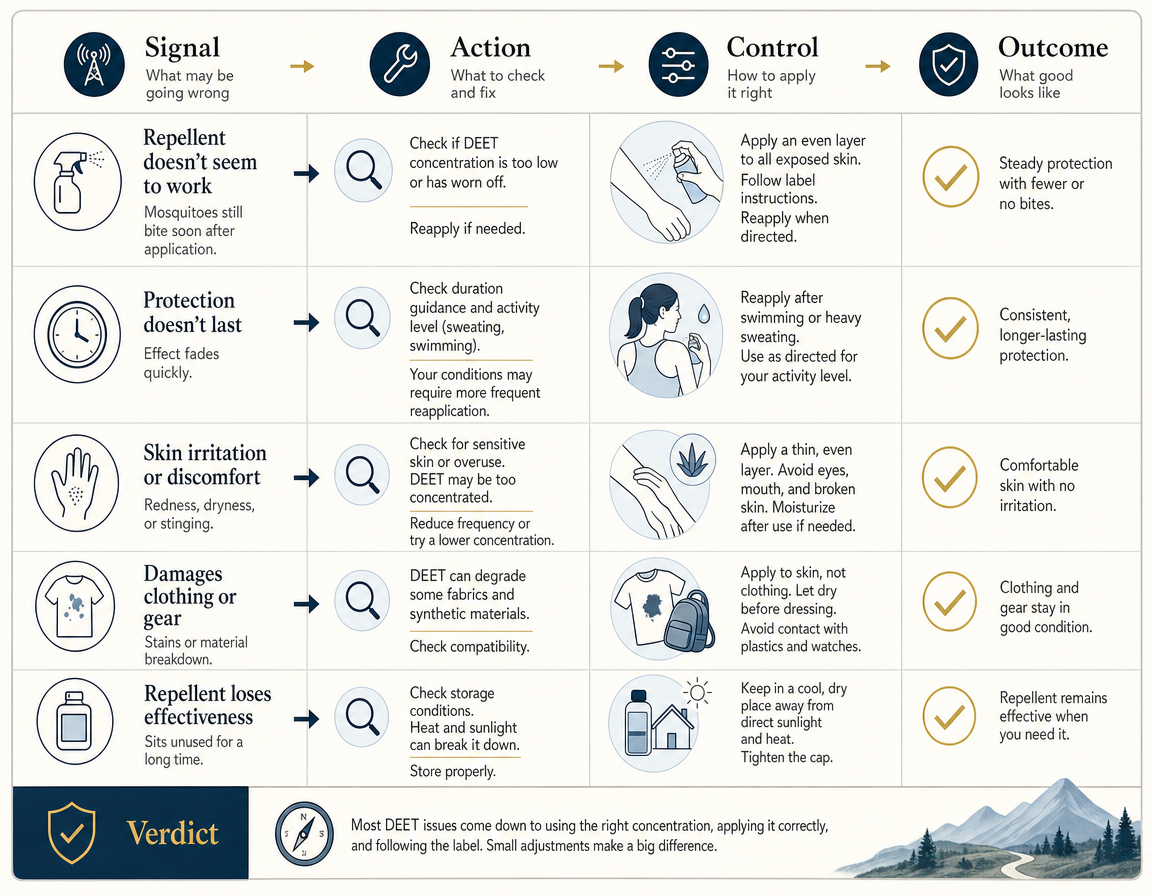 ## Verify the Result Go back to your Success Checks from the start. You need all five confirmed: **Concentration match:** Every user got age-appropriate or species-appropriate DEET percentage, with babies under 2 months and all cats excluded from chemical protection entirely. No one received more than their documented maximum. **Application coverage:** Visual check confirmed complete treatment of exposed skin with no product on young children's hands, near anyone's eyes, or on pet faces and paws. No broken skin or eczema patches received product. **Post-application isolation:** Timer ran full 15–20 minute drying period with no early contact between treated individuals and untreated family members, furniture, or especially cats. The isolation zone stayed secure throughout. **Residue removal:** Soap-and-water washing removed all detectable product after outdoor exposure ended, with attention to skin folds and pet fur. No bedtime application without prior washing occurred. **Storage security:** Product went back to child-resistant, latched, high or locked storage away from heat and humidity, with original labelling intact and expiry date noted. No storage in bathroom cabinets or near food containers. If any check fails, don't make this your routine. Figure out which stage went wrong, repeat it from the beginning, and verify again before establishing it as standard. Note the failure and your fix for future reference — repeated patterns mean something systemic needs professional input from your GP or vet. ## How BuzzKill Pest Control Helps Safe DEET use protects your family during outdoor time, but it doesn't tackle why biting insects are around your East London or Essex property in the first place. Standing water in plant saucers, blocked gutters, and thick vegetation near your house create breeding sites that bring mosquitoes, midges, and biting flies right to your door. Our [RSPH Level 2 qualified technicians](https://buzzkillpestcontrol.co.uk/blog) do thorough site surveys to find these problem spots, then apply targeted treatments that cut biting pressure without depending only on personal repellents. For families with young children, pets, or members sensitive to chemicals, combining proper repellent use with professional habitat management gives the most complete protection. We also advise on physical barriers — fine mesh screens, door sweeps, vegetation management — that reduce how much repellent you need during peak insect season. When biting insects have already moved indoors, like [fleas on pets](https://buzzkillpestcontrol.co.uk/blog/how-to-get-rid-of-fleas) or [bed bugs in bedrooms](https://buzzkillpestcontrol.co.uk/blog/how-to-get-rid-of-bed-bugs), personal repellents don't help and targeted professional treatment is what's needed. ## Next Steps Once your household's safe repellent routine is established, consider these follow-ups: - Book a professional site survey to find and eliminate mosquito breeding habitat on your property, reducing overall repellent needs - Look into permethrin-treated clothing as a lower-maintenance option for children old enough to wear long sleeves and trousers reliably - Create a family calendar marking peak biting insect periods where you live — typically May through September [in Essex and East London](https://buzzkillpestcontrol.co.uk/areas/east-london), with tiger mosquito activity running into October — so you can plan protection ahead - Discuss pet-specific repellent alternatives with your vet, especially if your dog has frequent outdoor exposure or your household includes cats where DEET exclusion is essential - Check your property for [signs of rodents](https://buzzkillpestcontrol.co.uk/blog/signs-of-rats) or other pests that may overlap with biting insects and need integrated management ## Completion Notes You now have a repeatable, checkable system for applying DEET insect repellent that protects each family member according to their specific vulnerabilities. The ongoing habit that matters most is washing up after outdoor time — most households remember to apply but forget to remove, turning temporary protection into unnecessary all-day chemical exposure. Set a phone reminder for the first month until washing becomes automatic. Your aim is effective biting insect defence with the minimum chemical exposure that gets the job done, backed by professional pest management that tackles the root causes of insects around your home. ## Related Blog Posts - [How to get rid](https://buzzkillpestcontrol.co.uk/blog/how-to-get-rid-of-rats) of fleas — When biting insects have already established themselves on pets or in your home, targeted treatment becomes necessary alongside personal repellent use - [Signs of bed bugs](https://buzzkillpestcontrol.co.uk/blog/signs-of-bed-bugs) — Learn to distinguish between outdoor biting insects and indoor bed bug bites that require completely different management approaches - [How to get rid of wasps](https://buzzkillpestcontrol.co.uk/blog/how-to-get-rid-of-wasps) — Stinging insects present different risks than biting mosquitoes; understand when professional nest removal is the safer choice over personal protection strategies
Need professional help? BuzzKill offers fast, reliable pest control services across London and Essex.