
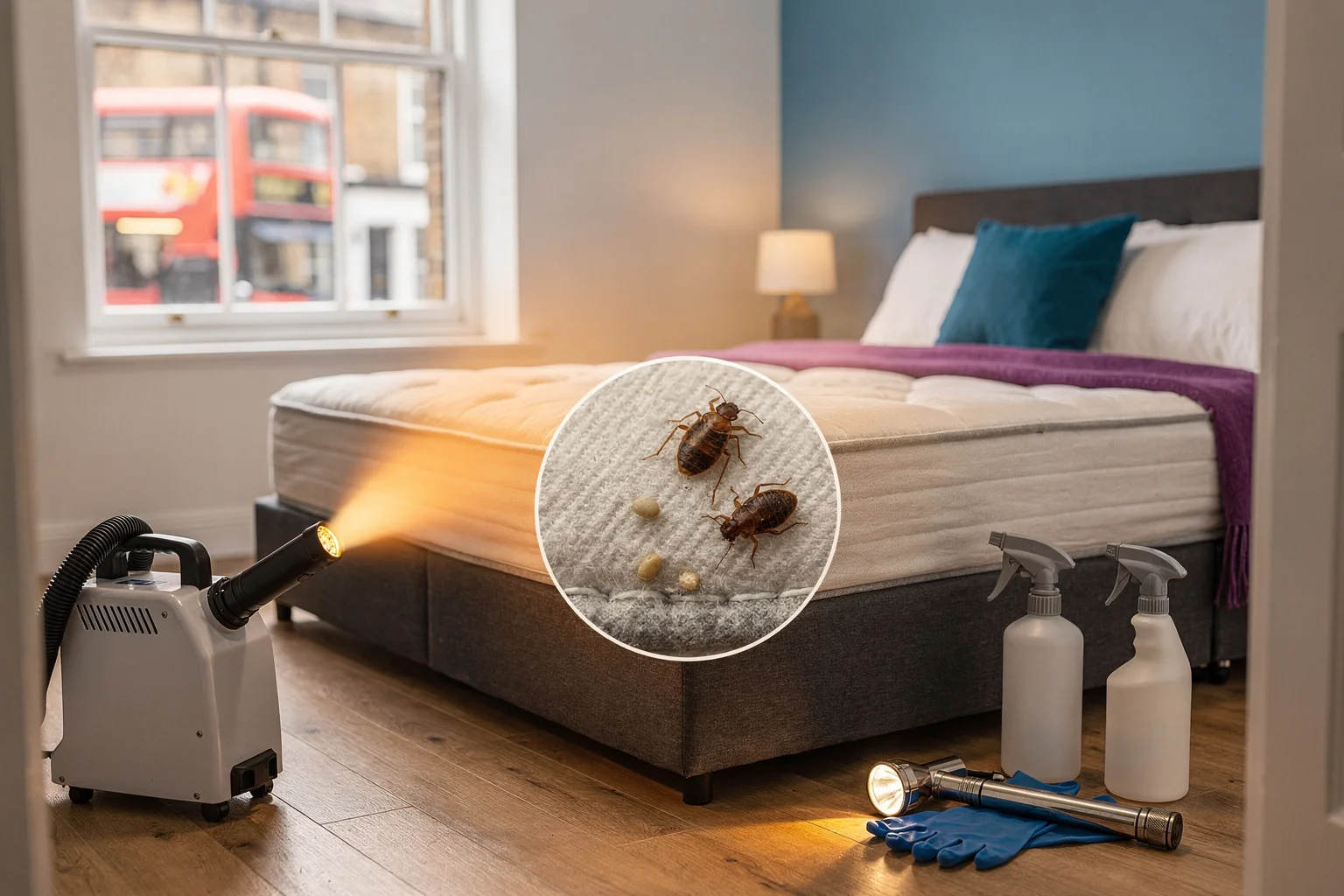
When Lisa spotted three tiny rust‑coloured smears on the edge of her Stratford rental mattress on a Tuesday morning, she had no idea whether to call her landlord, head to the chemist, or start bagging up every piece of fabric she owned. What she did know was that she’d woken up two nights in a row with itching along her arms and that something wasn’t right.
By Thursday evening she’d spoken to two pest control companies. One recommended a full flat heat treatment at £480 plus VAT. The other quoted £180 for a chemical spray — with the caveat that she might need two or even three follow‑up visits. Same flat, same problem, two completely different paths. She needed to choose, and she needed to choose fast.
That fork in the road is exactly where a lot of London households find themselves in 2026. Bed bug callouts have been climbing steadily across the capital, driven by a mix of international travel, short‑term lets, and a warming climate that no longer delivers a meaningful winter kill. But a rising problem doesn’t mean a one‑size‑fits‑all fix. This article walks through the two main professional treatment routes — heat and chemical — so you can decide with your eyes open about what’s happening inside your own four walls.
First things first: confirm you’re dealing with bed bugs
Before you pull a mattress into the street or cancel the weekend, it’s worth spending ten minutes confirming that the culprit is actually Cimex lectularius and not a carpet beetle larva, a flea, or a rogue mozzie from a half‑open window.
Bed bugs leave a small handful of tell‑tale clues. Along mattress seams and the joints of a wooden bed frame you’ll often spot dark speckling — digested blood excreted after a feed — or pale amber skins that nymphs shed as they grow. In heavier cases you might find live adults, flat and brown before a meal, more elongated and reddish after one. The bites themselves aren’t diagnostic on their own; some people react, others don’t, and the pattern can mimic other insect bites. But if you’re waking with clusters of small, itchy welts along skin that was exposed overnight, and you’ve found physical evidence where you sleep, it’s time to take the next step.
If you need help with identification, our signs of bed bugs guide walks you through the five things to look for and what to photograph before you call anyone.
Once you’re confident or strongly suspicious, the practical question becomes: heat or chemical? Both can clear an infestation when done properly, but they work very differently, and the one that suits your situation comes down to a handful of practical factors.
The two treatment philosophies
Professional bed bug control in London today is broadly split into two camps.
Chemical treatment — sometimes called insecticide treatment or residual spraying — uses a targeted application of liquid insecticide along bed‑frame joints, skirting boards, wall‑floor junctions, furniture seams, and anywhere bed bugs are likely to travel or rest. A competent technician will typically combine a fast‑acting contact spray with a longer‑lasting residual insecticide that keeps working for several weeks. Most chemical programs involve at least two visits spread two to three weeks apart, because no single application reliably kills eggs.
Heat treatment — sometimes called thermal remediation — raises the temperature of an entire room (or an entire flat) to a sustained 56–60°C for a set period, using industrial heaters and high‑velocity fans to push hot air into every crack. At those temperatures all life stages — egg, nymph, and adult — die within the treatment window. A single session normally runs four to eight hours. No chemical residue is left behind, and the room is safe to re‑enter the same evening once it’s been cooled and ventilated.
The BPCA’s Code of Best Practice for Bed Bug Management and Control makes clear that whichever route a member company offers, the treatment must be built on a thorough inspection and a written plan. A technician who turns up, sprays the bed, and leaves without documenting anything isn’t working to a recognised standard.
The preparation burden nobody talks about
The biggest surprise for most people is not the treatment itself — it’s the amount of work they have to do before the technician even arrives.
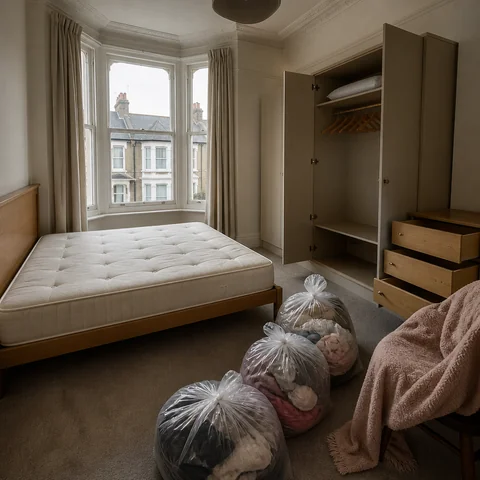
Chemical treatments generally demand the most from you. You’ll need to strip all bedding and wash it at 60°C or above, bag up clothing and soft furnishings, empty wardrobes and drawers in the rooms being treated, and move furniture away from walls. The Tower Hamlets council pest control guidance spells out that if preparation isn’t complete when the technician arrives, the treatment’s effectiveness drops and you’re likely to need a further visit — at further cost. You also have to stay out of the treated rooms for at least three hours after spraying and keep windows open for another hour.
Heat treatment asks for a different kind of prep. You don’t need to wash every piece of fabric before the visit, but you do have to remove or protect anything that heat might damage — candles, cosmetics, certain plastics, oil paintings, perishables. Good firms will talk you through a room‑by‑room checklist. Because the treatment is contained to one day and creates no lingering chemical barrier, there’s no re‑entry delay beyond the cool‑down period, and no need to avoid treated surfaces afterwards.
The direction this points towards is straightforward but worth stating plainly: if you’re managing childcare, working long shifts, or have mobility constraints, the one‑day, lower‑prep promise of heat treatment can make a real difference to whether the job gets done properly.
Speed and disruption: how long until the flat is yours again
Heat treatment is the clear winner on raw pace. A single room takes about four hours; a one‑bedroom flat might run six to eight. You’ll normally leave in the morning and return that evening to a warm, ventilated space that’s ready to sleep in the same night. There’s no second visit required, though a good operator will usually return after a couple of weeks for a quick monitoring check.
Chemical treatment is a slower burn. A first visit knocks down the active population, but the eggs that were present that day will hatch over the following two to three weeks. A second application — sometimes a third — is built into the plan from the start. Between visits you’re living with partially treated rooms, often sleeping in the same mattress that’s being monitored, which can feel unsettling even when it’s technically safe.
If you’re running a holiday let, a guest room, or you’ve got a hard deadline for a move‑in date, the calendar argument for heat gets very strong. But if you can tolerate a couple of weeks of residual unease and prefer to spread the cost, the chemical timeline may work in your favour.
What you’ll pay per room in London right now
Prices vary by company, property size, and infestation level, so treat these as mid‑2026 guide numbers rather than fixed quotes. Based on calls I’ve listened to and the pricing structures across independent East London firms, a rough breakdown looks like this.
Chemical treatment for a single room typically lands between £120 and £200 per visit, with a two‑visit programme sitting around £200–£350, and a three‑bedroom house sometimes climbing towards £400–£600 when multiple room treatments are needed. The lower initial quote can be appealing, but the total spend after follow‑ups often ends up comparable to a one‑shot heat session.
A whole‑room heat treatment for a large double bedroom generally runs £350–£500 plus VAT, with smaller rooms or targeted treatments sometimes dipping below that. Whole‑flat packages for a two‑bedroom property in areas like Tower Hamlets or Newham might sit in the £600–£900 range, depending on access.
You can get a wider overview of typical bed bug treatment costs in London. The key thing to weigh is whether you prefer a predictable one‑off payment or a lower entry price that may grow.
Why eggs decide whether the treatment sticks
Understanding what bed bugs actually do during their life cycle makes the egg problem less abstract. A female can lay two to five eggs a day, tucking them into screw holes, behind headboard fabric, inside electrical sockets — places that spray droplets might not reach. Those eggs are naturally protected by an outer coating, and most standard insecticides don’t penetrate it well.
Heat bypasses that problem completely. Sustained temperature above 50°C denatures proteins inside the egg and kills the embryo, even in crevices that a spray would miss. That’s the reason a properly executed thermal treatment can genuinely be a one‑session solution.
With chemical approaches, the technician relies on the residual insecticide to kill nymphs as they emerge over the following weeks. That works when the product is well‑placed and the follow‑up timing is right, but it does mean the infestation can feel like it rebounds just when you thought it was over. That rebound is actually the scheduled hatch — but if you weren’t expecting it, it’s demoralising.
Our bed bug lifecycle page walks through each stage from egg to adult if you want the full picture.
Reinfestation rates, warranties, and callbacks
Every pest controller will tell you that no treatment comes with a 100% guarantee against reintroduction. Bed bugs travel on luggage, clothing, second‑hand furniture, and through adjoining walls in flats, so a completely cleared room can be recolonised.
What does differ between methods is the short‑term reinfestation risk — and the warranty coverage that sits around it. Because heat treatment reaches every stage in one go, a handful of companies back it with a longer guarantee, often 60 or 90 days, provided you haven’t reintroduced bed bugs through new items or travel. Chemical programmes usually carry a shorter guarantee tied to the scheduled visit cycle.
If you’re in a converted Victorian terrace or a purpose‑built block where neighbouring flats share common voids, the ability to eradicate the infestation in one hit can be particularly valuable — it reduces the chance that undetected eggs in a party‑wall gap restart the problem while you’re mid‑programme.
The tenancy factor: who pays, and who needs to know
London’s rental market adds another layer to the decision. Under the Homes (Fitness for Human Habitation) Act 2018 and the Landlord and Tenant Act 1985, a landlord is responsible for keeping a property free from pests caused by structural defects. But a furnished flat with a pre‑existing bed bug problem? That can quickly become a dispute if the tenant is blamed for bringing them in — something the BBC highlighted earlier this year in a report that followed a couple who fled a £1,750‑a‑month rental after finding bed bugs crawling up their pillows.
Practically, many landlords in London now prefer to pay for heat treatment upfront because it usually solves the issue in one visit, keeps the property lettable faster, and creates less friction with sitting tenants who don’t want repeated disruption. But some agents still default to the cheaper per‑visit chemical route. If you’re a tenant who suspects bed bugs, your best move is to report it in writing immediately, take dated photos, and ask the landlord to arrange a professional inspection — ideally from a company that can talk both options through with you present.
If you’re a landlord or letting agent reading this, sites like East Ham bed bug removal and Tower Hamlets bed bug treatment are set up to handle multi‑occupancy properties quickly, with minimal downtime.
When to pick heat, and when chemical makes more sense
No method is universally “better” — the right choice depends on what you’re dealing with, what you can spend, and how much prep you can realistically manage.
Consider heat treatment when any of these apply: you’ve found bed bugs in multiple rooms and want a single‑session solution; you or someone in the household has respiratory sensitivities and wants to avoid insecticide residues; you’re a landlord needing a flat back on the rental market within 48 hours; you’re in a block of flats where wall‑void movement means eggs in hidden spaces are a genuine risk; or you’ve already tried DIY or earlier chemical treatments without success.
Chemical treatment can still be the better fit when: the infestation is caught early and contained to one piece of furniture; the property contains heat‑sensitive fixtures that can’t be safely removed; the budget is tight and you can commit to the full follow‑up schedule; or you’re in a property where the electrical load can’t support the industrial heaters — which sometimes happens in older London conversions with dated consumer units.
There’s no rigid rulebook, but if you’re uncertain, asking a technician to talk through both options after a site inspection is perfectly reasonable. A firm that only offers one method without being able to explain why it’s right for your flat isn’t giving you a fair assessment.
What changes after treatment, and what to watch for
Once the heat has cooled or the final chemical visit has been completed, the most important shift is the one in your own habits. Post‑treatment monitoring is straightforward but non‑negotiable. Keep using mattress encasements designed for bed bug protection — they won’t eliminate an active infestation, but they trap any survivors inside and make spotting new activity on the surface far easier. Vacuum skirting boards and bed frames weekly for a month and empty the canister outside straight away. Avoid bringing second‑hand upholstered furniture into the flat without a careful inspection, and if you travel, run your luggage through a hot wash or a dedicated heat chamber when you get back.
If bite‑like marks reappear two weeks after a chemical treatment, it’s often just the expected nymph emergence — not a sign the treatment failed. The technician should have given you a timeline of what to expect and when to call. If you haven’t heard from them by the agreed follow‑up date, chase them. That’s part of what you paid for.
When new evidence appears more than six weeks after a completed heat treatment, it almost always points to reintroduction rather than a failed session. In that scenario you’ll want to trace the likely source — a colleague’s coat, a cinema seat, a weekend bag — before re‑treating the room. Without that step you risk a cycle.
If you’re dealing with a confirmed infestation and the decision still feels heavy, getting a professional inspection early almost always saves money and stress compared to waiting. A technician who walks the flat can explain which approach fits your room layout, your tenancy situation, and your budget — and they can spot entry points or neighbouring‑flat risks you might not have considered.
Need professional help? BuzzKill offers fast, reliable pest control services across London and Essex.