
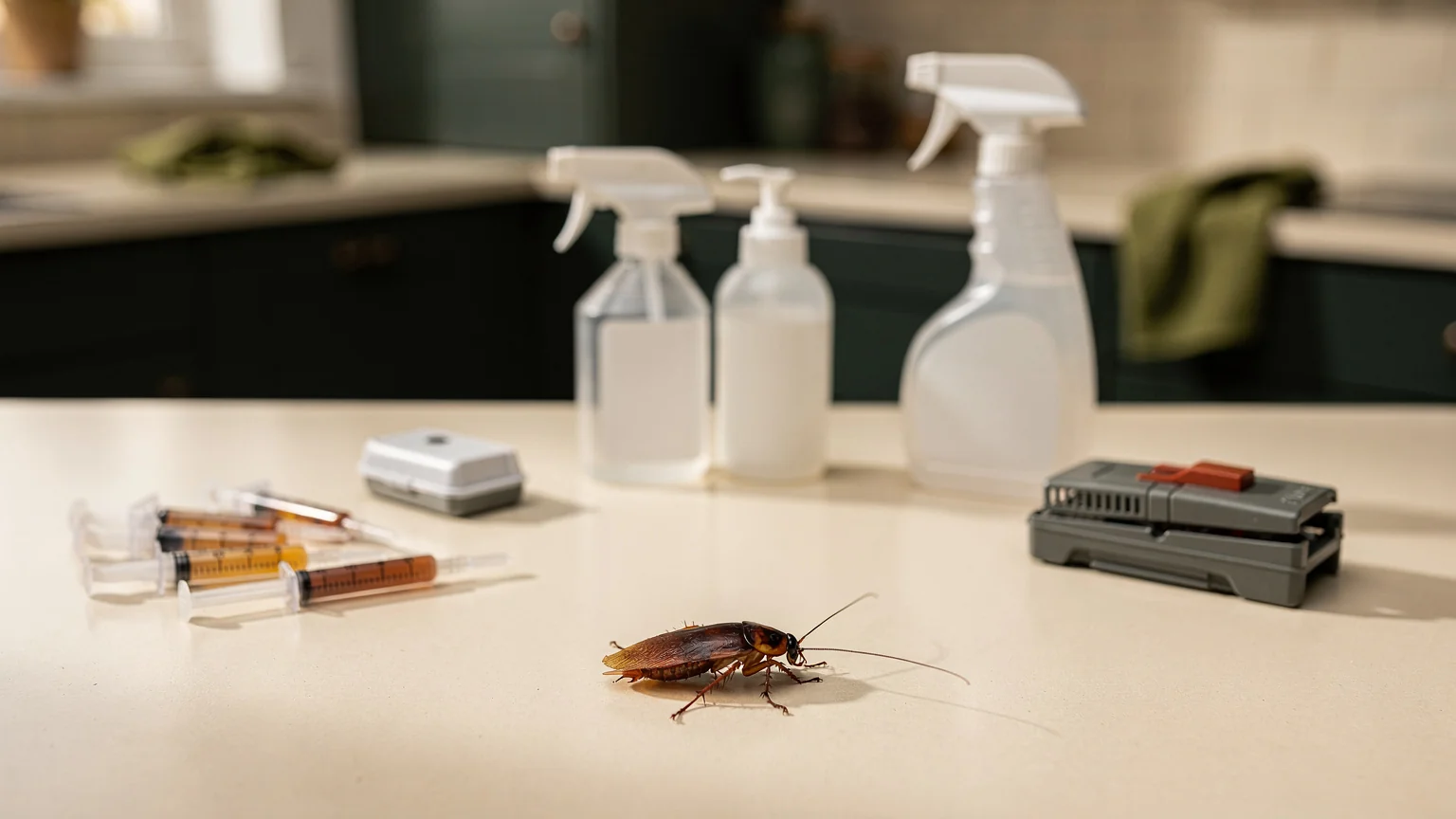
Most people facing cockroaches reach for the first product they spot on a supermarket shelf, then wonder why the problem returns six weeks later. The real mistake isn't choosing the wrong brand. It's treating gel baits, residual sprays, and sticky traps as interchangeable fixes when each one solves a completely different stage of the problem. There is also a fourth option that the packaging rarely mentions: doing nothing for long enough that the colony forces your hand.
Before you spend £15 to £40 on a DIY solution, you need to match the method to what you have actually found in your property. A single Oriental cockroach behind the fridge is not the same problem as German cockroaches scattering from a kettle in a tower-block kitchen. Your evidence, property type, and tolerance for chemical exposure should drive the decision, not the marketing on the box.
What You're Actually Dealing With
The two species that dominate London homes behave differently, and that behaviour determines which product has any chance of working. German cockroaches are smaller, lighter in colour, and prefer warm, humid areas near food preparation. They reproduce fast. A female carries an egg case containing 30 to 40 nymphs, and those nymphs reach breeding age in roughly 50 days at room temperature. Oriental cockroaches are larger, darker, and more tolerant of cooler conditions. They tend to live in drains, basements, and external bin stores, moving indoors when temperatures drop or food sources appear.
If you cannot identify the species, a UK cockroach species guide will help you match what you have seen to the correct treatment approach. Misidentification is a common reason DIY treatments fail. Gel baits designed for German cockroaches, for example, often use attractants that Oriental cockroaches ignore.
Property type matters too. A ground-floor flat in a converted Victorian house shares wall voids and pipe runs with neighbouring units. A detached house in Essex has fewer vectors for reinfestation but may have larger harbourage zones in lofts or subfloors. Tower blocks present the hardest case. A March 2026 BBC report described recurring cockroach problems in a Sheffield council block where treatments in individual flats could not address communal pipework and refuse areas. The tenant described the situation as "endemic" because untreated neighbouring units continually reseeded the colony.
Your urgency level depends on what you have seen and when. One cockroach in summer might be a wanderer from outside. Ten in a kitchen cupboard in January signals an established population. Smear marks on walls, shed skins in drawer corners, and a faint musty odour all indicate harbourage nearby. Egg cases glued to the underside of shelves confirm breeding.
Gel Baits: Colony Killer or Slow Burn
Gel baits work by exploiting cockroach social behaviour. The insect eats the bait, returns to the harbourage, and dies. Other cockroaches then consume the corpse and the faeces, spreading the active ingredient through the colony. This horizontal transfer is what makes gel baits potentially effective against large populations. The active ingredients in professional-grade products typically include indoxacarb, hydramethylnon, or fipronil. Consumer versions available in UK hardware stores often use lower concentrations or different compounds.
Best-fit situation: You have identified harbourage areas, you are willing to wait two to four weeks for population collapse, and you have children or pets who might contact sprayed surfaces. Gel baits allow precise placement in cracks, behind appliances, and inside cupboard hinges where sprays cannot reach safely.
Failure mode: The bait dries out before enough cockroaches consume it. Kitchen heat and grease residue degrade gel quality within days in some environments. Cockroaches also develop bait aversion if the active ingredient kills too quickly, before the insect returns to the harbourage. Over-application creates a repellent effect; cockroaches avoid areas with too much bait.
Time window: Expect visible reduction in seven to fourteen days. Full colony elimination, if it happens at all, typically takes three to six weeks and requires reapplication.
Cost and risk: A £12 to £20 syringe treats a small kitchen. Larger properties need multiple tubes. The main risk is false confidence. You see fewer cockroaches and assume the problem is solved, while the colony recovers from a sublethal dose.
A Tower Hamlets council pest control document notes that professional treatments for cockroaches typically use gel-based poison bait, sometimes combined with spraying, and require two follow-up visits about four weeks apart. This reflects the reality that even trained technicians need multiple applications and monitoring to confirm clearance. The Pestcontrolcockroaches.Pdf guidance also states that residents aware of cockroaches must either treat the problem themselves or use a professional service.
Residual Sprays: Contact Kill with Collateral Risks
Residual insecticides leave a toxic film on surfaces that kills cockroaches walking across it for days or weeks after application. Pyrethroids such as permethrin and cypermethrin dominate consumer products. Professional formulations may add insect growth regulators to prevent nymphs from reaching maturity.
Best-fit situation: You need immediate knockdown of visible cockroaches, you have identified specific travel routes along skirting boards or pipework, and you can exclude children and pets from treated areas for the required drying period. Sprays work well as a perimeter defence in utility rooms, bin stores, and external entry points where Oriental cockroaches travel.
Failure mode: Cockroaches detect and avoid treated surfaces. This behavioural resistance means you kill the individuals already exposed while the colony shifts to untreated harbourage. Sprays also drive cockroaches deeper into wall voids, making later baiting less effective because the insects no longer forage in accessible areas. In flats with shared construction, repellency can push the problem into neighbouring units.
Time window: Visible cockroaches die within hours of contact. Population impact peaks at three to seven days, then declines rapidly as survivors adapt.
Cost and risk: A £8 to £15 aerosol or trigger spray covers limited area. Multiple cans add up. The greater cost is exposure risk. Pyrethroids can trigger respiratory irritation, skin reactions, and are toxic to fish and aquatic invertebrates. Application in food preparation areas requires careful masking and post-treatment cleaning. Many products specify a six-hour exclusion period after spraying.
A 2026 market analysis from IndexBox noted that child-resistant and pet-safe packaging now features in over half of new roach-killer product launches in the UK, reflecting consumer concern about chemical exposure in homes. This trend does not eliminate the underlying toxicity; it simply reduces accidental ingestion risk.
Sticky Traps: Evidence, Not Elimination
Sticky traps, sometimes called monitor traps or cockroach houses, use adhesive surfaces to capture insects that walk across them. Some include pheromone attractants. They are primarily a detection and monitoring tool, though heavy trapping can reduce very small populations.
Best-fit situation: You need to confirm species and locate harbourage before choosing a treatment method. You want to monitor whether a treatment is working. You live in a property where any chemical application is undesirable, such as a home with a newborn or a kitchen with open food preparation.
Failure mode: Using traps as the sole control method for anything beyond a single wanderer. A sticky trap catches twenty German cockroaches in a week and the homeowner assumes progress, while hundreds remain in the wall void breeding. Traps also become saturated, losing effectiveness, and the adhesive dries in heated environments.
Time window: Immediate capture for monitoring. Zero population impact beyond incidental removal.
Cost and risk: £3 to £8 for a pack of five. Negligible chemical risk. The real risk is delayed professional intervention while the colony expands.
A 2026 study in Entomology Today demonstrated that AI image analysis can now detect and count cockroaches on sticky traps, reducing manual inspection time for pest professionals. The research focused on densely populated urban hotspots where German cockroaches dominated. This technology points toward faster monitoring but does not change the fundamental limitation: traps tell you where the problem is, they do not solve it.
The Hidden Fourth Option: Professional Escalation
DIY products have a legitimate place in pest control. They also have a ceiling. That ceiling is lower than most packaging suggests. Integrated pest management, the approach recommended by university extension services and professional bodies, combines multiple methods with source reduction and monitoring. A single product line on a shelf rarely delivers this.
Professional professional cockroach removal services bring species identification, professional-grade baits with rotation protocols to prevent aversion, application equipment that reaches voids safely, and follow-up verification. For commercial kitchens, care homes, and rental properties, professional treatment also provides documentation for insurance or regulatory purposes. A commercial cockroach control service addresses the compliance and operational continuity concerns that DIY methods cannot touch.
The decision to escalate is not a failure. It is a recognition that cockroach biology, building construction, and regulatory context have exceeded what consumer products were designed to handle.
Matching Method to Situation
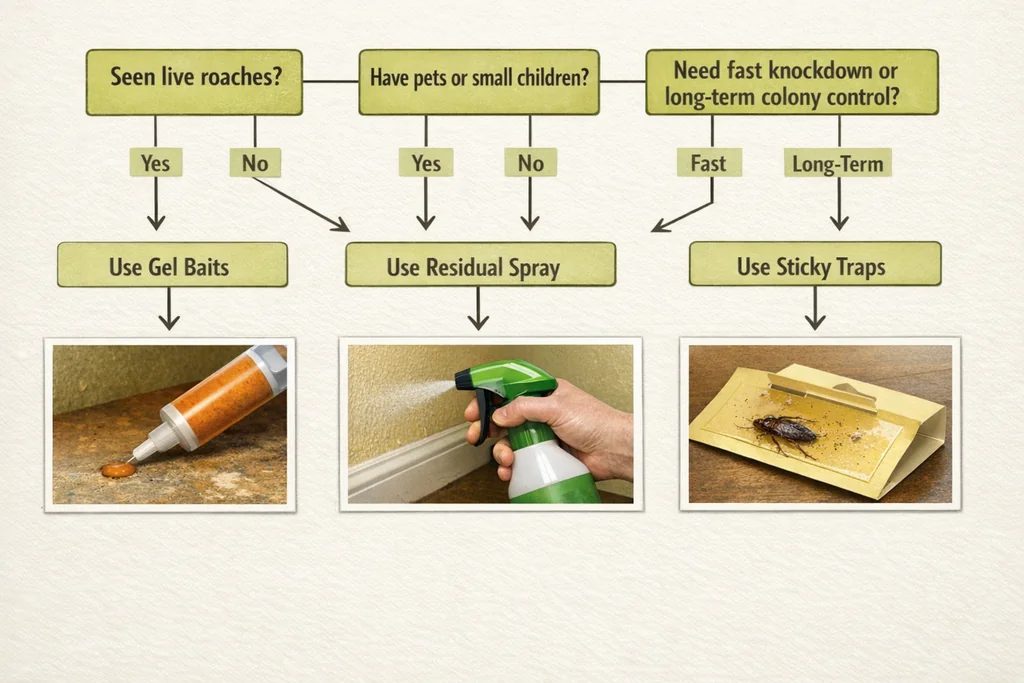
| Your Situation | First Choice | Why |
|---|---|---|
| Single cockroach, summer, ground floor | Sticky trap for confirmation | Distinguishes wanderer from infestation |
| German cockroaches in kitchen, no pets, patient | Gel bait in harbourage points | Colony-level impact via horizontal transfer |
| Oriental cockroaches in drains, bin store | Residual spray on travel routes | Immediate knockdown, perimeter defence |
| Recurring problem in flat or tower block | Professional survey | Shared construction, re-infestation vectors |
| Food business, care home, rental property | Professional treatment with documentation | Compliance, liability, verification |
When Each Method Fails and What That Costs
Gel bait failure typically manifests as reduced but persistent activity after four weeks. The homeowner buys another tube, applies it to the same spots, and achieves the same partial result. The colony has developed bait aversion or the harbourage has shifted to an untreated zone. Cost: £30 to £60 in products, six to ten weeks of ongoing exposure, and expanded population.
Residual spray failure shows as initial success followed by resurgence. The surviving cockroaches have avoided treated surfaces or developed physiological resistance. Cost: £20 to £40 in products, possible respiratory or skin irritation from repeated application, and deeper harbourage that makes later treatment harder.
Sticky trap failure is the most expensive because it is the slowest to recognise. The traps keep catching insects, which feels like progress, while the population grows. Cost: £10 to £20 in traps, two to three months of false confidence, and eventual professional treatment for a larger infestation.
Safety Realities for Homes with Children and Pets
All three DIY methods carry different risk profiles. Gel baits placed in cracks and behind appliances minimise contact exposure but require discipline about placement. A toddler can pull a fridge forward or open a cupboard. Pets may lick bait from floor-level application points. Residual sprays leave surface residue that transfers to skin, clothing, and food preparation areas. The drying period is critical; rushing back into a treated kitchen defeats the purpose. Sticky traps pose minimal chemical risk but can adhere to fur, skin, and small fingers, causing distress and possible injury during removal.
The 2026 IndexBox market report noted that insect growth regulator combinations and child-resistant packaging now feature in over half of new UK roach-killer launches. This trend responds to genuine consumer demand but does not eliminate the need for careful application and realistic expectations about what any single product can achieve.
The Verdict
Choose gel baits when you have identified harbourage, can wait three to six weeks, and need minimal surface chemical exposure. Choose residual sprays when you need immediate knockdown on identified travel routes and can manage exclusion periods. Choose sticky traps only for detection and monitoring, never as sole control. Escalate to professional treatment when you live in shared construction, run a food business or care home, face recurrence after DIY attempts, or simply need documented clearance. The right fix is the one that matches your evidence level, urgency, and property risk, not the one with the most prominent shelf placement.
Need professional help? BuzzKill offers fast, reliable pest control services across London and Essex.