
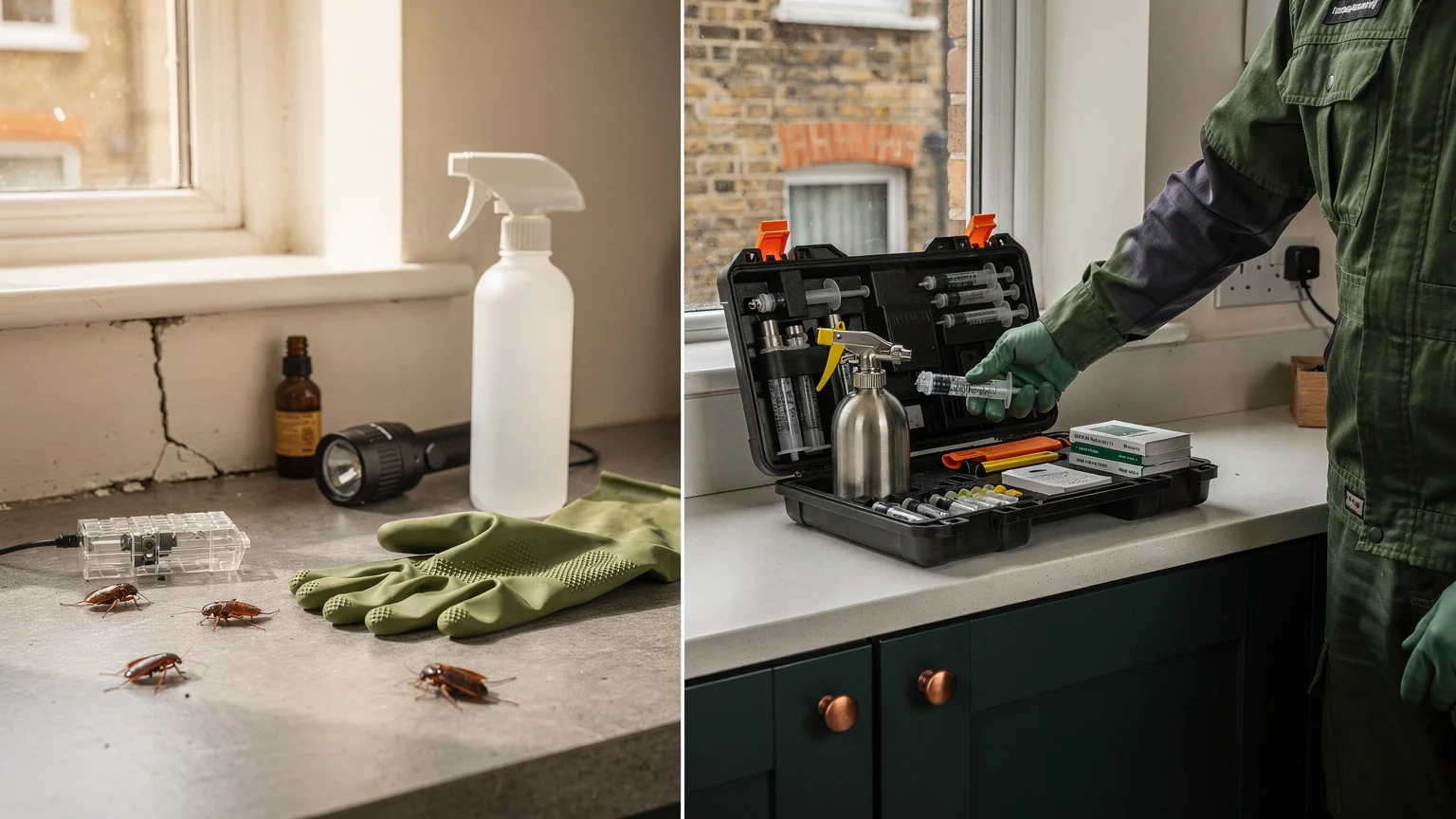
Most Hackney homeowners who spot a cockroach frame the problem as a straight two-way choice: buy something from the shop and sort it out yourself, or call a professional and pay someone else to deal with it. There's actually a third route sitting between those two, and understanding it can save you weeks of frustration. Council environmental health teams in London boroughs, including Hackney, carry a statutory duty to treat cockroaches in certain housing types, sometimes at no charge. Knowing whether that applies to your property before you spend money on gel baits or a private callout changes the whole calculation.
The real question isn't which approach is "better" in the abstract. It's which one matches what's happening inside your specific property right now.
What you're actually dealing with matters more than the method
Before you choose any treatment route, spend ten minutes looking at what the cockroaches have left behind. The evidence tells you the species, the severity, and roughly how long the population has been established, all of which affect whether DIY stands a chance or whether you're looking at a professional job.
German cockroaches, the smaller light-brown species at 12–15 mm, favour warm, humid spots close to food. In Hackney's typical Victorian conversions and purpose-built flats, they cluster behind fridges, inside boiler cupboards, and around the gap where kitchen worktops meet the wall. If you're seeing adults in daylight, the population is already large enough that daytime crowding forces some out of harbourage. Oriental cockroaches, the darker 20–25 mm species, prefer damp ground-floor areas: under sinks, in service ducts, and around shared drainage in basement flats. They're slower-moving and often mistaken for beetles at a glance.
Small black droppings that look like ground pepper, cast skins near hinges and kickboards, and egg cases tucked in crevices all confirm an active population. In dense Hackney blocks of flats, even a spotless flat can get cockroaches migrating through pipe runs, wall voids, and shared drainage from a neighbouring unit. Cleanliness helps reduce food sources, but it doesn't stop cockroaches arriving through the building's fabric. The BPCA Crawling With Cockroaches PestAware guide notes that due to the cockroach lifecycle, established populations can be an uphill battle to control once they've had time to breed.
Your property type also shapes the decision. A self-contained house gives you full control over treatment. A rented flat brings in landlord obligations and potentially council involvement. A shared building means treating your unit alone may not solve the problem if the source is next door or below.
When DIY cockroach treatment actually works
DIY treatment suits a narrow set of conditions: you've seen one or two cockroaches in a single room, you can identify where they're hiding, and the sighting is recent, within the past week or two. If that's your situation, consumer-grade gel baits and sticky monitoring traps can knock back a small, localised population before it establishes.
Supermarkets and hardware shops across Hackney stock crawling-insect gel baits and surface sprays. The approach is to place pea-sized dots of gel bait along the edges where cockroaches travel: under the kitchen worktop, behind the fridge, inside cupboard hinges, and along the gap where pipes enter the wall. Avoid spraying near the gel, because strong surface sprays can deter cockroaches from taking the bait. Sticky traps placed along skirting boards and under the sink give you a read on whether numbers are dropping over the following two to three weeks.
The DIY route fails when the population is already breeding. A single German cockroach egg case contains 30–40 nymphs, and the species can produce a new generation every two to three months in warm indoor conditions. If you're seeing multiple adults across more than one room, or if you've been seeing them for more than a couple of weeks, consumer products typically can't outpace the reproduction cycle. Tower Hamlets Council's cockroach advice leaflet notes that if you decide to treat yourself rather than use a professional service, specialist insecticides from shops are the alternative, but the council recommends professional advice and treatment. It also states plainly that if you're aware of cockroaches in a property, doing nothing isn't acceptable: you must either treat or hire a pest control company.
There's a practical ceiling on DIY, too. Consumer gel baits have lower active-ingredient concentrations than professional formulations. Professional-grade products like indoxacarb-based gels aren't available to the general public, and they work through a different mechanism: cockroaches that eat the bait return to harbourage, die, and are consumed by other cockroaches, creating a chain reaction that collapses the colony. Household sprays kill on contact but don't reach into wall voids, pipe chases, and appliance internals where the population lives. A thorough look at cockroach home remedies covers what home treatments can and can't do in more detail.
Realistically, DIY works best as an immediate holding action while you arrange a professional visit, not as a long-term solution for anything beyond the most minor sighting.
What a professional cockroach treatment involves in Hackney
Professional treatment starts with a survey, not a spray. A qualified technician inspects the property to identify the species, map where the population is concentrated, and determine how they're moving through the building. This usually takes 30–60 minutes depending on the size of the property and involves checking behind appliances, inside service voids, around plumbing penetrations, and in any shared structural gaps.
The treatment itself for most Hackney cockroach problems involves targeted gel baiting rather than broad-spectrum spraying. Professional gel baits are placed in small dots at high-traffic points identified during the survey. The cockroaches feed on the bait, carry it back to harbourage, and the active ingredient spreads through the population via cannibalism and coprophagy (cockroaches eating each other's droppings and dead). This is why professional treatments often trigger increased visible activity in the first 48 hours: dying cockroaches leave harbourage and become noticeable before the population crashes.
Follow-up visits are standard. Most professional cockroach treatments in London involve two or three visits spaced two to four weeks apart, because the gel bait targets adults and late-stage nymphs but may not affect freshly laid egg cases until they hatch. The technician checks monitoring traps, re-baits if needed, and confirms the population is declining. This staged approach is the main reason professional treatment takes two to six weeks for full resolution rather than an overnight fix.
Costs for professional cockroach treatment in Hackney vary by property size and severity, but single-treatment visits typically start around £120–£180 for a standard flat, with follow-up visits included in many service packages. When you factor in the cost of multiple rounds of shop-bought products that may not work, plus the time and stress of managing an ongoing problem, professional treatment is often the cheaper route for anything beyond the most minor sighting. Accessing professional Hackney cockroach control gives you a technician who knows the local building stock and common entry routes for this area.
What Hackney's cockroach control companies actually offer
Several pest control companies serve Hackney directly, and their approaches differ enough that it's worth understanding what each brings to the job.
Alesta Services covers Hackney postcodes E5, E8, E9, E20, N1, and N16 with eco-friendly methods and detailed inspections that produce a property-specific treatment plan. Their process starts with locating harbourage and assessing infestation levels before applying targeted treatments. East London Pest Control positions itself as a specialist in cockroach removal across Hackney and the wider East London area, handling both domestic and commercial properties with what they describe as comprehensive solutions even for severe infestations. Fanatic Pest Control offers what they call quick and discreet cockroach control with thorough property inspections looking for droppings, egg cases, and grease marks to map the problem before treatment.
The Pied Piper's guide to Hackney pest control is notable for its specificity about the borough's geography. They note that the River Lea and Regent's Canal corridor, combined with Victoria Park and London Fields proximity, creates both urban rodent and wildlife pressures across E5, E8, and E9, factors that shape the broader pest environment Hackney properties sit within. Pest Exterminators offers same-day service for urgent cockroach problems and emphasises eco-friendly methods alongside long-term prevention and pest-proofing. Able Group covers Hackney Wick specifically, offering 24-hour response within 30–90 minutes of a call with no upfront payment and no call-out fee.
Mr Pest Control's 2026 London cockroach guide makes a point worth repeating here: in blocks of flats or mixed-use buildings, cockroaches travel through pipe runs, wall voids, cabling routes, and shared drainage systems. Even very clean properties can end up infested if a neighbouring unit has a problem. This is a structural reality of Hackney's housing stock, particularly the converted Victorian terraces and post-war blocks where service routes are shared between units. For residents in Hackney Central or Hackney Wick, booking a local inspection through Hackney pest control means a technician who already understands these building-specific access points.
The council option most Hackney residents forget about
Under the Harrow Council pest control policy, London boroughs have a statutory obligation to treat rats, mice, and cockroaches in council-owned social housing at no cost to the tenant. Hackney Council's environmental health service operates similarly: if you live in council housing and report cockroaches, the borough will survey and treat the property. Leaseholders in the same blocks may face a charge recovered through service charges.
For private tenants and homeowners, the picture is different. Council environmental health teams can investigate pest complaints in private rented properties under the Housing Act 2004, particularly where a hazard assessment identifies pests as a risk to health. If your landlord is refusing to act on a cockroach problem, a complaint to Hackney's environmental health team can trigger an inspection and potentially an enforcement notice requiring the landlord to treat the property. This route is free to the tenant but slower, typically taking one to three weeks from complaint to inspection.
Homeowners in Hackney who don't live in council housing generally can't access free council pest treatment for cockroaches, though the borough does provide advice. If you're weighing whether to wait for a council slot or pay for a private exterminator, the deciding factor is usually urgency. A council appointment might take a week or more to arrange, while most private pest control companies in Hackney offer same-day or next-day response. When you've got cockroaches in the kitchen and children in the house, that week matters.
For residents across Hackney Central and the surrounding neighbourhoods, the practical question is whether the council timeline fits your situation. If you're in council housing and the problem is manageable in scope, reporting it through the borough's environmental health portal is the right first move. If you're in a private property and the problem is spreading, private treatment is faster and more thorough.
Making the call based on what you're seeing right now
If you've seen a single cockroach in one room in the past few days, and you can trace it to a specific gap or appliance, start with gel bait and monitoring traps while booking a professional assessment for a week out. If the traps come back clean after seven days, you may have caught it early enough. If the traps show activity, you've already got a professional visit lined up and haven't lost time.
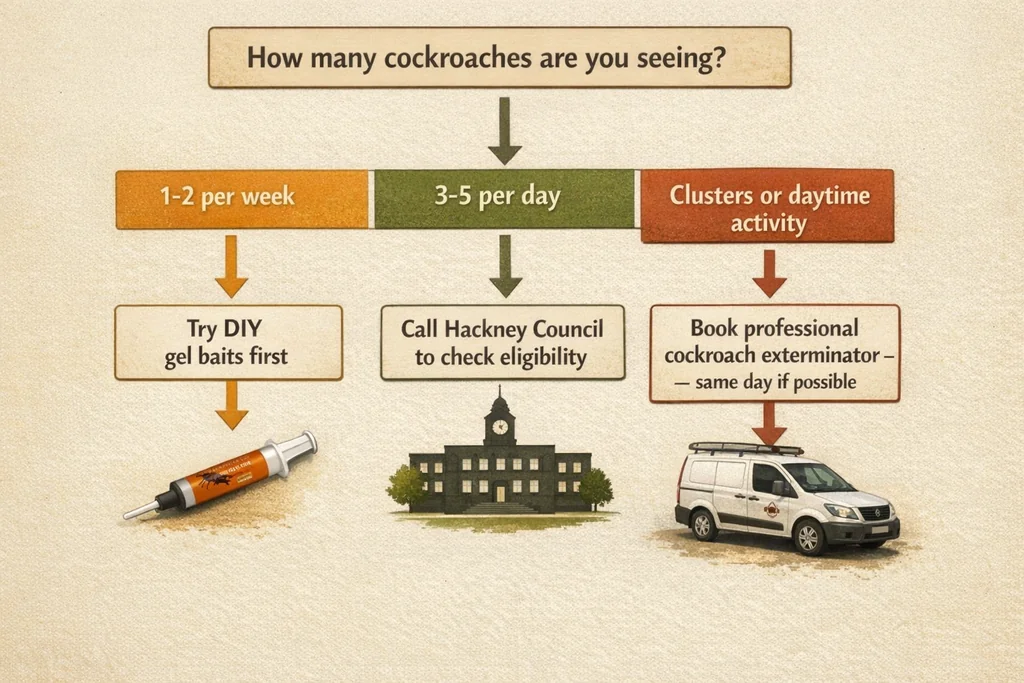
If you're seeing multiple cockroaches across rooms, noticing droppings or egg cases, or if sightings have been happening for more than a couple of weeks, go straight to a professional. The population is already established, and DIY treatment will likely fail to keep pace with reproduction. Cockroaches in a shared Hackney building make this even more urgent, because treating only your flat without addressing the building-wide movement routes means the problem will return. A professional who works in Hackney regularly knows which pipe chases, service ducts, and drainage points are the typical routes between units in the local building stock.
Need professional help? BuzzKill offers fast, reliable pest control services across London and Essex.