
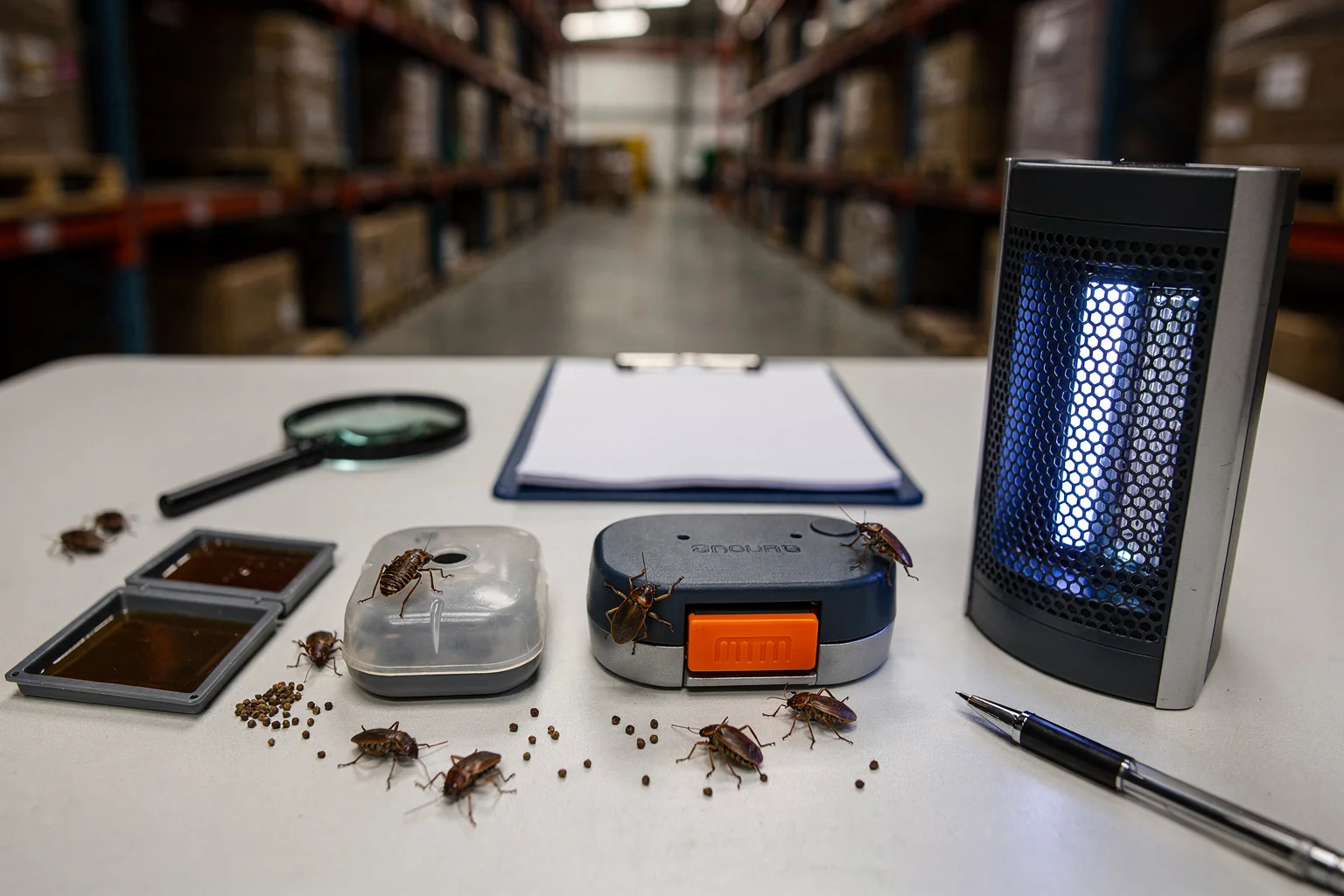
Stink bugs in a warehouse are not like mice or cockroaches. They do not chew wiring, spoil stock by direct feeding, or leave droppings that breach food-safety audits. What they do is worse in some ways: they appear in hundreds, sometimes thousands, squeezing through gaps around loading bays, roof vents, and window frames to spend autumn and winter inside. The brown marmorated stink bug, Halyomorpha halys, is the species behind most of the pressure. It arrived in the UK in 2018, and surveillance now shows it is beginning to establish breeding populations here. In 2025, records more than doubled compared with 2024, with 49 confirmed sightings and growing concern around caravans and motorhomes returning from continental Europe.
For warehouse managers, distribution centres, and food-prep facilities across London and Essex, the question is practical: what actually stops them? This guide compares the trap technologies that matter for commercial settings—pheromone traps, light traps, and the physical exclusion methods that must accompany them. I have ranked nothing by brand loyalty. Each option earns its place by the evidence of how it performs at warehouse scale, what it costs to run, and where it tends to fail.
Why Stink Bugs Target Warehouses in Autumn
Stink bugs are not random invaders. Their biology drives them toward large, warm buildings with southern or western sun exposure as daylight shortens. Warehouses fit this profile precisely: high roofs that hold heat, corrugated cladding with expansion gaps, and roller shutter doors that stay open for hours during dispatch.
The brown marmorated stink bug is highly polyphagous, meaning it feeds on a wide range of plants. In the UK it has not yet reached the agricultural damage levels seen in northern Italy, where estimated losses hit €250 million in 2019. But the same behaviour that makes it a crop pest makes it a nuisance in commercial buildings. Adults aggregate in response to aggregation pheromones, so one bug on a wall in September often signals dozens more to follow.
Defra's 2025 update notes that silicone-based sealants around doors and windows can help prevent invasions. Once inside, vacuum removal is the recommended first step in residential settings. For commercial premises, the scale is too large for vacuuming alone. That is where trapping systems come in.
How Pheromone Traps Work for Stink Bugs
Pheromone traps exploit the chemical signals that stink bugs use to gather. The aggregation pheromone of Halyomorpha halys has been isolated and synthesised, and several commercial lures are now available. These are not sex pheromones; they attract both males and females, which makes them more useful for monitoring and mass trapping.
The research on pheromone trap effectiveness is mixed in ways that matter for warehouse deployment. A Virginia Tech study found that pheromone-baited pyramid traps captured significantly more stink bugs during late season than light-baited traps or unbaited controls. During mid-season, however, traps with lights actually outperformed pheromone-only traps. The researchers concluded that both trap types can detect stink bug activity, but their relative effectiveness shifts with the season.
For warehouse managers, this seasonal pattern is critical. If you deploy pheromone traps in September expecting immediate mass capture, you may be disappointed. The traps work best when natural populations are already high and bugs are actively aggregating before winter. In low-density situations—early in the invasion or after partial treatment—pheromone traps still detect presence but may not reduce numbers significantly.
What to Look for in a Commercial Pheromone Trap
Not all pheromone traps suit warehouse scale. The factors that separate useful commercial units from garden-grade products include:
- Lure longevity: Commercial lures typically last 4–7 weeks. The Trécé dual-lure system and similar broad-spectrum combinations attract multiple stink bug species, which matters if your facility receives goods from areas where other species occur.
- Trap design: Pyramid traps with clear, yellow, or black panels capture the greatest species diversity according to 2023–2024 soybean field studies. Delta traps and sticky cards work for monitoring but clog quickly at high capture rates.
- Placement height: Stink bugs fly to aggregation sites. Traps mounted at 2–3 metres, near roof trusses or high window banks, outperform ground-level placement.
- Density: One trap per 500 square metres is a starting point for monitoring. For mass trapping in known aggregation zones, double this density along the warmest walls.
The honest limit of pheromone traps is that they attract bugs as well as capture them. Poor placement—too close to stored goods, too near door openings—can draw bugs into areas they would not otherwise reach. They are a detection and reduction tool, not a standalone solution.
Light Traps and Their Role in Warehouse Settings
Light traps for stink bugs work on a different principle. Halyomorpha halys, like many nocturnal insects, moves toward light sources during dispersal flights. The Virginia Tech research found that during mid-season, traps containing lights captured more adults than pheromone-baited alternatives. Light-plus-pheromone combinations performed best overall in some seasonal windows.
The mechanism matters for warehouse design. Stink bugs entering at dusk are often following light escaping from high windows or rooflights. A well-placed light trap intercepts this movement before bugs reach the building envelope. Inside, light traps can pull bugs away from production areas toward a controlled capture point.
Bug zapper effectiveness varies enormously by design. Traditional electrocuting grids work for some insects but are less reliable for stink bugs, which have a harder exoskeleton and may simply bounce off. Suction-based light traps, where a fan pulls attracted insects into a collection chamber, perform better for this species. The capture rate also depends on competing light sources: a trap placed near a brightly lit loading bay will underperform because the building itself is the more attractive beacon.
Practical Limits of Light Trapping
Light traps share the pheromone trap's fundamental limitation: they work with the insect's behaviour, not against it. In mid-season, when bugs are actively flying, they capture well. In late season, when bugs have already aggregated and are crawling into cracks, light traps become less effective. They also raise a compliance issue in food premises: shattered insect parts from electrocuting models can contaminate production areas. Suction models with sealed collection chambers are the only appropriate choice where food safety audits apply.
For warehouses storing packaged goods rather than open food, this constraint relaxes slightly. But any facility with BRC, SALSA, or similar certification should position light traps in non-production zones—dispatch corridors, mezzanines, external canopy areas—and never above production lines or raw ingredient stores.
Exclusion Methods: The Foundation That Traps Cannot Replace
No trap technology compensates for poor building sealing. This is the point most often overlooked in stink bug management, and it is where warehouse operators can achieve the most durable results.
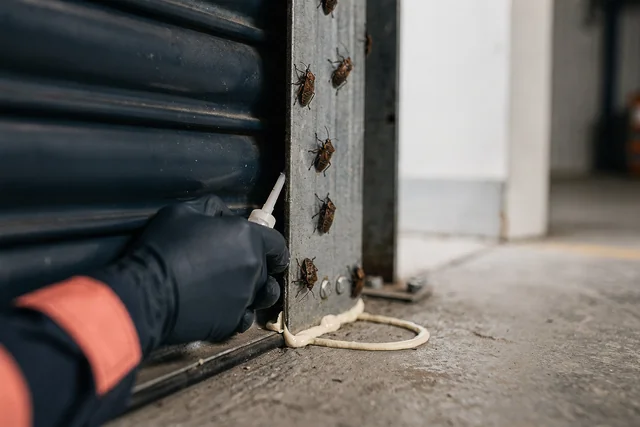
The brown marmorated stink bug enters through gaps as narrow as 3–5 millimetres. Common entry points in commercial buildings include:
- Expansion joints in corrugated cladding
- Gaps around roller shutter guide rails
- Roof vent cowlings without mesh backing
- Window frames with degraded seals
- Dock leveller pits and door thresholds
Defra's guidance emphasises silicone-based sealants for prevention. For warehouse scale, this translates to a systematic inspection programme each August, before autumn movement begins. Sealant application is labour-intensive but cost-effective compared with repeated trap servicing or, worse, customer complaints about bugs in dispatched goods.
Physical screens on vents and louvres add a second layer. Mesh size matters: standard insect mesh at 1.5mm aperture blocks stink bugs without the airflow restriction of finer screens. The pressure drop across mesh this size is negligible for most warehouse ventilation systems, but it should be checked against the building's original design specifications.
Comparing Trap Strategies by Warehouse Type
The right combination depends on what moves through your building. Three common warehouse profiles illustrate the decision:
Ambient storage, non-food goods: Pheromone traps for monitoring, light traps for interception along the warmest walls. Sealant programme as backup. This is the simplest case because regulatory constraints are minimal.
Food packaging, dry goods: Suction light traps only, positioned in dispatch and receiving areas. No electrocuting models. Pheromone traps permitted in non-production mezzanines for monitoring, but not in areas where open product or packaging materials are exposed. Exclusion sealing is the primary control; traps confirm it is working.
Temperature-controlled, fresh produce: The most challenging profile. Cold stores themselves are rarely invaded—stink bugs want warmth—but the loading docks and marshalling areas are highly attractive. Pheromone traps in dock canopies, suction light traps in personnel corridors, and aggressive sealing of the cold store envelope. Rapid door closure protocols matter more here than trap density.
What the 2026 Season Looks Like
The surveillance data for 2026 is still emerging, but the trajectory is clear. The Find a Tender contract for brown marmorated stink bug surveillance, published in June 2026, notes "significant and concerning increase in its presence in the UK" and explicitly states that breeding populations are establishing under UK conditions. This is not a transient port-of-entry problem anymore.
For warehouse operators, this means stink bug pressure will likely intensify through the late 2020s. The pest's spread in North America and Europe followed a similar pattern: slow initial detection, then rapid expansion once breeding populations established. The UK is now in that expansion phase.
Climate variation also extends the effective season. Industry analysis projects that warming trends will add roughly two weeks to the autumn dispersal window by the mid-2030s. Warehouses that saw peak pressure in mid-September may need to prepare from late August onward.
When to Bring in Professional Support
Traps and sealing are effective first-line measures, but there are thresholds where professional intervention becomes necessary. These include:
- Capture rates exceeding 50 bugs per trap per week, indicating a large aggregation source nearby
- Repeated invasion despite sealed entry points, suggesting an undetected harbourage in the building structure
- Customer complaints or audit failures linked to stink bug presence
- Staff distress from the odour or sheer numbers, which can become a health-and-safety issue in enclosed spaces
Professional pest control for stink bugs in commercial settings typically combines residual insecticide treatment of harbourage areas with ongoing monitoring. Pyrethroid insecticides including deltamethrin and lambda-cyhalothrin have shown effectiveness, though with the important caveat that they impact non-target arthropods including predatory species. Product approvals change; any treatment programme must use currently approved formulations applied by certified technicians.
For London and Essex warehouses, a same-day inspection can establish the scale of the problem and whether the building's construction makes DIY trapping viable or whether structural intervention is needed. The key is acting before October, when aggregation behaviour peaks and bugs become harder to dislodge.
Questions Warehouse Managers Ask About Stink Bug Control
Do pheromone traps attract more stink bugs than they catch?
Pheromone traps do emit an aggregation signal that draws bugs toward them. In open field settings this is rarely a problem because the attraction radius is limited and the surrounding area is already habitat. In a warehouse, placing a pheromone trap inside a storage area can concentrate bugs where you do not want them. The solution is placement at the perimeter—external canopies, loading dock undersides, or just inside roller doors—so the trap intercepts arriving bugs rather than redistributing them through stock.
Can I use the same traps for brown marmorated stink bug and native UK species?
Broad-spectrum lures attract multiple stink bug species, but specificity varies. The dual-component lure combining murgantiol and methyl E,E,Z-2,4,6-decatrienoate has shown consistent attraction across species in US soybean studies. For UK warehouses receiving goods from multiple origins, this broad capture is useful for detecting new arrivals. If you need to confirm brown marmorated stink bug specifically, send captured specimens to the Animal and Plant Health Agency or a qualified entomologist; visual identification is difficult for non-specialists.
How do I know if my light traps are working?
Count captures weekly and note the trend, not just the absolute number. A new installation should show a spike for 2–3 weeks as the trap draws in bugs already present, then a decline if the building is well-sealed. If captures stay high or increase, the building is still being invaded and the trap placement or sealing programme needs review. Empty traps after three weeks may mean no local population, poor placement, or trap failure—check the bulb and fan if suction-based.
Are stink bugs a food safety hazard or just a nuisance?
Primarily a nuisance and a contamination risk. Stink bugs do not vector disease and their defensive secretions, while unpleasant, are not toxic at the concentrations encountered in commercial settings. The regulatory and customer issue is the physical presence of insects in products. For food premises, this is an automatic audit failure. For non-food goods, customer tolerance varies but is generally low.
What is the most overlooked stink bug control measure?
Roof-level sealing. Warehouse managers often focus on ground-floor doors and loading bays, but stink bugs frequently enter at roof level, following heat plumes from production areas or solar gain on cladding. A rope-access or drone survey of roof vents, cowlings, and panel joints each August catches gaps that ground inspection misses.

Need professional help? BuzzKill offers fast, reliable pest control services across London and Essex.